.png)
What Is Freeze Dried Raw Dog Food: A Clear Guide
- wix mentor

- May 20
- 9 min read

TL;DR:
Freeze dried raw dog food preserves nutrients, enzymes, and natural food structure without cooking or dehydration.
Proper handling and choosing brands with pathogen reduction methods like HPP ensure safety and nutritional integrity.
If you’ve been researching the best food options for your dog, you’ve probably come across freeze dried raw dog food and wondered what actually makes it different. The short answer: it’s not cooked, and it’s not just dehydrated. Freeze dried raw dog food goes through a specialized preservation process that keeps nutrients, enzymes, and natural food structure intact in ways that standard kibble or canned food simply can’t match. This guide walks you through how it’s made, what’s in it nutritionally, how to handle it safely, and how to use it well for your dog.
Table of Contents
Key takeaways
Point | Details |
Not cooked, not dried | Freeze drying uses cold temperatures and vacuum pressure, preserving raw food qualities without heat damage. |
Nutrient retention is real | Heat-sensitive vitamins, amino acids, and digestive enzymes survive the freeze-drying process better than in kibble. |
Safety requires attention | Freeze drying reduces but does not eliminate pathogens; choosing HPP-processed brands and safe handling matters. |
Rehydration improves benefits | Adding water before serving restores moisture, supporting digestion and hydration in your dog. |
AAFCO compliance is non-negotiable | Only choose products labeled complete and balanced to avoid nutritional gaps. |
What freeze dried raw dog food actually is
The biggest misconception people run into is thinking freeze drying is just a fancy version of dehydrating or cooking. It is not. Freeze drying is a preservation method, not a thermal cooking method, which means the raw food qualities are retained throughout. Understanding this distinction changes how you think about every claim on the packaging.
The process itself is called lyophilization, and it works in three distinct stages.
Freezing. Raw ingredients, typically a blend of muscle meat, organ meat, bone, fruits, and vegetables, are frozen solid at very low temperatures. This locks the moisture into crystal form within the food’s cellular structure.
Primary drying (sublimation). The frozen food is placed in a vacuum chamber where pressure is dramatically reduced. In that environment, ice converts directly from solid to vapor without ever becoming liquid. The water exits the food without damaging its structure. This stage removes the bulk of the moisture.
Secondary drying (adsorption). Temperature is raised slightly to pull out any remaining bound water molecules. The result is a product with 95% to 99% moisture removed, achieved entirely without the high heat used in kibble extrusion (which runs at 150 to 200°C) or canned food retort processing (which reaches 121°C).
That low-temperature approach is exactly why freeze dried food preserves what other formats destroy. When you push food through an extruder at high heat, you degrade thermolabile nutrients, damage enzymes, and alter protein structures. Freeze drying sidesteps all of that.
Many reputable brands add one more step after freeze drying: High-Pressure Processing, or HPP. HPP uses intense water pressure, not heat, to further reduce pathogen counts without compromising the raw food qualities. If safety is a priority for you, which it should be, look for brands that list HPP on their labels or website. You can learn more about how this works in the freeze drying safety steps process.
Pro Tip: The low moisture content, under 5%, is what gives freeze dried raw dog food its long shelf life. Bacteria and mold need water to grow. Remove the water, and you remove the conditions they need to thrive.
Nutritional benefits worth understanding
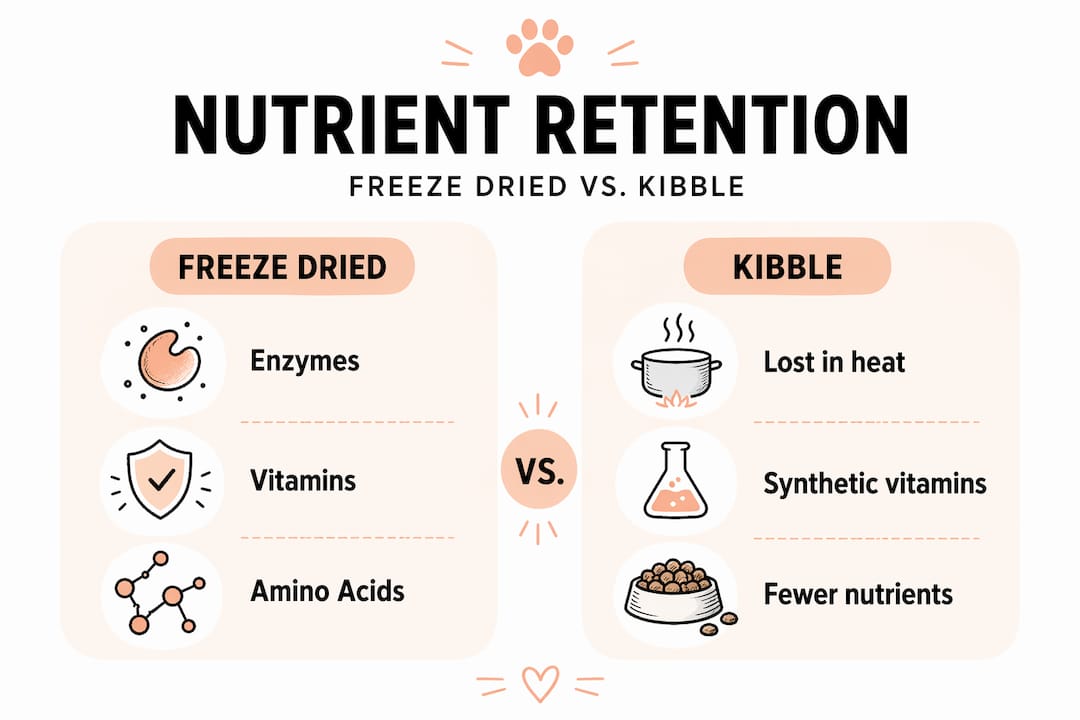
The reason so many dog owners are drawn to freeze dried raw as a category comes down to what survives the process. Heat-sensitive B vitamins, vitamin C, and amino acids are far better preserved in freeze dried food than in conventionally processed kibble. For a dog whose body depends on these compounds for energy metabolism, immune function, and muscle repair, that matters.
Here’s what the nutritional picture looks like across three common formats:
Nutrient factor | Freeze dried raw | Fresh raw | Kibble |
Enzyme integrity | Preserved | Preserved | Largely destroyed |
Thermolabile vitamins | Well retained | Fully retained | Significantly reduced |
Protein bioavailability | High | High | Moderate |
Moisture content | Very low (needs rehydration) | High (~70%) | Very low (~10%) |
Shelf life | 12 to 24 months unopened | Days to weeks | 12 to 18 months |
Convenience | High | Lower | Highest |
One thing that stands out in this comparison: freeze dried diets preserve digestive enzymes that are simply lost in heat-processed kibble. These enzymes help your dog break down and absorb nutrients more efficiently, reducing the metabolic work their system has to do with every meal. For dogs with sensitive stomachs or a history of digestive issues, this can translate to a noticeable difference.
Protein bioavailability is another area where freeze dried raw performs well compared to kibble. When proteins are exposed to high heat, their structure changes in ways that can reduce how well your dog’s body uses them. Freeze drying keeps those protein structures largely intact.
A few nutritional considerations to keep in mind:
Freeze dried raw food needs to be properly formulated to meet AAFCO nutrient profiles; homemade raw diets are frequently deficient in calcium and vitamin D
Rehydration before serving helps restore moisture and supports hydration, which matters because dogs fed dry formats consume less water through food
Organ meats in the formula contribute critical micronutrients like zinc, copper, and vitamin A that muscle meat alone doesn’t provide
If you want to go deeper on which specific nutrients show the biggest difference, the breakdown of top nutrients absorbed better in freeze dried food is a useful next read.
Safety: what you need to know
Here is where things require honest, clear information rather than marketing speak. Freeze drying reduces bacterial load by 90% to 99.9%, but it does not sterilize the food. Pathogens like Salmonella, E. coli, and Listeria can survive in a dormant state and become active again when moisture is reintroduced.
That does not mean freeze dried raw dog food is dangerous. It means you need to handle it thoughtfully, just as you would raw meat in your own kitchen.
“Properly handled freeze-dried raw food remains safer for healthy adult dogs due to stomach acidity and GI transit, but poses risks to immunocompromised pets and people.” — Puppy Longevity
Practical safe handling at home looks like this:
Wash your hands thoroughly before and after handling the food or your dog’s bowl
Use dedicated bowls and utensils for raw food prep; do not mix with your own dinnerware
Do not leave rehydrated food sitting out for more than 20 to 30 minutes
Keep surfaces wiped down after prep, especially if young children use those areas
Store opened packages in a sealed container in a cool, dry location
For households with young children, elderly family members, or anyone who is immunocompromised, extra caution is warranted. This is not a reason to avoid freeze dried raw entirely, but it is a reason to be rigorous about hygiene.
Veterinarians recommend baseline health testing when feeding freeze dried raw long-term, particularly for puppies, seniors, and dogs with underlying health conditions. A basic blood panel and fecal parasite exam give you a clear picture of how your dog is responding over time.
Pro Tip: When choosing a brand, look for one that publishes its sourcing standards and pathogen testing protocols. Transparency here is a sign of a serious, safety-conscious manufacturer.
How to use freeze dried raw dog food
Knowing what it is and how to handle it safely is one part. Knowing how to actually feed it well is the other. Freeze dried raw can be served dry or rehydrated, and both approaches work, though rehydration adds moisture back to the food and better mimics the profile of fresh raw.
Here’s a practical approach to getting started:
Start with the transition. Do not switch your dog cold turkey to a new food format. Mix a small amount of freeze dried raw with their current food, starting around 25%, and increase gradually over 10 to 14 days. Watch stool quality and energy levels as indicators.
Decide how to serve it. For rehydrating, add warm water or low-sodium broth to the food and let it sit for two to five minutes before serving. For convenience, you can feed it dry as a topper over kibble or as a standalone meal.
Portion by weight and life stage. Follow the feeding guidelines on the package as a starting point, but adjust based on your dog’s body condition. A dog maintaining a healthy weight at the suggested amount is right on track.
Store it properly. Freeze dried raw is shelf stable for 12 to 24 months when unopened, but once opened, store it in an airtight container away from heat and light. Do not refrigerate an opened bag unless the manufacturer specifically recommends it.
Consult your vet for tailored plans. If your dog has a health condition, is a senior, or is a growing puppy, a vet familiar with raw feeding can help you calibrate portions, supplement if needed, and set up monitoring check-ins.
Freeze dried raw also works beautifully as a topper on kibble, which is one of the most practical raw dog food alternatives for owners who want the nutritional benefit of raw without fully committing to a single-format diet. A small amount crumbled over a kibble meal adds enzymes, fresh protein, and palatability that many picky eaters respond to immediately.
Choosing a quality product
Not all freeze dried raw dog foods are created equal, and the label alone will not tell you everything. Here is what to look for when comparing options:
AAFCO statement. The label should say “complete and balanced for [life stage].” If it only says “for supplemental feeding,” it is not formulated to be a standalone diet.
Whole protein sources listed first. Muscle meat, organ meat, and named protein sources should dominate the ingredient list, not fillers, plant proteins, or vague “meat meals.”
Calcium source included. Look for ground bone, bone meal, or a named calcium supplement. Without adequate calcium, dogs on raw diets can develop skeletal problems over time.
No artificial preservatives, colors, or fillers. Freeze dried food should not need them; their presence signals a compromise on quality.
Sourcing transparency. Brands that tell you where their proteins come from and whether they third-party test for pathogens are holding themselves to a higher standard.
For a practical checklist you can bring to your next purchase decision, the nutrient-rich food checklist from Loyalsaintspets walks you through every factor worth evaluating.
My take on freeze dried raw dog food
I’ve worked closely with canine nutrition for a long time, and I want to be direct about something: the “raw is best, always” argument is oversimplified. Raw feeding done wrong, meaning unbalanced, poorly sourced, or handled carelessly, causes real harm. I’ve seen dogs develop calcium deficiencies, recurrent bacterial infections, and owners who unknowingly created hygiene risks in their homes, all in the name of natural feeding.
What I genuinely respect about freeze dried raw, when it is done right, is that it bridges the gap between nutritional integrity and practical safety for most dog owners. The nutrient and enzyme preservation in freeze dried formats is real. The convenience is real. But so are the handling responsibilities.
My honest advice: start with a commercially formulated, AAFCO-compliant freeze dried product from a brand that publishes its safety protocols. Get a baseline vet check before you switch, and schedule a follow-up three months in. Watch your dog, not just the marketing. A dog thriving on a diet shows it in their coat, energy, muscle tone, and stool quality. If those markers improve, you’re on the right path.
The market for raw and freeze dried dog food is evolving fast. More brands are entering with varying standards, and the noise around “ancestral diets” and “biologically appropriate” claims can obscure what matters: a nutritionally complete, safely processed food that your specific dog does well on. That is the goal. Keep it practical.
— Eyo
Why Loyalsaintspets is worth your attention
If you’ve read this far, you’re clearly someone who takes your dog’s health seriously. That’s exactly who Loyalsaintspets was built for.
Loyalsaintspets freeze dried raw dog food is made from human-grade proteins, whole fruits, and vegetables, with no fillers, artificial additives, or shortcuts in the formulation process. Every product is designed to meet AAFCO standards for complete and balanced nutrition, and the brand’s commitment to ingredient transparency means you know exactly what you’re feeding. Whether you’re ready to go all-in on freeze dried raw or want to start by using it as a topper, the Loyalsaintspets shop has options built for dogs at every life stage. And if you want the full story on why freeze dried beats conventional pet food, the why freeze dried page lays it all out clearly.
FAQ
What is freeze dried raw dog food made from?
Freeze dried raw dog food is made from raw animal proteins (muscle meat, organs, bone), fruits, and vegetables that are frozen and then dried under vacuum pressure without heat, preserving their natural nutrient content.
Is freeze dried dog food healthy for dogs?
Yes. Freeze dried raw retains heat-sensitive vitamins, amino acids, and digestive enzymes better than kibble, making it a nutritionally strong option when the formula is AAFCO-complete and properly sourced.
How do you use freeze dried dog food?
You can serve freeze dried dog food dry or rehydrated with water or low-sodium broth. Rehydrating for two to five minutes before serving restores moisture and supports digestion, which is especially helpful for dogs that don’t drink enough water.
Is freeze dried raw food completely safe from bacteria?
No. Freeze drying reduces pathogens by 90% to 99.9% but does not sterilize the food. Choosing brands that use HPP and practicing safe food handling at home significantly lowers the risk.
Can freeze dried raw food replace kibble entirely?
It can, as long as the product is labeled complete and balanced for your dog’s life stage. Work with your vet to confirm the transition is right for your dog’s age, health status, and specific nutritional needs.
Recommended
Comments