
TL;DR:
- Not all fillers are harmful; regulated levels typically pose low risk for healthy dogs.
- Marketing claims like “no fillers” are often misleading; focus on formulation and digestibility.
- Freeze-dried dog food offers high nutrient density with minimal unnecessary fillers when chosen carefully.
Most dog owners have heard the warning: avoid fillers in dog food. But when you dig into the science, the picture gets more complicated than a simple “fillers bad, no fillers good” rule. Some fillers are genuinely harmless, others can cause real problems for certain dogs, and the marketing around “filler-free” food is not always what it seems. This guide breaks down what fillers actually are, what the research says, and how to make smarter choices for your dog’s long-term health. Whether your pup has allergies or you just want the cleanest nutrition possible, you’ll walk away with real clarity.
Table of Contents
- What are fillers in dog food, and why do people avoid them?
- Examining the science: Are fillers actually harmful to your dog?
- The reality behind ‘no fillers’: Marketing or meaningful?
- Freeze-dried dog food: Spotlight on nutrition without unnecessary fillers
- How to read labels and choose the best food for your dog’s needs
- Our perspective: Why the ‘filler’ debate misses the real problem
- Ready to upgrade your dog’s nutrition? Explore premium freeze-dried options
- Frequently asked questions
Key Takeaways
| Point | Details |
|---|---|
| Filler risks are overblown | Scientific reviews show most approved fillers are not harmful to healthy dogs when used appropriately. |
| Marketers use ‘no filler’ claims | Brands use ‘no fillers’ as a selling point, but what matters most is the food’s complete and balanced nutrition. |
| Check for nutrient density | For optimal health, prioritize dog foods with high nutrient content, minimal fillers, and proven digestibility. |
| Freeze-dried foods excel | Freeze-dried dog foods usually offer concentrated nutrition with little to no unnecessary fillers. |
| Read labels carefully | Selecting high-quality food requires checking ingredients, AAFCO labels, and what works for your dog’s unique needs. |
What are fillers in dog food, and why do people avoid them?
To begin, let’s clarify what pet owners mean when they talk about “fillers” and why they’re such a controversial topic in canine nutrition.
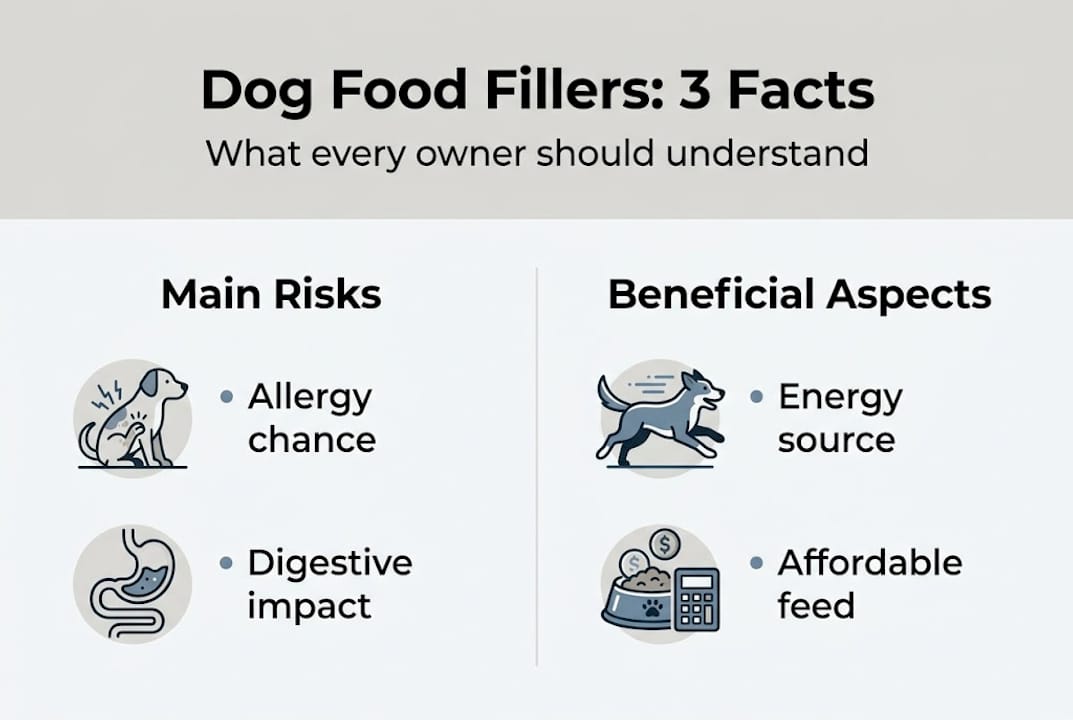
In the pet food world, fillers typically refer to low-cost, carbohydrate-heavy ingredients added to bulk up a formula, improve texture, or reduce manufacturing costs. Common examples include corn, soy, wheat, rice bran, and certain animal byproducts. These ingredients are not inherently toxic, but they often provide fewer bioavailable nutrients per calorie compared to whole meat proteins or vegetables.
Why do so many owners want to avoid them? The concern usually comes down to three things:
- Nutritional dilution: Fillers take up space in the formula that could go to higher-quality ingredients.
- Allergy triggers: Corn, soy, and wheat are among the most common food sensitivity culprits in dogs.
- Ingredient quality signals: A long list of fillers can suggest a brand is cutting corners on overall formulation.
Here’s a quick comparison of how typical fillers stack up against more nutritionally functional ingredients:
| Ingredient | Primary role | Nutritional value | Common concern |
|---|---|---|---|
| Chicken (named meat) | Protein source | High | Minimal |
| Corn | Filler/energy | Moderate | Allergy risk |
| Soy | Protein/filler | Moderate | Sensitivity risk |
| Sweet potato | Carbohydrate | Good | Low |
| Wheat | Filler/binder | Low to moderate | Gluten sensitivity |
That said, the science asks us to pump the brakes a little. No strong empirical evidence links approved fillers to harm in most healthy dogs. The concern is real, but it’s often amplified by marketing rather than hard data.
“Not all fillers are created equal. The overall formulation, digestibility, and nutrient balance of a food matter far more than any single ingredient label.”
For owners focused on reducing additive exposure, understanding this distinction is the first step. You can also use resources like dog food ingredient analysis to check how specific brands and formulas rank.
Examining the science: Are fillers actually harmful to your dog?
Now that we know what fillers are, let’s look at what the latest research actually says about their effect on your dog’s health.
The short answer is: for most dogs, approved fillers at regulated levels are not dangerous. Meta-analyses show no adverse effects from approved fillers or additives when they stay within established safety limits. That’s a reassuring finding for owners whose dogs have eaten standard kibble for years without issue.
But there are important exceptions worth knowing.
The FDA launched an investigation in 2018 into a potential link between certain grain-free, high-legume diets and dilated cardiomyopathy (DCM), a serious heart condition in dogs. The DCM and grain-free diet studies suggested that diets very high in peas, lentils, and legume seeds may interfere with taurine metabolism in some breeds. Ironically, this means that some “filler-free” grain-free formulas carry their own risks.

On the flip side, nutritionally balanced carbohydrates can actually support diet and heart disease prevention in dogs when they come from quality sources and are part of a complete formula.
Here’s a quick look at what the data tells us:
| Scenario | Risk level | Key factor |
|—|—|—|
| Approved fillers in balanced diet | Low | Overall formulation |
| High-legume grain-free diet | Moderate (some breeds) | Taurine metabolism |
| Filler-heavy, incomplete diet | Moderate | Nutrient gaps |
| Dog with known food sensitivity | Higher | Individual response |
Statistic to know: Some studies estimate that food sensitivities affect up to 10% of dogs, meaning the majority tolerate common fillers without issue.
Pro Tip: Always look for the AAFCO “complete and balanced” statement on packaging. This tells you the food meets minimum nutritional standards, regardless of whether it contains fillers.
If your dog shows signs of digestive upset, itchy skin, or chronic ear infections, fillers could be a contributing factor. But for a healthy dog with no known sensitivities, the evidence does not support panic.
The reality behind ‘no fillers’: Marketing or meaningful?
With science in mind, let’s examine how the phrase “no fillers” is used and sometimes misused when marketing pet food.
Here’s the honest truth: “no fillers” is not a regulated term. Any brand can slap it on a bag without meeting a specific standard. What one company calls a filler, another calls a functional carbohydrate. The true focus should be on formulation and digestibility, not just ingredient exclusion.
Vets, nutritionists, and pet food brands often define “fillers” differently:
- Brands use “no fillers” to signal premium positioning and attract health-conscious buyers.
- Veterinary nutritionists focus on digestibility coefficients and nutrient absorption rates.
- Owners often equate fillers with anything that sounds artificial or grain-based.
What actually makes a dog food high quality? It comes down to these factors:
- Ingredient function: Does each ingredient serve a nutritional purpose?
- Absorption rate: How much of each nutrient does your dog actually use?
- Dietary balance: Does the formula cover all essential vitamins, minerals, and amino acids?
- Digestibility testing: Has the brand conducted feeding trials, not just lab analysis?
Pro Tip: A food with a short, clean ingredient list is not automatically better than one with more ingredients, if those additional ingredients serve real nutritional roles. Always verify the AAFCO statement and look for brands that publish digestibility trial results.
For dogs with confirmed allergies or intolerances, avoiding specific fillers absolutely matters. But for the average healthy dog, a “filler-free” label alone does not guarantee superior nutrition. Learning about the advantages of freeze-dried food can help you understand what genuinely sets certain formats apart.
Freeze-dried dog food: Spotlight on nutrition without unnecessary fillers
For owners determined to skip fillers entirely, freeze-dried dog foods are an enticing option. Let’s break down how they work and what to watch for.
Freeze-drying removes moisture from raw ingredients at very low temperatures, locking in nutrients without the need for artificial preservatives, binders, or bulking agents. The result is a concentrated, nutrient-dense food that typically relies on whole meats, organs, fruits, and vegetables rather than grain-based fillers.
Here’s how to choose a well-formulated freeze-dried option:
- Check the first ingredient. It should be a named meat like chicken, beef, or salmon, not a generic “meat meal” or grain.
- Look for the AAFCO statement. “Complete and balanced” means the food meets minimum nutritional requirements for your dog’s life stage.
- Review the full nutrient profile. Protein, fat, fiber, and moisture levels should align with your dog’s age, size, and activity level.
- Verify the source of carbohydrates. Sweet potato, pumpkin, and blueberries are functional; corn syrup or unspecified grain fragments are not.
- Research the brand’s quality assurance. Does the brand test for pathogens and nutrient accuracy?
Freeze-dried options excel in nutrient density and typically avoid unnecessary fillers, but you still need to verify completeness before committing.
Why does nutrient density matter so much? Active dogs, senior dogs, and allergy-prone dogs all benefit from getting more nutrition per bite. Freeze-dried food often delivers this without the caloric padding that comes from filler-heavy kibble. You can learn more about nutrient preservation with freeze-drying and explore the benefits of freeze-dried nutrition to see why so many health-focused owners are making the switch.
Cost is a real consideration. Freeze-dried food is more expensive per pound than standard kibble, but many owners find that smaller serving sizes and fewer vet visits for allergy-related issues balance the equation over time.
How to read labels and choose the best food for your dog’s needs
Armed with science and ingredient knowledge, here’s exactly how you can confidently choose the right dog food for your canine companion.
Label reading is a skill, and once you know what to look for, it becomes second nature. Here’s what to focus on:
- Ingredient order matters. Ingredients are listed by weight before cooking. Named meats like “deboned chicken” or “salmon” should appear first. If corn or soy is in the top three, the formula is likely filler-heavy.
- Understand byproducts. Not all byproducts are bad. Chicken liver and heart are nutrient-rich. Unspecified “meat byproducts” are a lower-quality signal.
- Spot common allergens. Corn, wheat, soy, and dairy are the most frequent sensitivity triggers. If your dog has skin or digestive issues, these are worth eliminating first.
- Check the AAFCO statement. Look for “complete and balanced” and confirm it matches your dog’s life stage, whether puppy, adult, or senior.
- Look for digestibility trial language. Phrases like “animal feeding tests using AAFCO procedures” indicate the food was tested on real dogs, not just analyzed in a lab.
For health-conscious owners, prioritizing named meats and verifying “complete and balanced” is the single most impactful step you can take at the store.
If your dog has a known sensitivity, smart substitutions include switching corn for sweet potato, soy for eggs or fish, and wheat for oats or rice. Learning which nutrients dogs absorb better in certain food formats can also guide your decision.
Our perspective: Why the ‘filler’ debate misses the real problem
Here’s our honest take: the filler conversation, while important, often distracts owners from what truly matters.
Many high-quality foods include small amounts of carbohydrate-based ingredients for palatability, texture, or energy balance. That’s not automatically a problem. What is a problem is a food that looks clean on the label but fails to deliver complete, absorbable nutrition. Ingredient purity matters, but digestibility and overall nutrient profile matter just as much.
Every dog is different. A Labrador with a cast-iron stomach may thrive on a formula that would wreck a sensitive Bichon Frise. Trial and observation are your best tools. Watch your dog’s coat, energy, stool quality, and weight over four to six weeks when you switch foods.
Freeze-dried food often wins for nutrient density and minimal unnecessary ingredients, which is why we believe in it deeply. But even freeze-dried food needs to check all the boxes for vitamins, minerals, and amino acids. Learn more about freeze-dried raw food health benefits to see how the format holds up when formulated right. Stop chasing labels. Start reading results.
Ready to upgrade your dog’s nutrition? Explore premium freeze-dried options
If you’re seeking a trusted way to nix fillers and prioritize your dog’s health, here’s where to start.
At Loyal Saints Pets, every product is crafted from human-grade, whole ingredients with no unnecessary fillers, no artificial additives, and no shortcuts. Our freeze-dried formulas are designed to deliver maximum nutrition in every bite, meeting AAFCO standards so you never have to guess whether your dog is getting what they need.
Discover why freeze dried is the format that health-focused dog owners keep coming back to, and when you’re ready, shop freeze-dried options to find the right fit for your dog’s size, age, and health goals. More tail wags are coming.
Frequently asked questions
Are fillers always bad for dogs?
No strong evidence shows approved fillers are harmful for most dogs if they stay within regulatory limits. The bigger concern is whether the overall diet is complete and digestible.
Why do some dog food brands avoid fillers?
Some brands avoid fillers to appeal to health-conscious buyers and highlight ingredient quality, though “filler-free” claims often have marketing roots rather than strict regulatory definitions.
Are grain-free diets safer than those with fillers?
Not always. Some grain-free diets high in legumes have been linked to heart disease risk in dogs, while well-balanced carbohydrates from quality sources can actually be beneficial.
What should I look for in high-quality dog food?
Check for named meats first, a “complete and balanced” AAFCO label, minimal unspecified byproducts, and a formula that matches your dog’s specific life stage and health needs.
Is freeze-dried dog food always filler-free?
Most freeze-dried foods use minimal fillers, but you should still check the ingredient list for completeness, named protein sources, and verified nutrient adequacy before buying.


