
TL;DR:
- Premium dog food standards are defined by verifiable factors like named animal proteins, feeding trial validation, and veterinary nutritionist involvement, not marketing terms. Many brands rely solely on formulation claims, but actual feeding trials on dogs provide more reliable evidence of nutritional adequacy and safety. Critical label reading includes checking for AAFCO feeding trial statements, first ingredient transparency, and manufacturer accountability, ensuring your dog receives true high-quality nutrition.
Premium dog food standards are measurable criteria that separate nutritionally complete, safe food from products that simply carry a marketing label. The word “premium” itself is unregulated by AAFCO and FDA, meaning any brand can print it on a bag without meeting a single nutritional requirement. What actually defines quality is a set of verifiable factors: named animal proteins, AAFCO nutritional adequacy statements backed by feeding trials, transparent ingredient sourcing, and involvement from a board-certified veterinary nutritionist. If you want to choose the best food for your dog, understanding these real standards is where you start.
What measurable criteria define premium dog food today?
The industry term for genuine nutritional quality in dog food is “nutritional adequacy,” and it is the standard that separates real quality from packaging claims. AAFCO, the Association of American Feed Control Officials, sets the framework for what “complete and balanced” means. But not all AAFCO claims are equal, and that distinction matters more than most pet owners realize.
There are two ways a brand can claim AAFCO compliance. The first is formulation, where a manufacturer calculates that the recipe meets nutrient profiles on paper. The second is a feeding trial, where actual dogs eat the food for a minimum of 26 weeks under controlled conditions. Feeding trials reveal issues related to nutrient bioavailability and long-term health impacts that formulation calculations miss entirely. They are the gold standard for premium dog food verification, and the label will tell you which method was used.
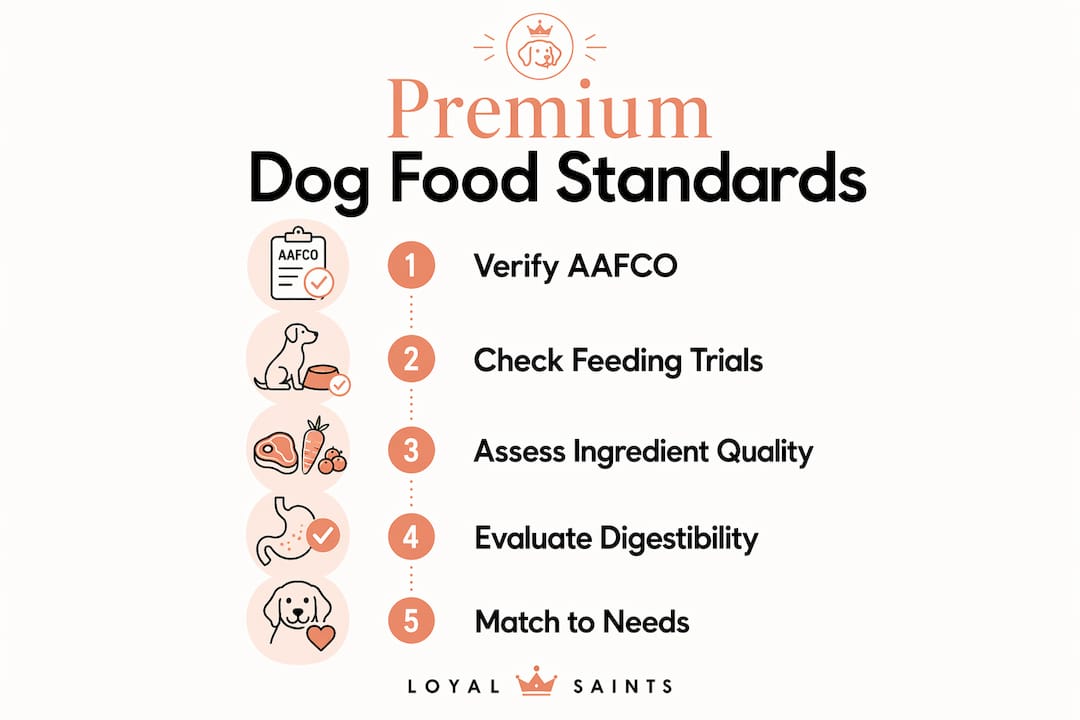
Here is what to look for when evaluating whether a dog food genuinely meets high-quality standards:
- Named animal protein as the first ingredient. “Chicken,” “salmon,” or “beef” are specific. “Meat meal,” “animal by-product,” or “poultry digest” are vague and signal lower sourcing standards.
- AAFCO feeding trial statement on the label. Look for the phrase “animal feeding tests” rather than “formulated to meet.” The difference tells you whether real dogs validated the food.
- Board-certified veterinary nutritionist involvement. A Diplomate of the American College of Veterinary Nutrition (DACVN) on the formulation team is a credible quality signal.
- Transparent manufacturer contact information. A phone number, physical address, and sourcing details indicate a company willing to be held accountable.
- No reliance on buzzwords. Terms like “holistic,” “superfood,” “ancestral,” and “grain-free” carry no regulatory definition and tell you nothing about nutritional quality.
Pro Tip: Check the AAFCO statement on the back of the bag before reading any front-panel claims. The back label is regulated. The front is marketing.
Only a handful of major brands, including Hill’s Science Diet and Purina Pro Plan, routinely conduct feeding trials. Most brands, including many marketed as premium, rely on formulation only. That does not automatically make them poor choices, but it does mean you are trusting a calculation rather than a tested result.
How to interpret dog food labels and marketing claims critically
Reading a dog food label critically takes about 30 seconds once you know what to look for. The challenge is that packaging is designed to appeal to you, not to inform you. Understanding the difference between regulated and unregulated language is the fastest way to cut through the noise.
Here is a practical 30-second label audit you can run in the store:
- Flip to the back panel. Find the AAFCO nutritional adequacy statement. Confirm it says “animal feeding tests” or “feeding trial.” If it says “formulated to meet,” note that and adjust your expectations.
- Read the first three ingredients. The first should be a named animal protein. If it is a grain, starch, or unnamed by-product, the protein density is likely lower than the front label suggests.
- Check for manufacturer contact details. A brand with a real address and phone number is more traceable than one with only a website URL.
- Look for a veterinary nutritionist credit. Some brands list their formulation team. A DACVN credential is a meaningful quality indicator.
- Ignore the front panel claims. “Natural,” “premium,” “holistic,” and “human-grade” are either unregulated or have very specific legal definitions that may not mean what you think.
The term “human-grade” is worth examining closely. Human-grade ingredients must meet food safety standards set for human consumption, which is a meaningful distinction. However, many highly regarded premium foods are not classified as human-grade and still maintain excellent nutrition. The absence of a human-grade label does not indicate low quality.
| Label Term | Regulated? | What It Actually Means |
|---|---|---|
| Complete and balanced | Yes (AAFCO) | Meets minimum nutrient profiles for the stated life stage |
| Feeding trial verified | Yes (AAFCO) | Tested on actual dogs for at least 26 weeks |
| Human-grade | Partially (USDA) | Ingredients meet human food safety standards |
| Natural | Partially (AAFCO) | No synthetic additives, but loosely enforced |
| Premium / Holistic / Superfood | No | Marketing terms with zero regulatory definition |
| Chicken flavor | Yes (AAFCO) | Contains detectable chicken, but not necessarily as a primary ingredient |
Pro Tip: “Chicken” and “chicken flavor” are legally different. “Chicken” means the ingredient is present in meaningful quantity. “Chicken flavor” means the food only needs to smell or taste like chicken.
Why ingredient quality, digestibility, and nutrient bioavailability matter
Crude protein percentage on a label does not tell you how much of that protein your dog can actually use. Bioavailability, meaning how efficiently a nutrient is absorbed and used by the body, is the real measure of ingredient quality. A food with 28% crude protein from highly digestible chicken muscle meat delivers more usable nutrition than one with 30% protein from feather meal or corn gluten.

Ingredient sourcing also affects digestibility in ways the label does not always reveal. Feed-grade ingredients meet minimum safety standards for animal consumption. Human-grade ingredients meet the higher bar set for human food production. The gap between these two tiers affects not just safety but also nutrient density and digestibility. Whole meats, organ proteins like liver and kidney, and named fish meals consistently outperform generic by-products in amino acid completeness.
One detail that trips up even careful shoppers is the moisture effect on ingredient listings. Ingredients are listed by weight before cooking, so fresh chicken may appear first because it is heavy with water. After cooking, that same chicken shrinks significantly. Comparing foods accurately requires analyzing nutrients on a dry matter basis, which removes moisture from the equation and gives you a true protein-to-carbohydrate ratio.
Here is what to prioritize when evaluating ingredient quality:
- Named whole meats and meals. “Chicken meal” is actually more protein-dense than fresh chicken because the moisture has already been removed.
- Organ proteins. Liver, heart, and kidney provide concentrated amino acids, vitamins, and minerals that muscle meat alone does not supply.
- Minimal fillers. Corn syrup, artificial colors, and unnamed “animal digest” add calories without nutritional value.
- Sourcing transparency. Brands that name their suppliers or specify country of origin give you traceability. You can learn more about why this matters by reviewing the difference between traceability and transparency in pet food sourcing.
Understanding AAFCO protein standards gives you a clearer picture of how minimum requirements translate into real-world nutrition for your dog.
How to match premium food standards with your dog’s individual needs
Choosing a food that meets premium standards is only half the job. The other half is matching that food to your specific dog. Veterinary experts consistently recommend choosing food based on life stage, breed size, and health status rather than trending ingredients or packaging appeal. A senior large-breed dog and a growing puppy have fundamentally different nutritional requirements, even if both foods carry the same quality credentials.
Here is how to apply premium standards to your dog’s individual situation:
- Life stage first. Puppies need higher protein and calcium ratios for growth. Senior dogs often benefit from lower phosphorus and joint-supporting nutrients. Always confirm the AAFCO statement matches your dog’s life stage. For detailed guidance, explore age-appropriate dog diets for every life stage.
- Breed size matters. Large breeds are prone to joint issues and benefit from controlled calcium-to-phosphorus ratios. Small breeds have faster metabolisms and may need calorie-dense formulas.
- Health conditions change the equation. Dogs with food sensitivities, kidney disease, or skin issues need formulas tailored to those conditions. A veterinarian-approved formulation is especially important here.
- Check recall history. Manufacturer transparency and a clean recall record are stronger quality indicators than price or packaging. The FDA maintains a public database of pet food recalls you can search by brand.
- Budget does not have to be all-or-nothing. Mixing a premium food with a solid mid-range option is a practical strategy that maintains nutritional quality without the full cost of feeding premium exclusively.
Industry experts recommend looking for a veterinary nutritionist on staff, documented feeding trials, and absence of recalls as a much stronger predictor of quality than any marketing term. Your vet can also help you interpret bloodwork and coat condition as real-world feedback on whether a food is working for your dog.
Key takeaways
Premium dog food quality is defined by AAFCO feeding trial verification, named animal proteins, veterinary nutritionist involvement, and manufacturer transparency, not by marketing terms like “premium,” “holistic,” or “grain-free.”
| Point | Details |
|---|---|
| “Premium” is unregulated | Any brand can use the term; look for AAFCO feeding trial statements instead. |
| Feeding trials beat formulation | Only trials lasting 26+ weeks on real dogs confirm nutrient bioavailability and long-term safety. |
| Named proteins signal quality | First ingredients should be specific: chicken, salmon, or beef, not “animal by-product.” |
| Dry matter basis for comparison | Remove moisture from the equation to accurately compare protein levels across different food types. |
| Recall history and transparency matter | A clean recall record and accessible manufacturer contact details are stronger trust signals than price. |
What I’ve learned about cutting through premium dog food marketing
I have spent years looking at dog food labels, and the single most common mistake I see pet owners make is trusting the front of the bag. The front is a sales tool. The back is where the actual information lives, and most people never flip it over.
The 30-second audit described in this article is not a shortcut. It is genuinely the most efficient way to separate real quality from clever packaging. Once you run it a few times, it becomes automatic. You stop being impressed by words like “ancestral blend” or “wild-crafted” and start asking the only questions that matter: Was this tested on real dogs? Who formulated it? Can I reach the company if something goes wrong?
The other thing I would tell any dog owner is this: consistency matters more than perfection. A food that meets solid nutritional standards and that your dog digests well and thrives on is worth more than constantly switching to whatever brand is trending. Monitor your dog’s coat, energy, stool quality, and weight. Those are your real-world quality indicators. Adjust when the evidence tells you to, not when a new marketing campaign does.
Investing in genuinely high-quality nutrition is one of the most direct ways to support a longer, healthier life for your dog. That is not a small thing.
— Eyo
Feed your dog the quality they deserve
If you want a food that checks every box in this article, freeze-dried dog food is worth a serious look. The freeze-drying process preserves nutrients that heat-based processing destroys, which means the protein, vitamins, and enzymes in whole ingredients stay intact from production to bowl.
Loyalsaintspets formulates its freeze-dried recipes with human-grade whole proteins, fruits, and vegetables, with no fillers or artificial additives. Every formula meets AAFCO standards and is developed with veterinary input. If you want to understand why the format matters as much as the ingredients, the freeze-dried nutrition guide explains the science clearly. When you are ready to shop, you can browse the full range and find the right fit for your dog’s life stage and needs.
FAQ
What does “premium” actually mean on a dog food label?
“Premium” is an unregulated marketing term with no legal definition under AAFCO or FDA rules. It carries no nutritional or safety requirements, so any brand can use it freely.
How do I know if a dog food has been tested on real dogs?
Look for the phrase “animal feeding tests” in the AAFCO nutritional adequacy statement on the back of the bag. If it says “formulated to meet,” the food was validated by calculation only, not by feeding actual dogs.
Are human-grade ingredients always better for dogs?
Human-grade ingredients meet food safety standards set for human consumption, which is a meaningful quality bar. However, many highly regarded premium dog foods are not classified as human-grade and still deliver excellent nutrition, so the absence of this label does not indicate low quality.
Why does dry matter basis matter when comparing dog foods?
Ingredients are listed by weight before cooking, so moisture content skews the numbers. Analyzing nutrients on a dry matter basis removes moisture from the equation and gives you an accurate comparison of protein and carbohydrate levels across different products.
How important is a brand’s recall history when choosing dog food?
Manufacturer transparency and a clean recall history are stronger indicators of food quality than price or branding. The FDA maintains a public pet food recall database, and checking it before committing to a brand is a straightforward step that most pet owners skip.


