
TL;DR:
- Premium pet food lacks a regulated legal definition and should be evaluated based on scientific standards.
- The best indicators include AAFCO statements, veterinary nutritionist involvement, named proteins, and transparency.
- Price does not always correlate with quality, and gradual transition and vet consultation improve dietary outcomes.
Premium pet food is defined as any pet food marketed with higher quality ingredients and elevated standards, yet the word “premium” itself carries no regulated legal meaning under U.S. law. The Association of American Feed Control Officials, known as AAFCO, sets the actual nutritional standards that matter. Brands like Hill’s Science Diet, Royal Canin, and Purina Pro Plan invest in veterinary nutritionists and feeding trials to back their formulas. Many terms you see on bags, including “natural,” “grain-free,” and “human-grade,” lack consistent regulatory definitions and can appear on products of wildly different quality. Knowing this upfront saves you money and protects your dog.
What is premium pet food, really? The criteria that actually matter
True high-quality dog food is identified by evidence-based standards, not bag design or price point. The World Small Animal Veterinary Association, known as WSAVA, publishes manufacturer-selection criteria that veterinarians use to evaluate brands. Those criteria focus on four concrete factors.
- AAFCO nutritional adequacy statement. Every bag should carry a statement confirming the food is “complete and balanced” for your dog’s life stage. Feeding-trial substantiation is stronger than formulation alone, because it proves the food works in real animals.
- Full-time veterinary nutritionist involvement. Brands that employ a board-certified veterinary nutritionist in formulation are held to a higher scientific standard. Ask the brand directly. If they cannot answer, that tells you something.
- Named animal protein as the first ingredient. “Chicken,” “beef,” or “salmon” as the lead ingredient signals a higher meat content than vague terms like “meat meal” or “poultry by-product.”
- Clean recall history and sourcing transparency. Manufacturer quality control, including traceable ingredient sourcing and a minimal recall record, is a stronger quality signal than any front-of-bag claim.
Pro Tip: Search the FDA’s pet food recall database before buying any new brand. A single major recall is not automatically disqualifying, but a pattern of recalls is a serious red flag.
Marketing buzzwords are the biggest trap in this category. “Grain-free” has no proven health benefit for most dogs and has been linked to cardiac concerns in ongoing FDA research. “Natural” simply means no synthetic ingredients were added after processing, which is a low bar. Focus on the AAFCO statement and the manufacturer’s scientific credentials instead.

Premium vs. budget pet food: what the comparison actually shows
The price-quality relationship in pet food is not linear. Some budget brands invest more in veterinary research and feeding trials than boutique premium brands, producing superior standardized nutrition at a lower cost. IAMS, for example, meets AAFCO standards and employs nutritionists, yet costs a fraction of many boutique labels priced above $4 per day.
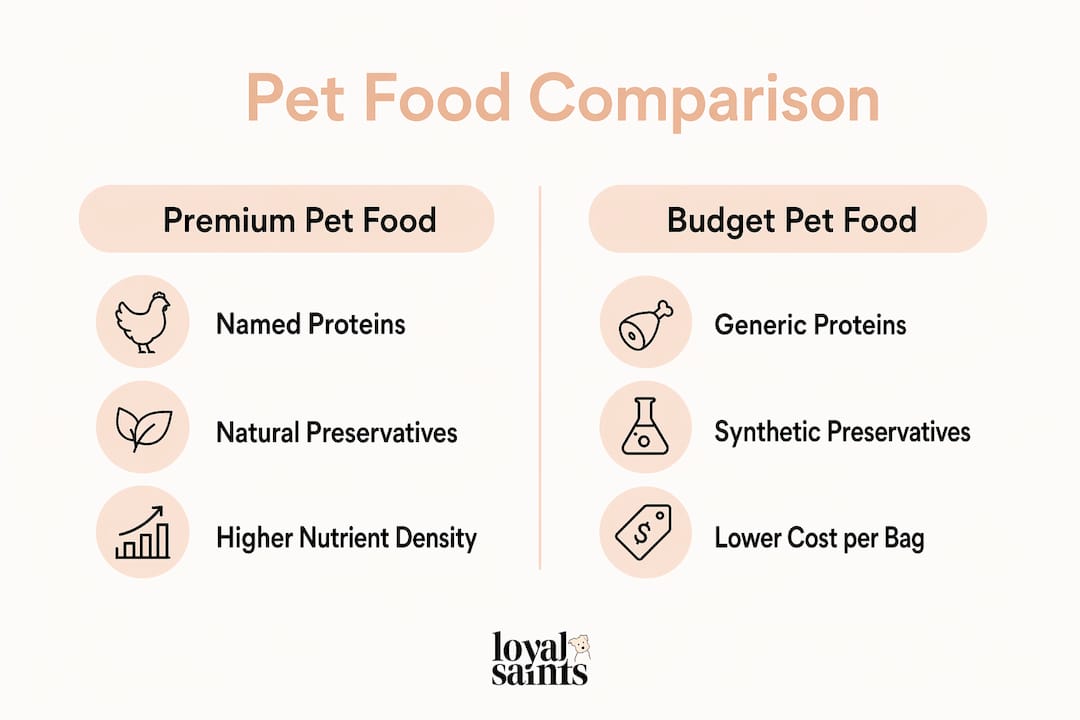
| Factor | Premium pet food | Budget pet food |
|---|---|---|
| Protein source | Named proteins: chicken, beef, salmon | Meat by-products, generic meal |
| Preservatives | Natural tocopherols, rosemary extract | Artificial BHA, BHT, ethoxyquin |
| AAFCO compliance | Feeding-trial substantiated | Formulation only, or not stated |
| Nutritionist involvement | Often yes, for established brands | Rarely disclosed |
| Cost per feeding | Higher upfront, lower volume needed | Lower upfront, higher volume needed |
| Recall history | Varies widely by brand | Varies widely by brand |
The cost-per-feeding comparison is the most overlooked factor. Higher nutrient density means your dog needs less food per meal to meet its caloric needs. A 30-pound bag of a nutrient-dense formula can outlast a same-size bag of a less digestible food, narrowing the real price gap considerably.
The ingredient quality difference is also meaningful. Premium foods use named proteins and natural preservatives like tocopherols and rosemary extract, while budget foods frequently rely on meat by-products and artificial additives. By-products are not inherently dangerous, but they are less consistent in protein quality and digestibility across batches.
One important correction to a common misconception: boutique brands with beautiful packaging and $80 price tags do not automatically outperform mainstream brands on WSAVA criteria. Many boutique brands score poorly on scientific and safety criteria despite their premium positioning. Price is a weak proxy for quality. The AAFCO statement and manufacturer transparency are far more reliable guides.
What are the real health benefits of high-quality pet food?
Genuinely well-formulated dog food produces measurable health improvements, particularly in dogs with sensitivities or chronic conditions. Premium diets support skin, coat, digestion, joints, and immune function when they are correctly matched to the dog’s life stage and health status.
The benefits most dog owners notice first are visible ones: a shinier coat, reduced shedding, and firmer stools. These reflect improved digestibility and better fatty acid profiles. Dogs eating higher-quality protein sources also tend to maintain lean muscle mass more effectively as they age.
For dogs with allergies or food sensitivities, a well-formulated diet can be genuinely transformative for health outcomes. A dog cycling through chronic ear infections or itchy skin may respond dramatically to a limited-ingredient diet built around a single named protein source. That improvement can reduce vet visits and the cost of repeated treatments over time.
Pro Tip: If your dog has recurring skin or digestive issues, ask your vet about a structured elimination diet trial before switching foods randomly. A 6–8 week trial with a novel protein source gives you real data on what your dog tolerates.
Not every healthy dog requires the most expensive food on the shelf. A dog thriving on a complete and balanced mainstream diet does not need an upgrade simply because a label says “premium.” The goal is matching nutrition to your dog’s actual needs, not chasing marketing language. Life stage appropriateness matters more than price tier. A puppy, a senior dog, and an active working dog each need different nutrient profiles, and no single “premium” label covers all three.
How to choose and transition your dog to a better diet safely
Choosing a genuinely high-quality food comes down to a short checklist applied consistently. Here is how to do it without getting distracted by packaging.
- Find the AAFCO statement. Look for “complete and balanced” language on the label, matched to your dog’s life stage: puppy, adult, or senior. Feeding-trial substantiation is the gold standard. If the bag only says “formulated to meet” AAFCO standards, that is a lower bar.
- Research the manufacturer. Call or email the brand and ask whether a board-certified veterinary nutritionist formulated the recipe. Ask about their quality control and ingredient sourcing. Reputable brands answer these questions without hesitation.
- Check the recall history. Use the FDA’s pet food recall database. A clean or minimal record over many years is a positive signal.
- Calculate cost per feeding, not cost per bag. Divide the bag price by the number of servings based on the feeding guide for your dog’s weight. This gives you a real comparison across brands.
- Transition gradually over 2–3 weeks. Veterinarians recommend a 14–21 day transition, mixing increasing amounts of the new food with the old. This prevents digestive upset, which is the most common reason owners abandon a new diet prematurely. A helpful step-by-step transition guide can walk you through the exact ratios week by week.
- Monitor and consult your vet. Watch for changes in stool quality, energy, coat condition, and weight. Schedule a check-in with your vet 4–6 weeks after the switch to assess the response.
Life stage matching and AAFCO verification are more critical to your dog’s health than any buzzword on the front of the bag. Keep that as your anchor when the marketing gets loud.
Key takeaways
The most reliable way to identify genuinely high-quality dog food is to verify the AAFCO nutritional adequacy statement, confirm veterinary nutritionist involvement, and evaluate cost per feeding rather than cost per bag.
| Point | Details |
|---|---|
| “Premium” is unregulated | The label carries no legal nutritional standard; AAFCO compliance is what counts. |
| Quality indicators are specific | Look for named proteins, AAFCO feeding-trial statements, and nutritionist involvement. |
| Price does not equal quality | Some budget brands outperform boutique labels on scientific and safety criteria. |
| Health benefits are real but conditional | High-quality diets improve coat, digestion, and allergy outcomes when matched to life stage. |
| Transition slowly and monitor | A 14–21 day gradual switch prevents digestive upset and gives you accurate results. |
My honest read on the premium pet food market
I have spent years reading pet food labels, talking to veterinary nutritionists, and watching dog owners make expensive mistakes based on beautiful packaging. The single biggest pattern I see is owners paying a premium for a story rather than a standard.
The word “premium” is doing a lot of heavy lifting for a lot of brands that have not earned it. I have seen boutique freeze-dried brands with stunning photography and zero evidence of feeding trials sitting next to mainstream brands that fund decades of nutritional research. The mainstream brand is often the better choice by every measurable standard, and it costs half as much.
That said, I genuinely believe that for dogs with sensitivities, allergies, or chronic health issues, a well-formulated, minimally processed diet makes a real difference. I have watched dogs with chronic ear infections and dull coats transform within two months of switching to a single-protein, limited-ingredient diet built from whole, traceable ingredients. That is not marketing. That is nutrition working.
My advice is simple: ignore the front of the bag entirely. Flip it over. Find the AAFCO statement. Look up the manufacturer. Ask about their nutritionist. Then calculate what you are actually paying per meal. If you do those four things, you will make a better decision than 90% of pet owners in the store aisle. Your dog cannot read the label. You can. Use that advantage.
— Kristina
Try Loyalsaintspets freeze-dried raw food for your dog
If you are ready to move beyond marketing claims and feed your dog something genuinely traceable and whole, Loyalsaintspets makes it straightforward. Every product is built from human-grade proteins with no fillers, no artificial additives, and no guesswork about what is inside.
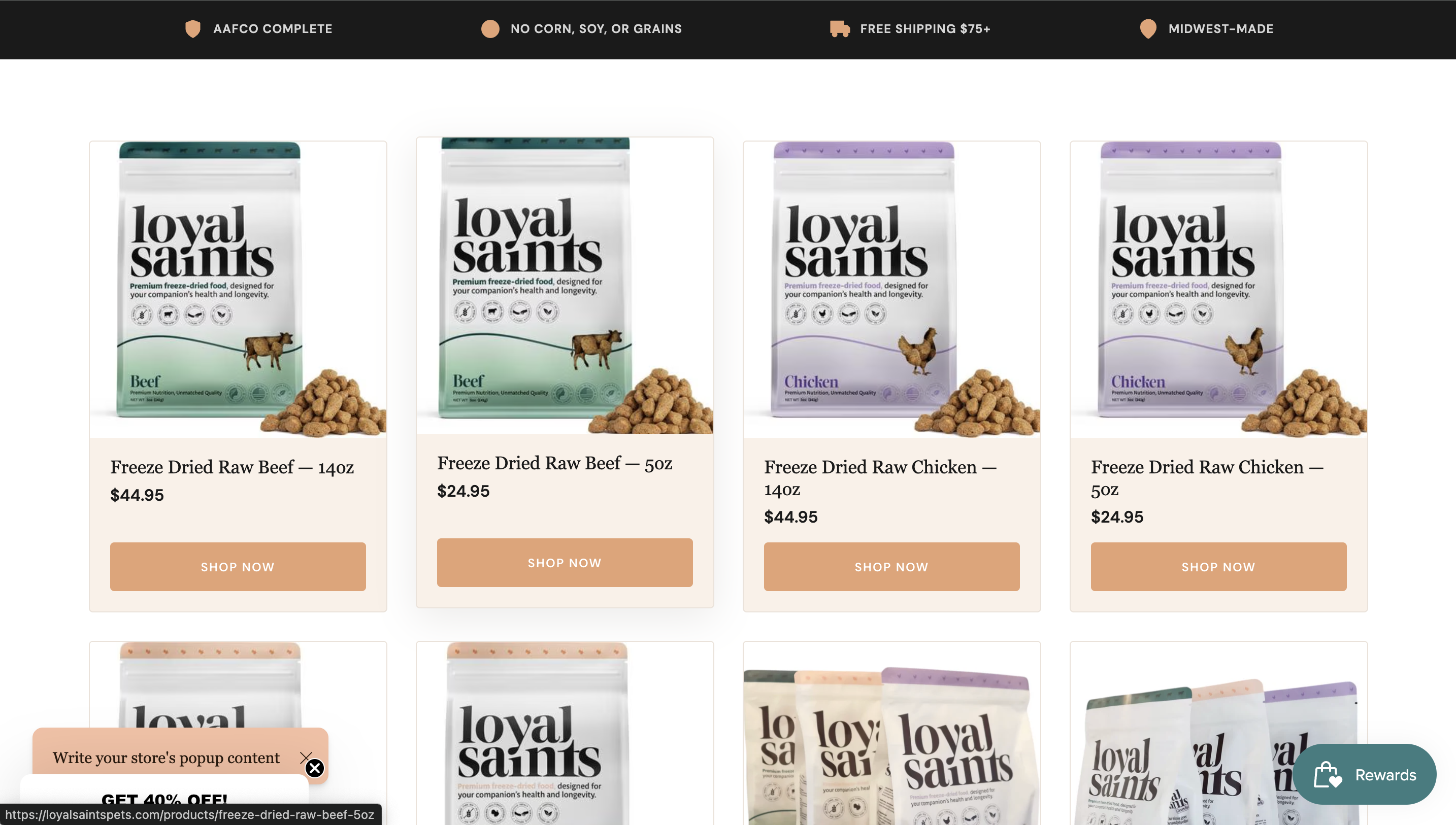
Start with the 14oz variety pack featuring beef, chicken, and turkey with salmon, which is a practical way to test which protein your dog responds to best before committing to a larger size. If your dog already has a favorite protein, the freeze-dried raw chicken and freeze-dried raw beef options are available in both 5oz and 14oz sizes. Free shipping is available on qualifying orders, so stocking up is easy. Your dog deserves food you can actually trust.
FAQ
What does “premium” mean on a pet food label?
“Premium” is a marketing term with no regulated legal definition in the United States. The AAFCO nutritional adequacy statement on the label is the actual standard that confirms a food is complete and balanced for your dog.
Is premium pet food worth the higher price?
It depends on the brand. Some premium foods genuinely deliver better ingredient quality, digestibility, and health outcomes. Others charge more for packaging and branding without meeting basic scientific criteria like AAFCO feeding-trial substantiation or veterinary nutritionist involvement.
How do I know if a dog food is truly high quality?
Check for an AAFCO “complete and balanced” statement substantiated by feeding trials, confirm the manufacturer employs a board-certified veterinary nutritionist, verify a clean recall history, and look for named animal proteins as the first ingredient.
Can a budget brand be better than a premium brand?
Yes. Some mainstream brands like IAMS invest heavily in veterinary research and meet AAFCO standards at a lower cost than many boutique premium labels. Price is not a reliable indicator of nutritional quality or safety.
How long does it take to transition a dog to a new food?
Veterinarians recommend a gradual transition over 14–21 days, slowly increasing the ratio of new food to old food. This prevents digestive upset and gives you a clear picture of how your dog responds to the new diet.
Recommended
- The Essential Guide to Why Choose Premium Pet Foods | The Loved by Loyal Saints Blog
- Complete Guide to What Makes Dog Food Premium | The Loved by Loyal Saints Blog
- Definition of Premium Pet Food: What Sets It Apart | The Loved by Loyal Saints Blog
- What Defines Premium Dog Food: Complete Guide | The Loved by Loyal Saints Blog


