
TL;DR:
- Fillers in dog food like corn and wheat add volume but offer fewer nutrients than meat proteins. Scientific evidence shows regulated fillers do not harm healthy dogs, and digestibility impacts nutrient absorption. Focus on ingredient quality and individual dog needs rather than marketing claims like “no fillers.”
Walk down any pet food aisle and you’ll see bold labels shouting “no fillers,” “grain-free,” and “all-natural.” But what does that actually mean for your dog? Fillers in pet food are low-cost, carbohydrate-heavy ingredients like corn, wheat, soy, and rice bran that add bulk but provide fewer bioavailable nutrients than meat proteins. The debate around them is loud, often driven by marketing rather than science. This guide cuts through the noise and gives you clear, evidence-backed answers so you can make smarter choices for the dog you love.
Table of Contents
- What are pet food fillers and why do they exist?
- Are pet food fillers actually harmful? Evidence vs. hype
- How fillers affect digestibility, nutrition, and dog vitality
- When (and why) should you avoid fillers? Special cases and practical choices
- What most dog owners miss about fillers: The real-world view
- Better nutrition choices for your dog—backed by evidence
- Frequently asked questions
Key Takeaways
| Point | Details |
|---|---|
| Define fillers clearly | Pet food fillers are typically grain-based ingredients with lower nutrient density than meats. |
| Risks are minimal | Regulated fillers pose little risk to healthy dogs but may be less digestible than protein. |
| Digestibility matters | Plant-based fillers have lower digestibility than animal proteins, affecting nutrient absorption. |
| Special cases require care | Avoid fillers for allergic, sensitive, or senior dogs, but some fiber fillers can support gut health. |
| Focus on whole nutrition | Assess pet food by overall nutrition and digestibility, not just filler marketing claims. |
What are pet food fillers and why do they exist?
Not every ingredient in your dog’s food is there for nutrition. Some are there to keep manufacturing costs down, improve texture, or simply add volume to the bag. These are what the industry calls fillers. Understanding the facts about dog food fillers starts with knowing exactly what we’re talking about.
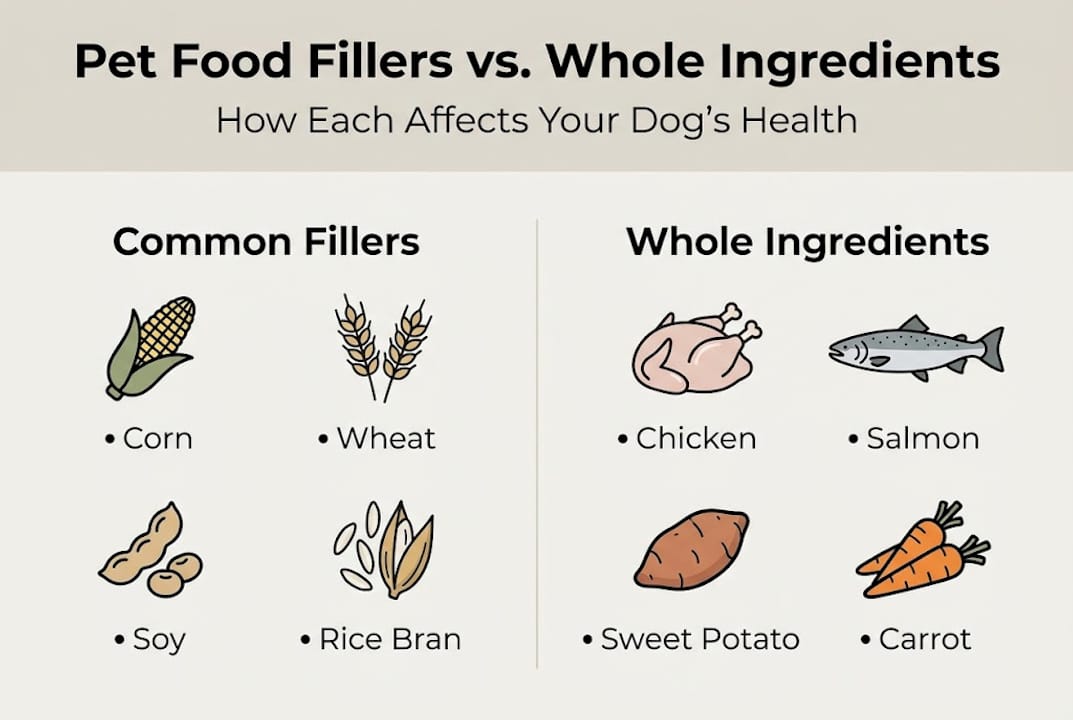
The most common fillers you’ll find on ingredient labels include:
- Corn – Adds bulk and energy, inexpensive to source
- Wheat – Used for texture and binding, a common allergen trigger
- Soy – Provides plant-based protein and volume at low cost
- Rice bran – A byproduct of rice milling, adds fiber and filler weight
- Corn gluten meal – A concentrated corn derivative used for protein padding
Manufacturers use these ingredients for straightforward business reasons. They are significantly cheaper than animal proteins, they help create a consistent kibble texture, and they allow companies to produce larger quantities at lower price points. There’s nothing inherently secretive about it, but it does matter for your dog’s nutrition.
Here’s a side-by-side look at how common fillers compare to whole ingredients:
| Ingredient | Nutrient density | Digestibility | Cost to manufacturer |
|---|---|---|---|
| Corn | Low | Moderate | Very low |
| Wheat | Low to moderate | Moderate | Low |
| Soy | Moderate | Moderate | Low |
| Chicken (whole) | High | High | Moderate to high |
| Salmon | High | High | High |
| Sweet potato | Moderate | High | Moderate |
The contrast is real. Whole ingredients like chicken or salmon deliver more usable nutrition per gram than corn or wheat. That said, not every filler-containing food is nutritionally deficient. The full recipe and the ratios matter enormously, which is why using an ingredient comparison tool can help you see the complete picture before you buy.
The controversy comes from a gap between marketing language and nutritional science. Brands that say “no fillers” often position it as a health claim, but that phrase has no regulated definition. What you really want to look at is the full ingredient list, guaranteed analysis, and whether the food meets established nutritional standards.
Are pet food fillers actually harmful? Evidence vs. hype
With a clear sense of what fillers are, it’s time to separate facts from fiction regarding their safety. And the honest answer may surprise you.
A recent scientific review found no strong empirical evidence linking approved fillers at regulated levels to harm in healthy dogs. That’s worth sitting with for a moment. The dramatic warnings you see on some pet food websites are largely not backed by peer-reviewed data for the average, healthy adult dog.
The bottom line from research: Risks associated with common fillers are frequently overstated by marketing, not by science. Healthy dogs eating regulated, balanced formulas do not show measurable harm from filler ingredients.
So why does the “no fillers” marketing feel so convincing? Because it plays on a real, understandable fear. You want your dog to thrive, not just survive. And any ingredient that sounds like “filler” sounds like something that isn’t serving your dog.
The truth is more nuanced. Some dogs, particularly those with food sensitivities or allergies, do respond poorly to specific fillers like wheat or soy. Checking dog food additive risks by looking at your individual dog’s history is far more useful than avoiding all fillers categorically.

Pro Tip: When you see a pet food labeled “no fillers,” ask what they replaced those ingredients with. If the first five ingredients are still carbohydrate-heavy, the label is more marketing than substance. Look for named animal proteins in the top two or three spots.
Marketing claims are not regulated the same way ingredient lists are. A brand can call their food “filler-free” without any independent verification. Your best protection is reading the ingredient panel itself, not the front-of-bag language.
How fillers affect digestibility, nutrition, and dog vitality
Knowing the risks are minimal, the real question is how fillers influence what matters most: your dog’s nutrition and vitality.
Digestibility is measured as a dry matter percentage (DM%), which tells you how much of a nutrient your dog’s body actually absorbs versus passes as waste. Plant-based fillers show lower digestibility, typically 72 to 82% DM, compared to animal proteins which range from 80 to 85% DM. Fermentation and added enzymes can close that gap, but it’s worth knowing.
| Ingredient type | Digestibility (DM%) | Protein quality | Energy contribution |
|---|---|---|---|
| Animal proteins | 80 to 85% | High (complete amino acids) | High |
| Plant-based fillers | 72 to 82% | Lower (incomplete) | Moderate |
| Dietary fiber sources | Variable | Minimal | Low |
Here’s how to put digestibility data to practical use:
- Check the guaranteed analysis on the bag for crude protein and fat percentages.
- Look at ingredient order because ingredients are listed by weight before cooking.
- Compare dry matter percentages if comparing wet and dry foods, since moisture content skews raw numbers.
- Research the protein source because “animal meal” varies widely in quality compared to named proteins like “chicken” or “salmon.”
- Monitor your dog’s stool because firm, small stools indicate high digestibility, while large, loose stools often mean more waste from low-digestibility ingredients.
Both AAFCO and FEDIAF guidelines focus on total nutritional adequacy, not on banning specific fillers. That means a food can contain corn and still meet every minimum requirement. But meeting minimums and optimizing ingredient quality are two different things. For dogs with high energy demands, older dogs, or those recovering from illness, higher digestibility from whole ingredients can make a visible difference in coat, energy, and stool quality.
The benefits of whole ingredients go beyond the numbers. When your dog’s body absorbs more from every bite, you often see it in their eyes, energy level, and overall happiness.
When (and why) should you avoid fillers? Special cases and practical choices
With digestibility and nutrition in mind, let’s get practical. When does avoiding fillers actually matter most, and how do you navigate the real-world choices at the pet store?
For most healthy adult dogs eating a balanced, regulated diet, fillers are not an emergency. But there are specific situations where reducing or eliminating them makes a real, noticeable difference.
When to be stricter about fillers:
- Food-sensitive or allergic dogs – Wheat and soy are among the most common dietary triggers. If your dog shows itching, ear infections, or digestive upset, reviewing allergy-friendly options is a smart first step.
- High-performance or working dogs – Dogs with elevated energy needs benefit from higher digestibility to fuel muscle and recovery.
- Senior dogs – Aging dogs have reduced digestive efficiency and benefit from more digestible protein sources.
- Dogs with chronic digestive issues – Lower-digestibility ingredients can worsen symptoms in dogs with irritable bowel or sensitive stomachs.
Interestingly, not all fillers are equal. Some fiber sources, like beet pulp or psyllium, actually support fiber’s role in dog gut health by feeding beneficial bacteria and improving stool consistency. According to a review on pet food additives, avoiding fillers matters most for allergy-prone, active, and senior dogs, while certain fiber sources can genuinely aid gut health.
What to look for on the label:
- Named animal protein in the first two ingredients
- Short, recognizable ingredient lists
- An AAFCO statement confirming nutritional adequacy
- Absence of vague terms like “animal digest” or “meat by-products”
Pro Tip: Before switching your dog’s food based on a label claim, ask your vet two questions: “Does my dog show signs of food sensitivity?” and “What digestibility standard should I aim for given my dog’s age and activity level?” Those answers are far more useful than any front-of-bag claim. Also check resources like marketing myths about fillers to keep your perspective grounded.
What most dog owners miss about fillers: The real-world view
Here’s the honest truth we’ve learned from years of watching the pet food space: the filler debate is mostly a proxy war for a bigger, messier question, which is whether a food is actually good for your specific dog.
“No fillers” has become shorthand for “high quality,” but that’s a marketing shortcut. A food with zero corn can still be poorly formulated, overly processed, or nutritionally incomplete. And a food with some rice bran can be perfectly balanced and genuinely nourishing. Quality is about the full recipe, the sourcing, the processing method, and how well it suits your dog’s individual needs.
What we’d encourage you to focus on instead is compliance with guidelines like AAFCO and FEDIAF, real-world feeding trial results, and most importantly, how your dog actually responds. Does their coat look vibrant? Are their stools consistent and firm? Are they energetic and happy?
The whole ingredient benefits are real and worth pursuing, but pursue them because the science supports it, not because a label told you to be afraid. Be informed, not alarmed. Individual response always tells a more reliable story than general hype.
Better nutrition choices for your dog—backed by evidence
If this article has you thinking more critically about what goes into your dog’s bowl, that’s exactly the right response. The next step is finding food that lives up to those standards, not just on the label but in the bowl.

At Loyal Saints Pets, we formulate our freeze-dried dog food with human-grade whole proteins, fruits, and vegetables because we believe your dog deserves more than filler weight. Every recipe is built to meet AAFCO nutritional standards and is free from artificial additives, so what you read on the label is exactly what your dog eats. Explore why freeze dried nutrition preserves more of what matters, or shop high-quality options and see what a filler-free, evidence-backed recipe looks like for your dog.
Frequently asked questions
What ingredients are considered fillers in dog food?
Common fillers include corn, wheat, soy, and rice bran, which are ingredients that add bulk to food with fewer nutrients than quality meat proteins.
Do fillers in pet food harm dogs?
No evidence shows harm in healthy dogs from regulated fillers, though plant-based fillers show lower digestibility than animal proteins, which may affect energy and stool quality over time.
How can I tell if my dog food is free from fillers?
Check the ingredient list for corn, wheat, soy, or rice bran in the top five spots, and look for an AAFCO nutritional adequacy statement paired with named animal proteins at the top of the list.
Are there any benefits to certain fillers?
Yes. Some fiber-based fillers like beet pulp can support gut health by improving digestion and stool consistency, according to findings on pet food additives, making them genuinely useful in specific formulations.


