
TL;DR:
- Always verify that dog food includes an AAFCO statement confirming it is complete and balanced.
- Check ingredients and guaranteed analysis on dry-matter basis, and ensure no red-flag additives are present.
Use the AAFCO nutritional adequacy statement, guaranteed analysis converted to dry-matter basis, clear ingredient sourcing, and correct calorie density as your primary criteria for dog food. Before you put anything in your cart, run through this quick check:
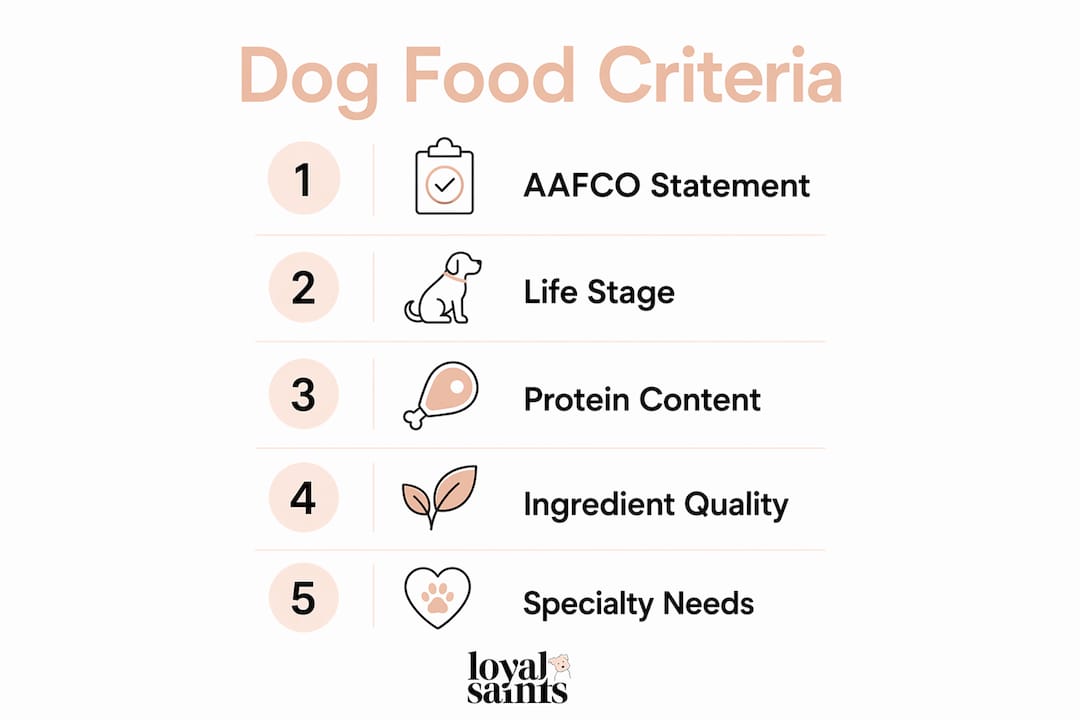
- AAFCO statement present? Look for “complete and balanced” on the label, backed by a nutrient profile or feeding trial.
- Guaranteed analysis listed? Confirm crude protein, fat, fiber, and moisture are all shown.
- Ingredients in descending order by weight? The first ingredient should be a named protein source.
- Calorie content stated? Match kcal per cup to your dog’s life stage and activity level.
- No red-flag ingredients? No xylitol, vague “meat by-products,” or undisclosed additives.
The very first thing to check on any package is the nutritional adequacy statement. If it’s missing or vague, put the bag down and choose another product. If your dog has a diagnosed health condition, stop shopping and call your vet before switching foods.
Table of Contents
- What does “complete and balanced” actually mean?
- How to read a dog food label correctly
- Which nutrients should you actually watch for?
- How do you match life stage, activity, and calories?
- When should you use a specialty diet, and what red flags should you avoid?
- What trust signals prove a manufacturer’s claims?
- Can freeze-dried raw food meet the same nutritional criteria?
- A checklist you can use the next time you shop
- Do nutrient needs change by breed size?
- How do ingredient substitutes and common allergens work?
- What about health conditions that don’t require a prescription diet?
- Key Takeaways
- The tradeoffs no one talks about honestly
- Loyalsaintspets freeze-dried recipes: a practical starting point
- Authoritative sources for further reading
What does “complete and balanced” actually mean?
“Complete and balanced” is a legally defined phrase in the United States, not a marketing slogan. According to the FDA, a dog food earns that claim only by meeting one of two AAFCO pathways: formulation to an AAFCO nutrient profile, or passing an AAFCO feeding trial protocol.
| Formulation to AAFCO Nutrient Profile | AAFCO Feeding Trial | |
|---|---|---|
| What it proves | Formula meets minimum nutrient levels on paper | Dogs actually ate and thrived on the food over a set period |
| Label language | “Formulated to meet AAFCO nutrient profiles” | “Animal feeding tests using AAFCO procedures” |
| Typical use | Most dry kibbles and many freeze-dried products | Premium lines, veterinary diets |
| Pros for you | Widely available, cost-effective | Real-world evidence of digestibility and palatability |
| Cons for you | Doesn’t confirm digestibility or bioavailability | Fewer products; trials have minimum size requirements |
AAFCO splits its nutrient profiles into two categories: Growth & Reproduction (for puppies, pregnant, and nursing dogs) and Adult Maintenance. A product labeled for “all life stages” must meet the more rigorous Growth & Reproduction profile, which means it’s technically adequate for adults too, but may carry more calories than a low-activity dog needs.
How to read a dog food label correctly
Start with the nutritional adequacy statement, then move to the ingredient list, then the guaranteed analysis and calorie content. That order matters because the statement tells you whether the product qualifies at all, and the rest tells you what’s actually in it. For a deeper walkthrough, the label-reading guide on the Loyalsaintspets blog covers each element with real examples.
Step-by-step label checklist:
- Nutritional adequacy statement. Confirm “complete and balanced” appears and note whether it’s backed by a nutrient profile or a feeding trial.
- Ingredient list order. Per FDA requirements, ingredients are listed in descending order by weight before processing. A named protein (e.g., “chicken,” “beef”) should lead the list.
- Water-weight caveat. In wet or raw foods, water inflates an ingredient’s position. “Chicken, water, chicken liver” may have less actual chicken than a dry food where “chicken meal” is the first ingredient.
- Guaranteed analysis. AAFCO requires minimum crude protein and fat, and maximum crude fiber and moisture to be listed. Convert these to a dry-matter basis before comparing products.
- Caloric content. The label must state kcal per kilogram and typically per cup or can. Use this number to calculate daily portions.
- Product name rules. The product name itself signals protein content under AAFCO naming rules.
Dry-matter conversion: a two-line example
Comparing a wet food (78% moisture) to a dry kibble (10% moisture) on an as-fed basis is misleading. Here’s how to level the playing field:
- Wet food: 10% crude protein as fed. Dry matter = 100% minus 78% moisture = 22%. Dry-matter protein = (10 ÷ 22) × 100 = 45.5%
- Dry kibble: 26% crude protein as fed. Dry matter = 100% minus 10% moisture = 90%. Dry-matter protein = (26 ÷ 90) × 100 = 28.9%
The wet food actually delivers more protein per dry ounce, even though its as-fed number looks lower. This math matters most when you’re comparing freeze-dried, canned, and kibble side by side.
What the product name tells you about protein content
- “Beef Dog Food” (95% rule): at least 95% beef by weight, excluding water. Beef is almost certainly the first ingredient.
- “Beef Dinner” / “Beef Entrée” (25% rule): beef makes up at least 25% but less than 95% of the formula.
- “Dog Food with Beef” (3% rule): beef is present at just 3% or more. The label descriptor “with” can be misleading — the named ingredient may be a minor component.
- “Beef Flavor Dog Food” (flavor rule): no minimum percentage required; the flavor may come from beef meal, by-products, or a flavoring agent rather than whole beef.
Pro Tip: When you want a high-protein food, look for the 95% rule products or check the guaranteed analysis on a dry-matter basis rather than trusting the product name alone.
Which nutrients should you actually watch for?
Focus on crude protein and fat on a dry-matter basis, calcium-to-phosphorus balance, essential fatty acids (omega-3 and omega-6), and the full vitamin and mineral profile required by AAFCO. The ingredient quality guide from Loyalsaintspets breaks down what each of these looks like in practice.
- Crude protein. Supports muscle maintenance, immune function, and coat health. Puppies and active dogs need higher levels; senior or kidney-compromised dogs may need moderation. Always evaluate on a dry-matter basis.
- Crude fat. The primary energy source and carrier for fat-soluble vitamins (A, D, E, K). Active dogs and puppies need more; weight-management formulas run lower.
- Calcium and phosphorus. Critical for bone development, especially in large-breed puppies where excess calcium can cause skeletal problems. The ratio matters as much as the absolute amounts.
- Omega-3 and omega-6 fatty acids. Support skin, coat, joint health, and inflammation response. Look for named sources like fish oil, flaxseed, or salmon in the ingredient list.
- Vitamins and minerals. Even a formula that is 95% meat by the AAFCO naming rule still needs up to 5% vitamins and minerals, because raw meat alone cannot meet calcium, phosphorus, or vitamin D requirements.
When protein and fat ranges matter most: Active adult dogs and working breeds benefit from higher dry-matter protein (above 25%) and fat (above 15%). Weight-loss formulas should run lower fat on a dry-matter basis. Puppies of large breeds need controlled calcium, not simply “more” of everything.
How do you match life stage, activity, and calories?
Choose a food labeled for your dog’s specific life stage and match its caloric density to how active your dog actually is. For most healthy adult dogs, an adult maintenance formula is the right starting point. For puppies, pregnant dogs, or nursing mothers, choose a food labeled for Growth & Reproduction or “all life stages.”
Calculating daily portions from the calorie statement:
Most labels express calories as kcal per kilogram and kcal per cup. A general starting formula for a moderately active adult dog is to calculate the Resting Energy Requirement (RER): RER = 70 × (body weight in kg)^0.75. Multiply by an activity factor (roughly 1.6 for a typical adult, higher for working dogs) to get daily kcal needs. Divide by the kcal-per-cup figure on the label to get your daily serving.
Give any portion change two to four weeks before assessing results. Weigh your dog every two weeks and check body condition: you should feel ribs easily but not see them. Adjust by 10% increments rather than large jumps.
One important caveat: “all life stages” formulas meet the Growth & Reproduction profile, which is more calorie-dense than adult maintenance. For a low-activity adult or a senior dog, feeding an “all life stages” food without adjusting portions often leads to gradual weight gain. Life-stage feeding guidance from Loyalsaintspets walks through this with practical portion examples.
When should you use a specialty diet, and what red flags should you avoid?
Use a veterinary-prescribed therapeutic diet only when a veterinarian has diagnosed a specific medical condition, such as kidney disease, severe food allergies, or pancreatitis. For every other dog, an AAFCO-complete food matched to life stage and calories is the right baseline.
Red flags that should disqualify a product:
- Missing or vague AAFCO nutritional adequacy statement
- Ingredient list led by vague terms like “meat by-products” with no species named
- Undisclosed additives or artificial preservatives not listed in the guaranteed analysis
- Known toxic ingredients: xylitol, onion powder, garlic in significant amounts, grapes, raisins, macadamia nuts
- Inconsistent guaranteed analysis across batches (check the brand’s published CoA history)
- Recent unresolved recalls or a manufacturer with a pattern of non-response to safety concerns
On grain-free diets: The FDA investigated a potential link between grain-free diets (particularly those high in legumes, peas, and lentils as primary ingredients) and dilated cardiomyopathy (DCM) in dogs. The research is ongoing and no definitive causal link has been established, but the concern is real enough that veterinary cardiologists recommend caution.
Pro Tip: Grain-free may be appropriate for a dog with a confirmed grain allergy diagnosed by a veterinarian. For most dogs, grains are a safe and digestible carbohydrate source. If your dog is on a grain-free diet and develops exercise intolerance, coughing, or labored breathing, consult your vet about cardiac screening.
Consult your veterinarian if your dog shows unexplained weight loss, chronic digestive upset, suspected food allergy, or any cardiac symptoms. These are not situations to manage through label-reading alone.
What trust signals prove a manufacturer’s claims?
The strongest signal is an AAFCO nutritional adequacy statement backed by a feeding trial, followed by published third-party Certificates of Analysis (CoA), clear manufacturing and sourcing information, and a documented recall history with transparent company responses.
Questions to ask any manufacturer
When you contact a brand or review its website, look for answers to these:
- Where is the food manufactured, and does the facility comply with FDA Current Good Manufacturing Practices (CGMPs) under FSMA/PCAF regulations?
- Is a third-party CoA available for each batch, and can you request one?
- What is the sourcing origin for the primary protein and produce ingredients?
- Has the product ever been recalled, and how did the company respond?
Reading CoAs and recall history
A Certificate of Analysis confirms that a specific batch was tested for nutrient levels, pathogens, and contaminants. A credible brand makes these available on request or publishes them on its website. Recall history is searchable through the FDA’s recall database. A single recall handled quickly and transparently is less concerning than a pattern of repeated issues or a company that goes silent.
Credible vs. vague trust signals
A credible signal looks like: “Formulated to meet AAFCO Adult Maintenance nutrient profiles; third-party tested for heavy metals and pathogens; manufactured in an FDA-registered facility in the United States.” A vague signal looks like: “Veterinarian approved” with no named veterinarian, institution, or published endorsement. Under FDA labeling rules, manufacturers must truthfully label their products, but endorsement language is not regulated the same way the adequacy statement is. Marketing language alone is not evidence of quality.
Can freeze-dried raw food meet the same nutritional criteria?
Yes, freeze-dried raw can meet AAFCO “complete and balanced” criteria when it is formulated and tested to an AAFCO nutrient profile or when the product is part of a product family where a lead product has passed feeding trials. The key is that the label must carry the same nutritional adequacy statement as any other complete food.
Advantages of freeze-dried raw:
- High nutrient density with minimal processing, preserving natural enzymes and palatability
- No synthetic preservatives needed due to the freeze-drying process
- Single or limited-protein options support dogs with ingredient sensitivities
- Long shelf life without refrigeration
Caveats to keep in mind:
- Caloric density is significantly higher before rehydration; always follow the manufacturer’s rehydration ratio
- Cost per serving is typically higher than kibble
- Proper formulation is non-negotiable: raw meat alone does not meet calcium, phosphorus, or vitamin requirements
Rehydration and kcal: what changes after you add water
When you rehydrate freeze-dried food, the guaranteed analysis shifts. A product showing 45% crude protein as-fed (freeze-dried, very low moisture) may drop to roughly 25–28% on a dry-matter basis after rehydration, depending on the rehydration ratio. Always use the manufacturer’s stated rehydration ratio (commonly 1 part food to 3–4 parts water by weight) and recalculate kcal per serving based on the rehydrated volume, not the dry weight. The manufacturer’s feeding guide should provide this clearly.
Loyalsaintspets offers three AAFCO-complete freeze-dried SKUs formulated with human-grade whole ingredients: Freeze Dried Raw Chicken (5 oz), Freeze Dried Raw Chicken (14 oz), and Freeze Dried Raw Beef (5 oz). Each is a single-protein formula free of fillers and synthetic additives, with clear feeding and rehydration guidelines on the packaging.
Transitioning to freeze-dried raw safely:
- Start by mixing a small amount (10–15% of the meal) into your dog’s current food
- Increase the proportion over 7–10 days while monitoring stool consistency
- If loose stools persist beyond a few days, slow the transition
- For dogs with medical conditions, get veterinary clearance before switching
A checklist you can use the next time you shop
Six checkpoints, in order of importance:
- [ ] AAFCO statement present and specific (names the life stage and method: profile or feeding trial)
- [ ] Named protein source leads the ingredient list (e.g., “chicken,” “beef,” not “poultry by-products”)
- [ ] Guaranteed analysis includes protein, fat, fiber, and moisture (convert to dry-matter basis to compare)
- [ ] Caloric content stated in kcal per cup or per kilogram (matches your dog’s life stage and activity)
- [ ] No red-flag ingredients (no xylitol, no unnamed by-products, no undisclosed additives)
- [ ] Manufacturer transparency (FDA-registered facility, CoA available, clean recall history)
Applying the checklist to a hypothetical bag: You pick up a bag labeled “Chicken Dinner for Dogs.” The AAFCO statement reads “formulated to meet AAFCO Adult Maintenance nutrient profiles.” Chicken is the first ingredient, followed by chicken meal and brown rice. The guaranteed analysis shows 24% crude protein and 10% moisture. You convert to dry-matter: (24 ÷ 90) × 100 = 26.7% protein. The calorie statement reads 360 kcal per cup. Your 30-pound adult dog needs roughly 700–750 kcal per day, so about two cups. No red-flag ingredients appear, and the brand’s website lists its manufacturing facility and offers CoA requests. This bag passes all six checkpoints.
Save or print this checklist and keep it on your phone for your next store visit. For medical questions, always confirm with your veterinarian before making a switch.
Do nutrient needs change by breed size?
They do, and the differences are meaningful enough to affect which product you choose. Small breeds (under 20 pounds) have faster metabolisms and higher caloric needs per pound of body weight than large breeds. They also tend to do better with smaller kibble sizes and more calorie-dense formulas. Large breeds (over 50 pounds) are prone to orthopedic problems if calcium and phosphorus are out of balance during growth, which is why large-breed puppy formulas specifically control these minerals rather than simply boosting them.
Medium breeds (20–50 pounds) generally tolerate a wider range of formulas, but the same dry-matter conversion and AAFCO-statement checks apply. For giant breeds like Great Danes or Saint Bernards, the calcium-to-phosphorus ratio during puppyhood is especially critical. Feeding a standard puppy formula rather than a large-breed-specific one can contribute to developmental orthopedic disease. For senior dogs, protein needs often stay similar to adult maintenance or even increase slightly to preserve muscle mass, while calorie needs typically decrease.
How do ingredient substitutes and common allergens work?
Manufacturers sometimes swap ingredients between batches due to supply availability, a practice called ingredient substitution. The formula may stay nutritionally consistent, but the protein or carbohydrate source changes. This matters most for dogs with food sensitivities, because a dog reacting to a food that “worked before” may actually be reacting to a new ingredient that replaced a previous one.

The most common food allergens in dogs are beef, dairy, wheat, egg, chicken, lamb, soy, pork, rabbit, and fish, roughly in that order of reported frequency. True food allergies are less common than food sensitivities, but both can cause chronic skin irritation, ear infections, or gastrointestinal upset. If you suspect an allergy, a veterinarian-supervised elimination diet using a novel protein (one your dog has never eaten) or a hydrolyzed protein formula is the diagnostic standard, not a rotation of commercial foods.
When evaluating ingredient substitutes, look for brands that publish their sourcing commitments and notify customers of formula changes. A brand that quietly swaps chicken for turkey without updating the label or notifying subscribers is a transparency concern worth noting.
What about health conditions that don’t require a prescription diet?
Many dogs live with conditions that benefit from thoughtful food choices without needing a veterinary therapeutic diet. Obesity is the most common. Overweight dogs benefit from a food with lower caloric density and higher fiber to promote satiety, combined with strict portion control. “Lite” or “low-calorie” labels under AAFCO rules must show the percentage reduction in calories compared to a named standard product, which gives you a real benchmark rather than a vague claim.
Dental health is another area where food choice plays a supporting role. Dry kibble provides some mechanical abrasion, but it’s not a substitute for regular tooth brushing or veterinary dental cleanings. Some brands offer kibble shapes or textures specifically designed to reduce tartar, and these can complement a dental care routine.
Dogs prone to digestive sensitivity often do better on limited-ingredient diets with a single protein and a single carbohydrate source, which makes it easier to identify and eliminate triggers. Dogs with joint issues may benefit from foods with higher omega-3 content, particularly EPA and DHA from fish oil, which support the inflammatory response. None of these adjustments replace veterinary care, but they can meaningfully support your dog’s comfort alongside it.
Key Takeaways
The single most important step in choosing dog food is confirming the AAFCO nutritional adequacy statement before evaluating anything else on the label.
| Point | Details |
|---|---|
| AAFCO statement first | Confirm “complete and balanced” is backed by a nutrient profile or feeding trial before evaluating anything else. |
| Dry-matter conversion | Divide as-fed protein or fat by percent dry matter and multiply by 100 to compare wet, dry, and freeze-dried foods fairly. |
| Ingredient order matters | A named protein (chicken, beef) should lead the list; vague terms like “meat by-products” are a transparency concern. |
| Match calories to life stage | Use the kcal-per-cup figure and your dog’s weight and activity level to calculate daily portions; reassess every 2–4 weeks. |
| Loyalsaintspets freeze-dried options | The Freeze Dried Raw Chicken and Beef SKUs are AAFCO-complete, single-protein, and free of fillers for owners prioritizing whole ingredients. |
The tradeoffs no one talks about honestly
Nutritional adequacy comes first, ingredient clarity second, and cost or palatability third. That’s the order I’d apply every time, and it’s the order that holds up when you look at what the FDA and AAFCO actually regulate versus what’s left to marketing.
Here’s what I think gets underestimated: the gap between a food that passes the AAFCO adequacy test and one that a specific dog actually thrives on is real. Digestibility, palatability, and ingredient quality above the minimum threshold all matter, and none of them are fully captured by the label alone. That’s why small experiments work better than big commitments. Mix a new food in gradually, watch your dog’s coat, energy, and stool quality over a few weeks, and let the dog’s response guide you rather than the packaging.
Premium ingredients are worth paying for when your budget allows, but a mid-range food with a clean AAFCO statement and transparent sourcing will serve most dogs better than an expensive food with vague claims and no CoA. And for any dog with a diagnosed condition, breed-specific concern, or unexplained symptom, a conversation with your veterinarian is worth more than any label-reading guide, including this one.
Loyalsaintspets freeze-dried recipes: a practical starting point
If you’ve worked through the criteria above and you’re looking for a freeze-dried option that checks the boxes, Loyalsaintspets has three AAFCO-complete single-protein recipes worth considering. The Freeze Dried Raw Chicken (5 oz) is a good entry size for trying freeze-dried for the first time. The Freeze Dried Raw Chicken (14 oz) is the better value for dogs who’ve already made the transition. And the Freeze Dried Raw Beef (5 oz) gives you a single-protein beef option for dogs that do better rotating proteins or avoiding poultry.
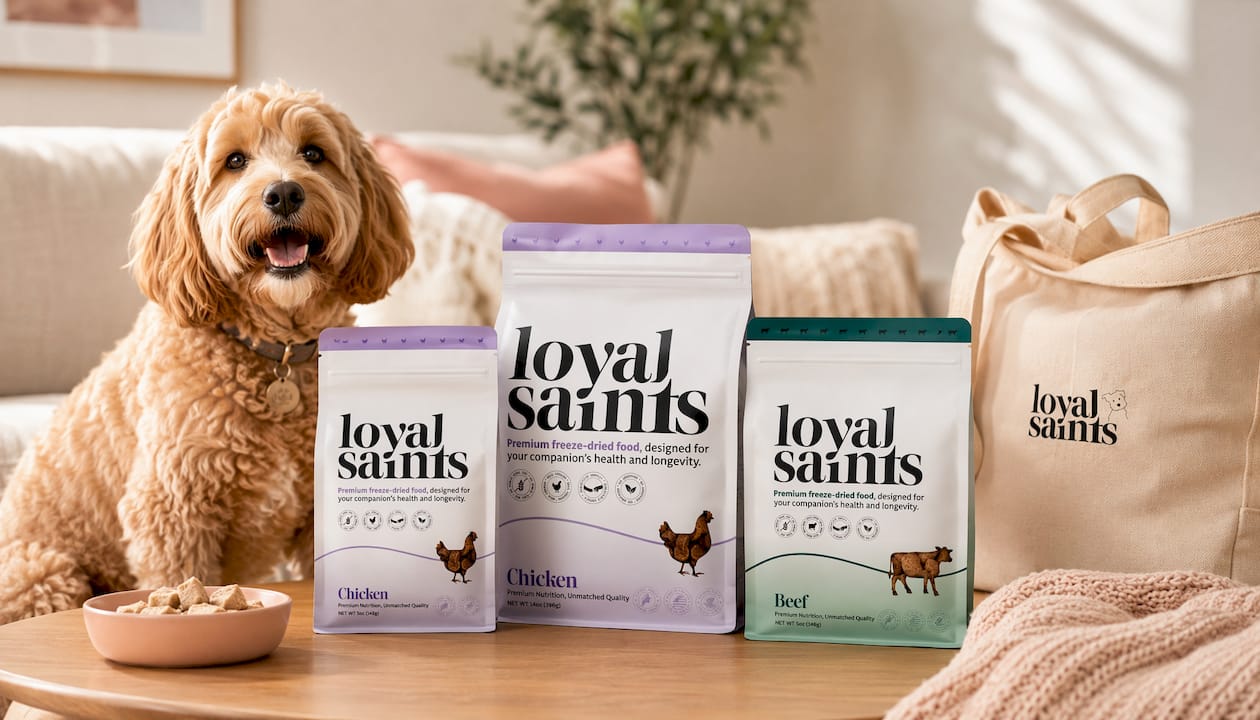
All three are formulated with human-grade whole ingredients, no fillers, and no synthetic additives, with clear rehydration and feeding guidelines included. The Halo Club recurring membership brings a discount on every order plus free shipping, which makes the per-serving cost more manageable over time. For dogs with diagnosed medical conditions, please confirm with your veterinarian before switching. Ready to try one? Browse the nutrient-rich options and pick the size that fits your dog’s routine.
This article is general nutritional information, not veterinary advice. Confirm any dietary changes with your veterinarian, especially for dogs with health conditions.
Authoritative sources for further reading
The following primary sources back the claims in this article and are worth bookmarking for your own research:
- FDA: “Complete and Balanced” Pet Food — Use this to understand what the adequacy statement legally requires and how to interpret feeding-trial vs. profile claims.
- AAFCO: Reading Labels — The definitive source for the 95%/25%/3%/flavor naming rules and what the guaranteed analysis must include.
- FDA: Pet Food — Covers FDA’s regulatory authority, ingredient safety standards, and how inspections work.
- Virginia Tech VCE: A Consumer’s Guide to Pet Food Labels — A university extension summary that translates regulatory requirements into plain language for pet owners.
- NC State Veterinary Hospital: Evaluating Pet Food — Veterinary-clinical perspective on how to assess food quality and when to involve a board-certified veterinary nutritionist.
For labeling rules, the AAFCO and FDA pages are the definitive sources. For medical or breed-specific questions, contact your veterinarian directly — regulatory pages describe what’s on the label, not what’s right for your individual dog.


