
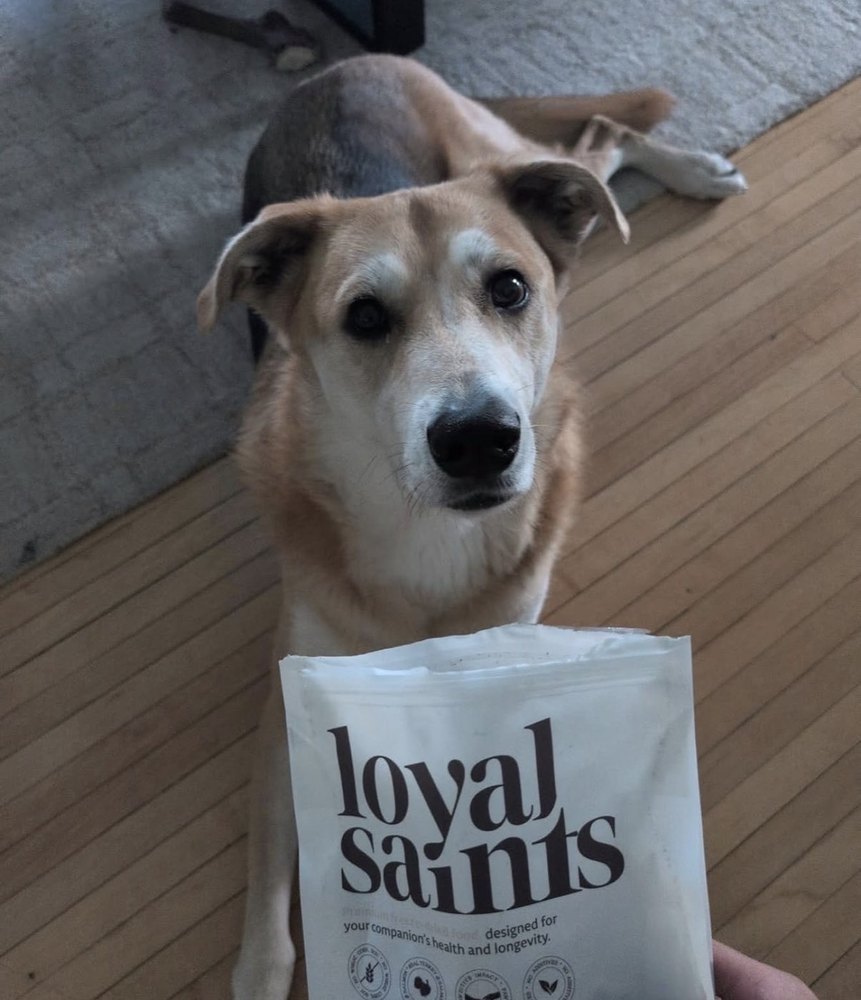
Loyal Saints Feeding Guide

Freeze-Dried Raw Feeding Guide: How Much to Feed, Rehydrating & Transitioning

Everything you need to feed Loyal Saints confidently — how much to feed by weight, how to rehydrate, how to transition your dog safely over 7–10 days, and how to store the food. Practical, step-by-step guidance for new and experienced raw feeders alike.

Updated June 2026 8-minute read Evidence-based
Loyal Saints — human-grade freeze-dried raw dog food

Quick Answer

The 2–3% guideline you’ll see quoted for raw feeding refers to fresh raw — which is mostly water. Freeze-dried raw has that water removed, so the same nutrition weighs roughly a quarter as much in the bag. Never apply 2–3% to the dry weight: use the feeding chart printed on your bag, or our feeding calculator, and adjust to body condition. Rehydrate with warm water for 5-10 minutes, or serve dry. Transition gradually over 7 days (10 for sensitive dogs), moving from 25% new food to 100% over the period. Adjust portions based on your dog’s body condition.

How Much Freeze-Dried Raw to Feed Your Dog

The general guideline for freeze-dried raw food is to feed 2–3% of your dog’s ideal adult body weight per day, divided into two meals. Active dogs and those needing to gain weight trend toward 3%; less active dogs and those needing to lose weight trend toward 2%.

Do not apply that percentage to the dry food in the bag. The 2–3% rule describes fresh raw, which is roughly three-quarters water. Freeze-drying removes that water, so an equivalent meal weighs about a quarter as much before you rehydrate it.

For the amount to actually scoop, use the feeding chart printed on your bag, or our feeding calculator below, which is set for each formula's calorie density. Then adjust to body condition over 2–4 weeks.

These are starting points. Monitor your dog’s body condition over 2–4 weeks and adjust: you should be able to feel (but not see) the ribs, and your dog should have a visible waist when viewed from above. Puppies, pregnant or nursing dogs, and dogs with medical conditions have different needs — consult your veterinarian.

How to Rehydrate Freeze-Dried Raw Food

Loyal Saints can be served dry or rehydrated. Rehydrating is recommended for most dogs because it improves hydration and digestibility, and intensifies the aroma.

Simple rehydration steps

  • Measure your dog’s portion into their bowl.
  • Add warm (not hot) water — roughly equal parts water to food by volume to start.
  • Let it sit for 5–10 minutes. The food will absorb the water and expand 3–4x in volume.
  • Stir and serve. Adjust water next time based on the texture your dog prefers.

Serving dry: Many dogs happily eat it dry, like a crunchy treat. This is fine — just ensure fresh water is always available. Dry feeding is also great for training treats and toppers.

How to Transition Your Dog to Freeze-Dried Raw

A gradual transition prevents digestive upset. Use a 7-day schedule for most dogs, or a 10-day schedule for dogs with sensitive stomachs.

7-Day Transition (standard)

  • Days 1–2: 25% Loyal Saints, 75% current food
  • Days 3–4: 50% Loyal Saints, 50% current food
  • Days 5–6: 75% Loyal Saints, 25% current food
  • Day 7+: 100% Loyal Saints

10-Day Transition (sensitive dogs)

  • Days 1–3: 25% / 75%
  • Days 4–6: 50% / 50%
  • Days 7–9: 75% / 25%
  • Day 10+: 100% Loyal Saints

If you notice loose stool at any stage, hold at the current ratio for 2–3 extra days before progressing. Some dogs transition immediately with no issue — but when in doubt, go slower.

Not ready for a full switch? Use it as a topper.

Freeze-dried raw makes an excellent topper over your dog’s current food. Crumble a small amount on top to boost nutrition, palatability, and aroma. It is also a perfect single-ingredient training treat. Many owners start here and transition fully once they see how much their dog loves it.

See which formula fits your dog →

Storage & Handling

  • Unopened: Store in a cool, dry place. Shelf life is 12–24 months from production.
  • Opened: Reseal the bag tightly or transfer to an airtight container. Use within 4–6 weeks of opening for best quality.
  • Rehydrated: Serve rehydrated food immediately. Refrigerate any uneaten rehydrated food and discard after 24 hours.
  • Hygiene: Wash hands and your dog’s bowl after handling, as with any raw or fresh food.

Feeding FAQs

How much freeze-dried raw food should I feed my dog?

Use the feeding chart printed on your bag, or our feeding calculator, which accounts for each formula's calorie density. The familiar 2–3%-of-body-weight rule applies to fresh raw, which is mostly water — freeze-dried raw has that water removed, so the amount you scoop is far smaller. Active dogs need more, less active dogs less. Monitor body condition over 2-4 weeks and adjust so you can feel but not see the ribs and your dog has a visible waist.

Do I have to add water to freeze-dried dog food?

No, it can be served dry, but rehydrating is recommended for most dogs. Adding warm water for 5-10 minutes improves hydration and digestibility and intensifies the aroma. Always provide fresh drinking water, especially when feeding dry.

How do I switch my dog to freeze-dried raw food?

Transition gradually over 7 days (or 10 days for sensitive dogs): start with 25% new food and 75% current food, then move to 50/50, then 75/25, then 100% over the period. If loose stool appears, hold at the current ratio a few extra days before progressing.

Can I feed freeze-dried raw as a topper instead of a full meal?

Yes. Freeze-dried raw is an excellent topper — crumble a small amount over your dog’s current food to boost nutrition and palatability. It also works as a single-ingredient training treat. Many owners start with topping and transition to full feeding over time.

How long does a bag of freeze-dried raw last?

Unopened, 12-24 months stored in a cool, dry place. Once opened, reseal tightly and use within 4-6 weeks for best quality. Rehydrated food should be served immediately, with any leftovers refrigerated and discarded within 24 hours.

How many calories does my dog need?

Caloric needs vary by weight, age, activity, and metabolism. As a rough guide, a moderately active dog needs about 30 calories per pound of body weight per day. Puppies, working dogs, and pregnant or nursing dogs need more; senior and less active dogs need less. Use body condition as your real guide and consult your vet for precise calorie targets.

A Loyal Saints dog
Know their bowl

A cup measures space. It was never a measure of what reaches her.

Know Their Bowl

A cup measures space. Not nourishment.

When you switch from kibble, the first thing you notice is the scoop. It looks like more. It isn't — and here is exactly why.

LOYAL SAINTS freeze-dried raw 51g 230 calories per cup PURINA PRO PLAN adult weight management, chicken & rice 101g 355 calories per cup vs ENERGY PER GRAM — THE COMPARISON THAT ACTUALLY COUNTS 4.52 kcal/g  Loyal Saints 3.52 kcal/g  Pro Plan
Loyal Saints figures from our own feeding data (a 14oz bag is 7.8 cups; Beef is 128 kcal/oz). Purina figures as printed on the back of an 18 lb bag of Pro Plan Adult Weight Management Chicken & Rice: a standard 8 oz measuring cup holds approximately 101 g, and the stated calorie content is 3,516 kcal/kg — 355 kcal per cup.
Apples to apples

A scoop is not a fair test. So here is every other one.

Four ways to compare the same two foods. We lose the first — and that is exactly the point.

01 By the cup
230calories · Loyal Saints
355calories · kibble

What that actually means A cup is a container, not an amount. Theirs is packed tight, ours is airy — so their cup weighs twice as much before you have compared a single thing. They win this one, and it tells you nothing useful.

02 By weight
455calories · Loyal Saints
355calories · kibble

What that actually means Put 101 g of each on a kitchen scale — same weight of food, no cups involved. Ours carries 28% more energy.

03 By calories
79gLoyal Saints
101gkibble

What that actually means To put the same 355 calories in her bowl, you pour 22% less food of ours. Less filler doing the same job.

04 By protein
42.4%protein · Loyal Saints
30.7%protein · kibble

What that actually means Every food holds some water, and water is not protein. Take the water out of both first — the way a vet would — and ours has 38% more protein. That is 39% at 8% moisture against 27% at 12%.

Measure by volume and you are measuring air. Measure by weight, by calories, or by protein — the three that actually reach her — and it stops being close.

Loyal Saints figures from our Beef formula: 39% crude protein, 8% moisture, 4500 kcal/kg. Kibble figures from the back of an 18 lb bag of Purina Pro Plan Adult Weight Management Chicken & Rice: 27% crude protein, 12% moisture, 3,516 kcal/kg, and a standard 8 oz cup holding approximately 101 g. Weight management formulas carry deliberately reduced fat, so this comparison is drawn on protein and energy rather than fat.

Fill one cup with popcorn and another with almonds. Both are honestly "one cup." Pick them up and you feel the difference instantly. Freeze-dried food and kibble compare the same way.

Put simply

We took the water out. Water is heavy.

  1. All dog food is really two things: food, and water.
  2. Kibble gets pressed into hard little pellets. They are small and heavy, so a lot of them fit in a cup.
  3. We take the water out instead. What is left is light and puffy — so it fills the cup up faster.
  4. You are scooping more space. She is eating the same amount of actual food.

A bigger scoop is not a bigger meal. It is just less water.

Light by nature

Freeze-drying removes moisture from real ingredients, leaving pieces that are porous and remarkably light. The volume stays. The weight does not.

Dense by design

Less water in the bag means more of what actually feeds her per ounce. A cup of Loyal Saints carries roughly 200–230 calories of real food, depending on the recipe.

Judge it by weight

Cups measure space. Calories and grams measure nourishment. Our feeding guide is built on the second one, which is why it is worth following over the scoop.

You are not comparing cup to cup. You are comparing two fundamentally different kinds of food.

How much should she eat?

Her Personalized Feeding Guide

See what it costs as a topper over her existing food — or as a complete meal. Toggle the mode, then find the perfect size for her.

2 lbs 120 lbs

Senior dogs: choose Low. Puppies: choose Very Active.

Quarter bowl = about 25% of her meal, replacing a quarter of what she eats now rather than added on top. Enough to change what is in the bowl, not so much that a big dog becomes expensive. No fridge, no thawing, no mess.

6 tbsp Quarter-bowl serving/day
92 kcal Bonus kcal/day
about $2.31/day Cost at a quarter bowl (14oz sub)*

How long each bag lasts (at a quarter bowl)

5oz bag 7 days

*Based on a quarter bowl — 25% of her meal, replacing a quarter of what she eats now. Reflects Halo Club membership price on the 14oz bag (). No ice packs, no freezer — stores in your pantry. Complete meal cost: about $9.22/day.

At a quarter bowl, one 14oz bag lasts about 15.6 days for a 25 lb dog — around $2.31 a day to put real raw in every meal.
Shop the Beef Formula →

40% off your first order — Code KING40

How this calculator works, and what it assumes

Where the numbers come from. Every serving figure is transcribed from the printed Daily Serving Guidelines panel on the bag — not estimated, and not typed in by marketing. Calories per cup are 230 for Beef and Turkey with Salmon, 200 for Chicken, cross-checked against the published 128 kcal/oz. A 14 oz bag is about 7.8 cups.

What it assumes. An adult dog at typical activity, fed to maintain current weight. Quarter-bowl mode shows 25% of the complete-meal serving — the same figure used everywhere else on this site.

What it does not account for. Puppies and pregnant or nursing dogs need considerably more energy per pound. Working and sporting dogs need more; less active and older dogs often need less. Any diagnosed condition changes the calculation entirely. Treats are not counted here, and for many dogs they are a larger share of daily calories than owners expect.

Use it as a starting point, then use your eyes. Feed to the chart for two to three weeks, then assess body condition: ribs findable under light pressure, a waist visible from above, a tuck from the side. Adjust by about 10% at a time. The dog in front of you outranks any calculator.

Reviewed. Figures last checked against the printed label September 2026. This calculator has not yet been reviewed by an independent veterinary nutrition professional. When it has been, that reviewer's name, credentials and review date will appear here.

Serving suggestions are based on the printed feeding guidelines for adult dogs at typical activity levels. Quarter-bowl mode reflects 25% of the recommended complete-meal serving — for mixing over existing food, transitioning off kibble, or keeping a large dog on real raw at a sane daily cost. Always provide fresh water. Speak to your veterinarian about dogs with diagnosed health conditions.