
TL;DR:
- Freeze-dried dog food requires proper handling, including verifying AAFCO completion and safe preparation. It differs from kibble and raw foods by removing water under low temperature, preserving nutrients while not eliminating bacteria. Safety depends on sourcing, processing, and hygiene practices, making transparency essential for responsible feeding.
Feeding freeze-dried dog food is straightforward once you know two things: whether to rehydrate or serve dry, and how to handle it safely. Rehydration can improve digestibility and hydration for many dogs, but serving dry is acceptable when fresh water is always available. Before anything else, confirm the product carries an AAFCO-complete statement or a documented lab nutrient analysis. Then treat every step of preparation the way you would handle raw meat.
Quick-start safety checklist:
- Confirm the bag shows an AAFCO “complete and balanced” statement or equivalent lab verification.
- Start rehydration at a 1:1 ratio (water to dry food by volume) and let it sit 3–5 minutes before serving.
- Wash your hands before and after handling; sanitize prep surfaces and your dog’s bowl.
- Refrigerate any rehydrated leftovers immediately and discard them within a day or two, or after a couple of hours at room temperature per AAFCO storage guidance.
- Keep product and bowls away from pregnant, elderly, very young, or immunocompromised household members.
Table of Contents
- What makes freeze-dried food different from kibble or raw?
- How to feed freeze-dried dog food step by step
- How much freeze-dried food does your dog actually need?
- How to transition your dog without upsetting their stomach
- Safe handling and storage rules you should follow every time
- What your vet needs to know about your dog’s diet
- How to choose a freeze-dried brand you can actually trust
- Key Takeaways
- Why the “freeze-dried is safe” assumption can get you in trouble
- Loyalsaintspets makes it easy to feed with confidence
- Useful sources and further reading
What makes freeze-dried food different from kibble or raw?
Freeze-drying removes water from raw or minimally processed ingredients under low temperature and pressure, leaving lightweight, shelf-stable pieces that retain most of the original nutrient profile. The process is fundamentally different from cooking, which means the food is not heat-treated the way kibble is.
Compared to kibble, freeze-dried food is typically higher in protein density and lower in starchy carbohydrates. Compared to dehydrated food, it uses a colder, faster process that better preserves texture and nutrients. Compared to fresh raw, it offers a much longer shelf life without refrigeration before opening. The catch: shelf-stable does not mean pathogen-free. Freeze-drying is not a kill step, so bacteria can survive in a dormant state and become active again once moisture is reintroduced.
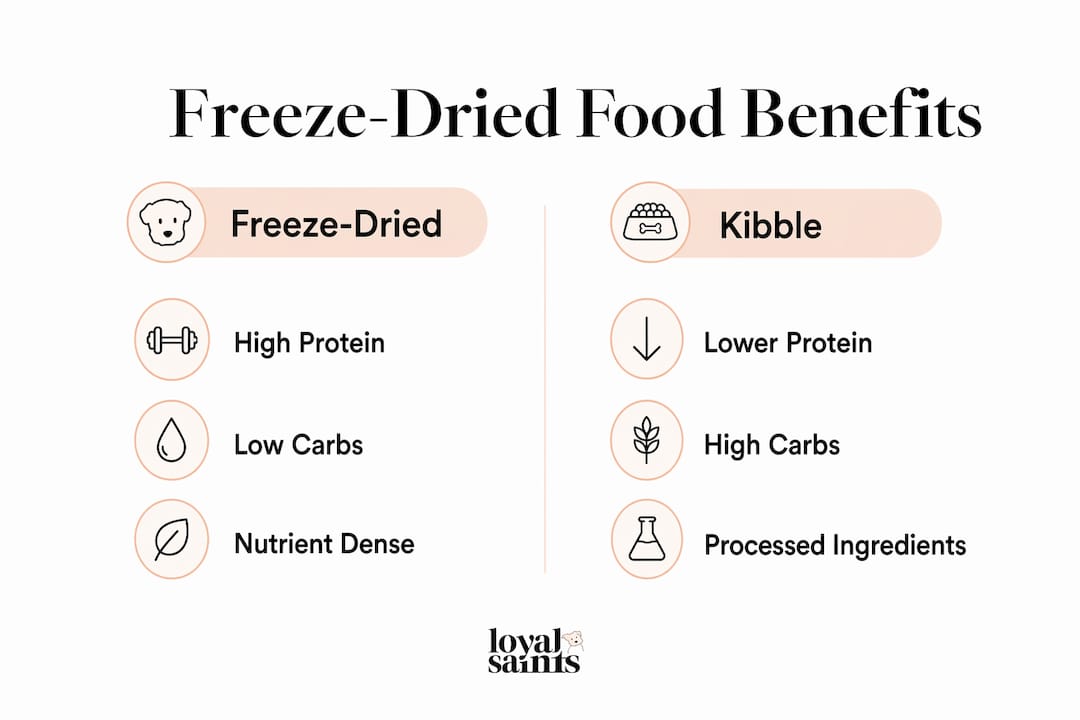
Pro Tip: Check the guaranteed analysis panel for protein and fat percentages on a dry-matter basis, not as-fed. Freeze-dried food looks very high in protein partly because moisture has been removed, so the as-fed numbers can be misleading when you compare them to kibble.
How to feed freeze-dried dog food step by step
The rehydration process takes about five minutes and makes a real difference in texture and moisture intake. Here is a simple workflow you can follow every meal.
- Measure the correct portion by weight (grams) or by the package’s scoop/cup guideline for your dog’s size.
- Place the measured food in a clean bowl. Never rehydrate directly in the bag.
- Add warm (not hot) water at roughly a 1:1 ratio by volume. Bone broth works well as a flavorful alternative, provided it contains no onion, garlic, or excess sodium.
- Let it sit for 3–5 minutes. Stir once and check the texture. Add a splash more water if your dog prefers a softer consistency.
- Serve immediately and set out fresh water alongside the bowl.
- Refrigerate or discard leftovers. Rehydrated food left at room temperature for more than 2 hours should be thrown out.
Rehydration improves aroma and texture but does not change the nutrient composition of the food itself, so you get the same nutritional value whether you rehydrate or not.
Serving dry is acceptable for dogs that prefer it and for on-the-go feeding. Just make sure your dog drinks enough water throughout the day, since freeze-dried food contains almost no moisture on its own.
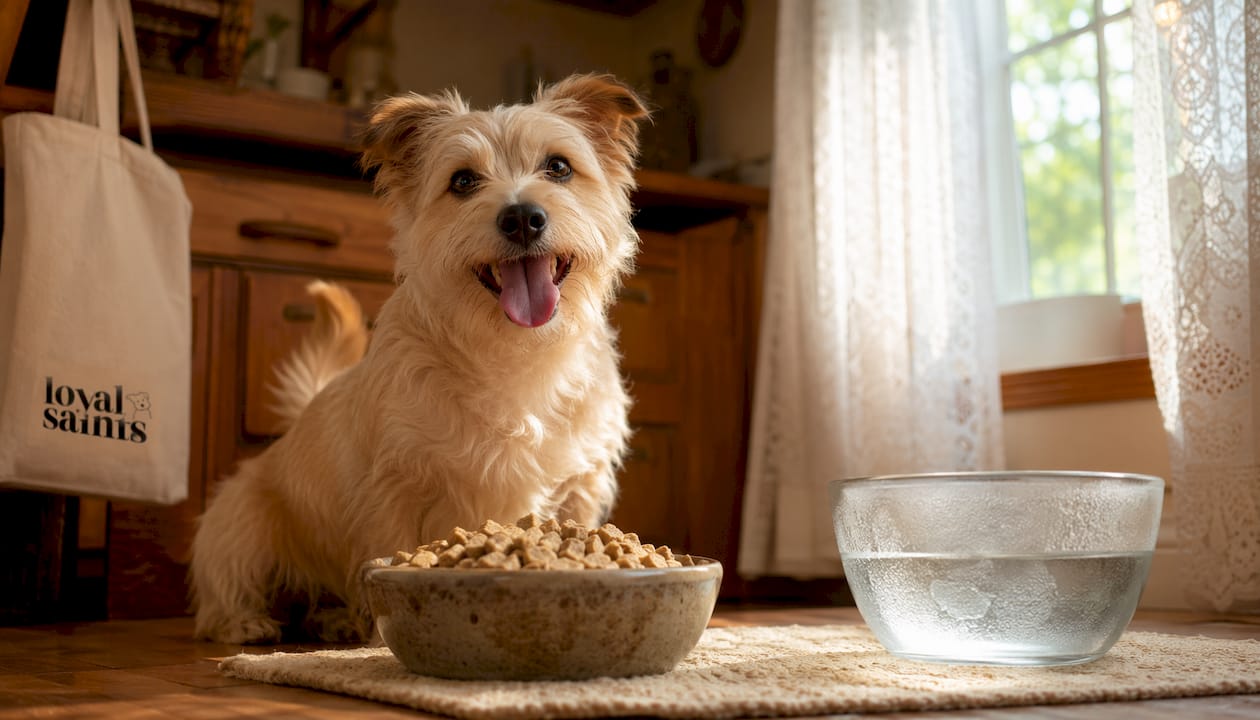
Mixing with other foods: You can combine freeze-dried food with kibble, canned food, or supplements, but watch your total calorie count carefully. Adding freeze-dried food on top of a full kibble portion is a common cause of unintentional overfeeding.
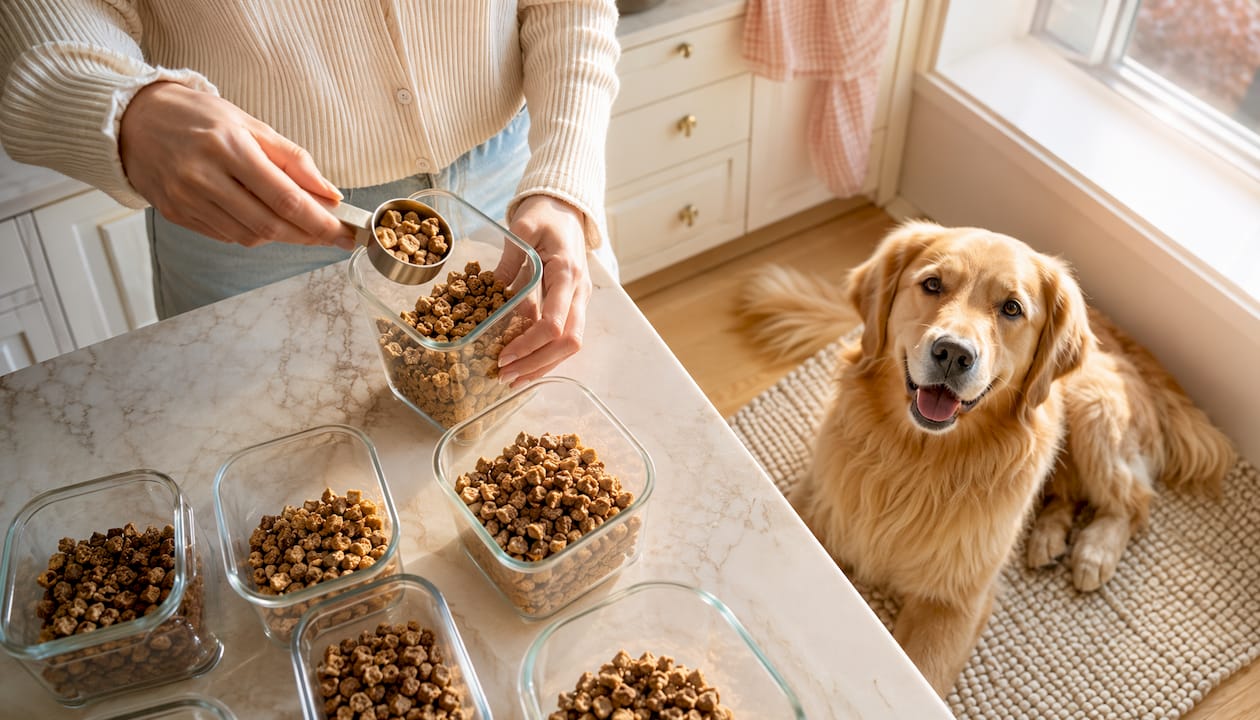
Pro Tip: Pre-measure daily portions into individual airtight containers the night before. It speeds up morning prep, keeps portions accurate, and reduces how often you open the main bag, which helps preserve freshness.
How much freeze-dried food does your dog actually need?
Start with the calorie density printed on the package, usually listed as kcal per cup or kcal per bag. If that number is not on the label, contact the manufacturer before feeding, since portion accuracy depends on it.
A practical starting point is the Resting Energy Requirement (RER), calculated as 70 × (body weight in kg)^0.75. Multiply that by an activity factor: roughly 1.2–1.4 for low-activity adult dogs and 2.0 or higher for highly active or working dogs. Divide the daily kcal target by the product’s kcal density to get the daily serving in cups or grams.
| Dog Size | Approx. Weight | Daily kcal Range (adult, moderate activity) | Starting Freeze-Dried Portion |
|---|---|---|---|
| Small | 5 lbs | 200 kcal | Follow package guideline; weigh in grams |
| Medium | — | — | Follow package guideline; weigh in grams |
| Large | — | — | Follow package guideline; weigh in grams |
These ranges are starting templates. Your dog’s actual needs depend on age, spay/neuter status, and health conditions.
How to fine-tune portions over time:
- Check body condition score (BCS) every two weeks. A score of 4–5 out of 9 is ideal for most adult dogs.
- Monitor stool quality. Firm, well-formed stools generally indicate good digestibility and appropriate portion size.
- Weigh your dog monthly, especially during the first 4–6 weeks on a new diet.
- Adjust in 10% increments rather than large jumps to avoid digestive upset.
How to transition your dog without upsetting their stomach
A gradual switch gives your dog’s gut microbiome time to adjust. The standard approach is a 7–10 day plan, though some dogs need a full two weeks.
- Days 1–3: 75% current food, 25% freeze-dried.
- Days 4–6: 50% each.
- Days 7–9: 25% current food, 75% freeze-dried.
- Day 10+: 100% freeze-dried if stools and appetite are normal.
Healthy adult dogs with prior raw or minimally processed food experience sometimes tolerate a faster switch over 4–5 days. Puppies, seniors, and dogs with sensitive stomachs generally need the full 10-day window or longer. For a detailed transition timeline, it helps to keep a simple log of stool consistency and appetite each day.
Watch for these signs and call your vet if they persist beyond 48 hours:
- Loose stool or diarrhea lasting more than two days.
- Vomiting more than once in a 24-hour period.
- Loss of appetite for more than one full day.
- Lethargy or unusual behavior.
When you call, have the product name, lot number, and the exact portion sizes you used ready. That information helps your vet and, if needed, supports a report to the FDA’s pet food complaint system.
Safe handling and storage rules you should follow every time
The FDA’s Center for Veterinary Medicine has found Salmonella and Listeria in commercially available raw pet food products, and freeze-dried formats carry similar risks because the freeze-drying step does not eliminate pathogens. Product safety depends on sourcing quality, manufacturing controls, and post-production testing, not the drying process itself.
Handling rules:
- Wash hands with soap and water for at least 20 seconds before and after handling.
- Never rinse freeze-dried pieces in the sink; splashing water spreads potential contaminants.
- Sanitize prep surfaces, utensils, and your dog’s bowl after every meal.
- Keep the product away from human food preparation areas.
Storage rules:
- Unopened bags: store in a cool, dry place below 80°F in the original sealed packaging.
- Opened bags: transfer to an airtight container and follow the label’s use-by guidance, typically within a few weeks of opening.
- Rehydrated food: refrigerate immediately and use within 24–48 hours; discard anything left out for more than 2 hours.
High-risk household note: If anyone in your home is pregnant, elderly, very young, or immunocompromised, the Cornell Riney Canine Health Center recommends reconsidering raw-style diets entirely or taking extra precautions, since the risk calculus changes significantly in those households.
What your vet needs to know about your dog’s diet
Nutrition labels tell you a lot, but they do not tell you everything. Here is what to verify before committing to any freeze-dried product long-term.
- AAFCO statement: Look for “complete and balanced” for your dog’s life stage (adult maintenance, all life stages, or growth/reproduction). A “complementary” or “intermittent feeding” label means the product is not nutritionally complete on its own.
- Guaranteed analysis: Check minimum crude protein and fat, and maximum moisture and fiber.
- Kcal per serving: Required for accurate portioning.
- Lab nutrient analysis: Some brands publish third-party lab reports. Ask for them if they are not posted publicly.
- Feeding-trial data: Stronger than formulation-only claims.
Supplements are sometimes needed, particularly for calcium/phosphorus balance in home-mixed meals or for fatty-acid ratios. Do not add supplements without guidance, since over-supplementing can cause as many problems as deficiencies.
Peer-reviewed evidence for superior clinical outcomes from raw-based diets compared to cooked diets remains limited. The RFVS position calls for transparent formulation and lab-verified products over marketing claims. Your vet should know what your dog is eating, review body condition and bloodwork at annual or semi-annual visits, and document diet changes in the medical record.
Pro Tip: Bring the product bag to your vet appointment. The AAFCO statement, lot number, and guaranteed analysis panel give your vet everything needed to assess the diet quickly.
How to choose a freeze-dried brand you can actually trust
Marketing language is easy to print on a bag. Documented quality is harder to fake. When evaluating any freeze-dried product, look for these criteria in this order:
- AAFCO-complete statement for the correct life stage, printed on the label.
- Third-party or in-house lab nutrient analysis available on request or published online.
- HACCP-equivalent safety documentation covering sourcing, manufacturing, and post-production testing.
- Clear ingredient sourcing with named proteins and no vague “meat meal” or filler language.
- Veterinarian approval backed by documented review, not just a logo.
Loyalsaintspets meets these criteria with human-grade, AAFCO-complete formulations and complete and balanced recipes built from whole, single-protein ingredients. The product line includes three options worth knowing:
- Freeze Dried Raw Chicken — 5oz: a compact trial size, ideal for confirming your dog tolerates the formula before committing to a larger bag.
- Freeze Dried Raw Chicken — 14oz: the standard size for regular feeding, with the same single-protein chicken recipe.
- Freeze Dried Raw Beef — 14oz: a beef-based alternative for dogs with chicken sensitivities or owners rotating proteins.
Ask any brand for their lab reports and lot-number traceability. Retain the packaging until the bag is finished in case a concern arises.
Key Takeaways
Feeding freeze-dried dog food safely comes down to three non-negotiables: confirm AAFCO completeness, follow raw-handling hygiene every time, and calculate portions by calorie density rather than volume.
| Point | Details |
|---|---|
| Confirm AAFCO completeness | Check the label for a “complete and balanced” statement before feeding as a sole diet. |
| Rehydrate for best results | A 1:1 water-to-food ratio and 3–5 minutes of soak time improves texture, aroma, and hydration. |
| Handle like raw meat | Sanitize surfaces and bowls, wash hands, and discard rehydrated leftovers after 2 hours at room temperature. |
| Transition gradually | A 7–10 day incremental swap reduces GI upset; watch stool quality and appetite daily. |
| Loyalsaintspets products | AAFCO-complete, single-protein, complete and balanced options in chicken and beef, available in trial and full sizes. |
Why the “freeze-dried is safe” assumption can get you in trouble
There is a quiet assumption in a lot of freeze-dried dog food marketing: that because the product is shelf-stable and looks clean and dry, it is somehow safer than fresh raw. It is not. The freeze-drying process preserves nutrients beautifully, but it also preserves bacteria in a dormant state. The moment you add water, you are reactivating the same microbial environment that existed in the original ingredients.
What this means practically is that the safety of a freeze-dried product is entirely upstream of the bag. It depends on where the protein was sourced, how the facility was run, and whether post-production testing was done. A brand that publishes lab reports and HACCP documentation is not just being transparent for marketing reasons. It is the only real evidence you have that the product was handled responsibly before it reached your kitchen counter.
The other thing worth saying plainly: the evidence base for raw-style diets producing better health outcomes than well-formulated cooked diets is genuinely limited right now. That does not mean freeze-dried food is a bad choice. It means the reason to choose it should be nutritional quality and ingredient transparency, not a belief that raw is inherently superior. Feed your dog what you can verify, not what sounds best on a label.
Loyalsaintspets makes it easy to feed with confidence
If you have been reading labels and second-guessing whether a freeze-dried product actually delivers what it promises, Loyalsaintspets is built for exactly that concern. Every formula is AAFCO-complete and made from human-grade whole ingredients, with no fillers, no synthetic additives, and no guessing about what is actually in the bag.
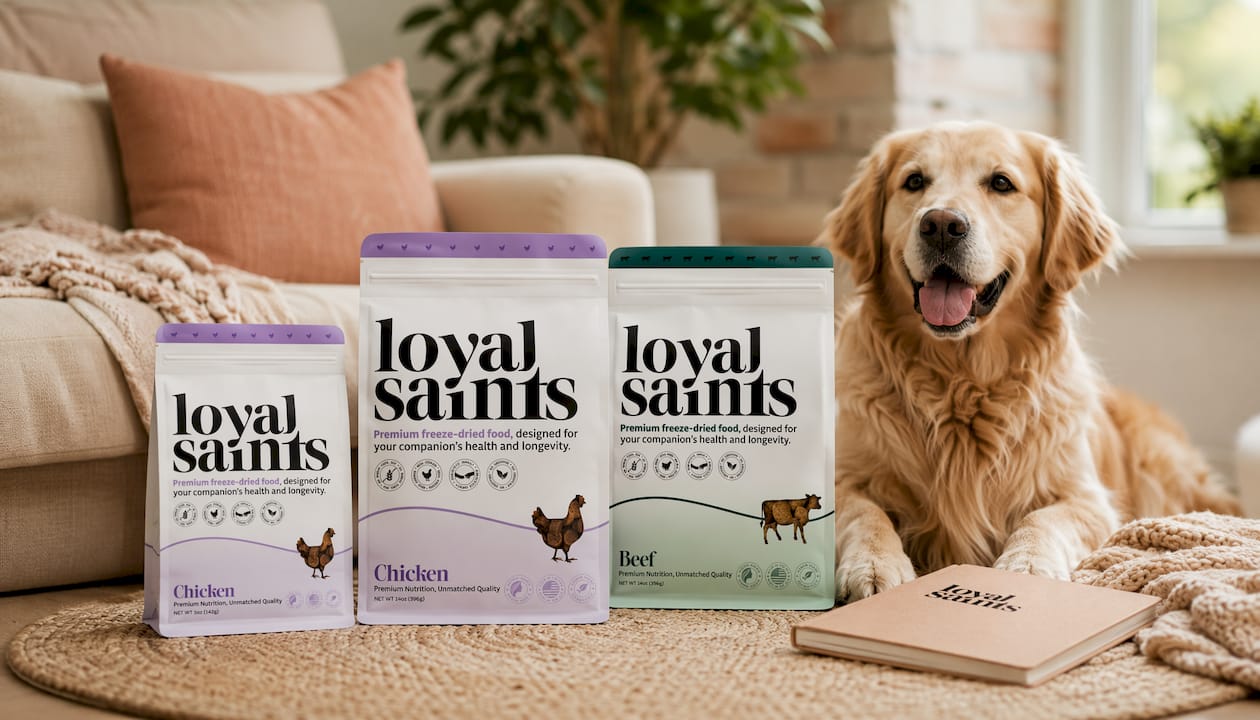
Start with the 5oz chicken trial bag to confirm your dog loves the formula and tolerates it well. When you are ready to commit, the 14oz chicken and 14oz beef options give you a full feeding supply, and enrolling in the Halo Club membership gets you recurring savings plus free shipping on every order. Head to Loyalsaintspets to browse the full line and find the right fit for your dog.
This article is for general informational purposes only and is not a substitute for professional veterinary advice. Consult your vet before making significant changes to your dog’s diet.
Useful sources and further reading
| Source | Topic |
|---|---|
| FDA: Raw Pet Food Diets Can Be Dangerous | Pathogen risks (Salmonella, Listeria) in raw and freeze-dried pet foods |
| AAFCO: Product Handling Safety | Storage temperatures, handling steps, and safe disposal timelines |
| Cornell Riney Canine Health Center: Raw Foods for Dogs | Evidence-based guidance on raw-style diets and freeze-drying as a non-kill step |
| RFVS Position Statement | Veterinary guidance on lab verification and transparent formulation |
| FDA: How to Report a Pet Food Complaint | Reporting channel for suspected illness linked to commercial pet food |


