
If your senior dog seems confused, paces at night, or has accidents indoors, don’t guess. Start with a vet visit, then look at diet. In older dogs, brain glucose use can drop by up to 25% by about age 6, and some diets may help by supplying alternate fuel, omega-3 fats, and antioxidant support.
Here’s the short version:
- Rule out other causes first like arthritis, thyroid disease, UTIs, kidney issues, pain, or hearing and vision loss.
- Watch for common signs such as disorientation, sleep changes, house soiling, anxiety, and lower social interest.
- Look for key nutrients: DHA, EPA, MCTs, B vitamins, vitamins E and C, selenium, L-carnitine, and alpha-lipoic acid.
- Check labels closely. “Brain health blend” means little if the food does not list actual amounts.
- Give diet changes time. Some dogs may show changes in about 2 weeks, but many need 6 to 12 weeks.
- Use food with daily mental activity like scent games, food puzzles, and walks.
One study in senior Beagles found that a diet with 5.5% MCTs helped with learning and problem-solving after 8 months. Other research points to DHA at 33–67.5 mg/kg and EPA at 27–43 mg/kg body weight for cognitive support. That does not mean every dog needs the same plan. It means labels, dosage, and vet input matter.
Optimal Nutrition for Promoting Healthy Brain Aging in Dogs
sbb-itb-b2753ee
What I’d focus on first
If I were choosing a food for an older dog with brain-aging signs, I’d keep it simple:
- Get a diagnosis first
- Pick a complete and balanced senior diet
- Look for named DHA and EPA sources
- Check for MCT oil, not vague claims
- Track sleep, accidents, pacing, and alertness by date
- Stick with one plan long enough to judge it
Quick checklist
| What to check | What I’d look for | Why it matters |
|---|---|---|
| Vet workup | Exam, bloodwork, urinalysis | Helps rule out non-brain causes |
| Food standard | AAFCO complete and balanced statement | Covers core nutrient needs |
| Omega-3s | DHA and EPA listed by name | Supports brain cell membranes |
| Brain fuel | MCT oil with C8/C10 | Gives the brain another energy source |
| Cell support | Vitamin E, vitamin C, selenium | Helps limit oxidative stress |
| Added support | B vitamins, L-carnitine, alpha-lipoic acid | Supports nerve and energy function |
| Timeline | 6–12 weeks of steady feeding | Gives the diet time to work |
Bottom line: food won’t cure canine cognitive dysfunction, but the right formula may help support brain function and day-to-day comfort. The smartest first step is a vet exam. After that, a label-driven food choice and steady routine give you the best shot at seeing whether diet helps.
What cognitive decline looks like in senior dogs
Before you pick freeze-dried food for senior dogs for brain support, it helps to know what cognitive decline can look like. Canine cognitive dysfunction syndrome (CDS) is a brain-based condition that affects memory, awareness, and behavior. Vets often use the DISHAAL framework to follow the most common signs: Disorientation, Interactions, Sleep, House soiling, Activity, Anxiety, and Learning/memory. [12]
Common behavior changes owners may notice
These changes often start small. A dog may stare at a wall, get stuck in a corner, or pause at a doorway they’ve gone through a thousand times. [10][11] It can feel minor at first, almost easy to brush off.
For many owners, nighttime is when it becomes harder to ignore. A dog that used to sleep through the night may begin pacing, whining, or barking after dark, then sleep more during the day. [10] That flipped sleep-wake pattern is a classic sign of CDS. [10]
You may also notice changes in how your dog acts around people. Some dogs pull back and show less interest in family time. Others become more clingy, more short-tempered, or both. House soiling can happen too, often because the dog forgets the routine or loses track of where they are in the home. [10]
A dated behavior log can help a lot when you talk with your vet. Small shifts are easy to miss day to day, but patterns stand out on paper. [10]
Normal aging vs. signs that need a vet visit
Some slowing down is part of getting older. A senior dog may move more stiffly in the morning, sleep longer, or miss sounds they used to notice right away. That can fall within normal age-related change.
What’s not typical is getting lost in familiar rooms, having sudden accidents indoors, showing abrupt personality changes, or becoming restless at night for no clear reason.
A vet needs to rule out other causes first. [9][12] Arthritis, hypothyroidism, urinary tract infections, and vision or hearing loss can all cause signs that look a lot like cognitive decline. [11][12]
"If pain or a systemic disease is present, it is important to resolve or treat those medical issues first [before diagnosing CDS]." - VCA Hospitals [5]
If you’re seeing any of these signs, the right first move is a veterinary exam, bloodwork, and urinalysis before making any assumptions about cognitive decline. [11][12] Once other causes are ruled out, nutrition can play a role in supporting brain function and day-to-day comfort.
Nutrients that support cognitive health in senior dogs
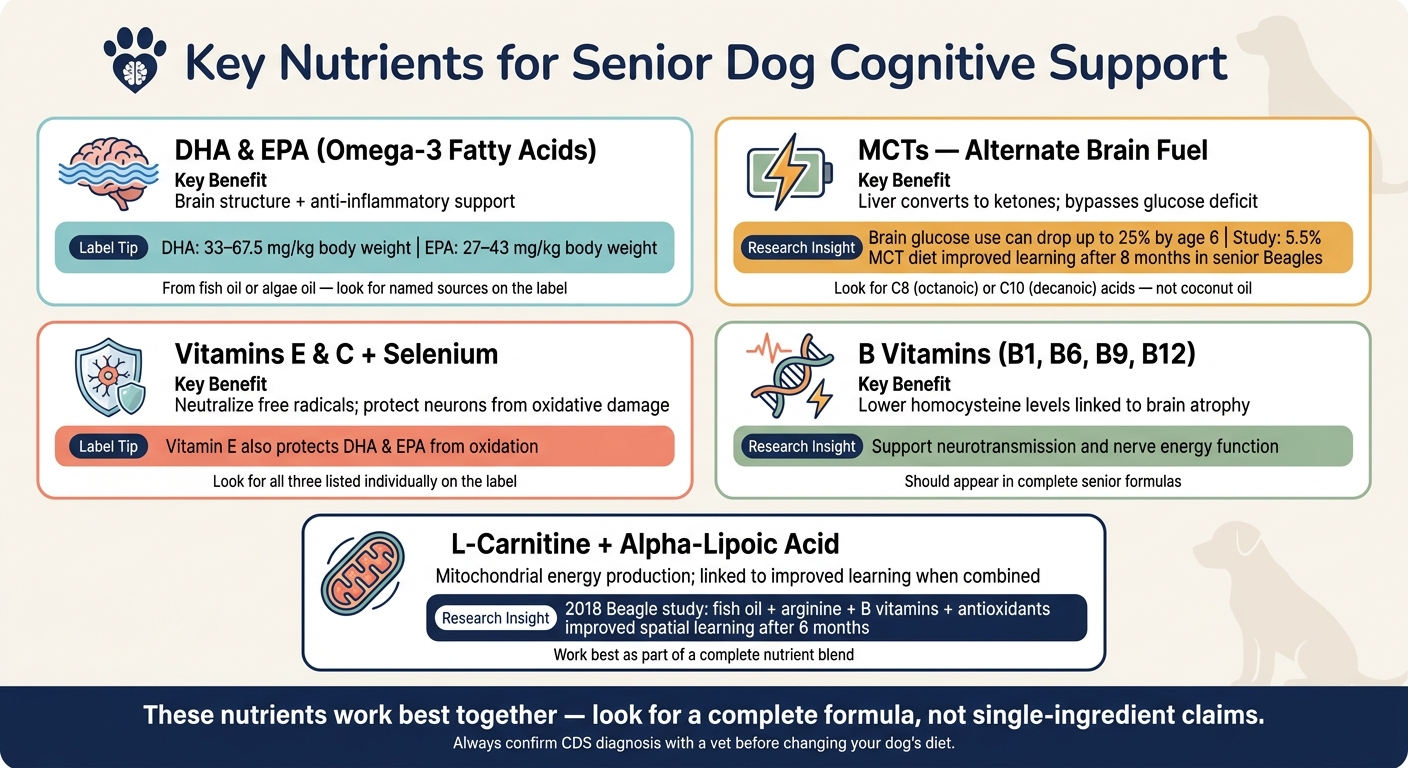
Key Nutrients for Senior Dog Cognitive Support: What to Look For
Once other causes are ruled out, it makes sense to focus on nutrients that help with brain fuel, cell protection, and inflammation control. For senior dogs, brain support tends to work best as a combination of nutrients, not one magic ingredient.
Omega-3s, especially DHA and EPA
DHA (docosahexaenoic acid) is one of the brain’s main structural fats. It helps keep synaptic membranes fluid and supports neuroprotection.[2] EPA (eicosapentaenoic acid) works with DHA to help lower neuroinflammation.[2][1]
"DHA, which is abundantly present in dogs and cats' brain, is known to have neuroprotective effects. It improves synaptic membrane fluidity, reduces pro-inflammatory metabolites... and promotes neurogenesis." - T. Boutigny et al., GeroScience [2]
Both fatty acids come from fish oil, often sourced from menhaden or white fish. When you check a label, look for DHA and EPA by name, not just a vague mention of “omega-3s.” Research points to high-dose cognitive benefit at DHA 33–67.5 mg/kg and EPA 27–43 mg/kg of body weight.[2] Vitamin E also matters here because it helps protect DHA and EPA from oxidation.[2]
Omega-3s help with brain structure and inflammation. MCTs help with fuel.
MCTs and other brain-support nutrients
As dogs age, their brains don’t use glucose as well. By around age 6, regional brain glucose metabolism in dogs can drop by as much as 25%.[1] Medium-chain triglycerides (MCTs) offer another path. The liver turns them into ketone bodies, which the brain can use as an alternate fuel source.[1]
A 2010 study in the British Journal of Nutrition looked at 24 Beagle dogs with an average age of 9.79 years. They were fed a diet with 5.5% MCTs made up of 97% caprylic acid. After 8 months, the MCT group performed better on spatial learning and problem-solving tasks than the control group, and they also had higher levels of the ketone beta-hydroxybutyrate.[13] On a food label, look for purified MCT oils that list octanoic (C8) or decanoic (C10) acids. Coconut oil is a weak MCT source.[1]
Other nutrients matter too. B vitamins, antioxidants, L-carnitine, and alpha-lipoic acid each play a part in brain health.
- B vitamins - especially B1, B6, B9, and B12 - help lower homocysteine, a compound linked to brain atrophy when levels run high.[1][6]
- Antioxidants, especially vitamins E and C plus selenium, help neutralize free radicals that can damage neurons over time.[1][14]
- L-carnitine and alpha-lipoic acid support mitochondrial energy production and have been linked to better learning performance when used together.[1][14]
| Nutrient | Main Benefit | Role in Brain Health |
|---|---|---|
| DHA | Structural integrity and neuroprotection | Synaptic fluidity and neurogenesis |
| EPA | Anti-inflammatory support | Reducing neuroinflammation |
| MCTs | Alternate brain fuel (ketones) | Bypassing glucose deficits |
| Antioxidants | Free radical scavenging | Protecting brain cells from oxidative damage |
| B Vitamins | Homocysteine reduction | Supporting neurotransmission and brain health |
What matters most is the full mix. These nutrients tend to work better together in one complete formula than on their own. A 2018 Beagle study found that a blend of fish oil, arginine, B vitamins, and antioxidants improved spatial learning and problem-solving tasks after 6 months.[6]
The next step is checking whether a senior food delivers these nutrients in amounts the dog can actually use.
How to choose a senior dog food for cognitive support
Knowing which nutrients matter is only half the job. The next step is figuring out if a food actually includes them in a meaningful way.
What to look for on the label and in the formula
Use those nutrients as a simple checklist. The goal is to find a formula that delivers DHA, EPA, and MCTs, not one that just hints at them on the front of the bag.
Start with the basics. Look for an AAFCO "Complete and Balanced" statement for adult maintenance or all life stages.[10][11] That means the formula is meant to meet core nutrient needs.
Then read the ingredient list. Named animal proteins like deboned chicken, salmon, or turkey should show up near the top. Clear protein sourcing matters. And protein still needs to stay high enough to help support lean mass.
For omega-3s, don’t stop at a vague claim like "contains omega-3s." Look for DHA and EPA from fish oil or algae oil.[10][11]
For MCTs, check for listed MCTs or purified MCT oil (C8/C10).[1][3][4]
The table below gives you a quick way to compare senior formulas:
| Selection Factor | What to Look For | Why It Matters |
|---|---|---|
| Protein Quality | Named animal proteins (e.g., Salmon, Turkey) as the first ingredient | Prevents muscle loss |
| Omega-3 Inclusion | Specific DHA and EPA levels from fish or algae oil | Supports neuron membrane health |
| Brain Energy (MCTs) | Listed MCTs or purified MCT oil (C8/C10) | Provides alternate fuel when glucose metabolism slows |
| Antioxidant Blend | Vitamins E and C, selenium, and plant polyphenols | Helps combat oxidative stress |
| Digestibility | High-quality, whole-food ingredients with minimal fillers | Helps older dogs absorb nutrients efficiently |
| Transparency | AAFCO "Complete and Balanced" statement and disclosed amounts of functional ingredients | Confirms nutritional adequacy |
One more thing: look for disclosed amounts of DHA, EPA, and MCTs. If a formula talks about a "brain health blend" but doesn’t tell you how much is inside, you’re not getting much to work with.[11][4]
Once a food checks those boxes, it comes down to fit. Does the format make sense for your dog, your budget, and your routine? For owners in urban areas, finding the best dog food for senior dogs often means prioritizing convenient delivery of high-quality formulas.
How freeze-dried raw can fit
Freeze-dried raw can work well for senior dogs that need concentrated protein and fat in a minimally processed format.
It’s one option that can meet this checklist without piling on filler. Loyal Saints offers U.S.-made freeze-dried raw food with human-grade, all-natural ingredients, high protein, and no additives or fillers.
And if a full switch feels like too much, there’s a simpler route. Freeze-dried raw can also work as a nutrient-dense topper on top of a standard senior diet, adding high-quality protein and fats without changing the whole feeding routine.
Feeding strategy, veterinary guidance, and key takeaways
How to feed for better results
A formula only helps if you bring it in slowly and stick with it. Picking the right food matters, but day-to-day use is what decides whether it helps.
Start with a 7-day transition:
- 25% new food for days 1–2
- 50% for days 3–4
- 75% for days 5–6
- 100% on day 7
If the diet includes MCTs, add them over 2 to 3 weeks to help cut down on digestive upset. During the switch, keep an eye on appetite, stool quality, sleep, and alertness.
Once the transition is done, feed the diet as your dog's main source of nutrition every day. Some dogs show early changes in about 2 weeks, but give the diet 6 to 12 weeks before judging results. [7][5] If nothing changes after 12 weeks, food is not the whole answer. [5]
Diet also works better when you pair it with daily brain activity. Food puzzles, scent work, and walks all help. [5][1]
If things level off or symptoms get worse, it’s time to shift from a diet trial to a medical workup.
When to involve your veterinarian
The same signs that may push you to try a diet should also push you to call your veterinarian. Disorientation, sleep changes, house soiling, and anxiety all call for a professional exam. [5][8][2] The reason is simple: pain, endocrine disease, organ disease, and sensory loss can look a lot like CDS. [5][8][4]
"Before nutrition can be of any benefit to cognitive function, CDS must be confirmed as the appropriate diagnosis. Many diseases can cause symptoms similar to CDS." - Canadian Academy of Veterinary Nutrition (CAVN) [5]
Before you lean on nutrition, confirm the CDS diagnosis. Then go over all medications and supplements with your vet before changing the diet. [4] Some ingredients in cognitive-support formulas may interact with current prescriptions.
Conclusion: Core nutrition principles for senior dog cognitive health
Spot changes early, use a cognitive-support diet, and feed it with consistency. Cognitive impairment can start showing up in dogs as early as 6 years of age, [1][2] so it makes sense to think about nutrition early, even before the signs are clear.
Work with your veterinarian to confirm the diagnosis, set up a feeding plan that matches your dog’s health needs, and check in every 6 months with a DISHAA tracking tool. Nutrition will not cure CDS, but it can help support brain function when used every day. The goal is simple: support the aging brain with complete nutrition, not guesswork.
FAQs
Can food alone help dog dementia?
Food on its own usually won’t fix canine cognitive dysfunction syndrome (CDS). It tends to work best as one part of a bigger care plan.
Some diets made for brain health include antioxidants, omega-3 fatty acids, and other nutrients that may help slow cognitive decline in senior dogs. In some cases, they can also help with learning and memory. That said, results vary from dog to dog.
A good rule of thumb: if you don’t see any improvement within 12 weeks, diet alone probably isn’t enough.
How do I compare brain-support dog foods?
Start by making sure the food is complete and balanced for your dog’s life stage. That part comes first. Brain health doesn’t hinge on one ingredient, so it helps to choose a food with a multi-nutrient approach, since several nutrition factors work together here.
When you check the label, look for marine-sourced omega-3s like EPA and DHA, plus antioxidants such as vitamins C and E. It also helps to look for clear sourcing details, including:
- Named animal proteins
- Clear fat sources
- Certificates of analysis
Before you switch foods, ask your veterinarian to review the nutrient levels and ingredient safety.
When should I call my vet?
Call your veterinarian as soon as you notice changes in your dog’s behavior. Even small shifts can be a sign of cognitive dysfunction syndrome. They can also point to other health problems, like pain, hearing or vision loss, or an endocrine disorder.
You should also check with your vet before changing your dog’s diet or adding supplements. Reach out if you don’t see improvement within 12 weeks, or if your dog has kidney disease, liver problems, or pancreatitis. It also helps to bring a dated behavior log to the visit.


