
If my dog has kidney disease, I don’t want to cut protein too hard. The main goal is to feed enough high-quality protein to help hold muscle, while keeping total protein and phosphorus in check so the kidneys have less waste to deal with.
Here’s the short version:
- Too much protein can add more nitrogen waste and may make uremic signs worse.
- Too little protein can lead to muscle loss, low albumin, and weight loss.
- For many dogs with CKD, vets look for a moderate protein range of about 31–41 g per 1,000 kcal.
- Phosphorus matters just as much as protein because high phosphorus can speed kidney damage.
- A renal diet has been linked with 13 months longer average survival, a 3-fold lower risk of uremic crises, and fewer kidney-related deaths in dogs with CKD.
- Freeze-dried food is not ruled out, but I’d only use it if the full nutrient profile fits CKD targets and my vet agrees.
- After any diet change, I’d track weight, muscle condition, appetite, BUN, creatinine, SDMA, UPC, and phosphorus.
A simple way to think about it: the right diet for CKD is not “low protein at all costs.” It’s controlled protein, lower phosphorus, enough calories, and close follow-up.
| Topic | What matters most |
|---|---|
| Protein amount | Moderate, not high and not very low |
| Protein source | High-quality amino acid profile |
| Phosphorus | Kept lower than standard adult diets |
| Freeze-dried diets | Only if nutrient targets fit CKD needs |
| Monitoring | Labs, body weight, and muscle condition |
If I’m choosing food for a dog with CKD, I’d focus on those numbers first and the food format second.
Veterinary Nutrition: The Nutritional Management Of Chronic Kidney Disease In Dogs
sbb-itb-b2753ee
What Research Says About Protein Levels in CKD
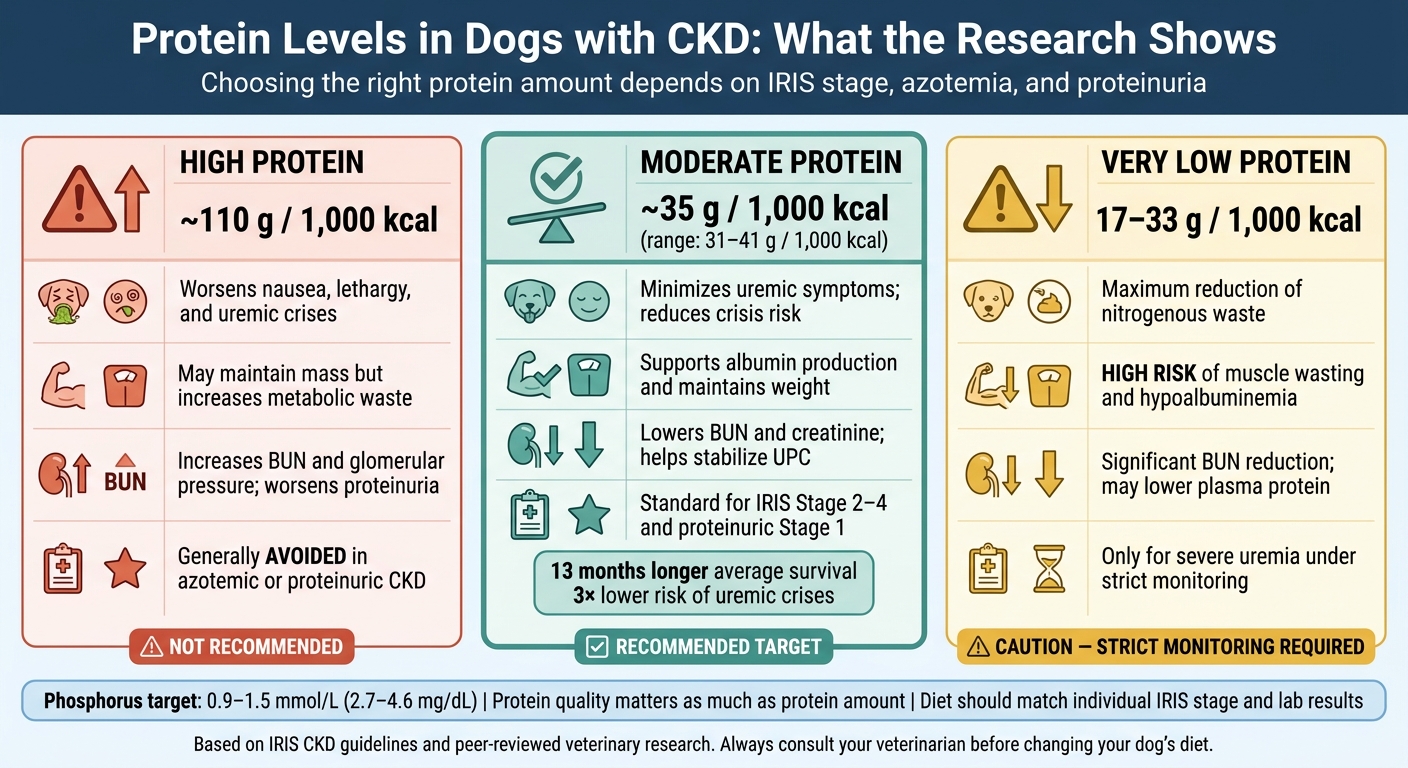
Protein Levels in Dogs with Kidney Disease: High vs. Moderate vs. Very Low
Research points to moderate protein restriction, not cutting protein out altogether. The right target depends on the dog's CKD stage and lab results.
Moderate Restriction vs. Very Low or High Protein
A 2-year study of dogs with spontaneous CKD found that dogs fed a renal-supportive diet lived 13 months longer on average, had a 3-fold lower relative risk of uremic crises, and were less likely to die from kidney-related causes: 33% versus 65% for dogs on a maintenance diet [1].
Protein was not the only piece in that result. Phosphorus restriction, omega-3 fatty acids, and keeping calorie intake high enough also matter. In plain terms, diet changes can help slow CKD progression, ease uremic signs, and support day-to-day quality of life.
The International Renal Interest Society (IRIS) recommends starting a therapeutic renal diet at IRIS Stage 2 when creatinine is > 1.4 mg/dL, or earlier if a Stage 1 dog has persistent proteinuria with UPC > 0.5. At that stage, moderate protein restriction of about 35 g/1,000 kcal helps cut down nitrogenous waste while still supporting albumin and body weight [1][5]. So protein amount matters, yes, but protein quality and phosphorus matter too.
On the other end of the range, dogs with induced CKD fed a high-protein diet at about 110 g/1,000 kcal showed worse clinical signs and higher death rates. But going too low has its own cost. Very low protein intake, around 17–33 g/1,000 kcal, can lead to protein malnutrition, lower plasma albumin, and marked weight loss [1]. That’s why the goal sits in the middle and should shift based on the individual dog’s IRIS stage, azotemia, and proteinuria.
What Studies Measure in Real Dogs
Researchers usually look at uremic signs, body condition, and kidney markers like BUN, creatinine, SDMA, and UPC. That makes it easier to compare how dogs do on different protein levels.
| Protein Level | Typical Inclusion | Effect on Uremic Signs | Effect on Muscle and Weight | Effect on BUN, Creatinine, and Proteinuria | Clinical Consideration |
|---|---|---|---|---|---|
| High | ~110 g/1,000 kcal | Worsens nausea, lethargy, and uremic crises [1] | May maintain mass, but increases metabolic waste [1] | Increases BUN and glomerular pressure; worsens proteinuria [1] | Generally avoided in azotemic or proteinuric CKD [1] |
| Moderate | ~35 g/1,000 kcal | Minimizes uremic symptoms; reduces crisis risk [1] | Supports albumin production and maintains weight [1] | Lowers BUN and creatinine; helps stabilize UPC [1][5] | Standard for IRIS Stage 2–4 and proteinuric Stage 1 [1][5] |
| Very Low | 17–33 g/1,000 kcal | Maximum reduction of nitrogenous waste [1] | High risk of muscle wasting and hypoalbuminemia [1] | Significant BUN reduction; may lower plasma protein [1] | Only for severe uremia under strict monitoring [1] |
There’s one detail here that matters a lot: early-stage dogs do not respond the same way as dogs with advanced azotemia. As Dr. Witzel Rollins notes, "Dogs with early stages of CKD will likely tolerate less protein restriction than dogs with severe azotemia." [1] That’s why a one-size-fits-all low-protein plan falls short. Protein targets should match the dog’s CKD stage and current clinical picture.
The next part is figuring out which protein sources do the best job of holding that balance.
Protein Quality, Phosphorus, and Muscle Preservation
Protein amount sets the target. Protein quality decides how well a dog can hit that target.
Why Digestibility and Amino Acid Profile Matter
Dogs need essential amino acids, not just crude protein. That’s a big deal.
A high-quality protein source gives dogs a balanced amino acid profile. So the body can meet amino acid needs with less total protein and less waste left over. And less waste means less work for kidneys that are already under strain. Put simply, protein quality matters just as much as protein amount.
In a 180-day study of 10 dogs with IRIS Stage 3 or 4 CKD, a therapeutic renal diet preserved Muscle Mass Score, showing that high-quality protein plus adequate calories can support lean tissue [7].
How Phosphorus and Nitrogen Waste Affect Diseased Kidneys
Protein choice isn’t only about amino acids. It also affects phosphorus load.
When the kidneys can’t excrete phosphorus well, phosphorus builds up in the blood. That triggers the release of parathyroid hormone (PTH). Over time, this can lead to secondary hyperparathyroidism and soft tissue calcification. Both can speed up CKD progression [1][2]. Serum phosphorus should be kept between 0.9 and 1.5 mmol/L (2.7–4.6 mg/dL) [4].
| Protein Level | Quality | Phosphorus | Key Effect |
|---|---|---|---|
| High | Variable | High | More uremic toxins; faster progression [1] |
| Moderate | High | Low/restricted | Reduced uremia; muscle preserved [1][7] |
| Very low | Variable | Very low | Risk of muscle wasting; hypoalbuminemia [2][3] |
There’s a catch here: feeding too little protein doesn’t solve the problem. If protein drops too low, the body starts breaking down muscle to get the amino acids it needs. And that still creates nitrogen waste.
Those are the main label details to check in a freeze-dried CKD-supportive diet.
How Freeze-Dried Diets Can Fit Into a Kidney-Supportive Plan
Once protein quality and phosphorus targets are clear, the next step is simple: check whether a freeze-dried diet actually lines up with those numbers.
Freeze-dried food is not automatically off-limits for dogs with CKD. But it isn't automatically safe either. For CKD, the nutrient profile matters more than the food format.
What to Check on a Freeze-Dried Diet for CKD
Start with protein in grams per 1,000 kcal. This is the number that gives you a fair apples-to-apples comparison.
Freeze-dried labels often show protein as a percentage "as fed." That can send people down the wrong path. The better move is to ask the manufacturer for a full nutrient analysis, then read the dog food labels to compare from there. Therapeutic CKD diets usually aim for 31–41 g of protein per 1,000 kcal.
Next, check phosphorus. This is the big one after protein. A CKD-supportive diet aims for less phosphorus than a standard maintenance food because high phosphorus can speed up kidney damage.
It also helps to review sodium and omega-3 levels with your veterinarian. And one practical point matters a lot here: freeze-dried food should be rehydrated before serving to help support fluid intake.
Use those numbers first. Then decide whether a formula belongs in the plan.
Where Loyal Saints May Be Relevant

Loyal Saints sells freeze-dried raw dog food with high protein density. That means any recipe would need a close review against CKD therapeutic targets before it becomes part of a kidney-supportive plan.
This isn't a pick-and-pour situation. A veterinarian should be involved. In some cases, portion control, phosphorus review, and using the food as just one part of a broader feeding plan may make sense when the nutrient panel matches CKD targets.
What a CKD-Adjusted Freeze-Dried Profile Looks Like
Use the table below as a quick comparison tool when reviewing any freeze-dried formula with your vet.
| Nutrient (per 1,000 kcal) | Standard Adult Maintenance (AAFCO) | CKD-Adjusted Profile (Therapeutic) |
|---|---|---|
| Protein (g) | 45g minimum [6] | 31–41g [6] |
| Phosphorus (g) | 1.0g [6] | 0.5–0.8g [6] |
| Sodium (g) | 0.2g minimum [6] | 0.4–1.2g (moderate) [6] |
| EPA + DHA (g) | n/a | 0.4–1.2g [6] |
| Moisture & Rehydration | Variable | High; mandatory rehydration [4][1] |
If a formula fits CKD targets, bring it in slowly to help lower the risk of nausea and food aversion. Transition over 14 days [4]. Do not start a new diet during nausea or hospitalization.
After any diet change, keep an eye on labs, weight, and appetite.
Monitoring, Adjustment, and Key Takeaways
What Veterinarians Monitor After a Diet Change
Once the diet is picked, the next step is simple in theory and a bit more nuanced in practice: watch how the dog responds. That matters even more after a switch to a renal diet or a freeze-dried food.
Vets look at more than body weight. Muscle Condition Score (MCS) is a big part of the picture, because a dog can hold steady on the scale while still losing muscle. The rest comes from lab work.
| Category | Markers | What a Change May Signal |
|---|---|---|
| Physical | Body weight, BCS, MCS, appetite, hydration | Weight loss, muscle wasting, poor intake, dehydration |
| Renal waste | BUN, creatinine, SDMA, UPC ratio | Higher azotemia or proteinuria |
| Minerals | Phosphorus, potassium, calcium, sodium | Hyperphosphatemia or electrolyte imbalance |
| Nutrition and acid-base | Albumin, blood pH, bicarbonate | Low albumin or metabolic acidosis |
Why does this matter so much? Because weight by itself can be misleading. A dog may look stable on paper while muscle loss is happening in plain sight. Protein-Energy Wasting (PEW) can develop even when body weight stays the same, especially in advanced CKD. That’s exactly why feeding too little protein can be just as risky as feeding too much. [3]
These check-ins also help the vet decide if the protein target still fits. CKD doesn’t stand still, and diet plans shouldn’t either. As the disease moves from IRIS stage 1 to IRIS stage 4, the balance between limiting kidney strain and keeping muscle on the dog often needs to shift.
Conclusion: Enough High-Quality Protein, but Not Excess
The goal is enough high-quality protein, without overdoing it, while keeping phosphorus under control. Protein quality matters, but total intake still needs limits.
If a freeze-dried diet like one from Loyal Saints is on the table, the nutrient panel should be checked against CKD therapeutic targets with a veterinarian or veterinary nutritionist before that food becomes part of the plan. Every call here - protein level, food format, and feeding method - should be based on the dog’s current IRIS stage, lab results, and muscle condition. [1][4]
FAQs
How much protein is too much for a dog with CKD?
For dogs with CKD, too much protein seems to be around 110 g per 1,000 kcal. In one study, that amount made clinical signs worse and was linked to higher death rates.
On the other hand, research points to about 35 g per 1,000 kcal of high-quality protein as a better target for many dogs. That level may help dogs live longer while also supporting albumin levels and body weight.
That said, there’s no one-size-fits-all number here. The right protein level should be tailored to the dog and checked over time by your veterinarian.
Does my dog need a renal diet in early CKD?
It depends. In early chronic kidney disease, IRIS currently recommends a renal diet for dogs with confirmed, persistent proteinuria.
For dogs in IRIS Stage 1 that are not azotemic or proteinuric, the value of a renal diet is still unclear. Your veterinarian can help you pick the right diet based on your dog’s clinical findings.
Can freeze-dried food work for dogs with kidney disease?
Yes, freeze-dried food can work for dogs with kidney disease if the formula is balanced and approved by your veterinarian.
The aim isn’t just to cut protein. It’s to give your dog high-quality, easy-to-digest protein in controlled amounts, while also keeping phosphorus, omega-3s, and amino acids in the right balance. Your veterinarian can help confirm that the diet matches your dog’s stage of kidney disease.


