
Yes, you can mix kibble with raw dog food safely, but only under specific conditions. Choose a commercially formulated, AAFCO-complete raw or freeze-dried product, keep the raw portion modest (a topper rather than a full swap), and follow strict hygiene during storage and prep. Vulnerable dogs and households with young kids, elderly members, or immunocompromised people need a veterinarian’s input first, since raw products can carry pathogens even when the dog itself shows no symptoms.
TL;DR:
- Mixing commercially formulated, AAFCO-complete raw or freeze-dried raw with kibble is safe if hygiene practices are followed and raw portions are kept modest.
- Transitioning dogs gradually over 14 to 21 days reduces digestive upset and allows the gut to adapt to higher raw ratios.
- Raw and cooked diets do not interfere with digestion in healthy adult dogs, and mild changes like stool softness or increased gas are normal early on.
- Pathogen risks require strict handling, storage, and hygiene measures, especially in households with vulnerable members or immunocompromised individuals.
- Using commercially formulated freeze-dried raw improves safety and nutrient consistency compared to homemade raw recipes.
Table of Contents
- How to Mix Kibble With Raw: Ratios and Serving Methods
- What Does “Complete and Balanced” Mean When You’re Mixing Foods?
- Does Mixing Kibble and Raw Actually Disrupt Digestion?
- Pathogen Risk: What Hygiene Steps Actually Matter
- Freeze-Dried Raw vs. Frozen Raw vs. Kibble: What Actually Changes
- A 14-to-21-Day Plan for Transitioning to a Mixed Diet
- What Backs This Guidance and Which Products Fit
- Does Mixing Raw Into Kibble Change Your Dog’s Dental Health?
- Where the Conventional Advice on Mixing Gets It Wrong
- Bringing Freeze-Dried Raw Into Your Dog’s Bowl
- Sources
- FAQ
How to Mix Kibble With Raw: Ratios and Serving Methods
Start small. Most dogs tolerate raw food better when it arrives gradually instead of as a sudden overhaul of their bowl.
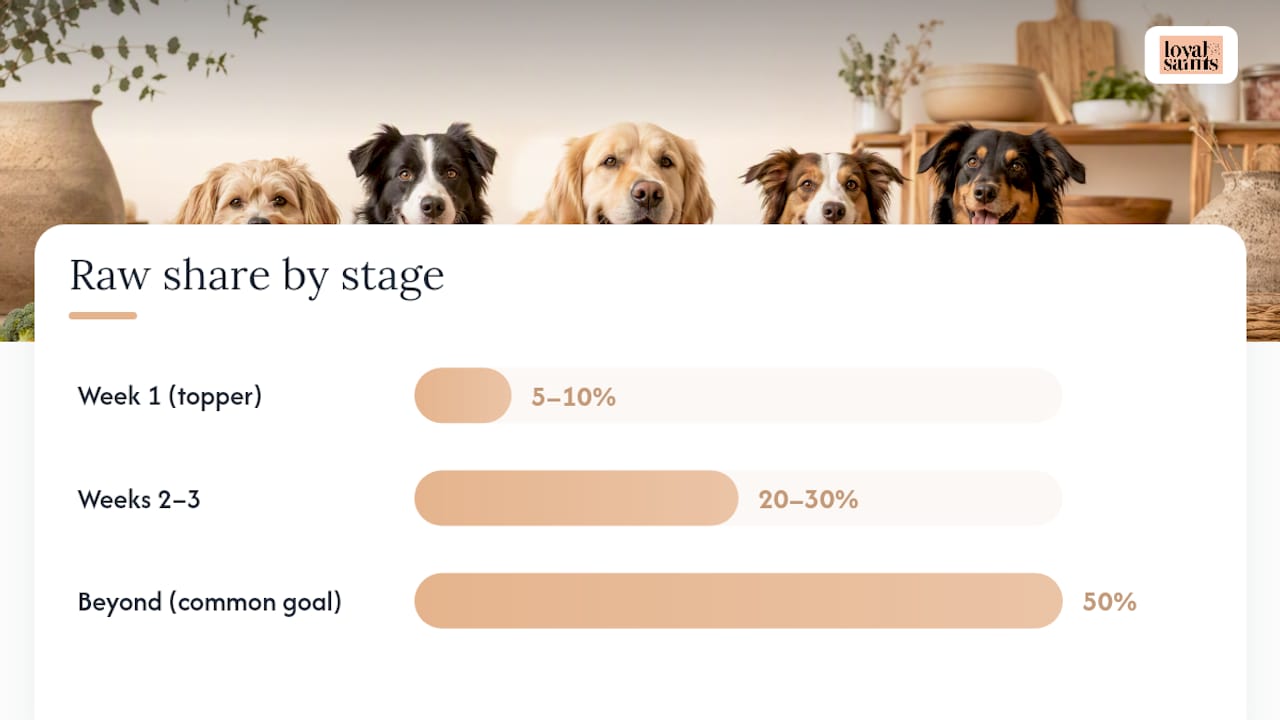
- Week one: Use raw or freeze-dried raw as 5 to 10% of daily calories, sprinkled over kibble as a topper.
- Weeks two and three: If stools stay firm and appetite is normal, move to 20 to 30% raw.
- Beyond that: Some owners push toward a 50/50 split, but jumping there abruptly is the most common cause of loose stool and gas. Slower is almost always better.
You have two basic serving strategies, and neither is wrong:
- Mixed in one bowl — simpler for busy mornings, and it lets picky eaters take in raw food they might otherwise ignore.
- Served as separate meals (raw at breakfast, kibble at dinner) — easier to track exactly how much of each your dog ate, which matters if you’re monitoring for a food sensitivity.
Match calories, not just volume. A cup of freeze-dried raw and a cup of kibble are not calorie-equivalent, so weigh portions against your dog’s Resting Energy Requirement and adjust kibble downward as raw calories go up. Consistent daily totals matter more than which format delivers them.
Storage matters too. Rehydrated freeze-dried raw or thawed frozen raw shouldn’t sit in the bowl for more than 20 to 30 minutes at room temperature. Refrigerate leftovers immediately and use them within the manufacturer’s stated window, typically 1 to 3 days.
Pro Tip: Prep a week of mixed bowls in advance using separate lidded containers for each day. It keeps portioning consistent and cuts down on the daily guesswork that leads to overfeeding.
What Does “Complete and Balanced” Mean When You’re Mixing Foods?
Food labeled “complete and balanced” has met AAFCO’s nutrient profiles for a dog’s life stage, either through formulation or feeding trials. That label matters more, not less, when you’re mixing two foods, because you’re relying on both products to have already solved the balance problem independently.
Here’s the distinction that trips up a lot of owners: mixing two AAFCO-complete commercial products is fundamentally different from mixing kibble with homemade raw. A homemade raw recipe, even one built carefully at home, frequently misses key micronutrients unless a veterinary nutritionist reviewed it. Combine two complete foods and you’re layering redundancy, not filling gaps with guesswork.
Nutrient risks worth watching when you mix:
- Calcium to phosphorus ratio. A mismatch here, sustained over months, can contribute to bone and joint problems in growing puppies especially.
- Trace minerals like zinc and copper, which raw formulations sometimes under supply if they lean heavily on muscle meat.
- Omega-3 to omega-6 balance, which shifts depending on the protein source and fat content of the raw product you choose.
- Caloric density, since raw and freeze-dried products often run richer per ounce than kibble, which changes your math even when ratios look modest.
Before buying, read the label like a nutritionist would. Check the guaranteed analysis for protein, fat, and moisture; confirm the life-stage claim (growth, adult maintenance, or all life stages); and look for the AAFCO statement itself, not just marketing language like “vet approved” or “premium.” Cooking and processing also change nutrient availability, and raw ingredients can carry antinutritional compounds, like thiaminase in raw fish, that heat normally neutralizes, according to the Merck Veterinary Manual. That’s one more reason a formulated commercial raw product beats a kitchen experiment.
Does Mixing Kibble and Raw Actually Disrupt Digestion?
Short answer: rarely, for a healthy adult dog. The idea that raw and kibble “fight” in the stomach because of different pH needs is one of the most persistent myths in the raw-feeding conversation, and it doesn’t hold up well against the data.
A controlled feeding trial comparing extruded kibble, roasted diets, and raw diets found that raw and lightly cooked diets showed higher apparent total tract digestibility for protein and fat than extruded kibble, while also shifting fecal pH and microbial diversity. Dogs in that trial stayed clinically healthy throughout. Digestion adapted; it didn’t break.
Expect some changes when you introduce raw, and don’t panic at the first sign of them:
- Softer, darker stool in the first week is common and usually temporary as gut bacteria adjust.
- Slightly increased stool frequency can happen, especially early in a transition.
- A short window of gas is normal as microbial populations shift to handle the new protein and fat ratios.
Separately, observational research comparing raw-fed and kibble-fed dogs found small improvements in some composite clinical health scores among the raw group, though owner management differences complicated the comparison — raw-feeding owners in that study also used more supplements and paid closer attention to routine care. That’s a caution against overselling raw’s benefits, not a reason to dismiss them.
What actually signals a problem: stool that stays watery past 5 to 7 days, blood in stool, repeated vomiting, or a dog going off food entirely. Those symptoms point past normal adaptation and into something that needs veterinary evaluation.
Pathogen Risk: What Hygiene Steps Actually Matter
Raw meat carries a real, measurable pathogen risk, and that risk doesn’t disappear because your dog seems fine. A 2014 FDA review found that roughly one in three tested frozen raw samples carried foodborne pathogens, and more recent surveillance identified ESBL-producing bacteria in about 10% of tested raw products. Separate peer-reviewed work found raw pet food samples frequently exceed hygiene thresholds for Enterobacteriaceae and can harbor antimicrobial-resistant organisms, which is a public-health concern that extends beyond the dog.
Dogs can shed Salmonella in their feces without ever showing a symptom themselves. That means the risk in a raw-fed household isn’t just to the dog. It’s to everyone who touches a bowl, a leash, or a patch of yard.
That single fact should shape how you handle raw food day to day.
- Buy from reputable manufacturers that publish testing protocols and batch information rather than unlabeled or small-batch sources with no visible safety practices.
- Store raw and freeze-dried raw separately from other foods, refrigerated or frozen per label instructions.
- Thaw in the refrigerator, never on the counter, and rehydrate freeze-dried raw with fresh water right before serving.
- Wash bowls, scoops, and counters with hot, soapy water immediately after each feeding, and disinfect surfaces the raw food touched.
- Wash your hands before and after handling raw or freeze-dried food, every single time.
- Pick up feces promptly, especially in yards shared with kids or other pets, since shedding can continue for days.
Pregnant household members, infants, elderly people, and anyone immunocompromised face higher risk from these pathogens, so talk to a doctor and a veterinarian before feeding raw in that kind of household.
Pro Tip: Keep a dedicated set of raw-food bowls, scoops, and cutting surfaces, color coded and stored apart from anything used for human food or kibble. It removes the guesswork on cross-contamination entirely.
Freeze-Dried Raw vs. Frozen Raw vs. Kibble: What Actually Changes
Freeze-drying removes moisture through a vacuum process at low temperature, which is why the product stays shelf-stable at room temperature for months without refrigeration. It’s a preservation method, not a sterilization method. Bacteria present before drying can survive the process in a dormant state and reactivate once the product is rehydrated, so freeze-dried raw deserves the same hygiene discipline as raw meat, according to guidance from the Cornell Riney Canine Health Center.
Here’s how the three formats compare on the things that actually affect your routine:
- Kibble needs no refrigeration, has the longest shelf life, and carries the lowest pathogen risk of the three.
- Frozen raw requires freezer space, a refrigerator thaw cycle, and the strictest hygiene handling of any format.
- Freeze-dried raw splits the difference: shelf-stable and easy to portion like kibble, but it still needs raw-meat level hygiene once rehydrated.
Nutrient retention also favors freeze-drying over long-term frozen storage, since the process locks in nutrients closer to their fresh state without the degradation that comes from freeze-thaw cycles. When you’re shopping for a freeze-dried product to mix with kibble, check for an AAFCO-complete statement, a named manufacturing facility, a batch or lot code, and clear rehydration instructions. Skip anything that won’t disclose sourcing or testing practices. For more detail on how reputable manufacturers handle the process, see how freeze-drying preserves safety during production.
A 14-to-21-Day Plan for Transitioning to a Mixed Diet
Rushing a diet change is the single most common reason owners give up on mixing before it has a fair chance to work.
- Days 1 to 4: Raw or freeze-dried raw at 5 to 10% of total calories, kibble making up the rest. Watch stool consistency daily.
- Days 5 to 10: If stool holds firm and appetite stays normal, move to 20 to 30% raw.
- Days 11 to 17: Hold that ratio for a full week before deciding whether to increase further. Some dogs plateau here happily; others tolerate more.
- Days 18 to 21: If everything looks stable, edge toward 40 to 50% raw only if that’s your goal. Plenty of dogs do fine staying at 20 to 30% indefinitely.
Track four things daily during the transition: stool consistency and frequency, energy level, appetite, and weight, checked weekly rather than daily since day-to-day weight swings mean little. A simple notebook or phone note works fine. Patterns matter more than any single day.
Red flags that warrant a call to your veterinarian: stool that hasn’t firmed up after a week at a given ratio, repeated vomiting, lethargy that lasts more than a day, or a sudden refusal to eat. None of those are “wait and see” situations.
Pro Tip: Don’t add probiotics or digestive supplements on your own before starting. Introduce the food change first, give it two weeks to settle, and only add a supplement if your vet recommends one for a specific issue you’re seeing.
What Backs This Guidance and Which Products Fit
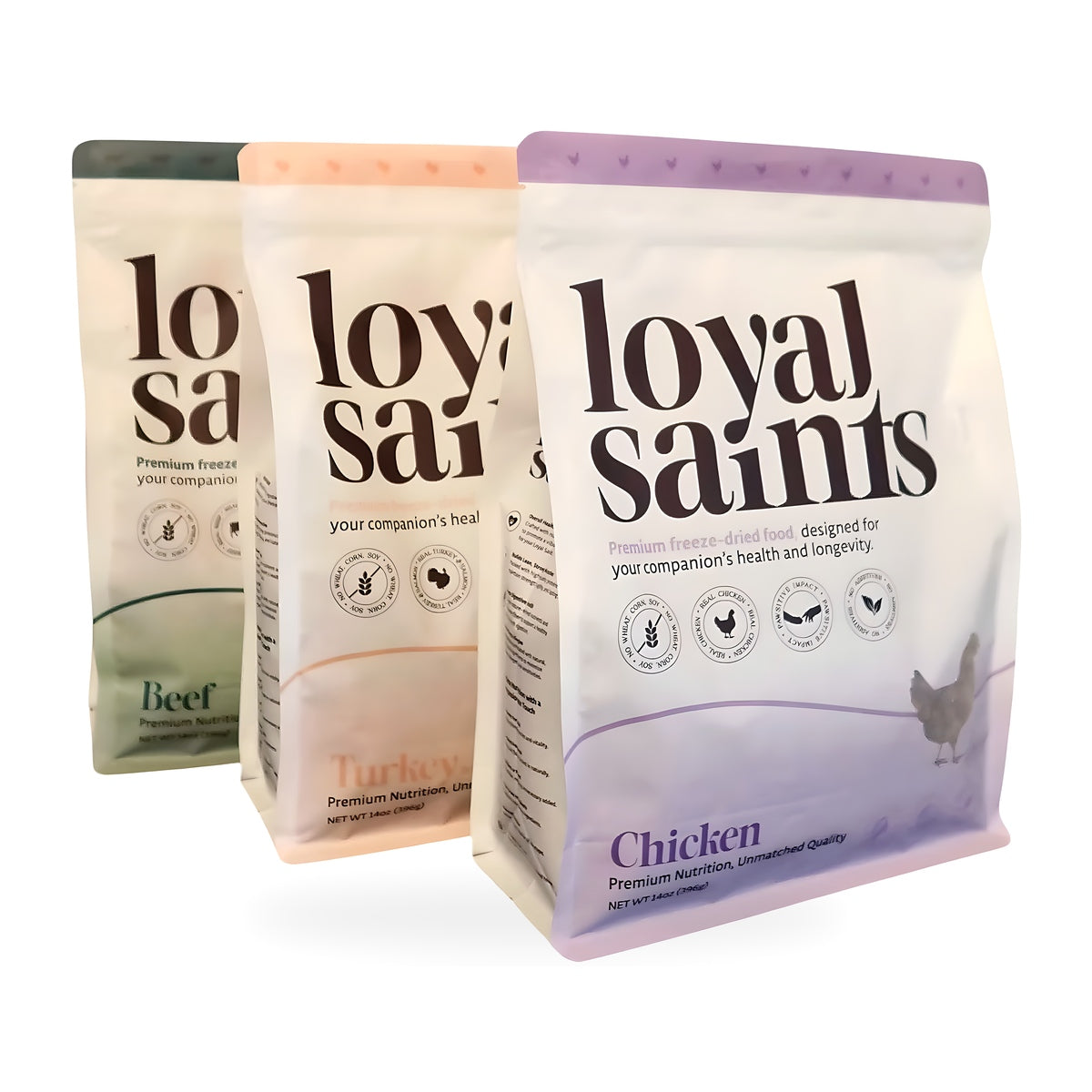
Loyalsaintspets builds its freeze-dried recipes from human-grade proteins, fruits, and vegetables, with no fillers or synthetic additives, and formulates to meet AAFCO nutrient standards. That combination is exactly what the research above points to as the lower-risk way to add raw benefits to a kibble routine, since a commercially complete product removes the formulation guesswork that trips up homemade raw.
A few practical matches for common use cases:
- New to mixing? The Variety Pack — 14oz | Beef, Chicken & Turkey with Salmon lets you test three proteins without committing to one before you know what your dog tolerates.
- Small dog or a cautious first trial? Freeze Dried Raw Chicken — 5oz keeps the initial topper portion manageable.
- Settled into a routine? Freeze Dried Raw Chicken — 14oz covers regular daily topping without constant reordering.
For handling specifics once the food arrives, the raw food safety guide covers storage and prep in more depth.
Does Mixing Raw Into Kibble Change Your Dog’s Dental Health?
Kibble’s abrasive texture has long been credited with scraping some plaque off teeth as a dog chews, though the effect is modest and varies by kibble size and shape. Raw meat and freeze-dried raw don’t offer that same mechanical scraping action once rehydrated into a soft topper, so mixing raw into kibble at moderate ratios generally preserves whatever dental benefit the kibble portion was providing.
Where owners run into trouble is assuming raw feeding alone handles dental care. It doesn’t, and neither does kibble alone, entirely. Observational data comparing raw-fed and kibble-fed dogs found slightly better composite health scores in some raw-fed groups, including some dental measures, but the same research flagged that raw-feeding owners in the study also managed their dogs’ care more closely overall, which muddies how much credit goes to the diet itself versus the owner’s habits.
The practical takeaway: don’t expect a diet change, in either direction, to substitute for dental care. Brushing several times a week, dental chews formulated for that purpose, and regular veterinary dental checks matter more than whether the bowl contains 20% raw or 50%. If you’re mixing raw specifically hoping to improve your dog’s teeth, treat it as one small piece of a bigger routine rather than the whole solution. Texture and chew resistance in any topper you add should factor into portion size too, since a very soft, wet topper mixed heavily into kibble can reduce the chewing time that gives kibble its modest dental edge in the first place.
Where the Conventional Advice on Mixing Gets It Wrong
Most of the raw-feeding debate online treats this as a binary: raw is either dangerous or transformative, and kibble is either fine or inferior. That framing doesn’t match what the research actually shows. The digestibility data suggests raw and lightly cooked diets can outperform extruded kibble on some measures, and the clinical outcome data suggests the differences that matter most often trace back to owner management, not the food format alone.
What gets underweighted constantly is the pathogen conversation. Too many raw-feeding guides treat hygiene as a footnote when it should be step one, given that asymptomatic dogs can shed Salmonella and put every person in the house at some risk. That’s not a reason to avoid raw. It’s a reason to be deliberate about which raw product you buy and how you handle it.
If you take one thing from this, it’s that mixing done well means choosing an AAFCO-complete commercial format, freeze-dried included, over any homemade raw recipe unless a veterinary nutritionist has reviewed it. That single decision removes most of the risk this article covers.
— Kristina
Bringing Freeze-Dried Raw Into Your Dog’s Bowl
Homemade raw asks you to solve a nutrition puzzle on your own, and getting the Calcium to phosphorus ratio wrong for months at a time is a real risk, not a theoretical one. A commercially formulated freeze-dried topper skips that puzzle entirely, since the formulation work and the AAFCO compliance are already done before the bag reaches your kitchen.

Loyalsaintspets makes that lower-risk path easy to start. The Variety Pack — 14oz | Beef, Chicken & Turkey with Salmon gives you three human-grade proteins in one order, useful if you’re not sure which one your dog will take to first. If you’d rather start narrower, Freeze Dried Raw Chicken — 5oz is sized for a topper-level trial, and Freeze Dried Raw Chicken — 14oz is built for owners who’ve already settled into a daily mixing routine. Once opened, reseal the bag tightly and keep it somewhere cool and dry, and portion by weight against your dog’s daily calories rather than by scoop count.
Ready to start? Order a topper size that matches where you are in the transition, and check the Halo Club membership for recurring savings and free shipping if mixing becomes part of your dog’s regular routine.
Sources
- Raw foods for dogs: Evidence-based advice from the Riney Canine Health Center
- Controlled feeding trial comparing extruded, roasted, and raw diets (digestibility and microbiota outcomes)
- AAFCO dog food nutrient profiles and feeding protocol background
- Nutritional requirements of small animals — Merck Veterinary Manual
FAQ
Is it safe to mix dry dog food with raw meat?
It can be safe if the raw meat comes from an AAFCO-complete commercial product and you follow strict storage and cleaning practices, but homemade raw meat carries higher nutritional and pathogen risk without professional guidance.
Is it okay to mix kibble with fresh dog food?
Yes, mixing kibble with a fresh, commercially complete dog food is generally fine, as long as you adjust portions to match total daily calories and introduce the change gradually over one to three weeks.
Why don’t vets like raw feeding?
Many veterinarians raise concerns about pathogen exposure, since studies have found raw products can carry Salmonella, Listeria, or antimicrobial-resistant bacteria, and about nutritional imbalances in homemade recipes that lack professional formulation review.


