
If you want more active mushroom compounds in a smaller dose, extracts usually make more sense. Whole mushroom powders can still work for daily use, but dogs often get less from them because mushroom cell walls contain chitin, which dogs do not break down well.
Here’s the short version:
- Extracts are concentrated and usually easier for dogs to use
- Whole mushroom powders keep the full food material, but often need larger servings
- Label words matter: look for 100% fruiting body, dual extracted, and a listed beta-glucan %
- Watch for fillers like mycelium-on-grain, rice, or oats
- Daily cost depends on serving size and active content, not just the price on the jar
- In one 2012 study, dogs given a Turkey Tail extract had a median survival time of 199 days vs. 86 days in the untreated group
If I were comparing products, I’d focus on four things first: form, beta-glucan level, fruiting body vs. mycelium, and cost per day.
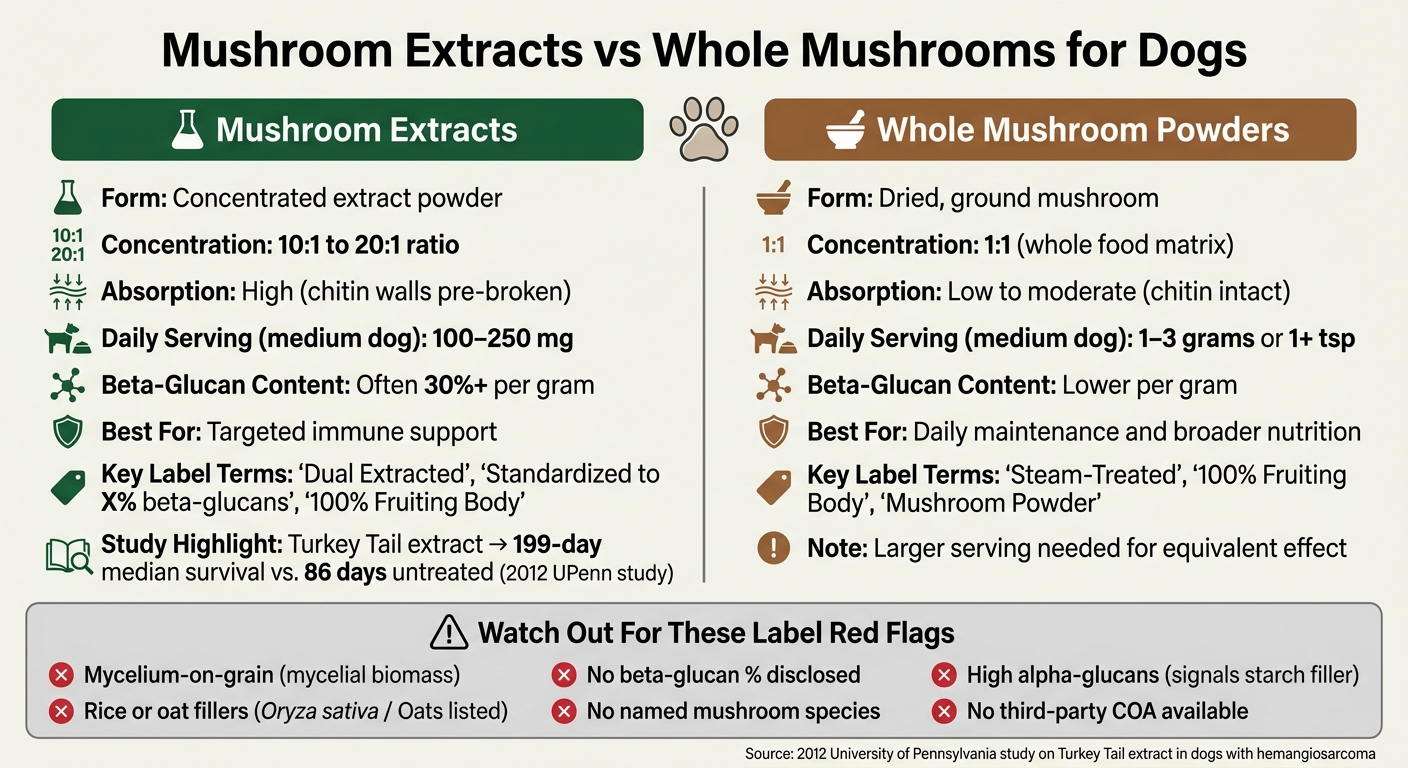
Mushroom Extracts vs Whole Mushrooms for Dogs: Side-by-Side Comparison
Medicinal Mushrooms For Dogs & The Problem With Mycelium
sbb-itb-b2753ee
Quick Comparison
| Criteria | Mushroom Extracts | Whole Mushrooms |
|---|---|---|
| Form | Concentrated extract | Dried, ground mushroom |
| Absorption | Higher | Lower to moderate |
| Serving size | Often 100–250 mg for a medium dog | Often 1–3 grams or more |
| Label terms | Extract, dual extracted, standardized actives | Powder, dried mushroom, steam-treated |
| Active compounds per gram | More | Less |
| Best fit | Targeted support | Daily maintenance |
| Cost check | Compare active mg per serving | Compare serving size and total days |
The bottom line: extracts tend to give more in less, while whole mushrooms are the simpler, food-style option. The better buy depends on what your dog needs and what the label actually tells you.
Mushroom Extracts vs Whole Mushrooms: Key Differences
An extract is concentrated. A whole mushroom ingredient is dried and ground.
What Counts as a Mushroom Extract
A mushroom extract uses hot water, alcohol, or both to pull out compounds like beta-glucans and triterpenes. That step can help your body take in more of those compounds.
You’ll often see extracts labeled with concentration ratios like 4:1, 10:1, and 20:1.[6] In plain English, that usually means the product is more concentrated than plain mushroom powder.
What Counts as a Whole Mushroom Ingredient
Whole mushroom ingredients are made by drying the mushroom and grinding it into a powder. This keeps the whole-food matrix in place, including fiber, proteins, minerals, and secondary metabolites.
The downside is potency. These powders tend to absorb less well, so you usually need a bigger serving to get the same punch. Some products are steam-treated or micronized, which can help release compounds without doing a full extraction.
| Feature | Mushroom Extract | Whole Mushroom Powder |
|---|---|---|
| Concentration | High (4:1, 10:1, 20:1) | 1:1 (whole food matrix) |
| Bioavailability | High; chitin walls are pre-broken | Low to moderate; depends on processing |
| Potency | High in small doses | Lower; requires larger servings |
| Label Wording | "Extract", "Standardized to X%", "Dual Extracted" | "Mushroom Powder", "Dried Mushroom", "Steam-Treated" |
When you compare the two, the biggest things to watch are absorption, label wording, and cost per serving.
Absorption, Label Terms, and Quality Markers
Absorption and Bioavailability: What the Difference Means in Practice
Once you know the mushroom form affects potency, the next step is simple: can your dog absorb it? That’s where bioavailability comes in.
The main issue is access. If chitin stays intact, fewer active compounds can reach your dog. Raw, unprocessed mushroom powder may sound good on the label, but it often gives less than people expect because those tough cell walls are still closed.
Processing changes that. Steam-treated mushrooms can help break open cell walls. Hot water extraction pulls out water-soluble compounds. Dual extraction uses both water and alcohol, which helps pull a broader mix of compounds [1][3][4][8].
"The compounds are in there. Whether your dog can actually ACCESS them is a different question." - Lilly, Director of Education, Austin & Kat [1]
That’s why label language matters just as much as the ingredient itself.
Label Words That Change What You Are Getting
One of the biggest label checks is fruiting body vs. mycelium.
The fruiting body is the mushroom cap, and that’s where helpful compounds tend to be more concentrated. Mycelium-on-grain products, by contrast, can be heavy in starch. Fruiting body extracts often contain 30% or more beta-glucans [10].
| Term | What It Means | Quality Signal |
|---|---|---|
| 100% Fruiting Body | Made from the mushroom cap | High |
| Dual Extracted | Processed with water and alcohol | High |
| Standardized to a stated active level | Guaranteed active compound level per batch | High |
| Steam-Treated | Heat-processed to break chitin walls | Medium-High |
| Mycelial Biomass | Root system grown on grain; mostly starch | Low |
| Oryza sativa / Oats | Indicates rice or oat fillers in the product | Low |
If a label doesn’t name the species, such as Trametes versicolor for Turkey Tail, or disclose the beta-glucan percentage, there’s no easy way to check what you’re buying. The same goes for vague blends that don’t list each species and amount [10].
After that label check, the next step is to look for outside proof that backs up the product.
Quality Markers to Look For and Red Flags to Avoid
A few clear signals can help you tell a well-made mushroom product from one that’s padded with fillers.
Good signs include:
- a named mushroom species
- a disclosed beta-glucan percentage, ideally above 20%
- a third-party COA that confirms potency and screens for heavy metals [10][5]
That third-party testing matters because mushrooms can absorb contaminants from the place where they’re grown.
The NASC (National Animal Supplement Council) Quality Seal is another strong signal. It shows the company has passed independent quality audits and random testing [3][5].
On the flip side, watch for products with vague blends that don’t list each species and amount. Be cautious with any brand that can’t say whether it uses fruiting body or mycelium-on-grain. As Angela Ardolino, Founder of MycoDog, notes:
"If a company isn't transparent about whether their product is fruiting body or mycelium-on-grain, that's usually a sign they don't want you to know." [7]
One more label clue: high alpha-glucans often point to starch or grain filler.
Serving Size and Cost per Use
Label terms tell you what the product is. Serving size tells you what it will cost you day to day.
Why Extracts Often Require a Smaller Serving
Once you know what's in the container, the next step is simple: how much does your dog get each day?
Extracts use smaller servings because processing removes much of the bulky mushroom matter and leaves behind a concentrated powder with more active compounds [4][5].
High-quality extracts often reach 10:1 or 20:1 concentration ratios. That means it takes 10 to 20 grams of raw mushroom to make just 1 gram of extract [6]. So the daily amount can look tiny on the scoop. For a medium dog weighing 25–50 lbs, a daily extract dose is often just 100–250 mg. A whole mushroom powder serving for that same dog may be measured in full grams or teaspoons [8][6].
That smaller serving also means measurement mistakes matter more. A packed scoop versus a level scoop can shift the dose, so it's smart to use a precise tool [4].
How to Calculate and Compare True Daily Cost
A smaller serving only helps if it also gives you a lower cost per active compound.
The price on the front of the bag doesn't tell you much by itself. What matters is the cost per day based on your dog's weight-based dose and the product's concentration.
A simple way to compare products:
- Divide the total product price by the number of days the product will last at your dog's daily dose.
- Then check the beta-glucan percentage to compare active content per dollar.
For example, a product with 20% beta-glucans gives about twice as much beta-glucan per gram as one that lists 10%. If both products cost the same, the higher-potency one ends up costing less per active milligram [5].
| Form | Typical Daily Serving | Concentration | True Daily Cost |
|---|---|---|---|
| Whole Mushroom Powder | 1–3 grams or 1+ tsp [9] | 1:1 (low) [6] | Moderate (large volume needed) |
| Mushroom Extract Powder | 100–250 mg for a medium dog; 250–500 mg for a large dog [8] | 10:1 to 20:1 (high) [6] | Often lowest per active mg |
One more practical check: if a label lists only total weight and does not show a beta-glucan percentage or extract ratio, you can't make a fair value comparison per serving [4].
That makes it much easier to see which form lines up with your dog's needs. For more ways to support your pet, see our guide to enhancing dog vitality naturally.
Which Mushroom Form Fits Your Dog
The right pick usually comes down to three practical things: your dog’s health needs right now, how easy the product is to use every day, and how much you’re getting for the money.
When a Mushroom Extract Makes More Sense
If you want the highest delivery of active compounds, start with extracts. They make more sense when your dog needs concentrated support because they give you a more dependable amount of those compounds in each serving.
There’s a good example of this in a 2012 University of Pennsylvania study. Dogs with hemangiosarcoma that received a concentrated Turkey Tail extract had a median survival time of 199 days, compared with 86 days for the untreated group [8]. Extracts also deliver more beta-glucans per serving, which makes them a better fit for targeted support. And because the serving size is smaller, they’re often easier to give every day.
When Whole Mushrooms Work Well Enough
If you’re looking for routine support instead of maximum potency, whole mushrooms can do the job. Whole mushroom powders are a solid fit for day-to-day use when you want broader nutrition and don’t mind giving a larger serving.
A steam-activated whole mushroom powder keeps the full mushroom matrix intact and is a better fit for daily maintenance [1][6].
| Goal | Best Form | Key Label Signal |
|---|---|---|
| Targeted immune support | Mushroom extract | Standardized to >20% beta-glucans [8][2] |
| Routine maintenance | Steam-activated whole powder | "100% Fruiting Body", steam-activated [3][7] |
| Picky eater or small daily dose | Mushroom extract | 10:1 or 20:1 concentration ratio [6] |
| Routine maintenance | Whole mushroom powder | No myceliated grain listed [7] |
FAQs
How do I choose the right mushroom form for my dog?
Choose products labeled 100% fruiting body instead of mycelium grown on grain if you want more beta-glucans.
For daily wellness, steam-activated powders are often a smart pick. They can help with absorption while keeping a broad mix of compounds intact.
If you want more targeted, potent support, look at a dual-extracted product instead.
It also helps to check for:
- Third-party contaminant testing
- The exact mushroom species listed on the label
What beta-glucan percentage should I look for on the label?
Look for a verified beta-glucan level from the fruiting body. Good fruiting body extracts often contain 30% or more. By contrast, grain-grown or mycelium-based products may have only 1% to 5%.
That said, test methods can differ. So a high number on the label doesn't automatically mean it's a better product. Focus on verified fruiting body ingredients that have been properly extracted or activated so your body can use them.
How can I tell if a mushroom product has fillers?
Check the ingredient label for terms like mycelium, myceliated grain, mycelial biomass, or fermented grains such as oats or brown rice.
Those terms often mean the product contains grain substrate, not just mushroom material. And that can mean a higher starch content.
A better product should clearly state that it uses 100% fruiting bodies. It should also say whether any substrate is left over after processing, with less than 1% residual substrate being the ideal.
If the label doesn't make that clear, that's a red flag.


