
Puppies need concentrated, growth-formulated protein, and the number to look for is roughly 22.5% crude protein on a dry-matter basis, which is the AAFCO growth minimum. Needs peak in the weeks right after weaning, and taper as your puppy matures. The catch: hitting a protein percentage means nothing if the amino acid profile is weak or if calcium and phosphorus are out of balance, especially for large-breed puppies.
TL;DR:
- Most growth formulas exceed the AAFCO minimum of 22.5% crude protein to ensure amino acid adequacy and account for ingredient variability.
- Protein quality, especially the amino acid profile and digestibility, is more important than the percentage label reading, with animal proteins typically offering better profiles.
- Large-breed puppies require careful mineral management, particularly calcium and phosphorus, to prevent skeletal issues, not merely higher protein levels.
- Comparing protein content fairly requires converting “as fed” analysis to dry matter and considering calorie-based metrics, not just label percentages.
- During illness or recovery, puppies may need more high-quality protein unless they have specific kidney or liver conditions requiring restriction under veterinary guidance.
Table of Contents
- How Much Protein Do Puppies Actually Need?
- Why Protein Quality Matters More Than the Percentage
- Does More Protein Always Mean Better Growth?
- How Do You Read a Puppy Food Label Correctly?
- What Does Healthy Feeding Actually Look Like Day to Day?
- Do Small and Medium Breeds Need the Same Protein as Large Breeds?
- Why Does Protein Matter Beyond Muscle and Bone?
- How Should Protein Change if My Puppy Gets Sick?
- What Loyal Saints Pets Believes About Feeding Growing Puppies
- Where Freeze-Dried Protein Fits in a Puppy’s Diet
- Sources
- FAQ
How Much Protein Do Puppies Actually Need?
The AAFCO Dog Food Nutrient Profiles set a minimum of 22.5% crude protein on a dry-matter basis for growth and reproduction. That figure is a floor, not a target. Most reputable growth formulas run higher than the minimum because manufacturers build in a buffer for ingredient digestibility and to guarantee every essential amino acid clears the bar, not just the total nitrogen count reflected in crude protein.
A peer-reviewed review of canine protein requirements found that AAFCO and industry practice routinely exceed NRC minimums for exactly this reason. NRC numbers are closer to a bare physiological requirement; AAFCO and commercial formulas pad that number so real-world ingredient variability doesn’t leave a puppy short on a specific amino acid.
Timing matters here too. Puppies under about 14 weeks are in the steepest part of the growth curve, building muscle, organs, and skeletal structure at a pace they’ll never repeat. Veterinary feeding guidance confirms protein demand is highest right after weaning, then gradually eases as growth rate slows heading toward adulthood.
One label-reading trap catches a lot of owners: guaranteed analysis numbers are listed “as fed,” which includes moisture. A canned food showing 8% protein might actually be leaner or richer than a dry kibble showing 22%, once you strip out water content. To compare fairly, convert to dry matter, and Loyalsaintspets’ dog food protein converter walks through that math step by step. Nutritionists increasingly also look at protein per 1,000 kcal of metabolizable energy, since a calorie-dense food can deliver plenty of protein even at a lower percentage.
- AAFCO growth minimum: 22.5% crude protein, dry-matter basis
- Peak demand window: birth through roughly 14 weeks
- Best comparison metric: grams of protein per 1,000 kcal, not just the label percentage
Why Protein Quality Matters More Than the Percentage
A bag boasting “32% protein” tells you almost nothing about whether your puppy’s body can actually use it. Crude protein measures nitrogen content, not amino acid completeness, and puppies need specific building blocks in specific amounts to grow properly.
Research using the indicator amino acid oxidation (IAAO) technique on growing Labrador Retrievers pinned down concrete numbers for branched-chain amino acids and threonine.
Amino acid requirements (IAAO study, mean values): Valine 1.72 g per 1,000 kcal ME, isoleucine 1.43 g, leucine 2.25 g, threonine 1.74 g, according to research published in the Journal of Nutrition.
These figures matter because they show requirement data is getting far more precise than the old crude-protein-percentage shortcut. Threonine and the branched-chain aminos (valine, isoleucine, leucine) support muscle development and metabolic function, and a deficiency in even one can slow growth regardless of how high the total protein number looks on paper.
Digestibility separates good sources from mediocre ones. Animal-based proteins, think chicken, beef, and fish, generally offer a more complete and bioavailable amino acid profile than plant-based proteins like soy or pea isolate. That doesn’t make plant protein useless, but it does mean a formula leaning heavily on plant isolates needs a more carefully engineered blend to hit the same amino acid targets.
- Prioritize named animal proteins as the first ingredients, not protein isolates or meals as fillers
- Look for formulas that reference amino acid adequacy, not just a crude protein percentage
- Treat “high protein” claims skeptically until you check the AAFCO nutritional adequacy statement
Does More Protein Always Mean Better Growth?
Not once you factor in calories and minerals. Protein doesn’t work in isolation. Dietary fat and overall caloric density change how much protein is actually needed for efficient growth. A peer-reviewed protein review found that a diet running around 20% fat performs best with roughly 25% protein, while higher-fat formulas shift that ratio again to maintain feed efficiency. A food can look protein-rich on the label and still be poorly balanced once you account for its energy density.
Minerals carry even higher stakes. VCA veterinary guidance points to calcium and phosphorus imbalance, not protein percentage, as the bigger risk for skeletal problems. Large and giant-breed puppies (adult weight over 70 pounds) are especially vulnerable to abnormal bone development if calcium runs too high relative to phosphorus or calories.
Watch for these red flags that a diet doesn’t fit your puppy:
- Rapid weight gain with a soft, rounded belly and poor muscle tone
- Limb or joint abnormalities in a large-breed puppy
- Dull coat or low energy despite eating a “high protein” formula
Pro Tip: If you have a large-breed puppy, skip any food labeled simply “growth” and look specifically for one formulated for large-breed puppies. The mineral maximums are different, and a generic growth formula can deliver too much calcium for a big-boned frame.
How Do You Read a Puppy Food Label Correctly?
Every bag legally has to answer three questions, and most owners never check any of them.
- Find the AAFCO Nutritional Adequacy Statement. It should say the food is formulated for “growth” or “all life stages,” and for large breeds, it must specifically address large-breed growth or state it is not suitable for that use, per AAFCO’s intended-use labeling rules.
- Check the guaranteed analysis, then convert to dry matter. As-fed numbers are misleading, especially comparing wet and dry foods.
- Compare calorie content per cup or can. Two foods with identical protein percentages can deliver very different total protein once you factor in how much you’re actually feeding.
An “all life stages” claim technically covers puppies, but it’s often formulated to satisfy the highest mineral demands across every stage, including large-breed growth, which can mean more calcium than a small-breed puppy needs. A food labeled specifically “Puppy” for your dog’s expected adult size is usually the safer, more precise choice.
Pro Tip: Never add a calcium or protein supplement to a complete growth food on your own. Veterinary nutrition guidance warns that homemade additions are one of the most common ways owners accidentally unbalance a properly formulated diet.
What Does Healthy Feeding Actually Look Like Day to Day?
Transition puppies onto a growth formula gradually, mixing increasing amounts of the new food with the old over about seven to ten days to avoid digestive upset. Portion size should track your puppy’s expected adult weight and current body condition, not a flat cup measurement, since a food’s calorie density varies brand to brand.
Watch body condition rather than the scale alone. You should be able to feel ribs with light pressure and see a visible waist from above. If your puppy is thickening around the middle or growth seems to be accelerating too fast, that’s a cue to speak with your veterinarian about recalculating portions, per Tufts Cummings School growth guidance.
- Transition over 7 to 10 days, not overnight
- Portion by expected adult size and current body condition, not a generic cup guideline
- Reserve higher-protein formulas for genuinely active or working breeds, and avoid excess for average companion puppies
Do Small and Medium Breeds Need the Same Protein as Large Breeds?
The large-breed mineral caution gets most of the attention, but breed size shapes protein needs across the board, not just at the giant end of the spectrum. Small-breed puppies (adult weight under 20 pounds) grow fast and reach maturity in as little as nine to twelve months, compared to 18 to 24 months for giant breeds. That compressed timeline means small-breed puppies often benefit from calorie-dense, protein-rich formulas precisely because their stomachs are tiny and they need more nutrition packed into a smaller volume.
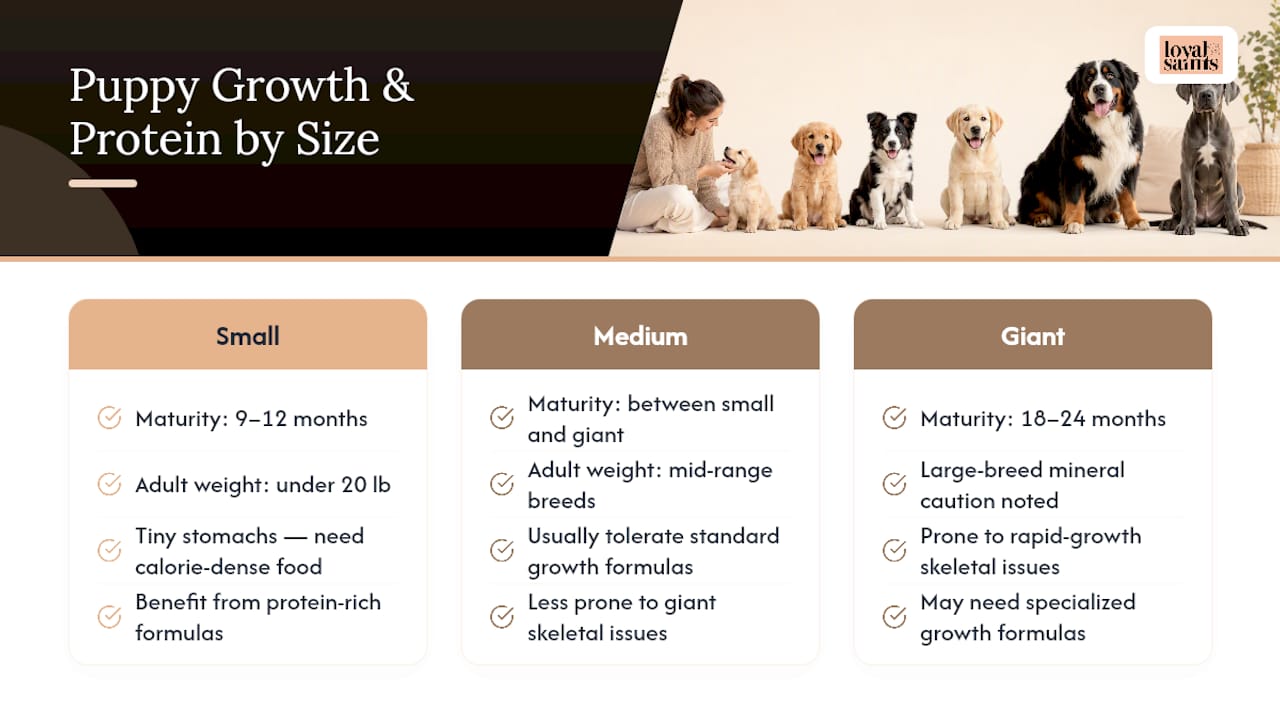
Medium-breed puppies sit in the middle and generally tolerate standard growth formulas well, since they’re less prone to the rapid-growth skeletal issues that plague giant breeds and less constrained by the tiny stomach capacity of toy breeds.
Coat type and activity level shape protein needs too. Working and sporting breeds, think Border Collies or retrievers bred for high activity, tend to do well on formulas at the higher end of the protein range because their muscle turnover is greater. A low-activity companion breed doesn’t need the same ceiling. This is exactly why a one-size-fits-all “puppy formula” claim deserves scrutiny. Loyalsaintspets’ overview of key nutrients puppies need for growth breaks down how these nutrient needs shift alongside breed-specific growth rates.
Why Does Protein Matter Beyond Muscle and Bone?
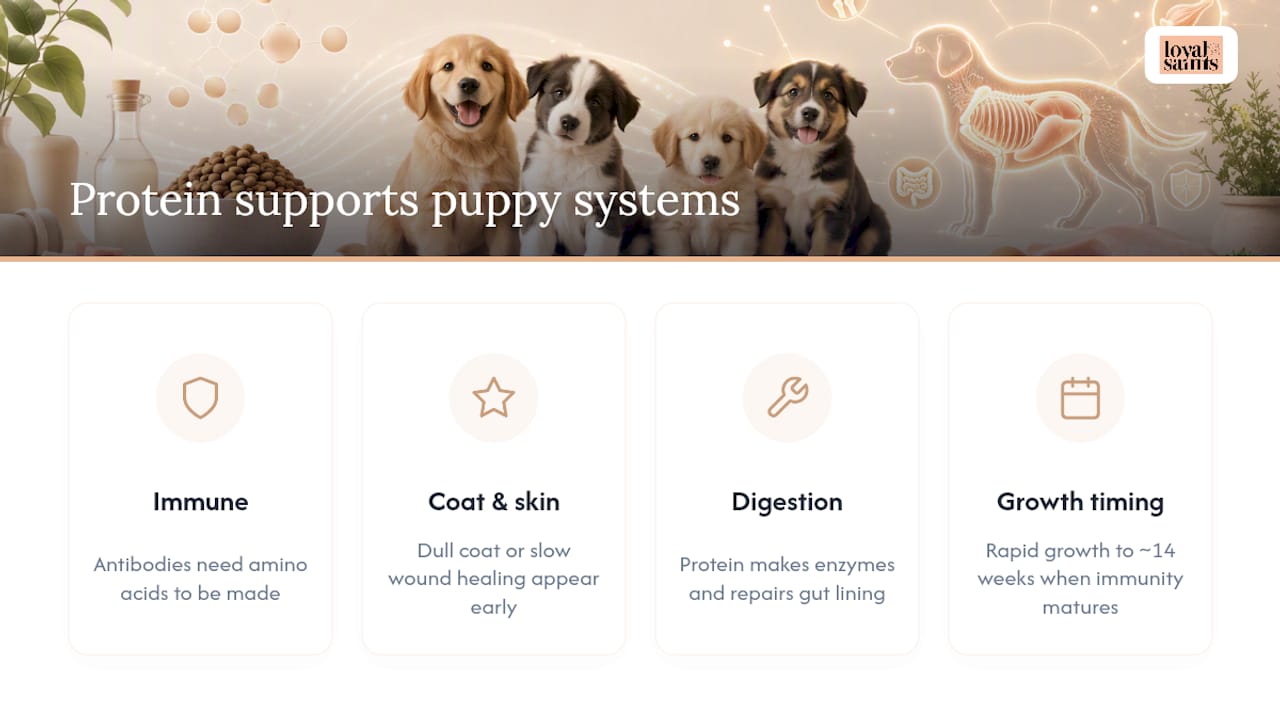
Protein’s job extends well past building bigger muscles. Amino acids are the raw material for antibodies, enzymes, and the structural proteins that make up skin and coat. A puppy running short on protein or key amino acids doesn’t just grow slower. Immune function can lag too, since antibody production depends directly on adequate amino acid supply.
The WALTHAM pocketbook on puppy nutrition notes that the rapid growth phase up to roughly 14 weeks is also when a puppy’s immune system is maturing and highly dependent on consistent nutrient supply. This is the same window vaccination series typically run through, which makes it a poor time to be running a marginal diet.
Coat and skin quality often show protein trouble before anything else does. A dull, brittle coat or slow wound healing can be early signs that amino acid intake isn’t keeping pace with what a growing body demands. Digestive health ties in too. Protein contributes to the enzymes and gut lining repair that keep digestion running smoothly, which is part of why sudden diet changes or protein deficits sometimes show up first as loose stool or poor stool quality rather than obvious muscle wasting.
How Should Protein Change if My Puppy Gets Sick?
Illness changes the protein equation, and not always in the direction owners expect. A puppy fighting an infection or recovering from surgery often needs more, not less, high-quality protein to support tissue repair and immune response, provided kidney and liver function are normal. Cutting protein during recovery, a once-common instinct, usually does more harm than good for an otherwise healthy puppy.
The exception is real and important: puppies with diagnosed kidney or liver disease may need protein restriction or a specifically modified amino acid profile, and that decision belongs to your veterinarian, not a general feeding guideline. Gastrointestinal illness, vomiting, diarrhea, or a recent bout of pancreatitis, can also call for a temporary shift to a more easily digestible protein source, sometimes at a lower fat level, while the gut recovers.
Never adjust protein levels on your own for a sick puppy. The wrong move, either restricting protein when it’s needed for healing or overloading a compromised kidney, can cause real harm. Any health condition changes the math enough that a phone call to your vet should come before a bag switch.
What Loyal Saints Pets Believes About Feeding Growing Puppies
At Loyalsaintspets, we build our freeze-dried recipes around human-grade, whole ingredients including high-quality proteins, fruits, and vegetables, formulated to meet AAFCO standards rather than just chase a high number on a label… We think the science is clear: amino acid quality and mineral balance matter more than a bold protein percentage, and that belief shapes every recipe we minimally process rather than overcook.
— Kristina
Where Freeze-Dried Protein Fits in a Puppy’s Diet
Real, minimally processed protein has a place in a growing puppy’s bowl, as long as it works alongside a properly formulated growth diet rather than in place of one. Loyalsaintspets’ Freeze Dried Raw Beef, 5oz makes a flavorful topper for puppies transitioning onto a new growth formula, adding real animal protein without a full recipe overhaul.
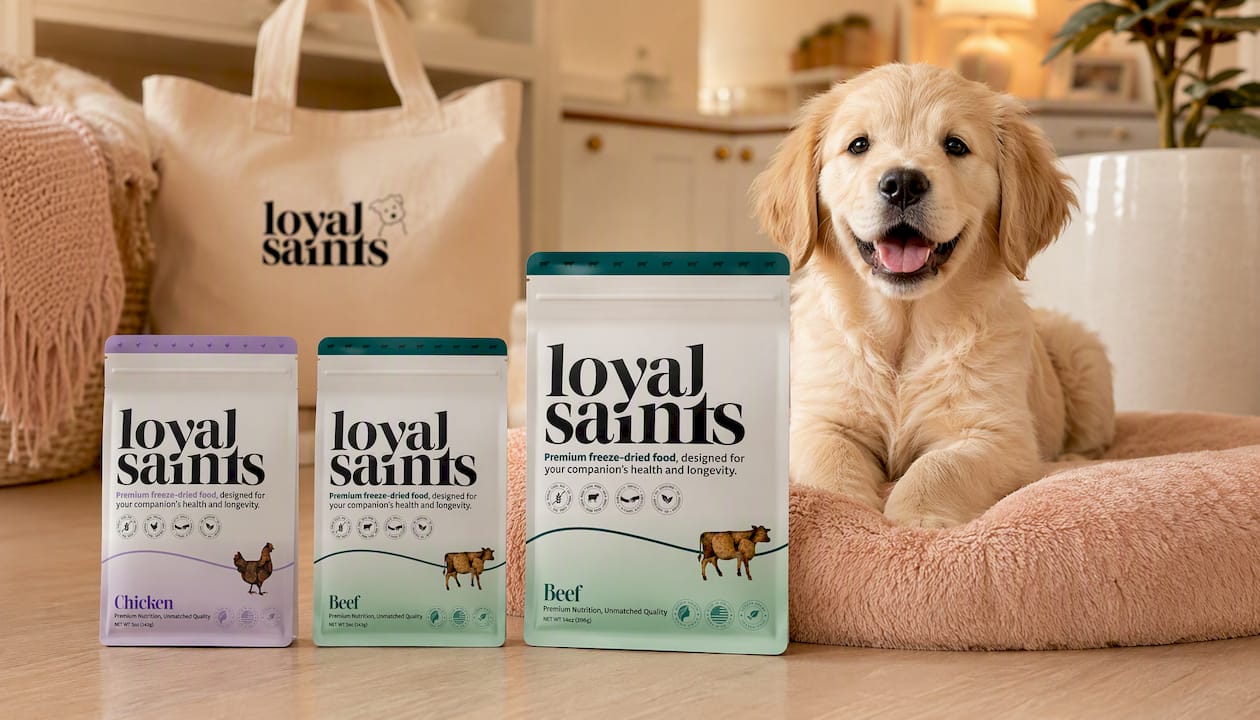
The Freeze Dried Raw Chicken, 5oz works well as a mixer for puppies who need extra encouragement to finish a meal, giving you a way to boost palatability with a whole-food ingredient instead of a synthetic flavor enhancer. For households feeding multiple dogs or wanting fewer reorders, the Freeze Dried Raw Beef, 14oz delivers the same human-grade beef in a larger, longer-lasting size.
One rule matters here: don’t replace a labeled growth formula with a supplemental topper unless that topper is specifically formulated and labeled for growth. Toppers add flavor and quality protein; they don’t substitute for the calcium, phosphorus, and amino acid balance a complete growth diet is built to deliver. Talk to your veterinarian before making any significant change to your puppy’s feeding plan, then visit the Loyalsaintspets product pages to see which size fits your household.
Sources
- AAFCO draft model pet food regulations (Nutritional adequacy and labeling)
- Feeding growing puppies | VCA Animal Hospitals
- Review: Protein requirements and recommendations for dogs
- Growth guide: keeping your puppy on the right track | Tufts Cummings School
FAQ
What Is the 10-10-10 Rule for Puppies?
There’s no universally recognized “10-10-10 rule” in AAFCO or veterinary nutrition literature; definitions vary across sources. If you’ve seen this term, treat it as informal advice and verify feeding amounts against your puppy’s specific growth formula label and your veterinarian’s guidance instead.
Is 2 Cups of Food a Day Enough for a Puppy?
It depends entirely on the puppy’s size, breed, age, and the food’s calorie density, so there’s no single answer that applies across the board. Base portions on your puppy’s expected adult weight and the feeding chart for your specific formula, then adjust using body condition as your guide.
Can You Feed a Puppy Too Much Protein?
Excess protein itself is rarely the primary danger for a healthy puppy; the bigger risks come from excess calories and mineral imbalance, particularly calcium and phosphorus in large-breed puppies, according to VCA veterinary guidance. A complete, purpose-formulated growth diet is generally safer than adding extra protein on your own.
Do Puppies Need a High-Protein Diet?
Puppies need a diet that meets or exceeds the AAFCO growth minimum of 22.5% crude protein on a dry-matter basis, with a complete amino acid profile, rather than simply the highest percentage available. Quality and balance matter more than chasing a maximum number.


