
If you want the short answer: no single upcycled protein does it all. From what I see in this article, organ blends, fish byproduct meals, and egg inputs each fill a different role in premium dog food.
Here’s the core takeaway in plain English:
- Organ blends bring high protein, taurine, heme iron, and B vitamins
- Fish byproduct meals add 60%–72% protein plus EPA and DHA
- Egg inputs offer 50% protein in whole egg, up to 83.5% in egg white, and 95%–98% protein use in dogs
- Low-heat processing, like freeze-drying, helps protect amino acids better than high heat
If I had to sum up the whole piece in one line, it would be this: premium freeze-dried dog diets work best when these protein sources are used for different jobs, not treated as direct substitutes.
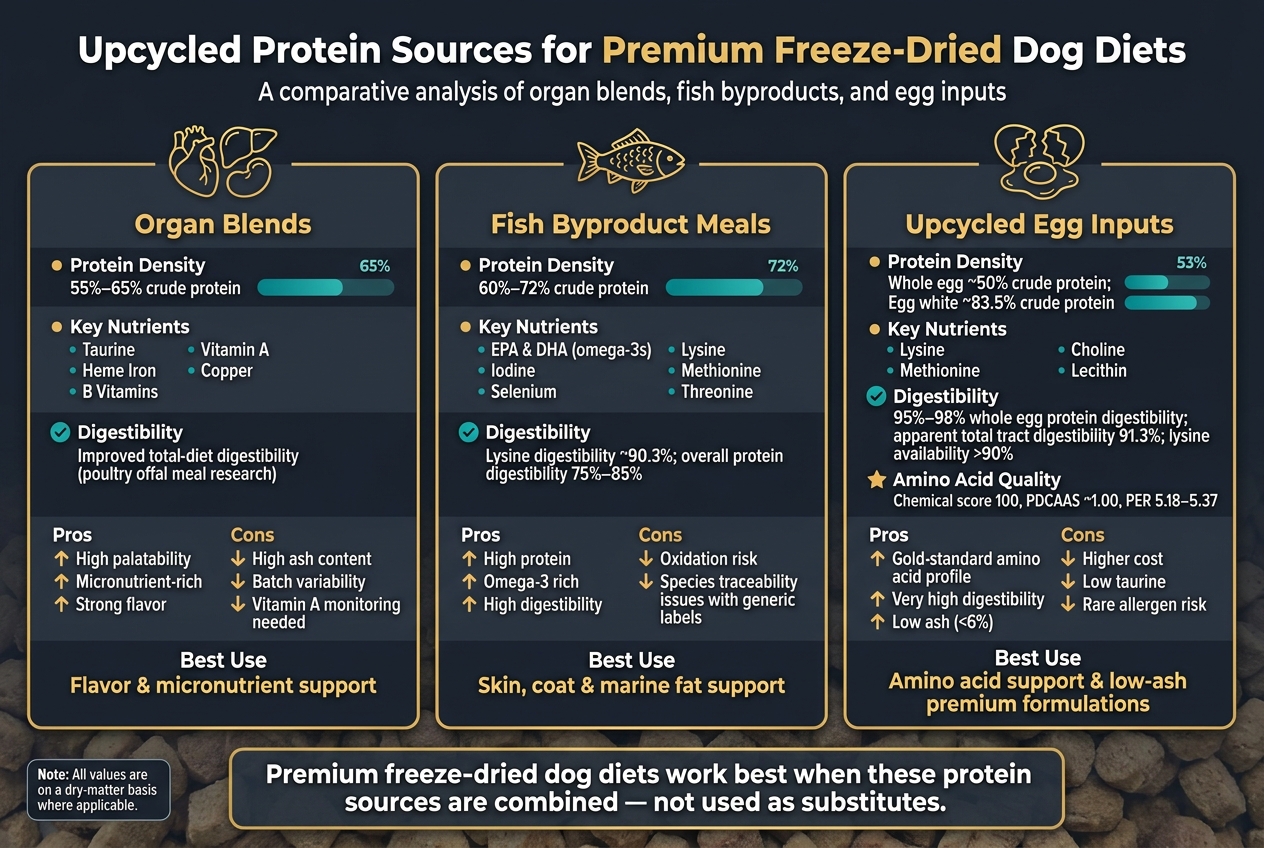
Upcycled Protein Sources for Premium Dog Food: Organ Blends vs Fish Meal vs Egg Inputs
Quick Comparison
| Protein source | What it adds | Main limits | Best fit in a formula |
|---|---|---|---|
| Organ blends | Taurine, iron, B vitamins, strong taste | More ash, batch shifts, vitamin A needs watching | Flavor and micronutrient support |
| Fish byproduct meals | High protein, omega-3s, iodine, selenium | Oxidation risk, species labels may be vague | Skin, coat, and marine fat support |
| Egg inputs | Top amino acid quality, low ash, high protein use | Higher cost, low taurine, rare allergy risk | Amino acid support and structure |
What follows is a short look at how these three compare in protein density, amino acid quality, protein use, and freeze-dried dog food advantages.
sbb-itb-b2753ee
1. Loyal Saints freeze-dried raw formulas using organ-rich animal proteins

Loyal Saints freeze-dried raw formulas are built around upcycled, organ-rich animal proteins like liver, heart, kidney, lung, and spleen. That matters because these ingredients pack a lot of nutrition into a small amount of food. They also widen the amino acid and micronutrient mix, which is a big part of what makes them such a strong base for freeze-dried raw diets.
Protein Density
Organ-rich proteins usually contain 60–75% crude protein. That’s higher than upcycled whole egg products, which come in at 48–50% [1][3][4].
Freeze-drying strips out moisture, so the nutrients become more concentrated per gram. In plain English: less water, more nutrition in each bite.
Amino Acid and Micronutrient Value
Organ meats do more than add protein. They also bring a broad mix of vitamins, minerals, and other nutrients that help round out the formula.
Liver, for example, is packed with vitamin A, B vitamins, iron, and copper. Heart stands out for taurine, L-carnitine, and Co-enzyme Q10. When you combine different organs, you get a broader nutrient spread than you would from muscle meat alone.
"Animal livers most notably have very high protein digestibility and quality, and are high in vitamins A, D and C, B vitamins, iron, zinc, copper, and fatty acids." - Leah Lambrakis & Jarrod Kersey, Department of Technical Services, Simmons Pet Food [5]
That broader amino acid and micronutrient profile helps these ingredients work well in complete-and-balanced formulas for all life stages.
Digestibility
Processing method makes a big difference here. High heat can lower lysine availability, while low-temperature processing helps preserve it [1]. Freeze-drying uses low temperatures, which helps limit Maillard reactions and protect amino acids.
That’s one reason freeze-dried raw foods are often valued for protein quality, not just protein level.
Freeze-Dried Recipe Role
In freeze-dried recipes, organ-rich proteins bring concentrated nutrition and strong palatability. The natural flavor of organ meats can make the food more appealing, which is no small thing if you’re dealing with a picky eater.
These whole-organ ingredients also set the starting point for the comparison with blended organ sources in the next section.
2. Upcycled organ blends
Upcycled organ blends bring several organ ingredients together in one meal. Unlike whole-organ formulas, these blends give up some ingredient-by-ingredient detail in exchange for steadier composition and easier formulation. Put simply: whole organs are more specific, while blended organ meals are more uniform.
Protein Density
Organ blends usually land in the 55% to 65% protein range, depending on what’s included.
Amino Acid Profile
The way the meal is processed has a big effect on lysine retention. Low-heat organ meals tend to keep more usable amino acids than high-heat meals. That means processing matters just as much as the ingredient source.
Digestibility
Research shows poultry offal meal improves total-diet digestibility and reduces fecal dry matter [7]. That matters in freeze-dried food, where better digestibility can help deliver nutrients in smaller, denser portions.
Freeze-Dried Recipe Role
In freeze-dried formulas, organ blends usually play a supporting role. They can boost flavor, add heme iron, and supply B vitamins. At the same time, they’re often kept at controlled levels to help protect mineral balance.
Fish byproduct meals shift the picture again. Instead of centering on organ nutrition, they move the focus toward marine protein and omega-3 content.
3. Fish byproduct meals
Fish byproduct meals come from the parts left after fish is processed for people to eat, including heads, frames, and viscera [8]. Those parts are dried and ground into a dense ingredient. So the focus here shifts a bit: instead of organ-heavy nutrition, you’re looking at a concentrated marine protein source.
Protein Density
Fish byproduct meals usually contain 60% to 72% crude protein on a dry-matter basis [8][10]. That puts fish meal firmly in the high-protein camp, which is one reason it shows up in many premium diets.
Amino Acid Value
Fish meal supplies all of the essential amino acids dogs need. It’s especially rich in lysine, methionine, and threonine [8]. Salmon meal, in particular, can provide a strong essential amino acid profile [6].
Digestibility
Lysine digestibility in fish meal averages about 90.3% [6][8]. Overall protein digestibility tends to fall between 75% and 85% [10].
Heat also plays a big role here. If fish meal is dried at very high temperatures - 120–160°C (248–320°F) - some amino acids and omega-3 fatty acids can break down [10]. In plain English, too much heat can chip away at part of what made the ingredient useful in the first place.
Freeze-Dried Recipe Role
In freeze-dried formulas, fish byproduct meals bring in marine-source nutrients such as iodine, selenium, and long-chain omega-3 fatty acids, including EPA and DHA [10]. Whitefish meal also has strong water-holding capacity, which can help with texture and rehydration in freeze-dried food [9].
There’s another practical point too. Named-species meals like salmon, menhaden, or herring give buyers a clearer idea of what’s in the bag and tend to offer more predictable omega-3 levels [8][10].
Egg inputs shift the comparison toward amino acid completeness and digestibility.
4. Upcycled egg inputs
Upcycled egg inputs come from retail-rejected eggs that are still nutritionally sound and then spray-dried for pet food. Compared with organ and fish proteins, eggs offer less protein concentration in many forms, but they make up for it with top-tier amino acid quality and high digestibility.
Protein Density
Spray-dried whole egg contains about 50% crude protein, and a big reason it lands there is its naturally high fat content: about 34.75% crude fat [1][4]. Spray-dried egg white is the outlier. It reaches about 83.5% crude protein with only 0.15% fat [1].
So yes, whole egg isn't as protein-dense as some other animal inputs. But protein percentage alone doesn't tell the whole story.
Amino Acid Value
Egg protein is a reference-quality protein. It has a chemical score of 100 and a PDCAAS approaching 1.00. It also supplies all essential amino acids, with strong levels of lysine and methionine [1][2][3].
That quality shows up in performance testing too. In Protein Efficiency Ratio testing, spray-dried whole egg scores 5.18, while spray-dried non-retail whole egg reaches 5.37 [1].
In plain terms, egg protein doesn't just look good on paper. Dogs can use it well.
Digestibility
Egg protein is one of the most digestible proteins available for dogs. Whole egg protein digestibility is estimated at 95% to 98%, and the apparent total tract digestibility of crude protein for spray-dried egg is 91.3% [3][11].
Lysine availability is another strong point. It exceeds 90% in spray-dried egg products, which is higher than chicken meal at 78% and chicken by-product meal at 84.1% [1]. That's a big deal, because amino acids only matter if the dog can absorb and use them.
This is part of what makes egg inputs such a good fit for freeze-dried formulas, where you want both nutrient delivery and physical structure.
Freeze-Dried Recipe Role
In freeze-dried formulas, egg inputs help act as binders and support structure. Their low ash content - usually below 6% - allows higher inclusion without throwing off mineral balance [12].
They can also help with taste. Dogs have shown a clear preference for diets containing spray-dried egg at a 4% inclusion rate compared with control diets [11]. Egg yolks add choline and lecithin as well [3].
Pros and Cons of Organ Blends, Fish Meals, and Egg Inputs
Each of these upcycled protein sources brings something different to a formula. And in premium freeze-dried diets vs kibble, those trade-offs matter a lot.
Why? Because freeze-dried food has the moisture removed. That means every ingredient has to pull its weight.
Organ blends stand out for palatability. Dogs and cats usually find them appealing, and they also bring micronutrients to the bowl. The catch is ash content and batch variability. High ash can cap how much you can use, so formulators need to watch inclusion levels closely. Sourcing can shift too, depending on species, cut, and rendering method. So while organ blends help with taste and nutrient density, consistency can be a moving target.
Fish byproduct meals change the picture by adding marine fatty acids. They’re often used for their omega-3 content and digestibility. But there’s a trade-off: oxidation and traceability. Polyunsaturated fatty acids can break down fast without antioxidant protection. On top of that, generic fish byproduct meal labels don’t name the species, which makes it harder to check contaminant loads or pin down EPA and DHA levels [8].
Egg inputs bring yet another strength: amino acid quality. They offer the strongest amino acid profile of the three. Their weak spots are cost and supply. Egg allergy can happen too, although it’s uncommon [3].
Used together, these ingredients can help balance palatability, amino acids, and fatty acids in freeze-dried recipes.
| Source | Pros | Cons | Best Use Case |
|---|---|---|---|
| Upcycled Organ Blends | High protein concentration; strong palatability; rich in B-vitamins, iron, and copper | High ash content; batch variability; requires careful Vitamin A monitoring | Palatability enhancement; micronutrient fortification in freeze-dried raw formulas |
| Fish Byproduct Meals | High protein concentration; rich in EPA/DHA; high digestibility | High oxidation risk; generic versions lack traceability | Skin and coat support; sensitive digestion diets; high-protein grain-free formulas |
| Upcycled Egg Inputs | Gold-standard amino acid profile; very high digestibility; low ash; rich in choline | Higher cost; potential supply disruptions; low in taurine; rare allergen risk | Low-ash premium formulations |
Conclusion
These sources each bring something different to the bowl. No single upcycled protein source wins across every category: whole egg offers the most complete amino acid profile, fish byproduct meals add omega-3s, and organ blends contribute micronutrients and taurine. That’s why premium U.S. dog diets often combine all three. Blending them can help support amino acid balance, palatability, fatty acids, and micronutrients in one recipe. Upcycling also turns co-products into useful dog protein and cuts food waste.
In freeze-dried raw dog food, that balance matters because low-heat processing helps preserve nutrient quality. Organ-rich proteins work well in freeze-dried diets for the same reason. Loyal Saints uses organ-rich, human-grade ingredients in freeze-dried raw formulas made in the USA.
That’s the core value of upcycled protein in premium freeze-dried diets.
FAQs
Why combine organ blends, fish meals, and egg inputs?
Combining organ blends, fish meals, and egg inputs creates a more complete nutritional profile than any single ingredient on its own.
Eggs provide a highly digestible amino acid balance, while fish by-products add EPA and DHA. Put them together, and these upcycled protein sources help Loyal Saints maintain high protein density, digestibility, and amino acid availability for dogs at every life stage.
Are upcycled proteins safe for dogs?
Yes - upcycled protein sources are safe for dogs when they’re processed the right way and meet nutrition and hygiene standards.
Ingredients such as poultry by-products, fish hydrolysates, and egg inputs go through rendering or are treated with high pressure and heat. That process helps improve digestibility, kill pathogens, and make storage safer. When these ingredients are handled under strict quality and safety standards, they can supply the essential amino acids and nutrients dogs need to stay healthy.
Why does low-heat freeze-drying matter?
Low-heat freeze-drying helps protect the nutritional quality of protein sources in premium dog diets. By using lower temperatures, it helps keep amino acids, essential fatty acids, and heat-sensitive vitamins from breaking down during processing.
At Loyal Saints, this gentle method helps preserve the dense nutrition and bioavailability of human-grade, all-natural ingredients, so dogs get strong support for their health and vitality at every life stage.


