
The WSAVA dog food guidelines say this clearly: choose a diet labeled “complete and balanced” for your dog’s life stage, prioritize manufacturers that employ qualified nutritionists and use AAFCO feeding trials, and bring that information to your veterinarian for a tailored assessment. Three actions you can take today: (1) check the AAFCO statement on the bag, (2) call the manufacturer and ask three specific questions about their nutritionist, feeding-trial validation, and quality control, and (3) bring the packaging to your next vet visit. One nuance worth knowing upfront: freeze-dried and raw diets can be excellent options, but they carry pathogen risks that require specific handling steps — covered fully in the safety section below.
Key Takeaways
The single most important action you can take is to verify the AAFCO feeding-trial statement on your dog’s food bag and call the manufacturer with three targeted questions before your next vet visit.
| Point | Details |
|---|---|
| Check the AAFCO statement first | Look for “complete and balanced” plus “animal feeding tests” language — not just “formulated to meet.” |
| Ask three manufacturer questions | Nutritionist credentials, feeding-trial vs. formulation, and typical nutrient analysis availability are the core three. |
| Bring labels to your vet | A formal nutritional assessment using BCS charts and calorie goals produces a tailored feeding plan. |
| Handle freeze-dried like raw meat | Freeze-drying does not kill pathogens; confirm HPP or end-product testing and follow kitchen hygiene every time. |
| Loyalsaintspets as a starting point | Loyalsaintspets offers AAFCO-complete freeze-dried options with human-grade ingredients — verify typical analysis and pathogen steps with the brand before committing. |
Table of Contents
- What do the WSAVA Global Nutrition Committee guidelines actually cover?
- How do you apply WSAVA guidance when choosing a dog food?
- Are AAFCO feeding trials stronger evidence than formulation?
- What safety risks does WSAVA flag for raw and homemade diets?
- Which WSAVA tools help you and your vet make better decisions?
- What should you bring to a veterinary nutritional assessment?
- How does a freeze-dried brand align with WSAVA signals?
- What are your next steps right now?
- What most owners get wrong about dog food labels
- Loyalsaintspets freeze-dried food meets you where WSAVA guidance starts
- Sources
What do the WSAVA Global Nutrition Committee guidelines actually cover?
The WSAVA Global Nutrition Committee was created to make nutrition a standard part of veterinary clinical care, not an afterthought. Its mission is to develop evidence-based tools that help veterinary teams assess and manage every patient’s nutritional status — from healthy adult dogs to hospitalized patients recovering from surgery.
The Committee publishes a practical toolkit that includes food label guides, diet history forms, body condition score (BCS) charts, hospitalized feeding guides, and consumer-facing resources. These tools give both owners and vets a shared language for evaluating diet quality. The WSAVA Global Nutrition Toolkit also warns owners to ignore unregulated marketing terms like “holistic” or “premium” — those words carry no legal definition in the U.S. and tell you nothing about actual nutrient content.
One point the Committee makes explicitly:
That means no seal of approval on a bag comes from WSAVA. Your vet, armed with WSAVA tools and your dog’s health history, is the right person to make the final call.
How do you apply WSAVA guidance when choosing a dog food?
Turn the guidelines into a concrete checklist you can use in a store, on a brand’s website, or on a phone call with a manufacturer.
Step-by-step label check
- Find the AAFCO nutritional adequacy statement. It should say “complete and balanced” for your dog’s life stage (puppy, adult, senior, or all life stages).
- Look for the phrase “animal feeding tests using AAFCO procedures.” That wording signals a feeding trial was conducted.
- Locate the calorie statement (required on U.S. labels). Confirm it matches the feeding guide on the bag so you can avoid unintentional overfeeding.
- Check the guaranteed analysis for minimums and maximums on protein, fat, fiber, and moisture.
- Note any “intermittent or supplemental use only” language — that means the food is not nutritionally complete on its own.
Questions to ask the manufacturer directly
Call or email before you buy. The WSAVA Nutrition Assessment Guidelines recommend asking manufacturers these specific questions:
- Do you employ a full-time, qualified nutritionist (board-certified DACVN or PhD in animal nutrition)?
- Were your diets validated through AAFCO feeding trials, or are they formulated to meet AAFCO nutrient profiles on paper?
- Can you provide a typical nutrient analysis (not just the guaranteed analysis)?
- What quality control steps do you use to verify ingredient consistency batch to batch?
- Do you conduct lot traceability and end-product testing?
- For freeze-dried or raw products: what pathogen-mitigation steps do you use (HPP, end-product testing, or other validated kill steps)?
Pro Tip: A manufacturer that responds quickly with a typical nutrient analysis and clear QC documentation is showing you exactly the kind of in-house expertise WSAVA recommends. Vague answers, delays, or “that information is proprietary” responses are a signal to keep looking.
Understanding what’s really in your dog’s food goes well beyond the ingredient list — the manufacturing process and nutritionist oversight matter just as much.
Are AAFCO feeding trials stronger evidence than formulation?
Yes, and the difference is meaningful for your dog’s long-term health.
| Validation Method | What It Means | Real-World Assurance |
|---|---|---|
| “Formulated to meet AAFCO nutrient profiles” | Nutrients calculated on paper from ingredient data | No live animal testing; digestibility and bioavailability unconfirmed |
| “Animal feeding tests using AAFCO procedures” | Diet fed to dogs under controlled conditions | Confirms digestibility, palatability, and that nutrients are actually absorbed |
Paper formulation checks whether a recipe should meet nutrient targets based on ingredient databases. Feeding trials confirm that real dogs actually absorb those nutrients at adequate levels. A food can look perfect on paper and still fall short in a dog’s gut.
When you contact a manufacturer, ask for the specific AAFCO statement language used on the label. If they say “formulated to meet,” ask whether any feeding trials have been conducted for any product in their line. Brands with genuine nutritional investment usually have at least some trial data available.
What safety risks does WSAVA flag for raw and homemade diets?
WSAVA and U.S. regulatory guidance both highlight several risks owners should weigh carefully:
- Pathogen contamination: Raw and freeze-dried raw diets can carry Salmonella, Listeria, and E. coli. Freeze-drying does not reliably kill pathogens — dormant bacteria can reactivate when the product is rehydrated.
- Cross-contamination: Handling raw pet food and then touching countertops, bowls, or your face transfers pathogens to humans. This risk is higher with young children or immunocompromised people in the household.
- Nutrient imbalances in homemade diets: Home-cooked meals rarely meet all canine nutritional needs without a board-certified veterinary nutritionist formulating the recipe.
- Obesity from calorie misestimation: Calorie density varies widely across food types. Without a calorie statement and a measured portion, overfeeding is common.
AAFCO’s raw food guidance recommends careful handling, thorough handwashing, and consumer awareness about bacterial contamination risks. For households with immunocompromised individuals or infants, WSAVA advises avoiding raw diets entirely.
For freeze-dried products specifically, ask manufacturers about validated pathogen-kill steps such as High Pressure Processing (HPP) or rigorous end-product testing. Treat rehydrated freeze-dried food with the same kitchen hygiene you’d apply to raw meat: wash hands, sanitize surfaces, and refrigerate leftovers promptly.
Which WSAVA tools help you and your vet make better decisions?
The WSAVA Global Nutrition Guidelines were designed so vets can make nutritional assessment part of every routine visit, not just sick-dog appointments. The toolkit includes:
- Diet history form: A structured questionnaire covering every food source your dog eats, including treats, table scraps, and supplements.
- Body condition score (BCS) charts: A 9-point visual scale that helps vets and owners assess whether a dog is underweight, ideal, or overweight.
- Calorie recommendations: Calculated from the dog’s Resting Energy Requirement (RER) and adjusted for activity level, life stage, and health status.
- Hospitalized patient feeding guide: Used for dogs recovering from illness or surgery where nutritional support is critical.
- Feeding instructions and monitoring chart: Tracks portion sizes, weight trends, and clinical signs over time.
Before your vet visit, photograph your dog’s current food packaging (front and back), measure out a typical daily portion, and note every treat, supplement, and table scrap your dog receives. That preparation lets your vet complete the diet history form in minutes rather than guessing.
What should you bring to a veterinary nutritional assessment?
A focused visit produces a better feeding plan. Bring these items and be ready to answer questions about each:
- Current food packaging (or clear photos of the front panel, AAFCO statement, guaranteed analysis, and calorie statement).
- The exact amount you feed per meal, measured in cups or grams, and how many meals per day.
- A list of all treats, chews, supplements, and any table food your dog receives.
- Your dog’s most recent weight and any weight trend you’ve noticed over the past few months.
- Previous lab results or medical records if your dog has a known health condition.
- Any clinical signs you’ve connected to diet: loose stool, itching, low energy, or coat changes.
Ask your vet these questions directly:
- Is this diet appropriate for my dog’s current life stage and health conditions?
- Does my dog need a therapeutic diet, or is a standard complete-and-balanced food sufficient?
- What calorie target should I use, and how should I adjust portions as my dog ages?
- Are any supplements necessary, or does this diet already cover those needs?
Your vet will use BCS scoring and calorie calculations to set a specific daily target and schedule a follow-up to track progress.
How does a freeze-dried brand align with WSAVA signals?
When you evaluate any freeze-dried brand, run through this neutral checklist before buying:
- Does the label carry an AAFCO “complete and balanced” statement with a specified life stage?
- Does the brand disclose whether that claim is based on feeding trials or nutrient formulation?
- Can the manufacturer provide a typical nutrient analysis (not just the guaranteed analysis)?
- Is calorie content clearly stated per cup or per ounce?
- Does the brand employ a qualified nutritionist (DACVN or PhD) on staff?
- What pathogen-mitigation steps are used in production?
- Is lot traceability available if a recall occurs?
Loyalsaintspets states that its freeze-dried products use human-grade, whole ingredients and meet AAFCO standards. The brand points to veterinary advisory involvement and a focus on minimal processing. To verify those claims independently, request the typical nutrient analysis for whichever product you’re considering, ask specifically about pathogen-mitigation steps for the freeze-dried line, and confirm the AAFCO validation method. You can review the human-grade ingredient verification process Loyalsaintspets describes on its site as a starting point for those questions. Always share manufacturer documentation with your vet before making a final decision.
What are your next steps right now?
- Check the AAFCO statement on your current dog food bag tonight — does it say “complete and balanced” for the right life stage?
- Call or email the manufacturer this week with three questions: nutritionist on staff, feeding-trial vs. formulation, and typical nutrient analysis availability.
- Bring the packaging and your notes to your next vet visit and ask for a formal nutritional assessment.
- If you feed a freeze-dried or raw product, confirm pathogen-mitigation steps and follow kitchen hygiene protocols every time you handle it.
- Document every answer you receive from manufacturers and share that file with your veterinary team.
What most owners get wrong about dog food labels
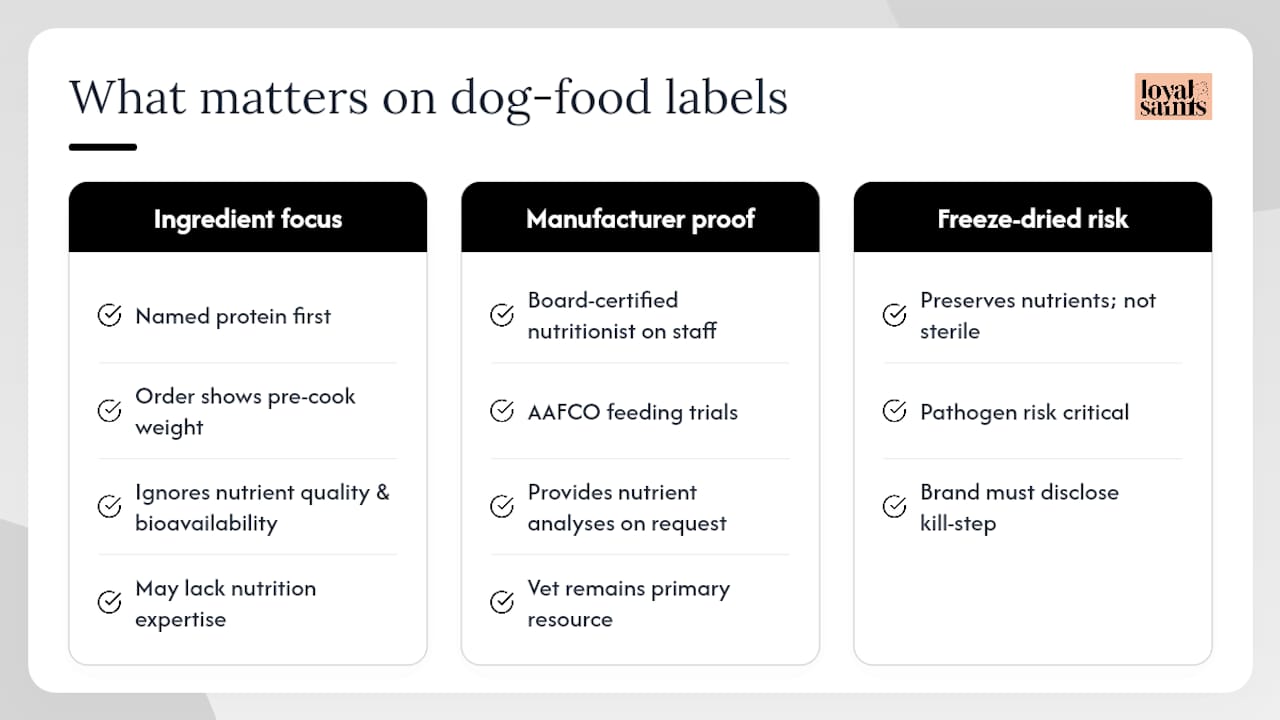
The conventional advice is to read the ingredient list carefully and look for a named protein first. That instinct is understandable, but it misses the point. Ingredient order tells you relative weight before cooking, not nutrient quality, bioavailability, or whether the manufacturer actually knows what they’re doing. A bag can lead with “deboned chicken” and still be formulated by someone with no formal nutrition training, tested on nothing but a spreadsheet.
The WSAVA framework shifts the question from what’s in the bag to who made it and how do they know it works. That reframe is the most useful thing this article can offer you. A manufacturer that employs a board-certified veterinary nutritionist, conducts AAFCO feeding trials, and shares typical nutrient analyses on request is showing you something no ingredient list can: that they have the expertise and the accountability to back their claims.
For freeze-dried diets specifically, the pathogen question is non-negotiable. Freeze-drying preserves nutrients beautifully, but it does not sterilize. If a brand cannot tell you what kill step they use, that gap matters more than whether the first ingredient is chicken or beef.
Your vet, armed with WSAVA tools and your dog’s full diet history, is still the most important resource in this process. No label guide replaces that relationship.
Loyalsaintspets freeze-dried food meets you where WSAVA guidance starts
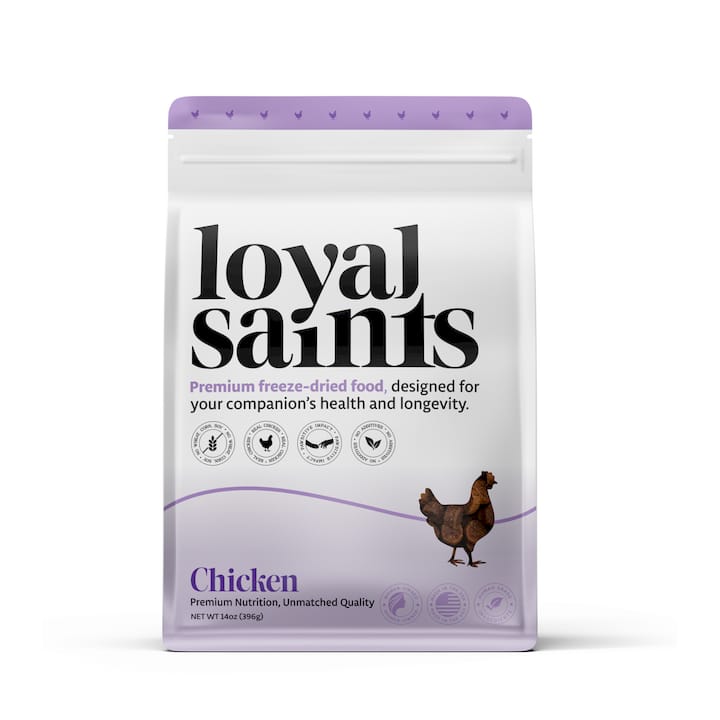
You’ve done the research. Now here’s a practical next step. Loyalsaintspets freeze-dried raw dog food is built on human-grade, whole ingredients — single proteins, real fruits and vegetables, no fillers, no synthetic additives — and formulated to meet AAFCO standards. That means the nutritional foundation WSAVA asks you to verify first is already in place.
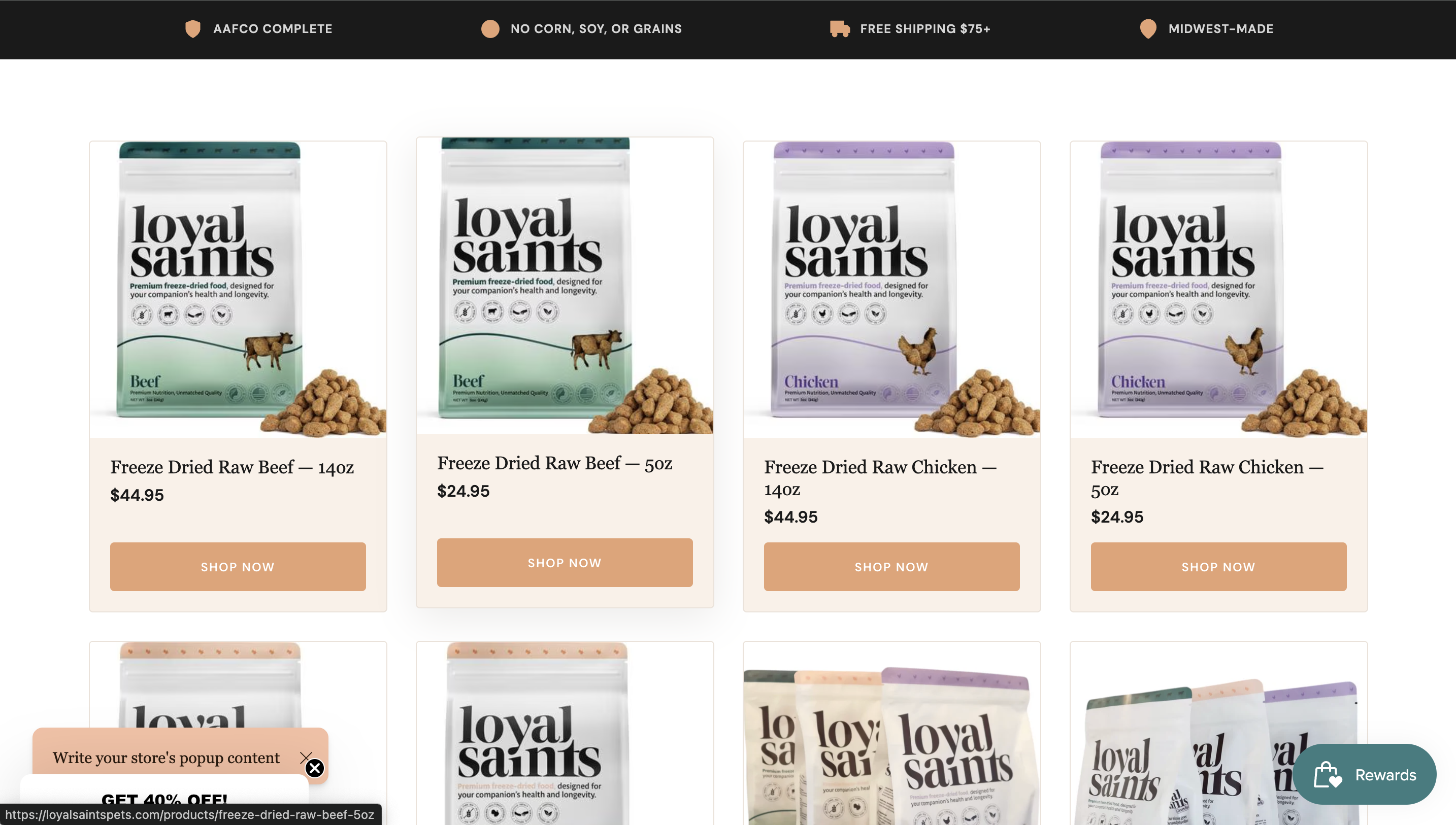
The Freeze Dried Raw Chicken (14oz) and Freeze Dried Raw Beef (14oz) are the full-size options for owners ready to commit to a cleaner diet. If you want to start smaller, the 5oz Freeze Dried Raw Chicken and 5oz Freeze Dried Raw Beef let you sample before scaling up. Halo Club members get recurring savings and free shipping — a practical way to stay consistent once your vet confirms the diet fits your dog’s needs. Browse the full lineup and learn why freeze-dried works before your next vet visit.


