
More than 50% of reviewed green claims were vague, misleading, or unsupported. So when I shop for pet food, I don’t trust words like “natural,” “eco-friendly,” or “planet-friendly” on their own.
Here’s the short version: I follow a pet food label reading workflow to check 5 things before I buy:
- Packaging: Is the bag actually recyclable or compostable where I live?
- Ingredients: Are the proteins clearly named, and can I trace where key ingredients come from?
- Nutrition: Does the label include an AAFCO adequacy statement?
- Safety and production: Does the brand show food-safety controls and back up claims like “human-grade”?
- Proof: Can I find outside certifications, disposal instructions, and sourcing details without digging?
A few facts make this worth the extra minute:
- The U.S. generates about 300 million pounds of pet food and treat packaging waste each year.
- More than 99% of that waste ends up in landfills.
- In the U.S., “natural” isn’t regulated for pet food marketing the way many shoppers assume.
If I can’t verify the bag, the formula, and the brand’s claims, I move on.
Quick comparison: what I check first
| Check | What I want to see | What makes me pause |
|---|---|---|
| Packaging | How2Recycle label, resin code, compost certification | Generic recycle symbol only |
| Ingredients | Named animal protein, lot codes, named farms/fisheries | Vague meat terms |
| Nutrition | AAFCO adequacy statement | No adequacy statement |
| Safety | Clear compliance details, recall history access | Big claims with no proof |
| Brand proof | Third-party seals and public verification pages | No outside verification |
That’s the whole idea of this checklist: less guesswork, more proof.
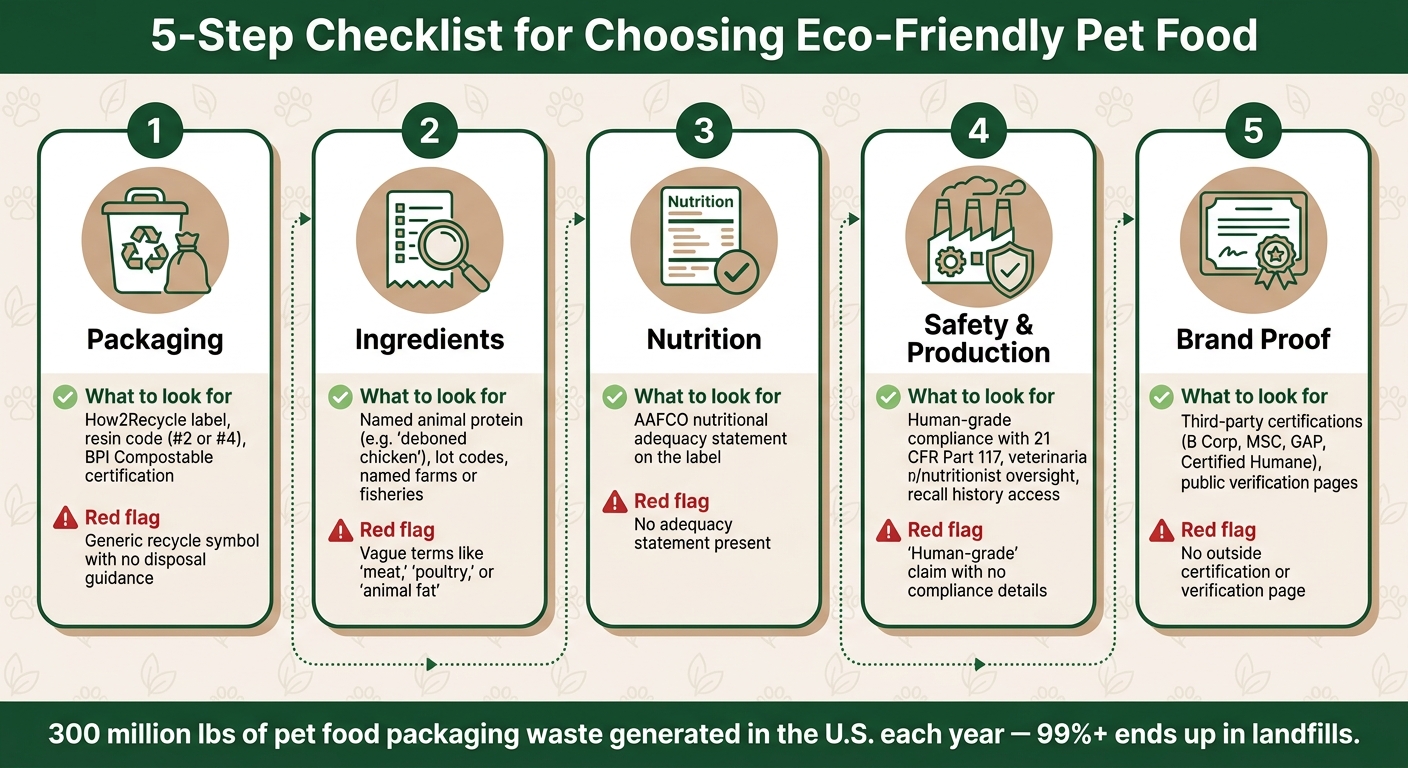
5-Step Checklist for Choosing Eco-Friendly Pet Food
10 Tips for Sustainable Lifestyle with Your Pets!
sbb-itb-b2753ee
Start with the Packaging
Packaging is the fastest place to check a brand's sustainability claims. The Pet Sustainability Coalition estimates that 300 million pounds of pet food and treat packaging waste is generated in the U.S. each year, and more than 99% of it ends up in landfills instead of being recycled [9]. That’s why this section matters. You can often tell, at a glance, whether a brand’s disposal claims line up with how waste systems in the U.S. work.
Start with the bag itself. Packaging claims are usually the easiest ones to verify.
Look for Recyclable, Compostable, or Low-Waste Materials
Look for mono-material bags made from 100% PE or PP, or certified compostable pouches built for industrial composting. Mono-material bags use one polymer only, which makes them easier for current recycling systems to process than the usual multi-layer pouches made from plastic, foil, and adhesive. By contrast, compostable pouches are made from materials such as PLA, cellulose, or starch blends. They break down in industrial composting facilities, not in a backyard bin unless the label clearly says Home Compostable [6].
The material matters. But the disposal instructions matter just as much.
Check Whether Packaging Claims Hold Up in Practice
A recyclable label doesn’t mean much if your local facility won’t take that material. Most U.S. curbside programs accept steel and aluminum cans, but they reject flexible pet food bags, even when those bags are marked recyclable [9]. So before you assume a bag belongs in your curbside bin, check your city or county website for accepted resin codes.
It also helps to look for the How2Recycle label. That label gives plain disposal directions, such as "Store Drop-Off" or "Check Locally," instead of just showing a generic recycling symbol [9]. For compostable packaging, check for BPI Certified Compostable or TUV Austria OK Compost Industrial before you assume your local compost system can handle it [6].
Use the table below to check each claim:
| Claim | What to Verify | Why It Matters |
|---|---|---|
| Recyclable | Check for the How2Recycle label; confirm "Store Drop-Off" vs. "Curbside." Verify local acceptance. | Works only where local systems accept it [9]. |
| Compostable | Confirm BPI Certified Compostable or TUV Austria OK Compost Industrial certification. | Requires industrial composting; may produce methane otherwise [6][9]. |
| Mono-material | Confirm a single polymer - look for "100% PE" or "100% PP" on the back or bottom of the bag. | Reduces contamination and improves recycling success rates [9]. |
If the package checks out, move next to ingredient sourcing. Understanding premium pet food ingredients is the next step in ensuring your pet's health and sustainability.
Review Ingredient Sourcing and Food Quality
After you check the packaging, move to the ingredient list. This is where you get a much better read on traceability and nutrition.
Find Out Where Ingredients Come From
Turn the bag over and tune out the front-label sales language. The part that matters is the origin detail. You want specifics, such as lot codes that let you trace ingredients back to a certain farm or fishery [5].
Look for:
- Lot codes
- Named farms or fisheries
- Third-party seals such as Certified Humane, MSC, Ocean Wise, or USDA Organic [2][4][5][7]
That kind of detail tells you more than broad claims ever will.
Check for a Clean Formula and Complete Nutrition
Start with the first ingredient. It should be a named animal protein like "deboned chicken", "beef", or "salmon", not a vague term such as "meat", "poultry", or "animal fat" [1][2].
Next, scan the rest of the list for fillers like corn, wheat, and soy, along with artificial preservatives such as BHA or BHT [1][8]. In many cases, a short ingredient list with familiar items points to less processing.
Then check nutrition completeness. This part is not optional. Make sure the label includes the AAFCO nutritional adequacy statement. That statement tells you whether the food was formulated to meet minimum standards or tested through animal feeding trials [10].
"Animal feeding tests using AAFCO procedures" is the stronger standard because it reflects actual feeding trials [10].
If the formula looks good, the next step is to review manufacturing, safety, and production practices.
Check Manufacturing, Safety, and Production Practices
Once the recipe looks solid, look at how the food is made. A clean label doesn’t mean much if the factory cuts corners on safety or if the brand makes big green claims it can’t back up.
Look for Food Safety Standards and Formulation Oversight
Next, check who built the recipe and how the company runs production.
Human-grade claims only matter when the entire product meets federal human-food handling rules. Under federal law (21 CFR Part 117), every ingredient and the finished product must be stored, handled, processed, and transported in line with federal human food laws for that claim to stand [3].
It also helps to see veterinarian-approved pet food or nutritionists involved in recipe development. That usually points to better oversight, not just better marketing.
Confirm Specific Sustainability Actions
Then pressure-test the brand’s green claims. Skip vague language like “earth-friendly” or “sustainable” and ask for proof. You’re looking for specific, verifiable actions such as renewable energy use, third-party carbon verification, or audited certifications.
The FTC warns that unsupported "sustainable" or "environmentally friendly" claims can mislead shoppers [3].
Use claims like these as a proof check:
| Sustainability Claim | Verify | Why It Matters |
|---|---|---|
| Energy Use | Renewable energy, verified carbon claims, or LEED certification | Cuts the facility's carbon footprint and lowers reliance on fossil fuels |
| Waste Diversion | "Zero Waste to Landfill" certification or Upcycled Certified ingredients | Keeps surplus nutrients and materials out of landfills |
| Animal Welfare Certified | Specific GAP step ratings (Step 4+) or AWA annual on-site audits | Shows humane treatment, pasture access, and tighter supply-chain standards |
| Carbon Neutral | Independent verification by partners like ClimatePartner | Confirms measured emissions cuts instead of vague promises |
| B Corp Certified | Current score and impact report on the B Lab directory | Shows the whole company meets high standards for transparency and accountability |
Check Brand Transparency Before You Buy
After you've looked at packaging, sourcing, and safety, use transparency as your last filter. Here's the simple test: can you find sourcing details, certifications, and disposal instructions fast? If not, that's a red flag.
Use a Final Pre-Purchase Checklist
Use this checklist to see whether a brand makes its claims easy to check. If you're missing answers on more than one or two points, it's smart to pause.
| What to Check | What to Look For | Red Flag |
|---|---|---|
| Ingredient origin | Named farms, fisheries, or lot codes for traceability | Vague terms like "unnamed meat meal" or "ocean fish" |
| Formula oversight | Veterinarian or nutritionist involvement; AAFCO adequacy statement | No nutritional adequacy statement on the label |
| Manufacturing standards | Human-grade processing that meets 21 CFR Part 117; recall history via FDA or AVMA | "Human-grade" claim with no compliance details |
| Sustainability proof | Named third-party certifications such as B Corp, GAP, or MSC | No public certification or verification page |
| Packaging disposal | Specific resin codes such as #2 or #4 plastic, or How2Recycle instructions | "Recyclable" label with no disposal guidance |
You can also cross-check a brand's claims with tools like the Pet Nutrition Alliance (PNA) Manufacturer Evaluation Report and Pet Sustainability Coalition (PSC) ratings.
Conclusion: The Best Eco-Friendly Pet Food Brands Make Claims You Can Verify
The best eco-friendly pet food brands make their claims easy to verify while still giving your dog balanced nutrition for its life stage.
FAQs
How do I verify if a pet food bag is recyclable where I live?
Check your city or county website, or call the local waste department, because recycling rules change from one place to another. You can also check the bag itself for the How2Recycle logo or a recycling symbol to get guidance based on the material.
Paper bags are often recyclable. But if the bag has a plastic lining, that usually changes the answer. Many pet food bags are made with multiple layers of plastic, and those typically can't go in curbside recycling. In that case, it’s smart to see if the brand has a special drop-off program.
What does the AAFCO adequacy statement tell me?
The AAFCO adequacy statement tells you if a pet food delivers complete and balanced nutrition for a certain life stage.
Here’s the key difference:
- A “formulated to meet” statement means the food’s nutrient profile matches AAFCO levels.
- A feeding-test statement means the diet passed an actual AAFCO animal feeding test.
You should also check the intended life stage. An All Life Stages food can have nutrient levels that fit growth better than adult maintenance.
Which certifications matter most for eco-friendly pet food?
Put the most weight on certifications checked by independent third-party audits. The main ones to look for are USDA Certified Organic, Regenerative Organic Certified, B Corp Certification, and, for fish-based products, the Marine Stewardship Council (MSC) label.
Other labels can help too. Certified Humane, Animal Welfare Approved, and the Non-GMO Project each check specific ethics and production standards, which can make it easier to choose more sustainable options.


