
TL;DR:
- A pet food label reading workflow involves systematically evaluating regulated sections to ensure nutritional adequacy and ingredient quality. Following a step-by-step order, starting with the AAFCO statement and moving through guaranteed analysis, ingredients, and feeding instructions, helps owners make informed decisions. Avoiding common pitfalls like trusting front claims or ingredient splitting enhances the accuracy of assessments for your dog’s health.
A pet food label reading workflow is a systematic, step-by-step process for decoding the required sections of pet food packaging so you can make genuinely informed nutrition decisions for your dog. The FDA and AAFCO both regulate what must appear on every label, which means the information you need is always there. You just need to know where to look and in what order. This guide walks you through the mandatory label sections, a practical reading sequence, common mistakes to avoid, and how to compare foods for your dog’s specific life stage.
What are the mandatory pet food label sections?
Every commercially sold dog food must include six regulated sections by law. Pet food labels follow consistent sections including the brand name, net quantity, guaranteed analysis, ingredient list, nutritional adequacy statement, feeding directions, and manufacturer contact information. Reading these in a structured order prevents you from missing anything critical.
Here is what each section tells you:
- Product and brand name: The name itself carries regulatory meaning. Words like “beef dinner” or “with chicken” indicate the percentage of that protein in the formula. “Beef dinner” requires at least 25% beef; “with chicken” requires only 3%.
- Net quantity statement: This is the weight or volume of food in the package. Use it to calculate cost per pound when comparing products.
- Ingredient list: FDA rules mandate listing ingredients by common or usual name in descending weight order before processing. The first ingredient is the heaviest.
- Guaranteed analysis: This panel shows minimum percentages of crude protein and fat, plus maximum percentages of crude fiber and moisture. It tells you the nutrient floor and ceiling of the food.
- Nutritional adequacy statement: This is the AAFCO statement confirming whether the food is complete and balanced for a specific life stage.
- Feeding directions and manufacturer info: Feeding guidelines give you a starting portion. Manufacturer contact details let you verify recall history and ask questions directly.
| Label Section | What It Confirms |
|---|---|
| Ingredient list | Protein source quality and ingredient order by weight |
| Guaranteed analysis | Minimum protein and fat, maximum fiber and moisture |
| Nutritional adequacy statement | Complete and balanced status for a specific life stage |
| Feeding directions | Starting portion size, adjustable by dog’s health and activity |
| Manufacturer info | Contact point for recall history and sourcing questions |
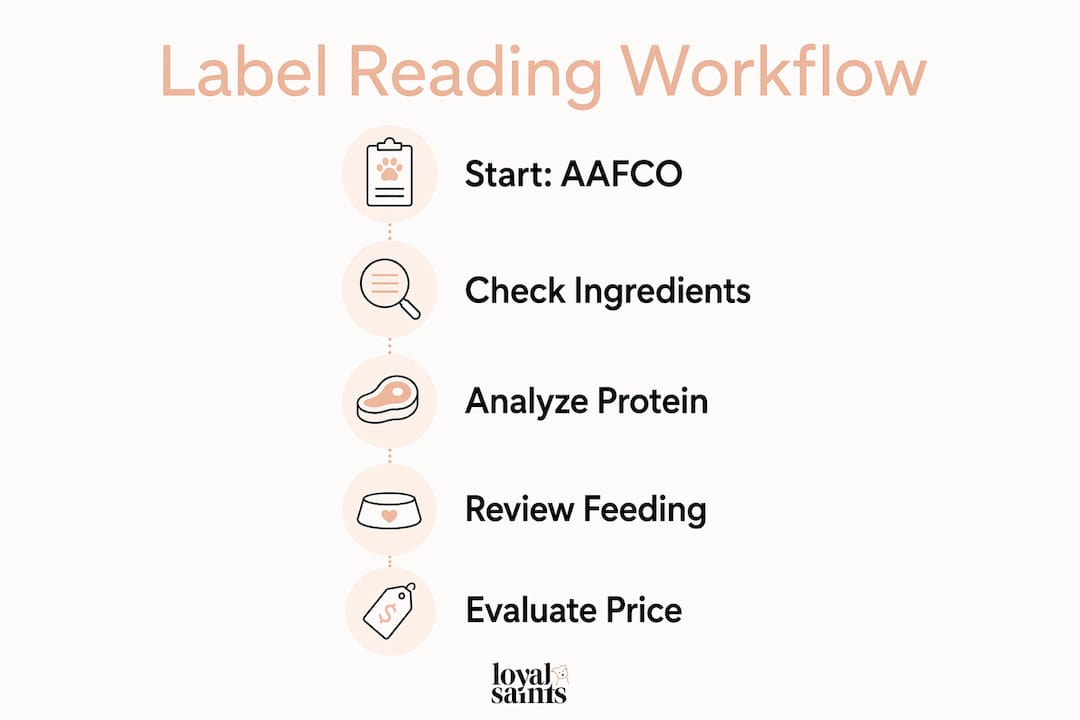
How to apply a step-by-step workflow to read dog food labels

The sequence you follow when reading a label matters as much as what you read. Starting with the front of the bag is the most common mistake dog owners make. Front packaging is marketing territory. The back and side panels are where the regulated, verifiable information lives.
Follow this order every time you evaluate a new food:
- Check the nutritional adequacy statement first. The AAFCO nutritional adequacy statement confirms whether the food is complete and balanced for your dog’s life stage, such as puppy, adult maintenance, or all life stages. If your dog is a senior, look for “adult maintenance” at minimum.
- Note the testing method. AAFCO feeding trials provide more rigorous proof of nutritional adequacy than formulation alone, because they involve actual animals monitored over weeks. A label that says “animal feeding tests” carries more weight than one that says “formulated to meet.”
- Read the guaranteed analysis panel. The guaranteed analysis provides minimums and maximums of protein, fat, fiber, and moisture. A food with 26% minimum crude protein and 15% minimum crude fat is a meaningfully different product from one showing 18% protein and 8% fat.
- Scan the ingredient list from top to bottom. Named proteins are ideal for quality indication. “Chicken” or “deboned beef” tells you exactly what you are getting. “Animal protein products” is a vague term the FDA does not permit on compliant labels. Look for a named protein in the first two or three positions.
- Check for ingredient splitting. If you see “ground corn,” “corn gluten meal,” and “corn bran” listed separately, mentally combine them. That combined quantity may outweigh the named protein at the top of the list.
- Review feeding directions as a starting point. Feeding guidelines are starting points, not exact prescriptions. Adjust portions based on your dog’s weight, activity level, and health status.
- Look up the manufacturer. Search the brand name alongside “recall history” before committing to a new food. The FDA maintains a public database of pet food recalls you can check in under two minutes.
Pro Tip: Calculate cost per ounce, not cost per bag. A $60 bag that lasts 45 days beats a $35 bag that lasts 20 days. Use the net quantity statement and feeding directions together to run this math before you buy.
Common pitfalls when deciphering pet food ingredients
Understanding the rules is one thing. Avoiding the traps is another. These are the most frequent errors dog owners make when reading labels, and each one can lead to a genuinely poor nutritional choice.
- Trusting front-of-bag claims over regulated sections. Words like “natural,” “premium,” and “holistic” have no legal definition in pet food. The FDA emphasizes that regulatory sections deserve priority over front packaging marketing. Flip the bag over.
- Missing ingredient splitting. Multiple similar grains split into different entries distort total quantity. Three separate corn entries could collectively outweigh the chicken listed first. Mentally consolidate similar ingredients to see the real picture.
- Ignoring a vague or missing AAFCO statement. If the nutritional adequacy statement is missing or says “intermittent or supplemental feeding only,” downgrade that product to a treat or add-on, not a complete meal. This is one of the most overlooked signals on any label.
- Overvaluing a single impressive ingredient. A food with “wild-caught salmon” as the first ingredient can still be nutritionally incomplete if the guaranteed analysis shows low protein and the AAFCO statement is absent. No single ingredient confirms overall quality.
- Treating feeding guidelines as fixed rules. A 50-pound active dog and a 50-pound sedentary dog have different caloric needs. Feeding directions are a starting range, not a prescription.
“The ingredients section is the most vital part of the label due to order-by-weight rules and naming requirements that directly impact what your dog actually consumes.” — Dr. Jerry Klein, AKC Chief Veterinary Officer
Cross-reference any new food with the dog food ingredient analyzer at Loyalsaintspets to verify ingredient quality against labeling standards before you commit.
How to compare pet foods using label reading for your dog’s needs
Once you know how to read a label, the next skill is comparison. Evaluating two foods side by side using a consistent framework removes guesswork and marketing influence from the decision.
Comparing foods by life stage
A puppy food must meet AAFCO nutrient profiles for growth, which require higher protein and calcium than adult maintenance formulas. A senior dog often benefits from lower caloric density and higher fiber. Always match the AAFCO life stage claim to your dog’s actual stage. You can learn more about how AAFCO protein standards affect your choice of food at Loyalsaintspets.
Side-by-side label comparison
| Comparison Factor | What to Look For |
|---|---|
| First named protein | Specific animal source (chicken, beef, salmon) vs. generic “meat” |
| Crude protein minimum | Higher percentage generally indicates more protein density |
| AAFCO testing method | Feeding trial preferred over formulation-only claim |
| Life stage match | Label must match your dog’s current stage (puppy, adult, senior) |
| Ingredient splitting | Check for repeated grain or starch entries that inflate perceived protein rank |
Grain-free foods are not automatically superior. Some dogs thrive on whole grains like brown rice or oatmeal, which provide fiber and steady energy. The right choice depends on your dog’s digestion, activity level, and any known sensitivities. For a deeper look at ingredient standards, the AAFCO standards guide at Loyalsaintspets breaks down what “complete and balanced” actually requires.
Price is a real factor, but cost per day of feeding is more useful than sticker price. A food with 30% crude protein fed at smaller portions can cost less per day than a lower-protein food fed at larger volumes.
Key takeaways
A reliable pet food label reading workflow starts with the AAFCO nutritional adequacy statement and works through the guaranteed analysis and ingredient list before considering any front-of-bag claims.
| Point | Details |
|---|---|
| Start with the AAFCO statement | Confirm the food is complete and balanced for your dog’s life stage before reading anything else. |
| Prioritize feeding trial labels | Foods validated by AAFCO feeding trials offer stronger nutritional proof than formulation-only claims. |
| Watch for ingredient splitting | Mentally combine similar ingredients to reveal their true combined weight in the formula. |
| Use guaranteed analysis for comparison | Compare crude protein and fat minimums across brands to evaluate actual nutrient density. |
| Ignore front-of-bag marketing | Regulatory terms on the back panel are legally defined; front claims like “premium” are not. |
What i’ve learned from reading hundreds of pet food labels
I have looked at a lot of pet food labels over the years, and the single most consistent finding is this: the owners who feel most overwhelmed are almost always starting in the wrong place. They read the front of the bag, get pulled in by a beautiful photo of a grilled chicken breast, and then feel lost when they flip it over and see a wall of text.
The workflow fixes that. When you have a sequence, the label stops feeling like a puzzle and starts feeling like a checklist. The AAFCO statement either passes or it does not. The first ingredient either names a protein or it does not. The guaranteed analysis either meets your dog’s needs or it does not. Each step is a binary decision, and that makes the whole process faster than most people expect.
What surprises me most is how often ingredient splitting goes unnoticed. I have seen labels where chicken was listed first, but three separate corn derivatives followed immediately after. Combined, those corn entries outweighed the chicken. That food was not a high-protein chicken formula. It was a corn-based food with some chicken in it. The label was technically compliant. It was also genuinely misleading to anyone who did not know what to look for.
My honest recommendation: run this workflow every single time you switch foods, not just when you are buying for the first time. Formulas change. Manufacturers update recipes without fanfare. A food that passed your review two years ago may look different today.
— Kristina
Why Loyalsaintspets makes label reading easier
When you know what a great ingredient list looks like, finding one becomes straightforward. Loyalsaintspets products are built around exactly the kind of transparency this workflow rewards.
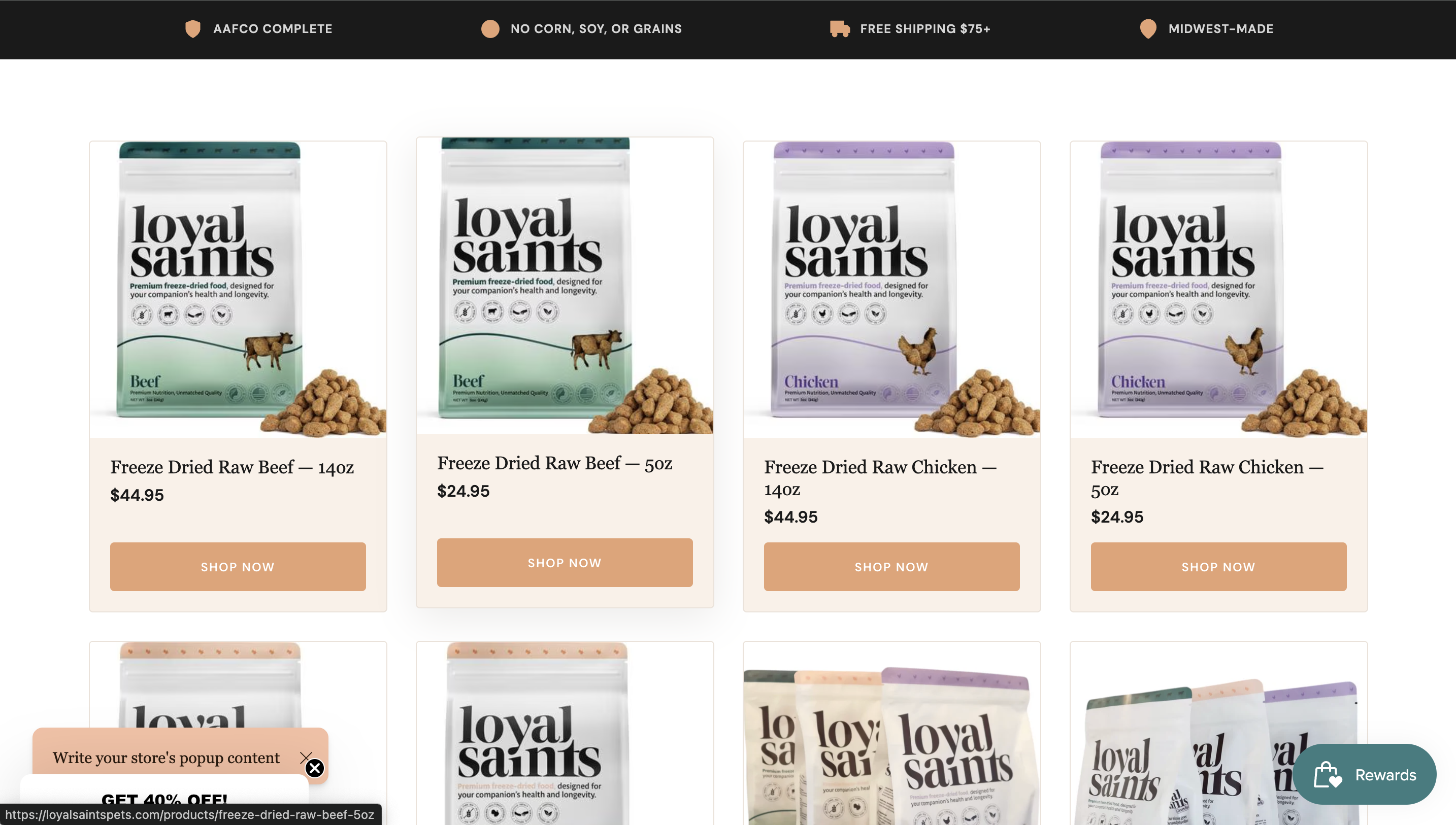
The freeze-dried raw chicken and freeze-dried raw beef options from Loyalsaintspets lead with a single, named protein and nothing else to hide. No fillers, no vague “animal by-products,” no ingredient splitting to decode. The ingredient list is short because the food is simple. That is exactly what a clean label looks like in practice. If you are ready to put your new label-reading skills to work, browse the full selection at the Loyalsaintspets shop and see how straightforward a transparent ingredient panel can be. More tail wags are coming.
FAQ
What is a pet food label reading workflow?
A pet food label reading workflow is a structured sequence for evaluating the regulated sections of a pet food label, starting with the AAFCO nutritional adequacy statement and working through the guaranteed analysis, ingredient list, and feeding directions. Following a set order prevents you from missing critical nutritional information.
What does the AAFCO statement mean on a dog food label?
The AAFCO nutritional adequacy statement confirms whether a food is complete and balanced for a specific life stage, such as puppy, adult maintenance, or all life stages. Foods validated by AAFCO feeding trials carry stronger nutritional proof than those that are only formulation-based.
Why does ingredient order matter on pet food labels?
The FDA requires ingredients to be listed in descending order by weight before processing, so the first ingredient is the heaviest. Named proteins like “chicken” or “deboned beef” in the top positions indicate a higher-quality protein source than vague terms like “meat meal.”
What should i do if a label has no AAFCO statement?
A missing or vague AAFCO statement means the product is not confirmed as complete and balanced. Treat it as a supplement or topper, not a primary meal, until you can verify its nutritional completeness with the manufacturer or a veterinarian.
How are feeding directions different from a feeding prescription?
Feeding directions on pet food labels are starting-point recommendations based on average dogs at a given weight. You should adjust portions based on your dog’s actual activity level, health status, and body condition, ideally in consultation with your veterinarian.


