
The single best approach to dog food storage for small spaces is simple: keep dry food in its original bag, sealed inside an airtight, food-grade container sized to match that bag, and tuck it into a cool, interior spot between 50–70°F. Two container types work especially well in tight quarters. A slim, vertical airtight canister fits neatly on a pantry shelf or kitchen corner without eating up counter space. A rolling, gasketed bin slides under furniture or into a closet and stays out of sight entirely. Both approaches protect freshness, block pests, and keep your home looking tidy — which matters a lot when every square foot counts.
For households feeding freeze-dried formats like those from Loyalsaintspets, the storage equation gets even simpler. Unopened freeze-dried pouches are shelf-stable and AAFCO-compliant, so they stack in a cabinet without refrigeration. Once opened, they still need airtight, moisture-proof secondary storage — more on that below. The FDA recommends keeping pet food in sealed containers and washing hands after handling, a baseline that applies to every format.
Key Takeaways
Airtight, right-sized containers stored in a cool interior spot — combined with a simple monthly cleaning routine — are the foundation of safe, space-efficient dog food storage in any small home.
| Point | Details |
|---|---|
| Airtight seal first | Choose a gasketed or threaded lid; test the seal before committing to a container. |
| Match size to consumption | Buy a bag you will finish in 4–6 weeks and a container sized to hold it without overstuffing. |
| Cool interior placement | Store between 50–70°F with humidity below 50%; avoid garages, laundry rooms, and porches. |
| Monthly cleaning routine | Wash containers with hot, soapy water and dry completely before refilling to prevent rancidity. |
| Loyalsaintspets freeze-dried | Compact, shelf-stable pouches reduce storage footprint and require no freezer space. |
Table of Contents
- What are the best space-saving dog food storage solutions?
- How do you choose the right dog food container for a small space?
- Where should you store dog food in a small home?
- DIY and furniture hacks that hide dog food in small homes
- Compact product picks that work in small spaces
- How does storing freeze-dried food differ from storing kibble?
- Maintenance and pest-proofing checklist
- What actually matters most about small-space pet storage
- Loyalsaintspets: premium freeze-dried food built for small-space living
- Sources
What are the best space-saving dog food storage solutions?
Small homes reward creativity. These eight ideas cover a range of budgets and skill levels, from zero-effort swaps to a quick weekend project. Each one keeps food sealed, accessible, and out of the way.
-
Slim vertical canister. Stands upright in a pantry corner or beside the fridge. Pro: uses dead vertical space. Con: narrow opening can make scooping awkward with large cups.
-
Stackable vault system. Two or three interlocking bins stack on a single pantry shelf. Pro: doubles or triples capacity without expanding the footprint. Con: you must unstack to reach the bottom bin.
-
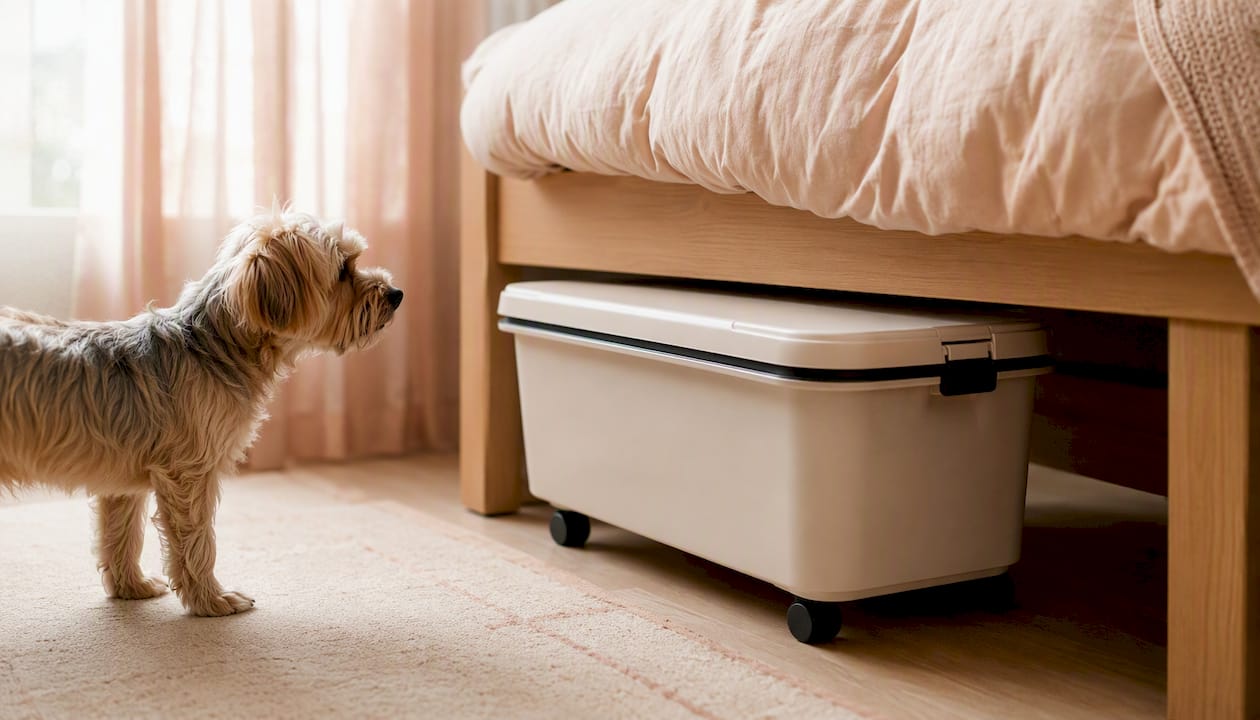
Rolling under-bed bin. A low-profile, gasketed container on casters slides under a bed frame or sofa. Pro: completely hidden and easy to pull out. Con: requires a bed frame with at least 6–8 inches of clearance.
-
Side table with internal bin. A small end table with a hinged top or hollow interior conceals a sealed plastic bin inside. Pro: doubles as furniture, zero visual clutter. Con: interior dimensions limit bag size.
-
Pull-out trash-drawer repurpose. An under-counter pull-out drawer (originally for trash) lined with a food-grade bin. Pro: already built into many kitchens, no new furniture needed. Con: requires a compatible cabinet and a correctly sized insert bin.
-
Lidded basket with inner container. A wicker or fabric basket holds a sealed food-grade canister inside. Pro: looks decorative, works in living rooms. Con: the basket itself is not airtight — the inner container must be.
-
Wall-mounted dispenser. A gravity-feed dispenser mounts to a pantry wall or inside a cabinet door. Pro: frees up floor and shelf space entirely. Con: most hold only 10–15 lbs and are harder to clean thoroughly.
-
Stair-nook drawer. Custom or prefab pull-out drawers built into the risers of a staircase. Pro: uses otherwise wasted space. Con: requires basic carpentry or a prefab stair-drawer kit.
Repurposed furniture and creative hidden storage — side tables, pull-out drawers, stair nooks, and lidded baskets — are practical, renter-friendly options as long as the inner container stays sealed.
How do you choose the right dog food container for a small space?
Start here: match container capacity to the bag you buy. A container that fits your typical bag size reduces trapped oxygen and means you never have to split a bag across two bins. Aim to buy a bag size you will finish within 4–6 weeks, then choose a container that holds that amount comfortably without being half-empty.
Seal type
A gasketed lid (a rubber or silicone ring around the rim) creates a reliable airtight seal with minimal effort. Threaded lids, like a screw-top, work well but can wear over time. Push-button or snap-lock lids are convenient but vary widely in seal quality — press the sides of a closed container: if you hear air escaping, the seal is not reliable.
Pro Tip: To test airtightness at home, place a damp paper towel inside a closed empty container for 24 hours. If the towel is still damp the next day, the seal is holding. If it has dried out, air is exchanging and the container needs a better lid.
Material
Food-grade HDPE or BPA-free plastic is lightweight, affordable, and widely available. Stainless steel is more durable and resists odor absorption, though it costs more and is heavier. Metal tins look attractive but can rust at the seam if moisture gets in. For small spaces, BPA-free plastic or stainless steel are the most practical choices.
Footprint and shape
Slim, vertical containers use height rather than floor area, which is the right trade-off in a pantry or closet. Wide, low bins work better under furniture. Measure your target spot before buying — a container that is one inch too tall for a shelf is useless regardless of its other features.
Openings, mobility, and extras
Wide-mouth openings make scooping easier, especially in tight spots where you cannot tilt the container. Wheels or handles matter if you store food under furniture and pull it out daily. Stackable designs and rolling bins maximize vertical and hidden storage, and features like removable inner buckets and included scoops improve both daily use and monthly cleaning.
A rough capacity guide: a 10–15 lb bag fits a 15–20 quart container; a 20–25 lb bag needs roughly 30–33 quarts; a 40–50 lb bag requires 45–50 quarts. When in doubt, choose the next size up rather than overstuffing — a jammed lid will not seal properly.
Where should you store dog food in a small home?
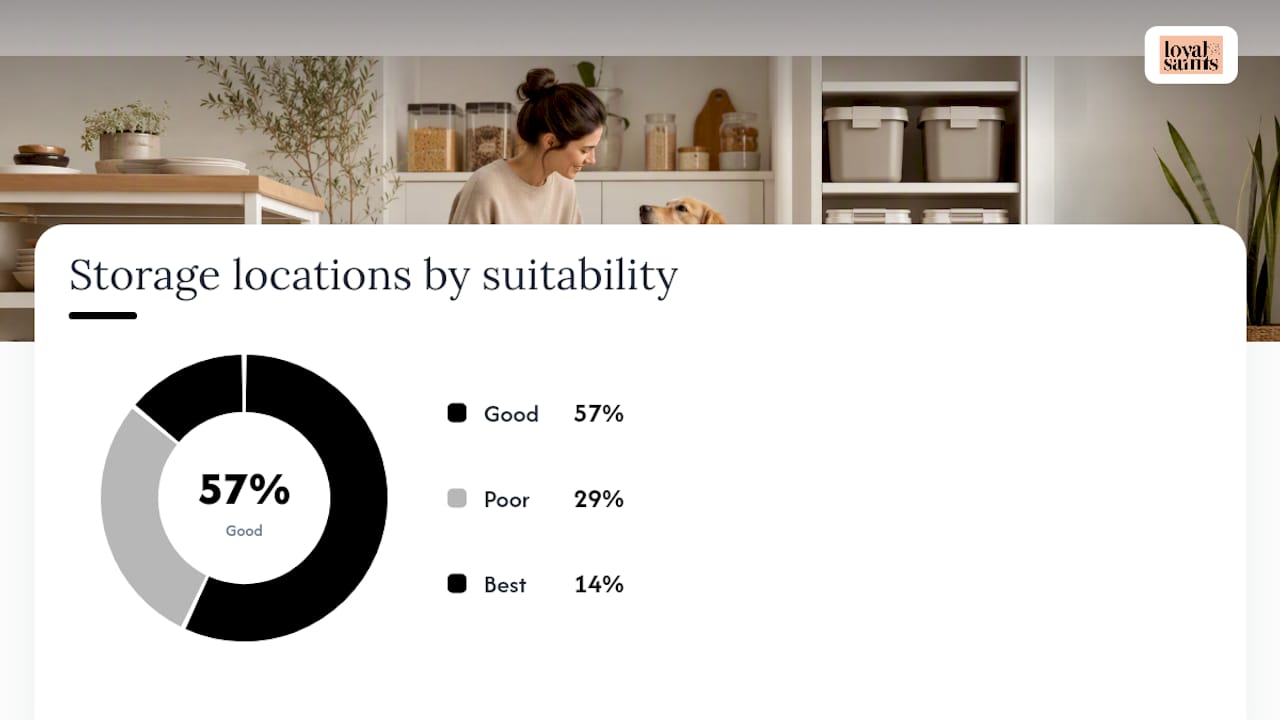
Pick an interior, climate-stable spot. Dry pet food stays freshest in a cool, dry indoor location — roughly 50–70°F with humidity below about 50%. Garages, laundry rooms, and porches swing too far in temperature and humidity, which accelerates fat oxidation and nutrient loss. The pantry wins for daily access; a hallway closet or under-bed location works well for bulk storage.
| Location | Temp/Humidity Suitability | Small-Space Notes |
|---|---|---|
| Pantry shelf | Best (50–70°F, low humidity) | Ideal for daily-use containers; use slim vertical canisters to save shelf depth |
| Kitchen lower cabinet | Good (climate-controlled) | Pull-out drawer insert works well; keep away from oven heat |
| Hallway closet | Good (climate-controlled) | Stackable bins use vertical space efficiently |
| Under-bed rolling bin | Good if interior room (not garage) | Requires 6–8 in. clearance; gasketed lid is a must |
| Stair nook | Good if interior (not exterior wall) | Custom or prefab drawer kits available; check for drafts |
| Garage | Poor (temperature swings, humidity) | Accelerates spoilage; avoid unless climate-controlled |
| Laundry room | Poor (heat, humidity, detergent fumes) | Not recommended for any pet food format |
For small-space households, pantry organization techniques that prioritize vertical shelving and sealed containers translate directly to pet food storage — the same principles that keep human food fresh apply here.
Rotation and timing: buy what your dog will eat within 4–6 weeks, check seals weekly, and inspect your storage location’s humidity seasonally. A $10 hygrometer placed near the storage spot tells you instantly whether conditions are safe.
DIY and furniture hacks that hide dog food in small homes
Small, inexpensive modifications can create tidy, hidden storage without permanent changes — which matters if you rent. Here are three renter-friendly hacks, each doable in an afternoon.
Hack 1: Convert a side table into a hidden bin
What you need: a small hollow side table (thrifted or flat-pack), one food-grade airtight bin sized to fit the interior, a waterproof mat, and a screwdriver.
- Measure the interior cavity of the table (height, width, depth).
- Purchase a food-grade airtight bin that fits with at least half an inch of clearance on each side.
- Place the waterproof mat on the interior floor of the table to protect against condensation.
- Set the sealed bin inside the table.
- Close the table lid or door. The bin’s own lid stays on at all times.
- Label the bin with the food type and the date you opened the bag.
- Pull the bin out for scooping; replace and close the table immediately after.
Safety note: keep the table away from radiators, heating vents, and gas appliances. The table’s exterior is decorative — the sealed bin is doing all the preservation work.
Hack 2: Repurpose a pull-out trash drawer
What you need: an existing under-counter pull-out trash cabinet, one food-grade bin with a gasketed lid that fits the drawer frame, and a non-slip liner.
- Remove the existing trash can from the pull-out frame.
- Measure the frame’s interior dimensions.
- Choose a food-grade bin with a gasketed lid that fits the frame with room to lift the lid fully when the drawer is open.
- Line the drawer base with a non-slip mat.
- Place the sealed bin in the drawer.
- Slide the drawer closed. The bin lid stays sealed between feedings.
- Pull the drawer open only for scooping; close it fully after each use.
Creative hidden storage ideas like this one are especially practical for apartment kitchens where floor space is already spoken for.
Hack 3: Build a rolling under-bed drawer
What you need: a low-profile food-grade bin with a gasketed lid, four swivel casters rated for the bin’s filled weight, a drill, four short screws, and a non-slip mat.
- Confirm your bed frame has at least 6–8 inches of clearance from floor to frame.
- Measure the bin’s base footprint and confirm it fits under the frame with room to maneuver.
- Flip the bin upside down and mark the four caster positions near each corner.
- Drill pilot holes and attach the casters with screws.
- Flip the bin right-side up and place the non-slip mat inside the bin base.
- Fill the bin (food stays in its original bag inside the bin), seal the gasketed lid, and roll it under the bed.
- Pull it out for scooping, reseal immediately, and roll it back.
Safety note: elevate the bin on casters so it is not sitting directly on a cold or damp floor. Secure the lid against curious pets — a bungee cord looped around the bin handles works well.
Compact product picks that work in small spaces
For small-space shoppers, the right categories are slim vertical canisters, rolling gasketed bins, and travel-size portion carriers. Prioritize airtight sealing and a wide enough opening to scoop without spilling. Food-grade materials, tight seals, and wide openings are the three features worth paying for — everything else is a bonus.
-
Slim airtight vertical canister (10–20 lb capacity). Narrow footprint, stands upright on a pantry shelf or beside the fridge. Pro: uses vertical space efficiently. Con: can tip if placed on an uneven surface. Widely available online and at major US pet retailers.
-
Rolling gasketed bin (20–50 lb capacity). Low-profile with swivel casters and a rubber gasket lid. Pro: easy to pull from under furniture; large capacity for multi-pet homes. Con: footprint is wider, so it needs a flat, clear floor path. Available at US home goods and pet supply stores.
-
Stackable vault set (10–15 lb each). Two or three interlocking bins that share a single shelf footprint. Pro: doubles capacity without new furniture. Con: bottom bin requires unstacking to access. Common online.
-
Travel or portion carrier (1–5 lb capacity). Small, sealed pouch or canister for day trips or single-meal portions. Pro: perfect for freeze-dried formats and travel. Con: not practical as a primary storage solution for larger dogs.
Why freeze-dried formats change the storage equation
Loyalsaintspets’ Freeze Dried Raw Chicken (14oz), Freeze Dried Raw Chicken (5oz), and Freeze Dried Raw Beef (14oz) are shelf-stable unopened, which removes the need for freezer space entirely. The compact pouch format fits in a kitchen drawer, a small pantry shelf, or even a cabinet door organizer — a genuine advantage when storage space is measured in inches. Once opened, the same airtight rules apply: reseal in the original pouch and place inside a secondary airtight container to block moisture.
How does storing freeze-dried food differ from storing kibble?
Freeze-dried products are shelf-stable unopened, making them especially convenient for small spaces. Many freeze-dried formats have an unopened shelf life measured in months, and because they require no refrigeration, they free up freezer and refrigerator space entirely. That is a meaningful trade-off in a studio apartment or small kitchen.
After opening, though, the rules tighten. Moisture is the main enemy of freeze-dried food — even a small amount of humidity can begin to rehydrate the product and degrade texture and nutrition. Freeze-dried raw dog food retains nutrients well but requires airtight, moisture-free storage after opening, and may benefit from a small food-safe desiccant packet placed inside the secondary container.
Practical steps for opened freeze-dried pouches:
- Press out excess air and reseal the original pouch using the built-in zip or a binder clip.
- Place the resealed pouch inside a secondary airtight container.
- Add a food-safe desiccant packet if you live in a humid climate or if the container will be opened frequently.
- Label the container with the opened date.
- Follow the manufacturer’s guidance on how quickly to use the opened product.
For storing Loyalsaintspets freeze-dried food safely at home, the same principles apply: cool, dry, airtight, and labeled.
AAFCO sets nutritional standards for complete pet foods, and Loyalsaintspets’ freeze-dried items meet those standards — but proper storage after opening is what keeps that nutrition intact until the last serving.
A note for households with infants, elderly family members, or immunocompromised individuals: follow your veterinarian’s and the manufacturer’s guidance before introducing raw-style or freeze-dried raw products into the home. Handling protocols matter in those situations.
Maintenance and pest-proofing checklist
Staying on top of a simple routine keeps food fresh and pests out. Here is what to do and when.
Daily
- Close lids fully after every feeding — do not leave containers open between meals.
- Wipe the scoop clean and store it inside or beside the sealed container.
Weekly
- Wipe the exterior of the container with a damp cloth to remove crumbs and dust.
- Check the area around the container for spilled kibble or crumbs that could attract insects or rodents.
- Inspect the lid seal visually — look for cracks, warping, or debris caught in the gasket.
Monthly
- Wash containers with hot, soapy water and dry completely before refilling to prevent oils and residue from turning rancid. This step is especially important with oilier kibbles and raw-style foods.
- Check the gasket or seal ring for wear and replace it if it feels brittle or no longer compresses evenly.
Seasonally
- Rotate stock: use older bags before opening new ones.
- Check your storage location’s humidity with a hygrometer — if readings consistently exceed 50%, move the container to a drier spot.
- Inspect for signs of pest activity (gnaw marks, droppings, webbing) around and under storage areas.
Pest-proofing specifics
- Elevate containers at least 6 inches off the floor when possible (casters count).
- Use gasketed lids — insects and rodents can work their way into folded bags or loosely closed containers surprisingly fast.
- Place a small food-safe desiccant pack inside the container if you live in a humid climate.
- Avoid ground-level floor storage in basements, garages, or any space that gets damp seasonally.
For long-term freeze-dried food storage, the monthly wash-and-dry step is just as important as it is for kibble — residue builds up even with drier formats.
What actually matters most about small-space pet storage
Most storage guides focus on the container itself. The bigger variable is placement. A beautiful airtight canister stored in a humid garage will fail faster than a basic bin kept in a cool interior closet. Temperature and humidity do more damage to dog food than almost any other factor, and in small homes, the temptation to use whatever space is available — a corner of the laundry room, a shelf above the dryer — is real.
The other thing people underestimate is the cost of buying too large a bag to save money. A 40 lb bag sounds economical, but if it takes three months to finish and sits in a container that gets opened daily, the last third of that bag is likely stale regardless of how good the container is. Buying a bag size matched to 4–6 weeks of consumption and a container matched to that bag is almost always the better call for both freshness and space.
Freeze-dried formats like those from Loyalsaintspets flip this math in a useful way. The smaller package sizes — a 5oz or 14oz pouch — mean you are almost never storing more than a week or two of food at once. Less food to store, less space needed, and less risk of the last serving being nutritionally compromised. For small-space households, that is a genuinely practical advantage, not just a marketing point.
Loyalsaintspets: premium freeze-dried food built for small-space living
If you are rethinking your dog’s food storage, it is worth rethinking the food format at the same time. Loyalsaintspets’ freeze-dried raw dog food comes in compact, shelf-stable pouches — no freezer required, no bulky bags to wrestle into a rolling bin. The Freeze Dried Raw Chicken (14oz) and Freeze Dried Raw Beef (14oz) fit in a kitchen drawer or a single pantry shelf, and the 5oz Freeze Dried Raw Chicken is ideal for travel or single-day portions.
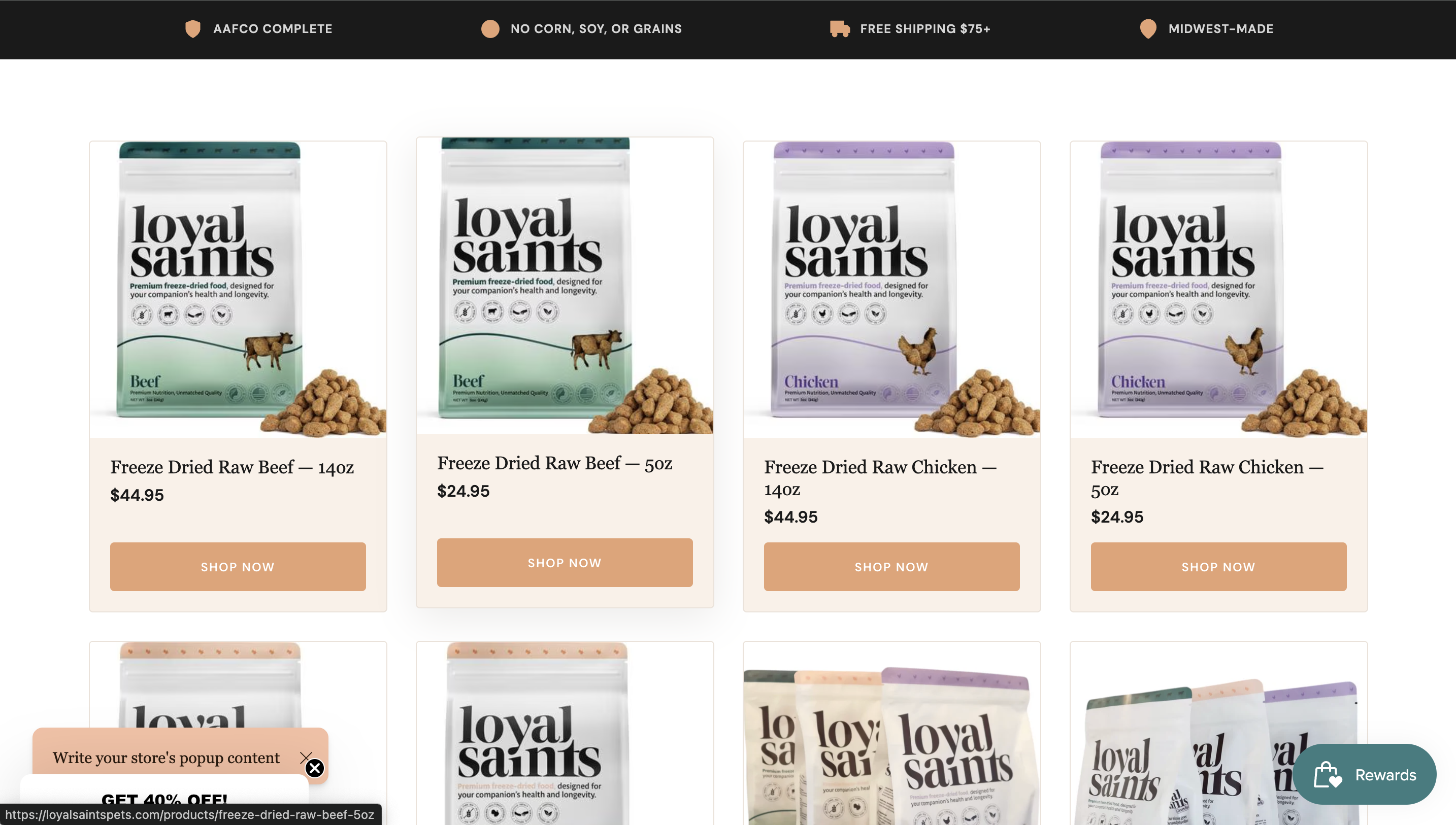
Every Loyalsaintspets product is made with human-grade, whole ingredients, free of fillers and synthetic additives, and formulated to meet AAFCO nutritional standards. The Halo Club membership adds recurring savings and free shipping, so you always have a fresh pouch on hand without overstocking. Visit Loyalsaintspets to find the right size for your dog and your space.
Sources
- How to store pet food properly so it stays fresh and safe | Honokage
- The best dog food containers: airtight, stackable options | Petmate Academy
- Dog food storage containers | Petful
- 10 dog food storage ideas | The Spruce
- How to store dog and cat food | OXO blog


