
Raw dog food can carry a legitimate “complete and balanced” claim under AAFCO’s model rules, but only if the maker backs that claim with real substantiation. Before you buy anything, flip the bag over and find three things: a nutritional adequacy statement citing an AAFCO nutrient profile or feeding trial, feeding directions matched to your dog’s life stage, and a guaranteed analysis. Because raw meat carries microbial risk, handle it the way you’d handle raw meat for your own dinner.
TL;DR:
- Raw dog foods claiming to be complete and balanced must be backed by either AAFCO nutrient profiles or actual feeding trials, verified through label statements.
- Manufacturers self-certify their formulas meet AAFCO standards, with enforcement relying on state inspections and FDA oversight, so no official approval stamps exist.
- Proper handling of raw meat-based diets is essential to prevent microbial risks, including safe storage, pathogen testing, and dedicated kitchen utensils.
- Feeding directions based on weight and life stage should be used as starting points, with regular adjustments and vet consultation for health issues or unexpected weight changes.
- When choosing raw diets, verify the packaging explicitly states the formulation method, target life stage, safety process controls, and includes complete ingredient and contact information.
Table of Contents
- What AAFCO Raw Dog Food Rules Actually Cover
- Nutrient Profiles vs. Feeding Trials: How Raw Formulas Prove Adequacy
- The Label Checklist Every Raw Dog Food Buyer Should Run
- Handling Raw Dog Food Safely at Home
- Turning Feeding Directions Into a Real Feeding Plan
- How Loyalsaintspets Approaches AAFCO-Formulated Raw Nutrition
- Choosing Between Raw and Heat-Treated: An Editorial Take
- Where to Find AAFCO-Formulated Raw Options From Loyalsaintspets
- Where to Verify These AAFCO Claims Yourself
- Sources
What AAFCO Raw Dog Food Rules Actually Cover
AAFCO does not test, license, or approve any pet food, raw or otherwise. It writes model nutrient profiles and model labeling regulations that states and the FDA then adopt into their own enforcement codes. When a bag says its formula meets AAFCO’s requirements, that’s the manufacturer’s own claim, not a stamp AAFCO handed out.
Here’s how the oversight actually breaks down in practice:
- AAFCO publishes the nutrient math and the Official Publication that defines terms like “complete and balanced.”
- Individual states run feed-control programs that license products and inspect facilities.
- The FDA polices interstate commerce, ingredient safety, and false or misleading labeling.
- Manufacturers self-certify that their formula meets AAFCO’s targets, and regulators can audit that claim after the fact.
That structure explains why you’ll never find an official AAFCO seal, a certified list of AAFCO raw dog food brands, or an approval database to search. There is no such registry, according to AAFCO’s own FAQ page. The label’s wording is the only proof you get, which is exactly why learning to read it matters more than trusting a logo.
Nutrient Profiles vs. Feeding Trials: How Raw Formulas Prove Adequacy
A food can only carry a “complete and balanced” claim in one of two ways, and the FDA spells out both as the sole accepted routes.
- AAFCO Dog Food Nutrient Profiles: the manufacturer formulates to meet specific minimums (and some maximums) for protein, fat, vitamins, and minerals, calculated on a dry matter basis so foods with different moisture content can be compared fairly.
- AAFCO feeding trials: the manufacturer actually feeds the finished food to dogs over a set period and monitors health markers, rather than just running the recipe through a nutrient calculator.
Pro Tip: A feeding-trial product doesn’t always print nutrient-profile numbers on the bag, since it proved adequacy a different way. If a raw food’s label just says “formulated to meet AAFCO standards” with no life stage named, email the manufacturer and ask which method they used and for which life stage.
Nutrient profiles split into two categories: growth and reproduction, and adult maintenance, with growth carrying higher minimums for calcium, phosphorus, and protein. A raw food built only for adult maintenance is not automatically safe for a puppy or a nursing mother, no matter how premium the ingredients look. Both the AAFCO Dog and Cat Food Nutrient Profiles and the finished-product feeding trial route are legitimate, but they answer slightly different questions about the same bag of food.
The Label Checklist Every Raw Dog Food Buyer Should Run
AAFCO’s model regulations require eight items on every pet food label, but three of them tell you almost everything you need for an adequacy decision.
- Nutritional adequacy statement. Look for language naming a life stage and citing either AAFCO nutrient profiles or feeding trials. No statement means the product is likely intended as a treat or topper, not a full diet.
- Guaranteed analysis. This lists minimum crude protein and fat, maximum fiber and moisture, on an as-fed basis. To compare a raw food against a kibble fairly, strip out the water: divide each guarantee by (100 minus moisture percentage), then multiply by 100 to get the dry matter figure.
- Feeding directions. Required specifically for complete and balanced products; amount per body weight and frequency should be spelled out, not vague.
- Ingredient statement and manufacturer contact. Ingredients listed by weight, plus a real name and address you can actually call.
If a raw product skips feeding directions entirely, or lists no adequacy statement, treat it as supplemental rather than a full replacement for your dog’s diet. Our guide on AAFCO protein standards breaks down what those life-stage terms mean in plainer language.
Handling Raw Dog Food Safely at Home
Raw diets skip the heat-kill step that most kibble and canned foods rely on, so bacteria like Salmonella can survive into the bowl. That’s not a reason to panic, but it is a reason to treat raw dog food exactly like raw meat in your own kitchen, a point AAFCO addresses directly in its consumer guidance.
Look for manufacturers who publish real process controls rather than vague marketing language:
- Cold-chain shipping and storage instructions, not just “keep frozen.”
- Disclosed pathogen testing or a stated food-safety process (high-pressure processing, freeze-drying, or similar).
- Clear lot-tracking in case of a recall.
Pro Tip: Keep a dedicated cutting board and set of bowls for raw meals, run them through the dishwasher’s hot cycle, and wash your hands before and after prep. Households with infants, elderly members, or anyone immunocompromised should talk to a vet before feeding raw, since human exposure risk is part of the equation too.
Turning Feeding Directions Into a Real Feeding Plan
Feeding directions are mandatory for any product claiming complete and balanced status, and they should give you a starting amount tied to your dog’s weight and life stage. AAFCO’s profiles assume a caloric density around 4,000 kcal ME/kg on a dry matter basis for these calculations, which is why a very calorie-dense raw or freeze-dried food often calls for a smaller volume than a bag of kibble.
Treat the printed amount as a starting point, not gospel:
- Weigh your dog monthly and adjust portions by 10 percent if you see steady weight gain or loss.
- Puppies and pregnant or nursing dogs need growth-formulated feeding amounts, not adult maintenance math.
- Body condition score (ribs easily felt but not visible, a visible waist from above) matters more than the number on the bag.
Call your vet if your dog loses weight unexpectedly, refuses food, or has a diagnosed condition like kidney disease or pancreatitis, since those situations often call for a different nutrient balance than a standard adult maintenance formula. Our piece on balanced canine nutrition walks through body condition scoring in more depth.
How Loyalsaintspets Approaches AAFCO-Formulated Raw Nutrition
Loyalsaintspets builds its freeze-dried raw beef and other single-protein recipes from human-grade, whole ingredients, with a formulation aimed at meeting AAFCO nutrient standards rather than skipping the question entirely. No fillers, no synthetic additives, just protein, produce, and the nutrient math done properly.
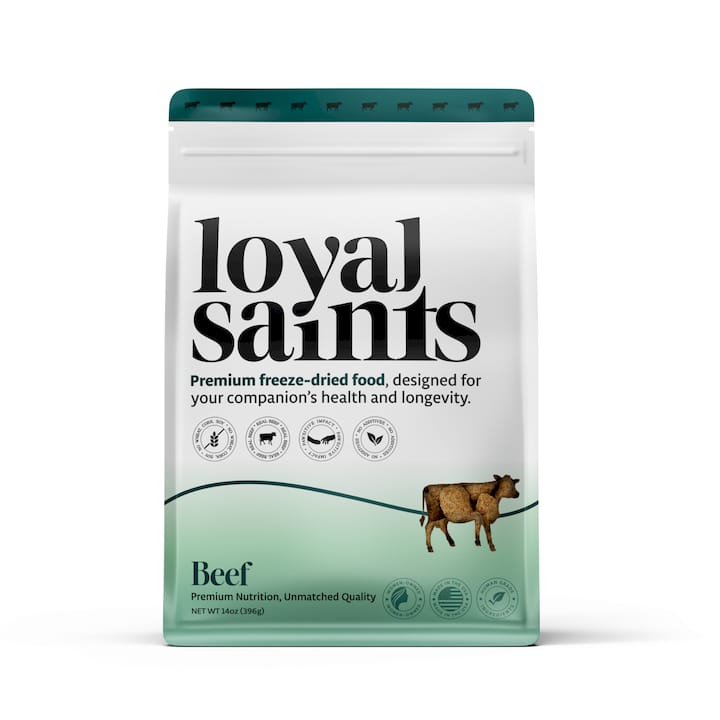
Because freeze-drying removes moisture without cooking out nutrients the way high-heat processing can, it gives you a shelf-stable format that still carries the balanced nutrition profile buyers look for in a raw diet, minus the freezer space and thaw planning.
Before you buy any raw food, including ours, ask the manufacturer these questions directly:
- Does this recipe meet an AAFCO nutrient profile, or was it validated through a feeding trial?
- What life stage is it formulated for?
- What process controls or lab testing back up the safety claims?
- What do storage and handling instructions look like once the package is opened?
Loyalsaintspets welcomes those questions, and our breakdown of AAFCO standards for premium nutrition covers exactly why a formulation statement means more than a shiny seal on the front of the bag.
Choosing Between Raw and Heat-Treated: An Editorial Take
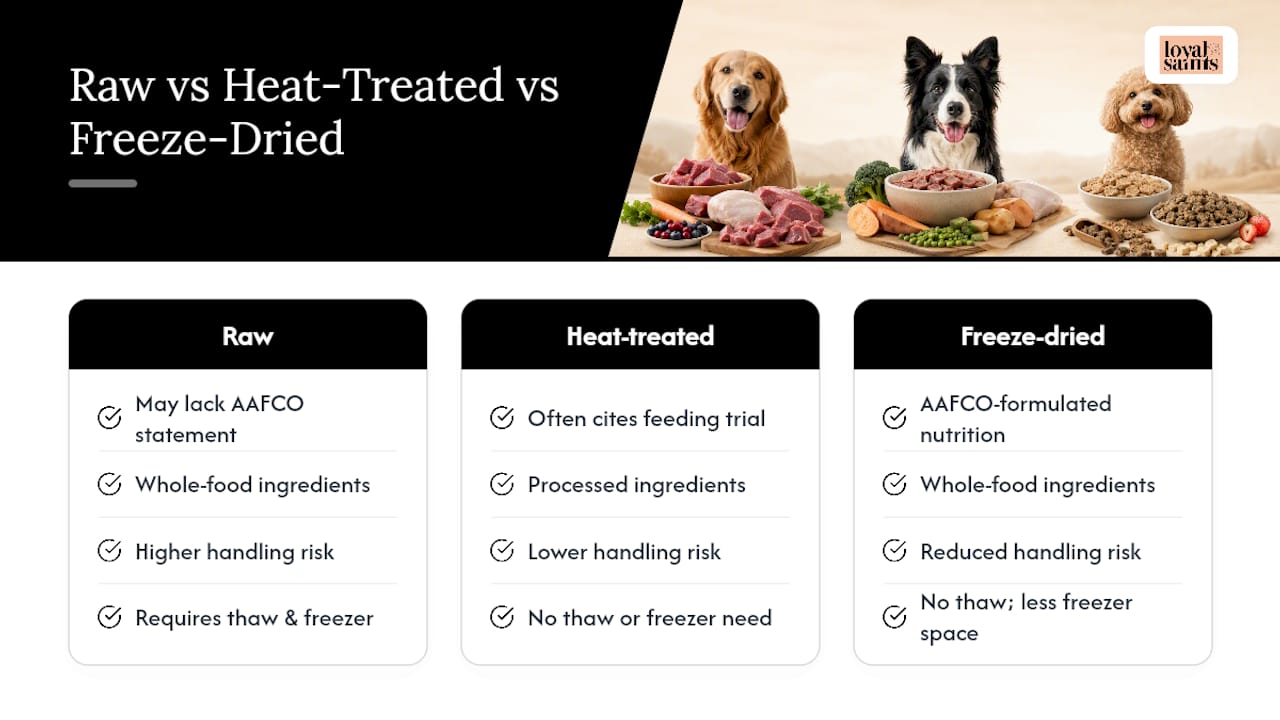
Raw feeding isn’t inherently better or worse than heat-treated food. It’s better or worse depending on whether the maker actually did the AAFCO homework and whether your household can handle raw meat safely. A beautifully marketed raw diet with no adequacy statement is a bigger gamble than a boring kibble that cites a feeding trial.
Freeze-dried raw splits the difference in a way I think more owners will lean into over the next few years: you keep the whole-food ingredient list and the AAFCO-formulated nutrition, but you lose the thawing, the freezer real estate, and some of the handling risk. It’s not a shortcut, it’s a format choice. For puppies, pregnant dogs, or any dog with a medical diagnosis, loop in your vet before switching, since life-stage and condition-specific needs can override general guidance fast.
— Kristina
Where to Find AAFCO-Formulated Raw Options From Loyalsaintspets
Everything covered above (the adequacy statement, the feeding directions, the process controls) is printed right on Loyalsaintspets packaging, so you don’t have to take our word for anything.
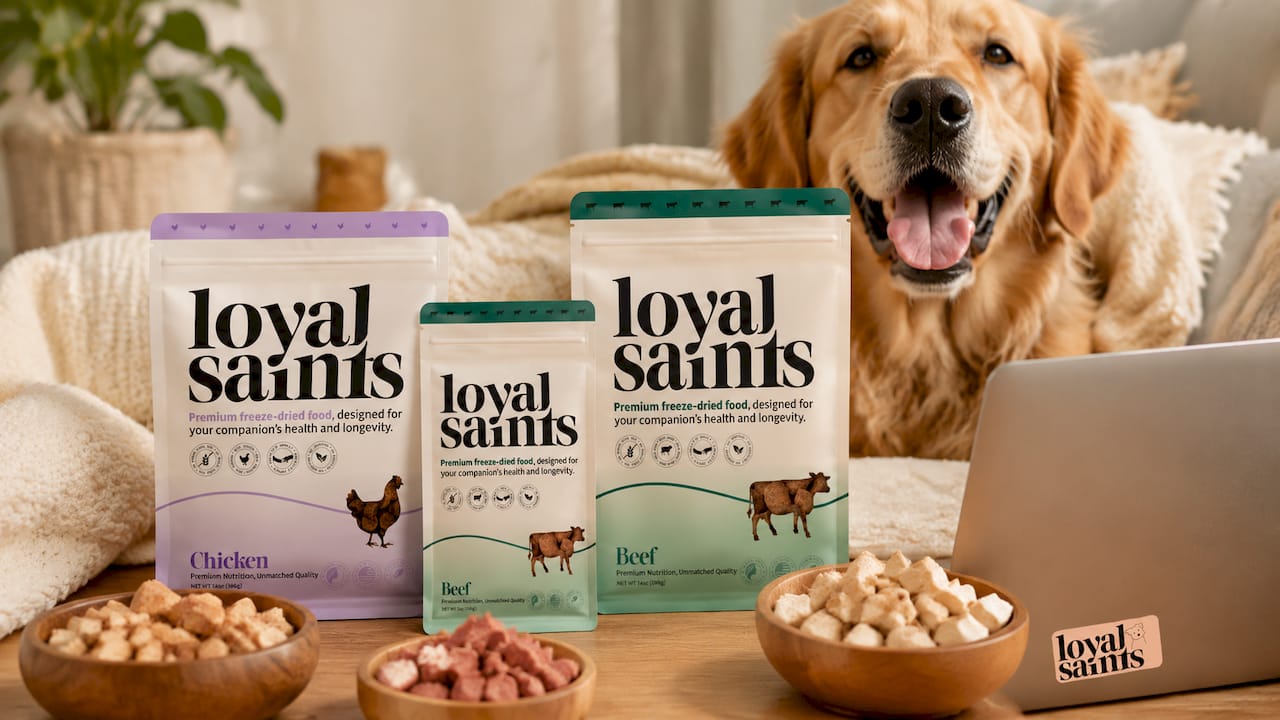
The Freeze Dried Raw Beef, 14oz works as a household staple for single-dog homes wanting a full bag between orders, while the 5oz beef option suits smaller dogs, trial runs, or travel. If chicken agrees better with your dog’s stomach, the Freeze Dried Raw Chicken, 14oz carries the same single-protein, AAFCO-formulated approach.
Joining the Halo Club subscription knocks down the per-bag cost and includes free shipping once your order crosses the site’s threshold, which matters if raw feeding is going to be a long-term habit rather than a one-bag experiment. Pull up any product page, check the nutritional adequacy statement and feeding directions yourself, and decide from there.
Where to Verify These AAFCO Claims Yourself
- FDA: “Complete and Balanced” Pet Food covers how nutrient profiles and feeding trials substantiate adequacy claims.
- AAFCO’s Role explains what AAFCO does and does not regulate.
- AAFCO: Raw Foods details microbial risk and handling guidance.
- AAFCO Labeling Requirements lists every required label element.
AAFCO sets the models; your state feed-control office and the FDA are the ones who actually enforce them.
Sources
- “Complete and Balanced” Pet Food | FDA
- AAFCO’s role | AAFCO
- Raw foods | AAFCO
- Labeling labeling requirements | AAFCO


