
If you want the short answer: freeze-dried diets usually keep more amino acids, fats, and vitamins intact than kibble, and that can give your dog’s gut and immune system better raw material to work with.
Here’s the simple version:
- Freeze-dried food uses low heat, so more nutrients stay closer to their original form.
- Kibble uses high heat and pressure, which can lower some amino acids and vitamins.
- Studies in dogs found higher amino acid use in freeze-dried diets than in extruded diets.
- Freeze-dried diets are also tied to smaller, firmer stools, less fecal waste, and some stronger gut immune markers.
- But there’s a limit: we do not have large, long-term studies showing freeze-dried food prevents disease or extends life.
So when I look at immune health, I’d sum it up like this: less processing usually means more of the nutrients your dog needs for immune cell function, gut lining support, and inflammation control.
Is Freeze-Dried Dog Food ACTUALLY Safe for Your Pup?
sbb-itb-b2753ee
Quick Comparison
| What matters | Freeze-dried protein | Kibble |
|---|---|---|
| Processing | Low-temperature moisture removal | High-heat extrusion |
| Amino acid use | Higher in studies | Lower in studies |
| Vitamin retention | Higher | Lower; often added back after processing |
| Fat stability | Better omega retention | More heat/air damage risk |
| Stool output | Smaller, firmer | Larger, softer |
| Gut markers | Higher local gut immune markers in some studies | Lower in some studies |
| Cost | Higher | Lower |
| Proof on long-term disease outcomes | Limited | Limited |
A few numbers stand out. Research cited in the article reports up to 97% nutrient retention in freeze-dried food, with protein use around 88%–92% versus 82%–85% for kibble. A 2023 University of Illinois Urbana-Champaign study also found the freeze-dried diet had the highest amino acid digestibility, while the extruded diet had the lowest.
For you, that means the comparison is not just about texture or shelf life. It’s about how much of the food still works after processing - and how much your dog can use after eating it, which is a key factor in digestive health.
How processing changes immune-supporting nutrients
What freeze-drying helps preserve
Freeze-drying removes moisture without high heat. That matters because it helps keep protein structure in better shape and protects heat-sensitive nutrients that play a part in immune function.
Some of the nutrients that matter most here don't do well under high temperatures. Amino acids like lysine and threonine help with immune cell regeneration and antibody production, and freeze-drying helps keep more of them intact and bioavailable. Vitamins A, D, E, and K help support skin barrier health and antioxidant defenses. Omega fatty acids help regulate inflammation. Research suggests freeze-dried food can retain up to 97% of original nutrients [8].
What extrusion can reduce or alter in kibble
Kibble is made through high-heat extrusion under intense pressure. That process can put stress on heat-sensitive nutrients.
Heat can lower amino acid availability, especially lysine and threonine. That cuts into the diet's immune-supporting value. It can also trigger the Maillard reaction, which reduces reactive lysine and signals protein damage. On top of that, high heat may degrade B vitamins and oxidize essential fatty acids. That's one reason kibble often needs synthetic vitamin supplementation after processing.
There's another piece worth noting. High-heat processing is also linked to the formation of Advanced Glycation End-products (AGEs), compounds now being studied for their possible role in chronic inflammation in dogs [5].
Comparison table: nutrient retention in freeze-dried protein vs. kibble
| Feature | Freeze-Dried Protein | Extruded Kibble |
|---|---|---|
| Processing Method | Sublimation (low-temperature vacuum moisture removal) | High-heat extrusion and pressure |
| Heat Exposure | Minimal to none | High |
| Protein Integrity | High; preserves native protein structure | Lower; proteins can be denatured |
| Amino Acid Availability | Very high (90%+ for most essentials) [1] | Moderate (about 80%–85%) [1] |
| Vitamin Retention | High; includes vitamins A, D, E, and K | Reduced; often requires synthetic supplementation |
| Essential Fatty Acids | Better preserves omega fatty acids | Can be oxidized by heat and air exposure |
| Protein digestibility | 88%–92% [5] | 82%–85% [5] |
Preservation is one part of the picture. The next part is whether a dog can actually absorb those nutrients.
A November 2023 University of Illinois Urbana-Champaign study compared five commercial diets. The researchers found that the freeze-dried diet had the highest amino acid digestibility overall, while the extruded diet had the lowest. Lysine and threonine digestibility were also much higher in freeze-dried and frozen raw formats than in extruded diets [1][2].
"Our results support the notion that AA digestibilities are affected by diet processing, with FD [freeze-dried], HFD [hybrid freeze-dried], FRZN [frozen raw], and FRSH [fresh] diets having higher AA digestibility coefficients... than the EXT [extruded] diet." - Elizabeth Louise Geary, PhD, University of Illinois Urbana-Champaign [4]
Preserving nutrients is only part of the story; how well a dog digests them matters next.
Digestion, gut health, and immune response
Amino acid availability and digestion
Freeze-dried diets usually deliver more usable amino acids after digestion. Studies on freeze-dried diets show high amino acid digestibility: methionine at 93%–95%, tryptophan up to 98%, and arginine at 94%–96% [7].
That matters for day-to-day health. Amino acids help support muscle maintenance, tissue repair, and immune function. When digestibility is higher, more of those nutrients get absorbed in the small intestine instead of passing into the hindgut, where protein fermentation can increase.
And that link matters because digestion affects how immune-supporting nutrients get where they need to go.
Gut microbiome differences between freeze-dried diets and kibble
Diet format can change the gut in a big way. Research shows it shifts gut diversity and alters more than 40 bacterial genera [9][4].
Dogs fed extruded diets also show more markers tied to protein fermentation, including:
- Lower fecal pH
- Higher ammonia
- Higher isobutyrate
- Higher isovalerate [4]
Freeze-dried diets, on the other hand, are linked with less fecal output and firmer stools [9]. In plain English, that points to more efficient digestion and a healthier microbial balance.
"Dietary format may lead to great differences in nutrient digestibility and fecal characteristics, metabolites, and microbiota." - Elizabeth Louise Geary, PhD, University of Illinois [9]
Stool quality isn't just about comfort or cleanup. It's one of the clearest daily signs of how well the gut is absorbing nutrients and keeping the microbial mix in good shape for immune defense.
Those gut shifts often show up in ways owners can spot day to day.
Freeze-dried protein vs. kibble: day-to-day immune health impact
Skin, coat, stool quality, and energy as practical indicators
Some of the best clues show up in daily life. When a diet is doing its job, owners often spot the changes first in stool, skin, coat, and energy.
Stool quality is one of the easiest signs to track. When a food is digested well, stools are often smaller and firmer. Skin and coat condition can also hint at how well a diet supports overall health. Some research on raw diets has reported science-backed health benefits that include skin health [14]. Energy levels may shift too. Freeze-dried diets provide more usable calories than extruded kibble [1], which may help support steadier energy through the day.
Those day-to-day changes match what short-term studies have picked up in the gut.
What current studies suggest and where evidence is limited
Visible changes are helpful, but they matter more when research backs them up. So far, short-term studies point in a similar direction. Freeze-dried and other minimally processed dog foods have been linked to better fecal consistency and some favorable gut-immune markers [12][13].
At the same time, there’s a limit to what the data can tell us right now. No large, long-term trials show that freeze-dried diets extend lifespan or prevent disease [5]. The open question is scale: how much do these differences add up over the course of a dog’s life?
That puts the focus on formula quality and how the diet is fed.
Comparison table: immune-related differences dog owners may notice
| Factor | Freeze-Dried Protein | Extruded Kibble |
|---|---|---|
| Stool volume and firmness | Smaller, firmer, less frequent [9][4] | Larger, softer, more frequent [9] |
| Local gut immune markers | Higher fecal IgA, IgG, and IAP [13] | Lower local gut immune activity [13] |
| Blood sugar response after meals | Reduced [12] | Higher [12] |
These signs give owners a practical way to judge how well a diet is working from one day to the next.
Choosing the right option for your dog
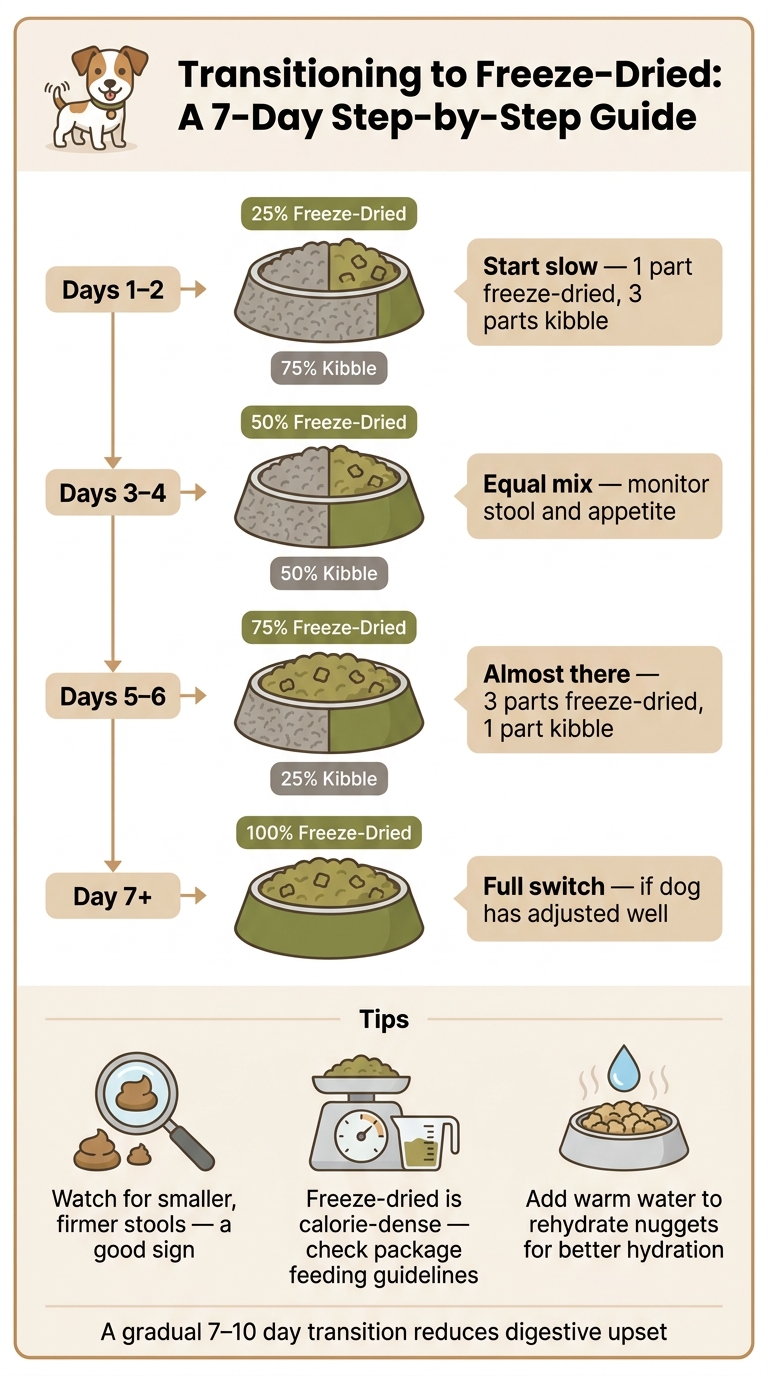
How to Switch Your Dog from Kibble to Freeze-Dried Food (7-Day Guide)
What to look for in a freeze-dried formula
If your dog’s stools, skin, or energy make you think the current diet isn’t doing enough, the next step is to look closely at formula quality. Once you understand how diet format can affect immune health, the buying question gets pretty simple: what on the label matters most?
Start with a formula labeled complete and balanced for your dog’s life stage. Then check the ingredient panel. You want named animal proteins at the top, not vague terms. A good formula should also include organ meats like liver, heart, and kidney along with muscle meat [10][6]. Freeze-dried diets are also usually more protein-dense than kibble [11].
Loyal Saints offers freeze-dried, complete-and-balanced, human-grade recipes made in the USA with no fillers [3].
How to transition from kibble to freeze-dried food
Once you’ve picked a complete formula, make the switch slowly so your dog’s gut has time to adjust. Moving too fast is the most common reason dogs end up with digestive upset during a food change. A 7- to 10-day gradual approach works well [16]:
- Days 1–2: 25% freeze-dried, 75% current kibble
- Days 3–4: 50% freeze-dried, 50% kibble
- Days 5–6: 75% freeze-dried, 25% kibble
- Day 7+: 100% freeze-dried if your dog has adjusted well
During the switch, keep an eye on stool changes and appetite. Smaller, firmer stools are usually a good sign [6][16]. Since freeze-dried food is more calorie-dense than kibble, check the feeding guidelines on the package so you don’t overfeed [6][11]. If you rehydrate the nuggets, add warm water to help with hydration [6][15].
Conclusion: less processing and higher-quality protein tend to support immune health better
The main point here is straightforward: how food is processed affects which nutrients stay intact, and those nutrients help support gut health, which plays a big role in immune function. Freeze-drying preserves more heat-sensitive nutrients than high-heat extrusion [10][15].
That said, the best pick still depends on your dog’s age, health status, and budget. Freeze-dried diets cost more, so price matters [11]. For healthy adult dogs, a complete, less-processed formula can support immune health when it’s fed properly.
As certified companion animal nutritionist Andrea Geiger, MSc, notes:
"I view freeze-dried diets as a useful tool, but not a universal solution. My first priority is always ensuring the diet is complete and balanced according to AAFCO guidelines." [10]
In day-to-day terms, better protein quality and less processing can give the immune system a stronger nutrition base.
FAQs
Is freeze-dried food safer for all dogs?
Not by default. Freeze-dried food can help keep nutrients and protein in place because it skips high-heat cooking, but it does not sterilize food the way cooking does.
That means raw-style diets can still carry microbes such as Salmonella, Listeria, or E. coli. If you live with immunocompromised people, young children, or older adults, use extra care. It’s also smart to ask your veterinarian whether this kind of food makes sense for your dog’s health and your home setup.
Can freeze-dried food fully replace kibble?
Yes. Freeze-dried food can fully replace kibble as a nutrient-dense, minimally processed option that keeps more natural enzymes, amino acids, and vitamins.
Loyal Saints offers complete, shelf-stable, highly digestible freeze-dried raw dog food made with human-grade, all-natural ingredients for daily feeding. Some owners also use it as a topper or mixer for convenience and to help manage cost.
How soon will I notice immune-related changes?
Research on the timing of specific immune-related changes is still limited. Even so, many pet owners say they notice better energy, a shinier coat, and more regular digestion after switching to a high-quality freeze-dried raw diet.
Results can differ from one dog to the next. But minimally processed, nutrient-dense food with highly digestible protein may help support immune function and long-term metabolic balance.


