
If your dog is overweight, the safest path is simple: feed for ideal weight, use a complete and balanced diet, weigh food in grams, keep treats at 10% or less of daily calories, and aim for just 1%–2% body weight loss per week.
About 65% of U.S. dogs carry extra weight. And the fix is not just “feed less.” I’d focus on a few things first: check body condition, rule out health problems with your vet, set calories from your dog’s target weight, and pick food that gives enough protein and nutrients even when calories are lower.
Here’s the short version:
- Overweight means about 10% above ideal body weight
- Obese means 20% or more above ideal body weight
- Use a Body Condition Score (BCS) to judge body fat at home
- Safe weight loss is usually 1%–2% per week
- In dogs with heavy obesity, 0.5% per week may be a better pace
- Protein helps limit muscle loss during dieting
- Fiber and adding water to meals can help your dog feel less hungry
- Treats, chews, and pill pockets count
- Owners often miss 40%–60% of treat calories
- Measuring cups can be off by 20%–40%
- Freeze-dried raw dog food can work, but it is calorie-dense, so portions need close tracking
- If a label says “for supplemental feeding only,” it should not be the only food, as a nutritional freeze-dried dog food must be complete and balanced.
- After weight loss, many dogs regain weight within 12–18 months if intake is not watched
A few food rules matter most. Feeding less of a regular maintenance food can leave nutrient gaps. A weight-loss plan should protect muscle, not just lower the number on the scale. And if you use freeze-dried food, the kcal per ounce matters as much as the ingredient list.
| Topic | What I’d keep in mind |
|---|---|
| Calorie target | Base it on ideal body weight, not current weight |
| Food choice | Use a complete and balanced food |
| Freeze-dried diets | Watch kcal/oz and weigh every serving |
| Treats | Stay at 10% or less of daily calories |
| Measuring | Use a digital gram scale, not a cup |
| Progress checks | Weigh every 2 weeks and review BCS often |
| After goal weight | Increase calories slowly and keep checking weight |
So if I had to sum up the whole article in one line, it would be this: weight loss works best when calories are controlled with precision, nutrition stays balanced, and progress is checked often.
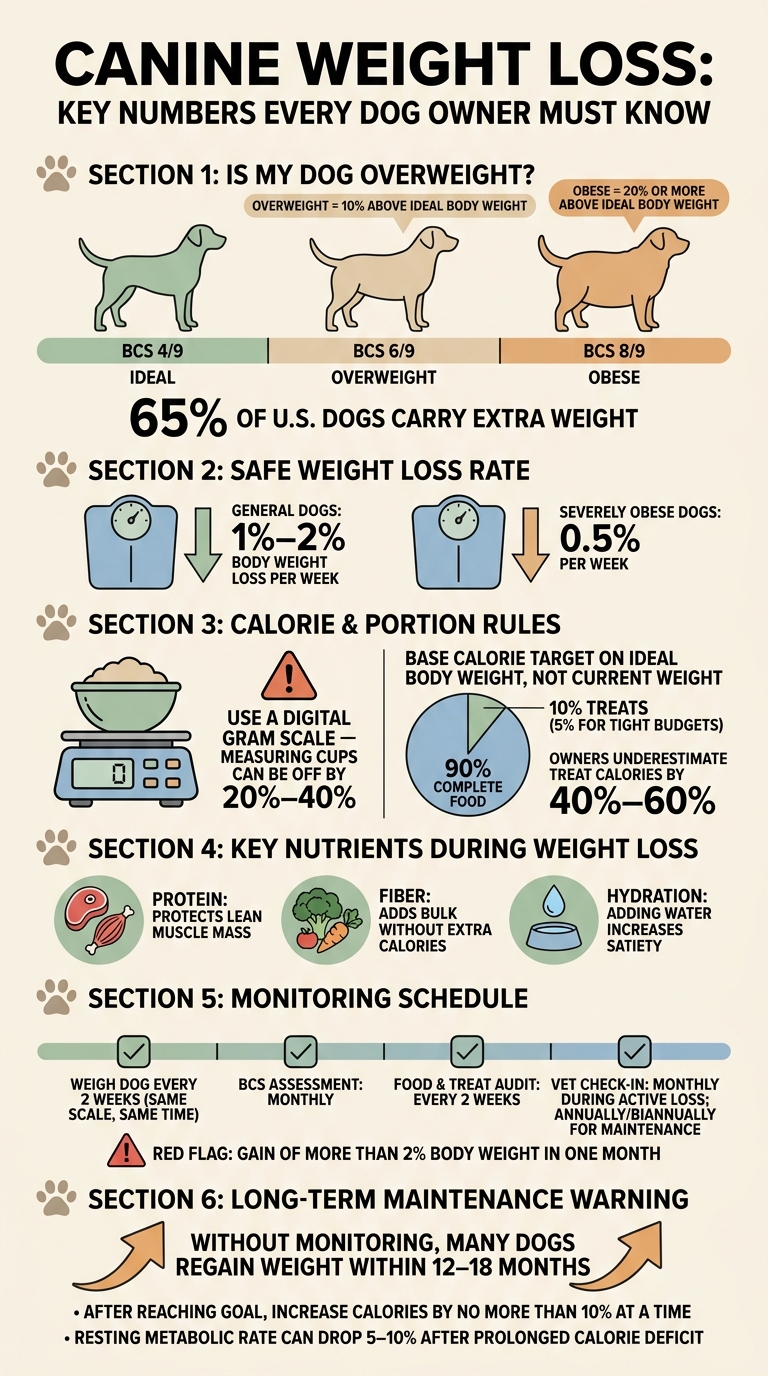
Canine Weight Loss: Key Numbers Every Dog Owner Must Know
Core nutrition rules for canine weight management
Food type, nutrient balance, and portion control decide whether a dog's weight-loss plan is safe.
Why feeding less of the current food may not work
Simply feeding less of a dog's current food can backfire. Severe calorie cuts with a maintenance diet can lead to undernutrition and nutrient gaps [2].
A lot of over-the-counter "light" diets have the same problem. They're often just lower-calorie maintenance formulas, not actual weight-loss diets [1][2]. That sounds like a small detail, but it isn't.
Maintenance diets are made to meet a dog's nutrient needs when fed at the amounts listed on the label. Weight-loss diets work differently. They pack more nutrients into each calorie, so a dog can eat less energy without coming up short on nutrition [1][2].
This matters even more when calories are being cut on purpose, especially with calorie-dense foods like freeze-dried diets.
Protein, fiber, hydration, and treat limits
A few nutrition basics make a big difference during weight loss.
- Protein helps protect lean muscle mass while the dog eats fewer calories.
- Fiber adds bulk to meals without adding many calories, which can help the dog feel full.
- Hydration matters too. Adding warm water to freeze-dried or dry food increases meal volume and can help with satiety.
Treats are where many plans go off track. Treats, chews, and pill pockets or medication treats should stay within 10% of total daily calories [1][2]. If a dog is on a tighter calorie target, that limit drops to 5% or less [2].
There's another catch: owners often underestimate treat calories by as much as 40% to 60% [3]. In plain English, the "little extras" add up fast. That's why tracking has to include everything, not just the main bowl of food.
Portion accuracy matters too. Weigh food with a gram scale, not a measuring cup. Cups can be off by 20% to 40%, which is enough to wipe out a small calorie deficit [1][3]. With freeze-dried diets, that level of precision matters even more because a small change in volume can mean a big change in calories.
These same rules apply when picking freeze-dried food for dogs, since calorie density and rehydration affect how much a dog can eat. Once those basics are clear, the next step is matching them to a freeze-dried feeding plan.
sbb-itb-b2753ee
How freeze-dried diets fit into a weight-loss plan
Once calories are set, the next move is picking a freeze-dried food that fits that target without giving up good nutrition. Freeze-dried food packs a lot into a small serving. That’s the catch. It’s nutrient-dense, but it’s also calorie-dense, so portions need to be measured with care if your goal is weight loss.
What to look for on the label
Two things matter most: the AAFCO nutritional adequacy statement and the calorie count per ounce.
The AAFCO statement tells you whether the food is "complete and balanced" for your dog’s life stage. If a product says "for supplemental feeding only," it’s not meant to be the sole diet. It works better as a topper or mixer. If it’s fed on its own for too long, your dog can miss key nutrients.
The other number to check is calorie density. Freeze-dried food is very concentrated, so even a small amount can bring a high calorie load. Look for a clear kcal-per-ounce figure so you can portion it with accuracy.
After that, the choice is pretty simple: does the food fit your dog’s calorie budget, and can you feed it in a way that stays consistent day after day?
Maintenance diets, weight-management diets, and freeze-dried diets compared
In practice, the best freeze-dried option is the one that gives your dog complete nutrition in portions you can measure the same way every time. Freeze-dried diets can support a weight-loss plan through high animal protein, dense nutrition, and careful portion control.
That’s a different setup from prescription weight-management diets. Those diets usually lean on higher fiber to add bulk while keeping calories lower. One approach isn’t automatically better than the other. The right pick depends on your dog’s health status and how closely you can manage portions.
Where Loyal Saints fits into the plan
Loyal Saints can fit into a weight-loss plan when portions are measured with care because it offers high-protein, freeze-dried raw food with no additives or fillers. The section that follows covers how to set calorie targets and build a structured feeding plan with your veterinarian.
Building a practical feeding plan with your veterinarian
Start with a veterinary exam. That gives you a clear feeding plan based on your dog's ideal weight, not just a rough guess. Once you pick a complete freeze-dried food, your vet can turn that choice into exact daily calories and grams.
Set calories and portions based on ideal body weight
Veterinarians base weight-loss calories on ideal body weight, not current weight, and then adjust that number for the dog in front of them. That calorie target creates the deficit. From there, convert calories into grams with a digital scale. Cups are too imprecise.
How to use meals, treats, and add-ins without going over the calorie budget
Once portions are set, keep the daily routine steady. Split the day's food into two or more meals. That can help your dog feel fuller and cut down on begging.
For training, don't stack extra treats on top of meals. Instead, pull a small amount from the day's measured freeze-dried food and use that as rewards.
Treat calories can pile up fast, so keep them to 10% or less of daily intake, with the other 90% coming from a nutritionally complete freeze-dried food [1][3]. If you use extras, keep them low-calorie and small.
Track progress and adjust safely
Then track the plan with regular weigh-ins. Weigh your dog every two weeks on the same scale at the same time of day. Also book a clinic check-in each month so your vet can review BCS and muscle condition score along with the number on the scale [5].
For severely obese dogs, your vet may start with a more conservative target. The aim isn't just to bring weight down. It's also to protect muscle while staying inside the freeze-dried calorie budget.
| Plan Element | Example |
|---|---|
| Current Weight | 40 lb (BCS 7/9) |
| Ideal Weight | 32 lb (Target BCS 5/9) |
| Daily Kcal Target | 550 kcal |
| Measured Food | 165 g (approx. 5.8 oz) |
If weight stalls for 4 weeks, check for hidden calories. If it still hasn't moved after 6 weeks, have your vet reassess before cutting calories by 10% of current daily calories [3][5].
Keeping a healthy weight long term
Reaching a goal weight isn't the finish line. It's the point where maintenance starts. Without monitoring, many dogs put weight back on within 12 to 18 months [3]. That’s why the next move matters: shift from weight-loss calories to a steady maintenance intake.
How to move from weight-loss calories to maintenance calories
Once your dog reaches an ideal BCS of 4–5/9, don’t jump right back to full maintenance portions. A slow increase works better. Add no more than 10% more daily calories at a time, then watch for weight stability before changing anything again.
For a neutered adult dog, the long-term target is about 1.6 times resting energy requirement (RER). For an intact adult, it’s closer to about 1.8 times RER [6][3].
There’s one catch. After a long calorie deficit, a dog’s resting metabolic rate can fall by 5–10%, which means the first maintenance intake may need to start a bit lower than standard formulas suggest [3]. As calories go up, keep portions measured in grams. Eyeballing food is where small mistakes start to pile up.
Monthly monitoring and household routines that prevent regain
A steady routine makes a big difference here. Keep protein high, around 25% to 35% dry matter, to help hold onto lean mass. Keep treats inside your calorie budget. And if you have more than one dog, feed them separately so extra bites don’t slip by unnoticed.
Movement matters too. Aim for 30–60 minutes of moderate activity each day [8]. For dogs with joint issues, swimming takes away impact stress while still burning calories. When adding more walking, go slowly: increase walk time by only 5 minutes per week to avoid overexertion [7][8].
Once calories settle into place, routine checks help you catch small changes before they turn into full regain.
| Monitoring Task | Recommended Frequency | Red Flags (Consult Vet) |
|---|---|---|
| Weight Check | Monthly for first 6 months, then every 2–3 months [3] | Gain of >2% body weight in one month [3] |
| BCS Assessment | Monthly [4] | Ribs hard to palpate; loss of visible waist |
| Activity Logging | Weekly | Limping, excessive panting, or reluctance to walk [7] |
| Food & Treat Audit | Every 2 weeks | Treats exceeding 10% of daily calories [1][6] |
| Medical Screening | Annually or biannually [8] | Lethargy, increased thirst, or sudden hair loss |
Conclusion: The key nutrition steps that make weight loss safer
Helping an overweight dog keep the weight off safely comes down to a few steady habits: calorie control, enough protein to protect muscle, portions weighed on a scale, and routine body condition checks.
Freeze-dried diets can fit into maintenance plans when portions are weighed with care. Loyal Saints freeze-dried raw food fits that setup when fed in measured portions because it is high in protein and free of additives and fillers. Long-term success still comes back to the same three habits: measured portions, limited extras, and regular weigh-ins.
FAQs
How do I know my dog’s ideal weight?
Use the Body Condition Score (BCS), which is a standard 9-point scale. A score of 4 to 5 is the ideal range.
At that level, you should be able to feel your dog’s ribs without pressing hard, but the ribs shouldn’t stick out. Your dog should also have a visible waist when viewed from above and an abdominal tuck when viewed from the side.
Your veterinarian can confirm your dog’s score and check for any medical issues that may be affecting weight.
Can freeze-dried food help my dog lose weight?
Yes. Freeze-dried food can help with canine weight management because it’s often lower in starch and sugar. That may help reduce blood sugar spikes that are often tied to carb-heavy kibble.
It also tends to be high in quality protein, which helps support lean muscle and can help dogs feel full after meals. On top of that, freeze-dried formulas are nutrient-dense and easy to digest, so dogs may get the nutrition they need in smaller portions.
Loyal Saints offers complete and balanced, high-protein freeze-dried raw food for balanced nutrition.
What if my dog isn’t losing weight?
First, talk to your veterinarian to rule out issues like hypothyroidism or Cushing’s disease. If your dog is otherwise healthy, they still may be eating too many calories. That’s because standard feeding guides are often built for maintenance, not weight loss.
For portion control, use a kitchen scale and measure food in grams. It’s a simple step, but it helps a lot with accuracy. A high-protein, nutrient-dense diet like Loyal Saints premium freeze-dried raw food may also help support lean muscle and help your dog feel full between meals.


