If I want the short answer: USDA Organic tells me how ingredients were grown and handled, while AAFCO tells me whether the food meets nutrition standards. Those are not the same check.
Here’s the simple takeaway:
- USDA Organic = ingredient production rules
- AAFCO statement = complete-and-balanced nutrition check
- Non-GMO Project Verified = GMO screening only
- Certified Humane / Animal Welfare Approved = animal care standards
- Fair Trade / MSC = labor or fish sourcing standards
That means a pet food can be 95% organic or more and still not tell me if it works as a full daily diet. And a food can meet AAFCO standards without being organic at all.
How to read pet food labels: The guaranteed analysis, AAFCO statement, and key nutrient ingredients
sbb-itb-b2753ee
Quick Comparison
| Label or Claim | What I learn from it | What it does not tell me |
|---|---|---|
| USDA Organic | Ingredients followed USDA organic rules; 100%, 95%+, and 70%+ tiers apply | Whether the food is complete and balanced |
| AAFCO statement | Food meets nutrient profile or feeding-trial standard for a life stage | Whether ingredients are organic, non-GMO, or humanely produced |
| Non-GMO Project Verified | Ingredients were checked for GMO risk | Pesticide use, nutrition, or animal care |
| Certified Humane / AWA | Farm animal treatment standards | Full nutrition or organic crop rules |
| Fair Trade Certified | Worker and sourcing standards for some ingredients | Full pet food nutrition or organic status |
| MSC | Wild-caught seafood source and traceability | Full diet quality or organic status |
If I’m reading a dog food label, I’d keep the order simple:
- Check the AAFCO statement first
- Look for USDA Organic second
- Use other seals for sourcing details after that
That’s the core point of this article: no single seal covers everything, so the best read is usually a mix of nutrition, sourcing, and animal-care labels.
How USDA Organic Works for Pet Food
Under the USDA National Organic Program (7 CFR Part 205), pet food sold as organic must be certified by a USDA-accredited certifier. That certifier inspects the facility, reviews records, and checks whether the company follows the rules.[1] The same standard applies to freeze-dried dog food vs kibble.
USDA Organic Labeling Levels: 100% Organic, Organic, and Made With Organic
USDA labeling tiers depend on how much of the product is certified organic.[4]
| Label Claim | Organic Content Required | USDA Seal Allowed? |
|---|---|---|
| 100% Organic | 100% organic ingredients | Yes |
| Organic | At least 95% organic ingredients | Yes |
| Made with Organic... | At least 70% organic ingredients | No |
| Specific Organic Ingredients | Less than 70% organic ingredients | No |
Only 100% Organic and Organic products can display the USDA seal.[4]
Production Rules Behind the USDA Organic Seal
Getting the USDA Organic seal takes more than changing a few ingredients. The NOP bans genetic engineering (GMOs), ionizing radiation, synthetic fertilizers, chemical pesticides, and sewage sludge. For livestock-derived ingredients such as chicken or beef, the animals must be raised on certified organic land, fed certified organic feed, and raised without antibiotics or growth hormones.[1][3]
Some synthetic substances are still allowed, but only if they appear on the National List. That list includes certain vitamins, minerals, and vaccines used for animal health.[3][5]
How to Read USDA Organic Claims on a Dog Food Package
When you check a dog food label for organic claims, focus on three things:
- The USDA Organic seal on the front panel. This shows the product meets at least the 95% threshold.
- The information panel, which must name the certifier, such as Oregon Tilth or CCOF.[2]
- The ingredient list, where organic ingredients must be named directly, such as "organic chicken" or "organic brown rice", for any product making an organic claim.[2]
One key point: the USDA seal does not tell you whether the food is complete and balanced. USDA Organic tells you how the ingredients were produced. AAFCO tells you whether the finished diet is complete and balanced. Those labels answer two different questions.
Next, it helps to compare these production rules with labels tied to nutrition, animal care, and ingredient sourcing.
Other Pet Food Certifications and Label Claims Worth Knowing
USDA Organic covers how ingredients are grown and handled. Other labels speak to nutrition, animal care, labor, or where ingredients come from.
AAFCO Nutritional Adequacy and FDA Labeling Rules
AAFCO sets the nutrition standard behind the phrase "complete and balanced" dog food, usually for a specific life stage like adult maintenance or all life stages.[1]
FDA and state officials oversee label claims and safety. That includes terms like "human-grade," which must meet both ingredient and facility standards.[9]
Here’s the simple way to think about it: USDA Organic tells you how ingredients were produced. AAFCO tells you whether the finished food meets nutrition standards.
For freeze-dried diets, the AAFCO statement is the fastest way to check whether the formula is complete and balanced.
So if you’re scanning a label, AAFCO and FDA are the next things to check after USDA Organic.
Animal Welfare, Non-GMO, and Fair Trade Labels
Once nutrition and safety are covered, many shoppers look at sourcing and ethics. That’s where these labels come in. They’re not all doing the same job. Some deal with genetic modification, some with animal care, and some with labor or fisheries. They only matter if you want sourcing or ethics details beyond USDA Organic.
- Non-GMO Project Verified checks ingredients for genetic modification, but it does not address pesticide use or animal welfare.
- Certified Humane sets standards for animal space and handling.
- Animal Welfare Approved goes further, requiring pasture access and lifetime care on one farm.[8]
- Fair Trade Certified looks at labor practices for commodity ingredients.
- The Marine Stewardship Council (MSC) blue label shows that seafood comes from sustainable, traceable wild-caught fisheries.[6][10]
Some label language sounds official but isn’t backed by outside review. Terms like "natural", "premium", and "holistic" are marketing claims, not certifications. A text-only claim is weaker than a third-party seal.
Next, compare which labels show production standards, which show nutrition, and which are mostly sourcing claims.
USDA Organic vs. Other Certifications: Direct Comparison
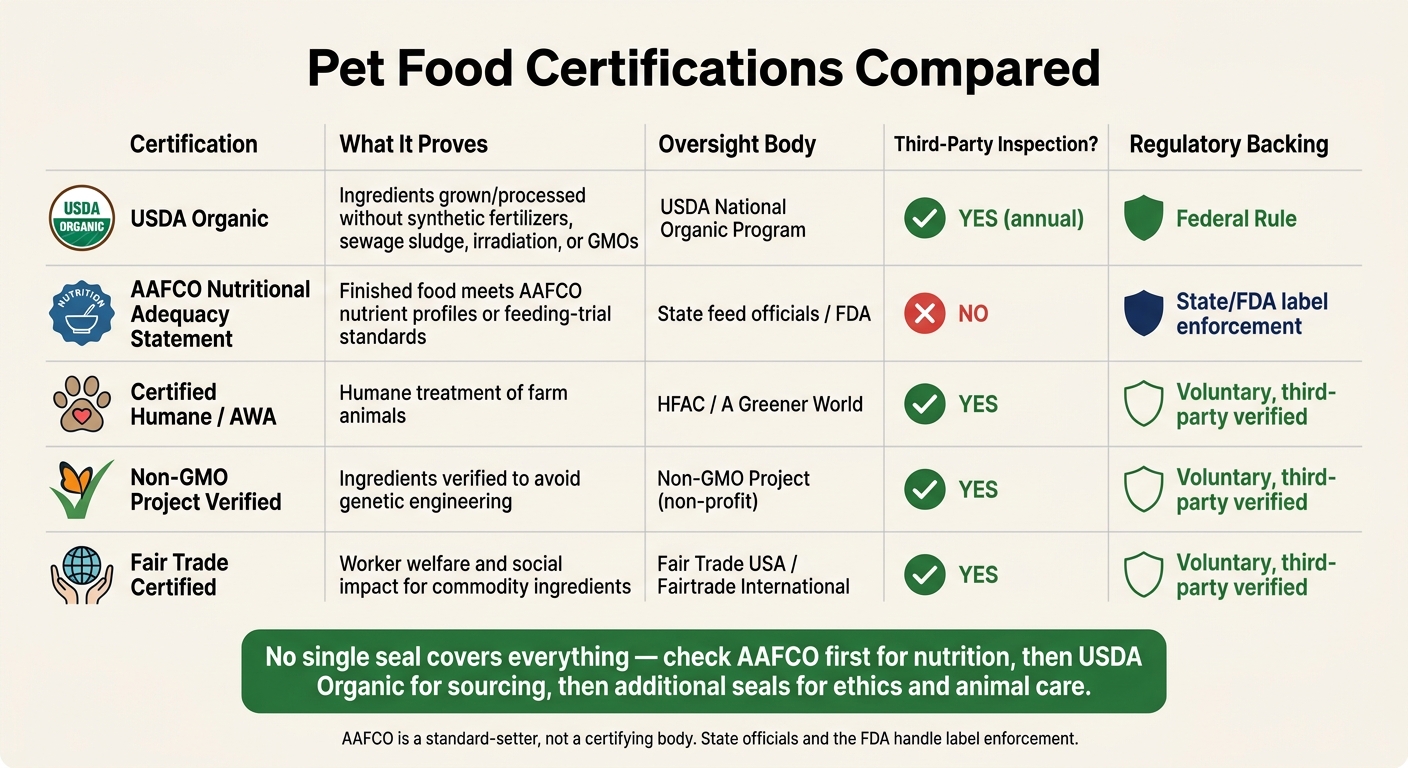
Pet Food Certifications Compared: USDA Organic vs. AAFCO & More
These labels don’t all mean the same thing. Each one checks a different part of the product. USDA Organic looks at how ingredients are grown and processed, while other methods like freeze-drying preserve nutrients during manufacturing. AAFCO deals with nutritional adequacy. Welfare labels focus on how animals are treated.
What Each Label Actually Verifies
The simplest way to compare them is to look at what each label does - and does not - confirm.
| Certification | What It Proves | Oversight Body | Third-Party Inspection? | Regulatory Backing |
|---|---|---|---|---|
| USDA Organic | Ingredients grown and processed without synthetic fertilizers, sewage sludge, irradiation, or genetic engineering | USDA National Organic Program | Required (annual) | Federal rule |
| AAFCO Nutritional Adequacy Statement | Finished food meets AAFCO nutrient profiles or feeding-trial standards | State feed officials / FDA | No - standard setter only | State/FDA label enforcement |
| Certified Humane / AWA | Humane treatment of farm animals | HFAC / A Greener World | Required | Voluntary, third-party verified |
| Non-GMO Project Verified | Ingredients are verified to avoid genetic engineering | Non-GMO Project (non-profit) | Required | Voluntary, third-party verified |
| Fair Trade Certified | Worker welfare and social impact for commodity ingredients | Fair Trade USA / Fairtrade International | Required | Voluntary, third-party verified |
AAFCO is not a certifying body. It writes the standards, while state officials and the FDA deal with label enforcement.[1] That’s why packages say things like “formulated to meet AAFCO standards” instead of showing an AAFCO seal.
Verification Strength, Farm Practices, and Practical Tradeoffs
USDA Organic is about production methods, not whether the food is nutritionally complete. A dog food can be organic and still fall short of being complete and balanced.
Animal welfare is its own category too. USDA Organic offers only limited detail on animal treatment, so a separate third-party label like Certified Humane or Animal Welfare Approved gives you a more specific signal.[7] That’s one big reason premium formulas often carry more than one seal.
How Certifications Are Combined on Premium Dog Food Labels
Premium brands often stack USDA Organic, AAFCO, and Non-GMO claims on the same package. The idea is pretty simple: one claim speaks to sourcing, another to nutrition, and another to ingredient identity. No single seal tells the whole story. When choosing a high-quality diet, it is also important to know how to feed freeze-dried dog food to ensure your pet gets the most out of these certified ingredients.
How to Choose the Right Certifications for Your Dog's Food
When you read a dog food label, keep the order simple: AAFCO first, USDA Organic second, then any sourcing or animal care seals after that. Put another way: nutrition first, sourcing second, ethics third.
That order helps cut through the noise on the front of the bag. A package can make all kinds of claims, but the first thing to check is whether the food is meant to serve as a complete meal for your dog.
A Step-by-Step Guide to Reading Pet Food Labels
Start with the AAFCO nutritional adequacy statement. This tells you whether the food is complete and balanced for your dog’s life stage. If that checks out, then move on to sourcing claims.
If organic sourcing matters to you, look for USDA Organic next. After that, check for added seals such as Non-GMO Project Verified or Certified Humane if those standards matter to you.
Also, verify any human-grade claim on the package. And don’t get distracted by broad marketing terms like “natural” or “premium.” Those are not certifications.
The same reading order applies to freeze-dried raw formulas too.
Applying These Standards When Shopping for Freeze-Dried Raw Diets
Freeze-dried raw diets follow the same order: AAFCO first, then sourcing seals, then ingredient details.
That first step matters most. Raw-style diets can miss key nutrients if the formula isn’t complete and balanced, so the AAFCO statement should be the first thing you confirm before you weigh any other claim on the label.
Loyal Saints freeze-dried raw dog food is made in the USA with human-grade ingredients and is formulated to AAFCO nutrient profiles for balanced nutrition for dogs of all life stages. [11][12]
Conclusion: USDA Organic Is a Strong Standard, But Nutritional Review Still Matters
USDA Organic is a strong government-backed standard for ingredient sourcing, but it only tells you how the ingredients were grown, not whether the finished food meets your dog’s nutrition needs. [8]
Organic tells you how the food was made. AAFCO tells you whether it works as a meal.
FAQs
Can organic dog food still be incomplete?
Yes. USDA Organic certification covers how ingredients are grown, processed, and handled. It does not tell you whether the food is nutritionally complete.
So a product can carry an organic seal and still fall short of a complete and balanced diet. Nutritional adequacy is judged by AAFCO standards, whether the ingredients are organic or conventional.
Which pet food label should I check first?
Check the AAFCO nutritional adequacy statement first. That’s the part that tells you the food is complete and balanced for your pet’s life stage. In plain English, it helps confirm the food covers basic nutrition needs.
Labels like USDA Organic can still be useful. They tell you about ingredient sourcing and how the product was made. But they don’t replace nutritional adequacy. A food can have sourcing claims and still fall short where it matters most: meeting your pet’s day-to-day nutrition needs.
Does USDA Organic mean the food is non-GMO and humane?
USDA Organic does mean the food is non-GMO. Genetically modified organisms aren't allowed in organic production.
What it doesn't do is guarantee humane treatment. USDA Organic has some general animal welfare rules, but they aren't as specific or as easy to audit as labels built for humane treatment.


