
TL;DR:
- A balanced dog diet must provide all essential nutrients according to AAFCO standards to support health at each life stage. Checking for the AAFCO nutritional adequacy statement on labels ensures the food is nutritionally complete and appropriate. Myths about ingredients like grains and byproducts are misleading, as they offer vital nutrients and are not inherently harmful.
A healthy diet for a dog is defined as one that is complete and balanced, providing all essential nutrients at levels proven to sustain health across the dog’s life stage. The industry standard for verifying this is the AAFCO nutritional adequacy statement, a label declaration that tells you whether a food can serve as your dog’s sole daily nutrition. Without this statement, a food may look premium but still leave your dog with dangerous nutrient gaps. Understanding what goes into a truly balanced canine diet cuts through the noise of marketing claims and puts you in control of your dog’s long-term health.
What is a healthy diet for a dog, and what nutrients does it require?
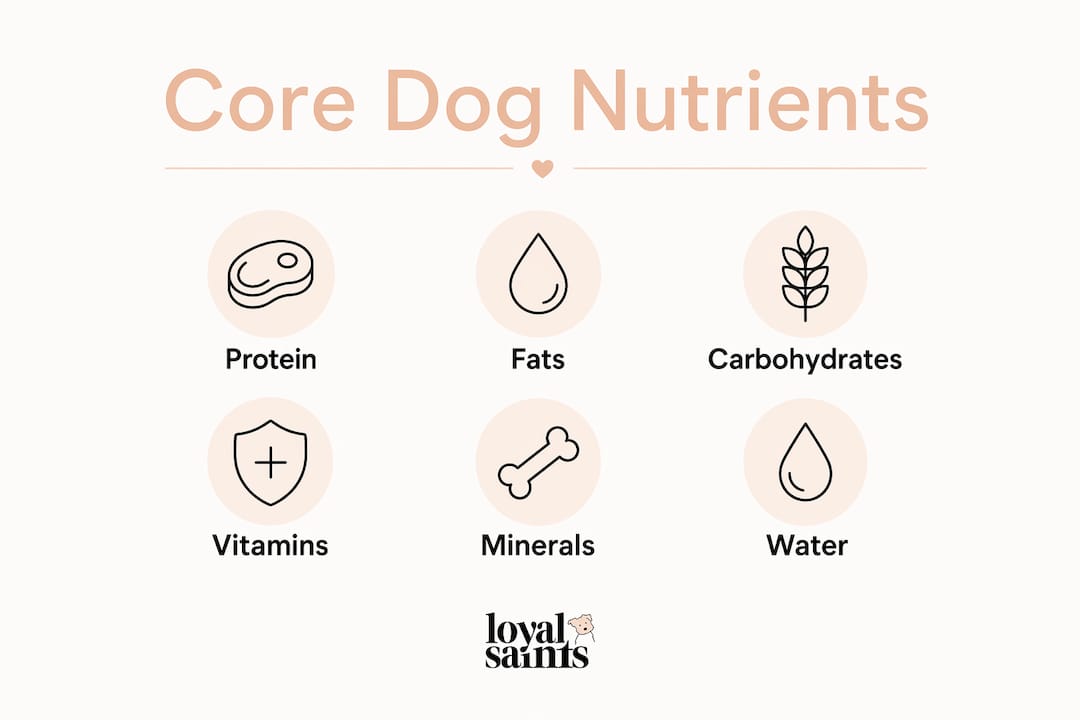
A complete and balanced dog diet must supply six core nutrient categories: protein, fat, carbohydrates, vitamins, minerals, and water. Each plays a specific role, and no single category can substitute for another.
Protein is the most discussed nutrient in dog food, and for good reason. It builds muscle, supports immune function, and provides essential amino acids dogs cannot produce on their own. According to AAFCO protein standards, adult maintenance formulas require at least 18% protein on a dry matter basis. Growth and reproduction formulas require at least 22%.

Fat delivers concentrated energy and carries fat-soluble vitamins A, D, E, and K. It also supplies omega-3 and omega-6 fatty acids that support skin, coat, and brain health. AAFCO sets a minimum of 5% fat for adult dogs and 8% for puppies.
Carbohydrates are not required by AAFCO minimums, but they provide a practical energy source and dietary fiber that supports gut health. Fiber levels that are too low or too high reduce digestibility, so balance matters here just as much as in any other category.
Vitamins and minerals work together to regulate metabolism, bone development, and nerve function. Calcium and phosphorus ratios are especially critical for puppies, where imbalances can cause skeletal problems.
Water is the most overlooked nutrient. Dogs on dry kibble diets consume far less moisture than those eating wet or fresh foods, which can affect kidney function over time.
Pro Tip: If you want to verify nutrient levels without reading a chemistry textbook, look for the AAFCO nutritional adequacy statement on the label. It does the verification work for you.
Here is a quick reference for key AAFCO minimums on a dry matter basis:
| Nutrient | Adult Maintenance Minimum | Growth and Reproduction Minimum |
|---|---|---|
| Protein | 18% | 22% |
| Fat | 5% | 8% |
| Calcium | 0.5% | 1.0% |
| Phosphorus | 0.4% | 0.8% |
Digestibility also shapes how much of these nutrients your dog actually absorbs. Gently cooked fresh diets often offer higher digestibility than heavily processed options. That means a food with slightly lower nutrient percentages on paper can still outperform a food with higher numbers if the nutrients are more bioavailable.
How do you read a dog food label to verify diet quality?
The single most important item on any dog food label is the AAFCO nutritional adequacy statement. This statement confirms whether the food is “complete and balanced” for a specific life stage or is intended only as a supplement or treat. A food labeled “supplemental” cannot meet your dog’s daily nutritional needs on its own.
Look for these elements when evaluating any label:
- AAFCO statement: Confirms completeness for a named life stage (adult, growth, all life stages).
- Guaranteed analysis: Lists minimum protein and fat percentages and maximum fiber and moisture. Use these to compare foods on a dry matter basis.
- Ingredient list: Ingredients appear in descending order by weight before cooking. A named protein source (chicken, beef, salmon) should appear near the top.
- Feeding guidelines: These are starting points, not fixed rules. Adjust based on your dog’s body condition and activity level.
Pro Tip: Convert all nutrient percentages to a dry matter basis before comparing wet and dry foods. Wet foods look lower in protein because of their high moisture content, but the actual protein level may be comparable once moisture is removed from the equation.
Many dog owners focus on marketing claims like “grain-free” or “natural” and overlook the AAFCO statement entirely. That is a mistake. A food can carry every trending label and still fail to meet basic nutrient requirements. The AAFCO statement is your baseline check, not the ingredient list.
Understanding AAFCO standards for pet nutrition also helps you recognize that AAFCO does not approve or certify individual pet foods. It sets the nutrient profiles that manufacturers use to claim completeness. Feeding trials go one step further by validating that a diet actually supports health when fed as the sole nutrition source, making them the gold standard for diet validation.
How does life stage affect your dog’s nutritional needs?
A puppy, an adult dog, and a senior dog have meaningfully different nutritional needs. Feeding the wrong formula for the wrong life stage creates real health risks over time.
Puppies need more protein, fat, calcium, and phosphorus to support rapid growth. Adult dogs require enough protein and fat to maintain muscle and energy without excess calories that lead to weight gain. The AAFCO “all life stages” statement covers both groups, making it a safe choice if you are unsure.
Senior dogs are where the picture gets complicated:
- No universal regulatory definition exists for “senior” dog food. Manufacturers set their own standards.
- Senior diets often resemble adult maintenance formulas but differ in energy density, protein levels, and fiber content.
- A senior dog with kidney disease needs a very different diet than a healthy 9-year-old with no medical issues.
- Assuming a “senior” label addresses your dog’s age-related needs without veterinary guidance is a common and costly mistake.
Because “senior” is an unregulated label, the right approach is to choose a diet based on your individual dog’s nutrient needs rather than the age category on the bag. Your veterinarian can assess body condition, bloodwork, and health history to guide that decision. For more on what the research actually says about senior dog food choices, the science often surprises owners who have been following marketing guidance.
What are the most common myths about dog food ingredients?
Marketing has convinced many dog owners that certain ingredients are harmful when the science says otherwise. Here is what the evidence actually shows.
Byproducts are not waste. Byproducts are organ meats including liver, kidney, and heart. Wild animals prioritize organ meats over muscle meat because organs are more nutrient-dense. AAFCO regulates what can be classified as a byproduct, so the term has a defined meaning, not a vague one.
Grains are not fillers. Grains contribute to energy balance and blood sugar regulation. Domestic dogs have adapted over thousands of years to digest starches and grains efficiently. Veterinary nutrition experts confirm that dogs digest grains well and that “wolf-like” ancestral diet thinking often leads owners toward nutritionally incomplete foods.
Grain-free does not mean healthier. Grain-free diets high in legumes like peas and lentils have been linked to potential heart issues including dilated cardiomyopathy in dogs. The FDA investigated this connection, and while research is ongoing, the risk is real enough to warrant caution.
Approved additives and preservatives are safe. Meta-analyses of additives across multiple studies show no adverse effects in dogs when ingredients fall within regulatory limits. The science on approved additives does not support the fear-based marketing around them.
Ingredients vilified in marketing, such as byproducts and grains, actually provide essential nutrients and should not be excluded without ensuring nutritional equivalence. Eliminating them without a plan risks creating real deficiencies in your dog’s diet.
The bottom line is that nutrient balance matters far more than ingredient lists. A food with “clean” ingredients that fails to meet AAFCO minimums is a worse choice than a food with byproducts and grains that is nutritionally complete.
Practical dog diet tips for daily feeding success
Getting the right food is only half the equation. How you feed your dog matters just as much as what you feed them.
- Keep treats to 10–15% of daily calories. Treats add up fast. A medium-sized dog eating 600 calories per day should get no more than 60–90 calories from treats. Exceeding this regularly disrupts nutrient balance and contributes to weight gain.
- Transition foods gradually. When switching foods, mix the new food with the old over 7–10 days. Abrupt changes cause digestive upset in most dogs, especially those with sensitive stomachs.
- Adjust portions based on body condition score. Feeding guidelines on labels are starting points, not prescriptions. A dog that is gaining weight on the recommended amount needs less. A dog losing muscle needs more. Check your dog’s ribs monthly.
- Use a board-certified veterinary nutritionist for homemade recipes. Homemade diets must be vetted by a qualified professional to prevent deficiencies. Most recipes found online are nutritionally incomplete. The American College of Veterinary Nutrition maintains a directory of board-certified specialists.
- Combine formats thoughtfully. Mixing freeze-dried raw proteins with a complete and balanced base food adds variety and palatability without sacrificing nutritional adequacy. For guidance on balancing homemade and commercial foods safely, work with your vet before making changes.
Pro Tip: Body condition scoring takes 30 seconds. Run your hands along your dog’s ribcage. You should feel ribs easily without pressing hard, but not see them. Visible ribs mean underweight; ribs you cannot feel at all mean overweight.
Key Takeaways
A dog’s diet must meet AAFCO nutritional adequacy standards for the correct life stage to qualify as complete and balanced nutrition.
| Point | Details |
|---|---|
| AAFCO statement is non-negotiable | Always verify the label carries an AAFCO nutritional adequacy statement before buying any dog food. |
| Life stage determines nutrient needs | Puppies, adults, and seniors have different protein, fat, and mineral requirements that generic labels often miss. |
| Ingredient myths mislead owners | Byproducts and grains are nutritious; grain-free diets carry documented cardiac risks worth discussing with your vet. |
| Treats must stay within calorie limits | Treats should not exceed 10–15% of daily calories to preserve the balance of the main diet. |
| Adjust portions to body condition | Use your dog’s body condition score, not label guidelines alone, to set the right daily feeding amount. |
What I’ve learned from watching owners navigate dog nutrition
By Kristina
After years of watching dog owners make food decisions, the pattern I see most often is this: owners spend enormous energy worrying about the wrong things. They scrutinize ingredient lists for grains and byproducts while never once checking for the AAFCO nutritional adequacy statement. They pay premium prices for grain-free foods that carry documented cardiac risks. They assume “natural” means complete.
The uncomfortable truth is that marketing in the pet food industry is far ahead of the science, and most of it is designed to trigger fear rather than inform. A food with a short, clean ingredient list can still be nutritionally deficient. A food with organ meats and whole grains can be one of the best choices you make for your dog.
My honest recommendation is to start with the AAFCO statement, then work backward to ingredients. If a food passes that test, look at the guaranteed analysis and compare protein and fat on a dry matter basis. Only then does the ingredient list become a useful tiebreaker. And if your dog is a senior, a puppy, or has any health condition, please talk to a veterinarian before changing their diet. Personalized guidance from someone who has examined your dog is worth more than any article, including this one.
— Kristina
Premium protein options from Loyalsaintspets
Loyalsaintspets offers freeze-dried raw proteins that pair well with a nutritionally complete base diet, adding variety and high-quality animal protein without fillers or additives.
The freeze-dried raw chicken 14oz and the freeze-dried raw beef 14oz are made from human-grade, whole ingredients with no artificial preservatives. For smaller households or dogs new to freeze-dried formats, the freeze-dried chicken 5oz is a convenient starting size. All Loyalsaintspets products are formulated to meet AAFCO standards, so you can add them to your dog’s feeding routine with confidence. Free shipping is available on qualifying orders.
FAQ
What does “complete and balanced” mean on dog food labels?
“Complete and balanced” means the food meets AAFCO nutrient profiles for a specific life stage and can serve as your dog’s sole daily nutrition. Foods without this statement are supplemental and cannot replace a full diet.
Are grain-free dog foods healthier than grain-inclusive options?
Grain-free diets are not inherently healthier and have been linked to potential dilated cardiomyopathy in dogs, particularly when high in legumes. Grains are a digestible, nutritious energy source for most dogs.
How much protein does my dog actually need?
Adult dogs need at least 18% protein on a dry matter basis per AAFCO standards. Puppies and pregnant or nursing dogs need at least 22%. Active dogs or those recovering from illness may need more.
Can I feed my dog homemade food every day?
Homemade diets can be fed daily, but they must be formulated by a board-certified veterinary nutritionist to prevent nutrient deficiencies. Most online recipes do not meet AAFCO minimums and are not safe as a sole diet.
How do I know if my senior dog needs a special diet?
“Senior” is an unregulated label with no universal nutrient standard. Work with your veterinarian to assess your dog’s individual health status and choose a diet based on their specific nutrient needs rather than their age alone.


