
Feeding trials give stronger evidence of nutritional adequacy than formulation, and it comes down to a simple difference: one method calculates nutrients on paper, and the other feeds the food to real animals and watches what happens to them. AAFCO recognizes two paths to back up a “complete and balanced” claim: formulating a recipe to match the AAFCO Dog and Cat Food Nutrient Profiles, or running a feeding trial under AAFCO protocols, often lasting several months for adult maintenance. Both are legitimate. Only one puts the food inside living dogs and measures the result.
Here’s what that means for your bowl, in plain terms:
- Formulation tells you what’s in the food, calculated against known nutrient targets.
- A feeding trial tells you what the food did to a group of animals that ate it for months.
- Neither one guarantees your specific dog will thrive on it forever. Both are checkpoints, not lifetime warranties.
The distinction isn’t marketing fluff. It’s the difference between a recipe that checks out on a spreadsheet and a food that a panel of dogs actually ate, without losing weight or developing lab-flagged deficiencies, for half a year straight.
Key Takeaways
Feeding trials substantiate nutritional adequacy through measured animal outcomes, while formulation substantiates it through calculated nutrient math against AAFCO’s published standards.
| Point | Details |
|---|---|
| Feeding trials rank higher | They test real animals over months, commonly several months for adult maintenance, rather than relying on calculations alone. |
| Formulation still has value | It’s faster, cheaper, and reliable for well-established recipes with known, tested ingredients. |
| Label wording tells the story | “Animal feeding tests using AAFCO procedures” means a trial happened; “formulated to meet” means it didn’t. |
| Neither proves lifetime superiority | Both are checkpoints for a specific life stage and time window, not permanent guarantees. |
| Loyalsaintspets prioritizes AAFCO-complete formulation | Its freeze-dried recipes are built on human-grade, whole ingredients with AAFCO nutrient standards as the baseline. |
Table of Contents
- AAFCO Feeding Trials vs Formulation: What AAFCO Recognizes
- The Formulation Pathway: What It Proves and Where It Falls Short
- Feeding Trials: AAFCO Protocols and What They Actually Measure
- Feeding Trials vs Formulation: A Side-By-Side Look
- How to Use This Information When You’re Choosing or Making Pet Food
- Clearing Up Common Label Misconceptions
- Primary Sources for Further Reading
- An Editorial Take on Formulation vs Feeding Trials
- Where Loyalsaintspets Fits Into This Picture
- Frequently Asked Questions
- Sources
AAFCO Feeding Trials vs Formulation: What AAFCO Recognizes
AAFCO doesn’t leave this up to interpretation. The formulation pathway means a manufacturer calculates the recipe’s nutrient content and confirms it meets or exceeds the AAFCO Nutrient Profiles for a given life stage, usually verified afterward with a lab analysis of the finished product. The feeding-trial pathway means the company actually fed the exact formula to a group of dogs or cats under standardized conditions and tracked their health throughout.
“Animal feeding tests using AAFCO procedures” is the exact phrase you’re looking for on a bag. If you see it, a trial happened. If you see “formulated to meet AAFCO nutritional levels,” you’re looking at a calculated recipe instead.
A third label wrinkle worth knowing: the family rule. A brand can extend one product’s feeding-trial results to a related “family” formula without running a brand-new trial, as long as the two recipes are similar enough across a defined set of core nutrients, according to AAFCO’s own guidance. That’s why you’ll sometimes see a feeding-trial statement on a flavor variant that, on its own, was never tested on a single animal.
The Formulation Pathway: What It Proves and Where It Falls Short
Formulating to AAFCO’s standards is a math and lab-science exercise, and it’s the backbone of most pet food on the market. Here’s roughly how it works:
- Formulators start with the AAFCO Dog and Cat Food Nutrient Profiles, which set life-stage minimums (and some maximums) for protein, fat, vitamins, and minerals on a dry-matter basis.
- They build a recipe using known ingredient composition tables, then calculate whether the finished blend clears every threshold.
- A lab typically runs a nutrient analysis on the actual finished product to confirm the math held up in the real batch.
- Adjustments account for moisture content and caloric density so the numbers translate correctly from a lab printout to a bag of kibble or a pouch of freeze-dried protein.
What formulation actually proves is nutrient presence. It confirms your dog’s food contains enough zinc, taurine, and calcium on paper. What it doesn’t automatically prove is nutrient availability. Not every ingredient releases its nutrients the same way once an animal digests it, and AAFCO’s own technical guidance acknowledges that formulators must build in allowances for bioavailability and for losses that happen during processing and storage. A nutrient can be sitting right there in the ingredient list and still underperform once it’s cooked, extruded, or stored for months.
Pro Tip: Ask whether a brand’s finished-product analysis was run on an actual production batch, not just a lab prototype. Small-batch and freeze-dried processes can behave differently than mass-extruded kibble, so a formulator who tests the real thing closes a gap that pure math can’t.
For most everyday recipes with well-established ingredients, formulation is a reasonable, cost-effective way to substantiate a claim. It becomes riskier territory with novel proteins, unusual nutrient sources, or aggressive processing methods where bioavailability is less predictable.
Feeding Trials: AAFCO Protocols and What They Actually Measure
A feeding trial puts the calculations to the test. AAFCO’s protocols specify a minimum number of animals, a defined trial length tied to life stage, commonly several months for adult maintenance trials, and a set of health markers the animals get checked against throughout.
During the trial, researchers monitor body weight, general clinical condition, and blood chemistry, and for cats specifically, taurine levels get particular attention given the species’ unique dietary needs. Animals that lose too much weight or show concerning clinical signs can disqualify the formula from passing, which is exactly the kind of real-world signal a spreadsheet can’t produce.
Industry analysis puts it plainly: feeding trials demonstrate stronger evidence of biological adequacy than formulation alone, precisely because the food has to keep a group of live animals healthy under observation, not just check boxes on paper.
That said, a feeding trial isn’t an all-purpose guarantee, and it’s worth being honest about its edges:
- Limited duration. Six months tells you a lot about short-term adequacy. It doesn’t tell you what happens over a ten-year lifespan.
- Small sample sizes. AAFCO trials use a modest number of animals under controlled conditions, not the wide genetic and lifestyle diversity of every dog eating that food at home.
- Controlled environment. Trial animals eat on a schedule, get monitored closely, and often live in a research setting. Your dog’s life looks different.
- Cost and rarity. Feeding trials take real time and real money, which is why formulation dominates the market and trials tend to show up on flagship or higher-tier lines.
On the label, the wording gives the game away. A trialed product says something like “Animal feeding tests using AAFCO procedures substantiate that [Product Name] provides complete and balanced nutrition for a specified life stage.” A formulated product instead says the recipe was “formulated to meet AAFCO nutritional levels.” One sentence describes a calculation. The other describes an experiment.
Feeding Trials vs Formulation: A Side-By-Side Look
| Dimension | Formulation | Feeding Trials |
|---|---|---|
| What it proves | Nutrient levels meet AAFCO minimums/maximums on paper | Animals stayed healthy eating the food under observation |
| Rigor / real-world evidence | Moderate; based on calculation and lab analysis | Higher; based on measured animal outcomes |
| Life-stage applicability | Matches the profile targeted (growth, reproduction, or adult maintenance) | Specific to the exact life stage and duration tested |
| Typical cost & time | Lower cost, faster to complete | Higher cost, several months minimum |
| Label language | “Formulated to meet the nutritional levels…” | “Animal feeding tests using AAFCO procedures…” |
| Practical limitations | Bioavailability and processing losses not directly tested | Small sample size, short duration, controlled setting |
Neither pathway is disqualifying on its own. A well-formulated recipe with a careful ingredient list and finished-product testing can be excellent daily nutrition; a feeding trial simply adds a layer of animal-level proof that formulation can’t offer by itself.
How to Use This Information When You’re Choosing or Making Pet Food
Reading a label with this knowledge changes what you actually look for. Run through this before you commit to a bag:
- Confirm the AAFCO statement names the correct life stage for your dog, not a vague “all life stages” claim that lumps puppies in with seniors.
- Look for the exact phrase, either “formulated to meet” or “animal feeding tests,” so you know which pathway backs the product.
- Check whether the brand mentions finished-product testing, not just calculated formulation.
- See if a named nutritionist or veterinary formulator is credited anywhere on the packaging or website.
If you’re the one formulating, the internal checklist looks a little different:
- Confirm batch-to-batch nutrient testing happens on production runs, not just prototype recipes.
- Document allowances for processing and storage losses, especially with freeze-drying or dehydration, where nutrient retention behaves differently than extrusion.
- Where a novel ingredient or protein source is involved, weigh whether a feeding trial is worth the investment before scaling production.
Watch for red flags on either side of the counter: vague life-stage wording, no AAFCO statement at all, or a product only labeled for “intermittent or supplemental feeding” when it’s being marketed as a full-time diet. That last one is easy to miss and matters a lot.
Pro Tip: Feeding trials tend to be worth the cost for genuinely novel formulas, new protein sources, or flagship products a brand wants to stand fully behind. For well-established recipes built on known, well-researched ingredients, rigorous formulation plus finished-product testing is a reasonable, well-supported standard.

Clearing Up Common Label Misconceptions
A few AAFCO terms get misread constantly, so here’s the short version. Neither rule has anything to do with whether a formula passed a feeding trial.
The biggest misconception overall: a feeding trial is not a lifetime health guarantee, and it’s not proof one food is superior to another. It proves the specific formula supported the tested animals through the trial window, nothing more, nothing less.
Family-product claims add one more layer. If you see a feeding-trial statement on a flavor variant, it may be borrowing results from a related formula rather than having been tested itself.
Three ten-second label checks before you buy: confirm the life stage matches your dog, confirm the AAFCO statement is present at all, and check whether the wording says “formulated” or “feeding tests” so you know exactly what you’re paying for.
Primary Sources for Further Reading
For label wording specifics, start with AAFCO’s reading labels guidance. For the nutrient science behind formulation, see the Dog and Cat Food Nutrient Profiles review. For a deeper explanation of the three label statements side by side, KibbleIQ’s breakdown is a solid plain-language resource. Readers curious how protein standards specifically get applied can also check what AAFCO protein standards mean for dog food.
An Editorial Take on Formulation vs Feeding Trials
The conventional advice treats feeding trials as the gold standard and formulation as the consolation prize. That framing misses something important: a feeding trial only proves a food worked for a small group of animals over a matter of months, under conditions nothing like your living room. It’s stronger evidence, not perfect evidence.

What actually deserves more attention is the quality of the formulation work itself, especially finished-product testing and how a brand accounts for bioavailability and processing loss. A careful formulation with real lab verification on production batches can outperform a sloppy feeding trial that just barely cleared the bar.
If you’re evaluating a food, don’t stop at whether a trial happened. Ask what the trial actually measured, ask how the formulation handles ingredient variability, and ask whether the company retests its recipes over time rather than resting on a single approval from years ago.
Where Loyalsaintspets Fits Into This Picture
Loyalsaintspets builds every recipe on AAFCO-complete formulation using human-grade, whole ingredients, with no fillers or synthetic additives diluting the nutrient math. That matters most for dogs on single or limited-protein diets, where ingredient quality and sourcing carry more weight than a trial statement ever could.
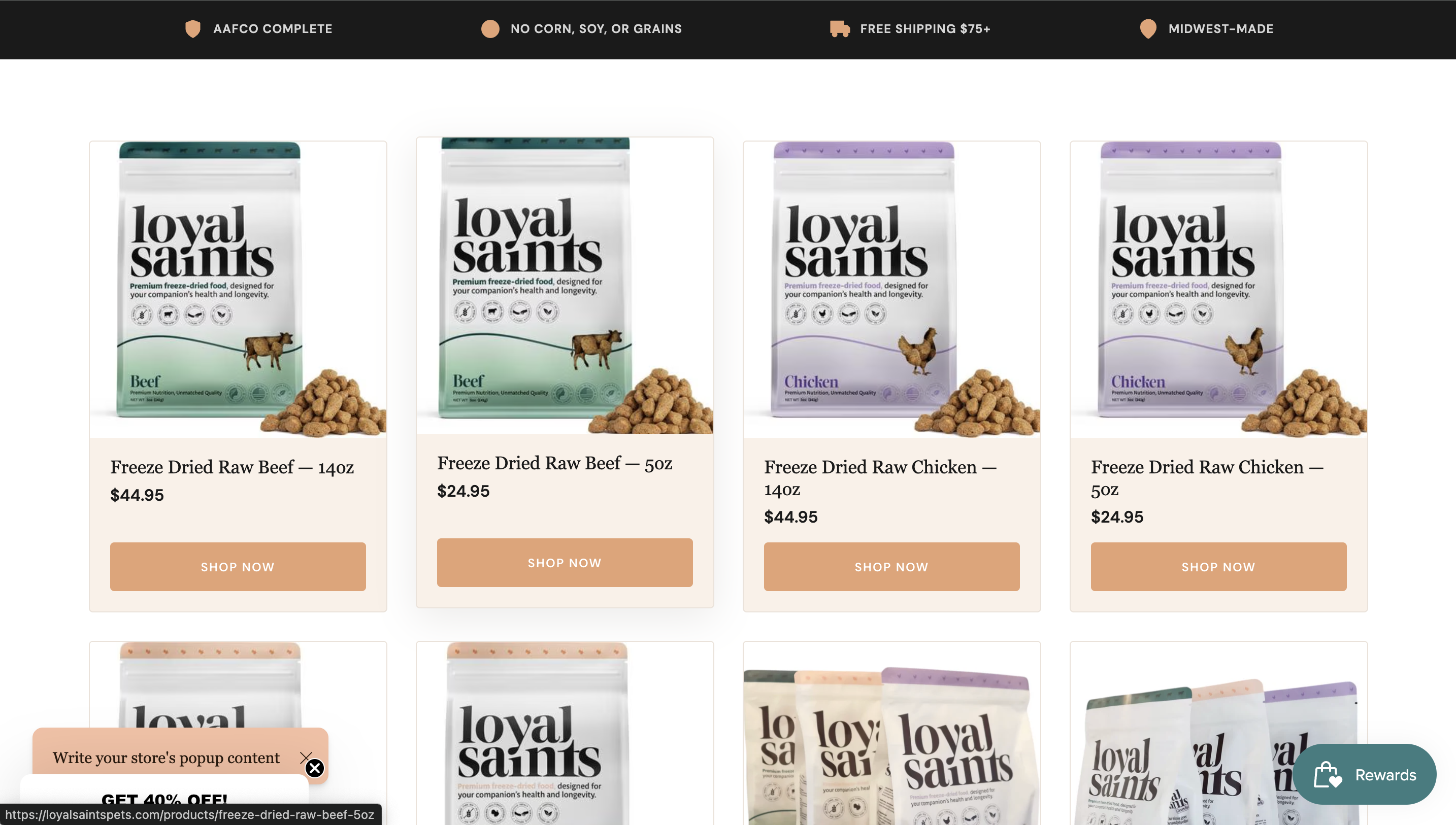
If you’ve read this far, you already know to check life-stage wording and AAFCO statements before buying. Loyalsaintspets makes that check easy: every bag states its nutrient basis clearly, whether you’re comparing the Freeze Dried Raw Chicken — 14oz, the trial-size Freeze Dried Raw Chicken — 5oz, or the single-protein Freeze Dried Raw Beef — 14oz. For dogs with demanding activity levels, the working-dog nutritional protocols from Elite Protection Dogs offer a useful complementary read. Start with the 5oz bag if you want to see how your dog responds before committing to a larger size.
Frequently Asked Questions
Does a feeding trial mean a food is better than a formulated one? No. It means the specific formula supported the tested animals through the trial period. It says nothing about long-term superiority over a well-formulated alternative.
What does “formulated to meet AAFCO nutrient profiles” actually guarantee? It guarantees the recipe’s calculated nutrient levels meet AAFCO’s published minimums and maximums for the stated life stage, verified with a finished-product lab analysis.
Why do so few pet foods use feeding trials? Cost and time. Trials run for months and require dedicated animal panels, so formulation dominates the market because it’s faster and cheaper to complete.
What is the AAFCO family rule? It lets a brand extend one product’s feeding-trial results to a closely related formula without a separate trial, as long as the two recipes match on a defined set of core nutrients.
Should I avoid foods that were only formulated, not trial-tested? Not necessarily. For established recipes with well-researched ingredients, careful formulation plus finished-product testing is a solid, evidence-based standard.
This article is general information, not a substitute for advice from a qualified doctor. Consult a qualified healthcare professional about your own circumstances before acting on anything here.
Sources
- MBRC minutes Attachment A (AAFCO)
- The Association of American Feed Control Officials Dog and Cat Food Nutrient Profiles (PubMed)
- Do AAFCO feeding trials matter for pet food nutrition (PetfoodIndustry)


