
The safe calcium-to-phosphorus ratio in dog food falls between 1:1 and 2:1, with veterinary sources pointing to an optimal range closer to 1.2:1 to 1.4:1. That’s the number to check first, whether you’re comparing bags at the store or reading a guaranteed analysis panel online.
Here’s the caveat that matters most: large-breed puppies need tighter limits than this general range allows, because their growing skeletons are far more sensitive to excess calcium than an adult dog’s. Pregnant and nursing dogs also have different needs than a couch-loving adult Lab.
These numbers aren’t arbitrary. They come from the AAFCO nutrient profiles that regulate commercial pet food, backed by NRC nutrient requirement tables that researchers use to calculate exact daily needs. You’ll see these values expressed as a percentage on a dry-matter basis or as grams per 1,000 kilocalories, both of which we’ll walk through below.
- General adult dogs: 1:1 to 2:1 Ca:P, ideally near 1.2:1 to 1.4:1
- Large-breed puppies: stricter calcium caps apply, often capped at 1.8% on a dry-matter basis
- Pregnant or lactating dogs: higher absolute mineral needs, same ratio principles
Quick fact: AAFCO sets the ceiling for commercial dog food at a 2:1 Ca:P ratio, with a floor of 1:1. Anything wildly outside that range signals a formulation problem, not a feature.
If you’re feeding a growing puppy, especially a large or giant breed, or managing a dog with a known medical condition, loop in your veterinarian before making any diet change based on ratio math alone.
Key Takeaways
A safe calcium phosphorus ratio in dog food falls between 1:1 and 2:1, with 1.2:1 to 1.4:1 as the veterinary-preferred target, and large-breed puppies need stricter calcium caps to avoid developmental orthopedic disease.
| Point | Details |
|---|---|
| Target the right ratio | Aim for 1.2:1 to 1.4:1 Ca:P for most adult dogs, staying within the AAFCO 1:1 to 2:1 range. |
| Watch large-breed puppies closely | Cap calcium near 1.8% dry-matter for large or giant-breed growth formulas to reduce DOD risk. |
| Convert before comparing | Calculate dry-matter and per-1,000 kcal values so you’re comparing foods accurately, not just as-fed numbers. |
| Homemade diets need calculation | Add mineral supplements only after calculating the actual gap, not as routine practice. |
| Choose formulated options | Loyalsaintspets’ freeze-dried recipes are AAFCO-complete, giving owners a lower-risk starting point than ad-hoc supplementation. |
Table of Contents
- Why the Calcium Phosphorus Ratio in Dog Food Actually Matters
- What Do AAFCO and NRC Say About Calcium and Phosphorus Levels?
- How Calcium Needs Change Across Life Stages
- How to Check a Dog Food’s Calcium Phosphorus Ratio Yourself
- Where Calcium and Phosphorus Come From, and Why the Source Matters
- Balancing Homemade Diets and Knowing When to Call Your Vet
- A Worked Example You Can Trust
- Meeting Calcium Phosphorus Standards Without the Guesswork
- Frequently Asked Questions
- Sources
Why the Calcium Phosphorus Ratio in Dog Food Actually Matters
Calcium and phosphorus aren’t just two minerals sitting side by side on a nutrition label. They’re chemically linked in your dog’s body, and the balance between them determines how well each one gets absorbed and used. Roughly 99% of your dog’s calcium lives in bones and teeth, and phosphorus is right there with it, forming the mineral scaffolding that gives a skeleton its strength.
Vitamin D and parathyroid hormone act as the traffic controllers here. When dietary calcium and phosphorus fall out of balance, the body pulls calcium from bones to correct blood levels, which is exactly the opposite of what you want in a growing puppy. This tug-of-war between diet and skeleton is why the relationship between calcium, phosphorus, and vitamin D gets so much attention in veterinary nutrition literature.
When the ratio tips too far in either direction, the consequences show up in the skeleton first:
- Developmental orthopedic disease (DOD) in growing puppies, including bowed limbs and joint deformities
- Nutritional secondary hyperparathyroidism, often linked to phosphorus-heavy, calcium-poor homemade diets
- Soft-tissue mineralization when calcium runs persistently high
- Kidney strain in dogs with pre-existing renal issues, where phosphorus handling becomes more delicate
Adult dogs tolerate small swings in this ratio far better than puppies do, since their bones have already finished forming. A growing puppy, on the other hand, is laying down skeletal structure daily, and that process doesn’t forgive mineral mistakes the way a mature dog’s body does. Interestingly, surveys of DOD cases have shown the dominant cause shifting over the decades, from historical over-supplementation to more recent cases tied to calcium-deficient home diets.
Watch for limping that comes and goes, joints that look swollen or misaligned, reluctance to play, or a puppy that seems to be growing unevenly. These are the visible red flags of a mineral imbalance, and they warrant a vet visit, not a wait-and-see approach.
What Do AAFCO and NRC Say About Calcium and Phosphorus Levels?
If you want a hard number to hold a dog food label against, this is where you’ll find it. AAFCO nutrient profiles set a minimum Ca:P ratio of 1:1 and a maximum of 2:1 for both growth and adult maintenance formulas. Most veterinary nutritionists narrow that further, pointing to an optimal range around 1.2:1 to 1.4:1 as the sweet spot for absorption and bone health.
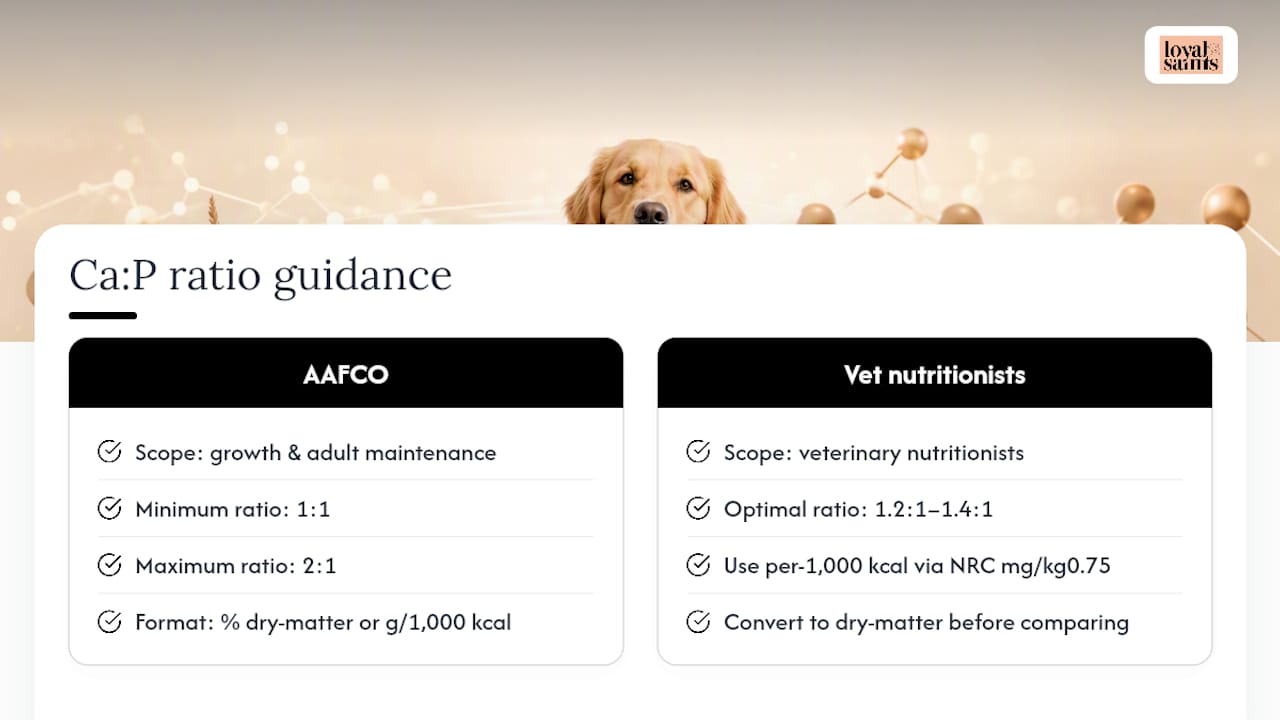
You’ll typically encounter these numbers in two formats: percent on a dry-matter basis, and grams per 1,000 kilocalories of metabolizable energy. Both matter, and they tell you slightly different things.
Per-1,000 kcal values do something different: they tell you how much calcium and phosphorus your dog actually consumes relative to the calories in each meal, which is especially useful for dogs eating calorie-dense diets. NRC’s mg/kg0.75 tables are the backbone of these per-calorie conversions, and they’re what most veterinary nutritionists use when formulating a diet from scratch rather than relying on a label alone.
As-fed numbers, the ones printed directly on most bags, include moisture and can make a wet food look artificially low in minerals compared to a dry kibble. That’s why converting to dry-matter basis before comparing two products is a step worth taking every time, not an optional extra.
How Calcium Needs Change Across Life Stages
A ratio that’s perfectly safe for your seven-year-old retriever could be a genuine problem for an eight-week-old Great Dane puppy. That’s not an exaggeration. Growing puppies, especially large and giant breeds, absorb calcium less efficiently at regulating intake than adults do, which means excess dietary calcium doesn’t just pass through. It gets absorbed anyway and can accelerate bone growth in ways that outpace what the joints and growth plates can structurally support.

This is exactly why regulatory bodies have moved toward stricter limits. Recent AAFCO proposals tightened the maximum calcium allowance for large-breed puppy growth formulas to 1.8% on a dry-matter basis, down from the general maximum of 2.5% that applies to other growth diets. The reasoning is straightforward: a Great Dane puppy that gains 100 pounds in its first year needs precise mineral dosing, not “more is better.”
Here’s how the guidance breaks down by stage:
- Small and medium-breed puppies: general growth guidelines with a Ca:P ratio between 1:1 and 2:1 typically apply without extra restriction
- Large and giant-breed puppies: stick to formulas capped at 1.8% calcium on a dry-matter basis to reduce developmental orthopedic disease risk
- Adult maintenance: the full 1:1 to 2:1 range is generally tolerated, with 1.2:1 to 1.4:1 as a reasonable target
- Pregnancy and lactation: absolute calcium and phosphorus needs rise substantially, but the ratio principle stays the same
Pro Tip: If you’re raising a large-breed puppy, don’t just check the Ca:P ratio. Check the absolute calcium percentage too. A food can have a “correct” ratio while still delivering too much total calcium for a rapidly growing skeleton.
If you own a large-breed puppy, a large-breed specific formula removes the guesswork, since these diets are built around the tighter calcium ceiling from the start rather than requiring you to calculate it yourself.
How to Check a Dog Food’s Calcium Phosphorus Ratio Yourself
You don’t need a chemistry degree to verify whether a bag of food meets the guidelines. You need the guaranteed analysis panel, a calculator, and about five minutes.
- Find the guaranteed analysis. Every commercial dog food label lists minimum calcium and phosphorus percentages, usually expressed “as fed.”
- Find the moisture percentage. This is also on the guaranteed analysis, typically listed as a maximum.
- Convert to dry matter. Divide the as-fed percentage by (100 minus moisture percentage), then multiply by 100. For a food with 2% calcium and 10% moisture: 2 ÷ 90 × 100 = 2.2% calcium on a dry-matter basis.
- Repeat for phosphorus, then divide the calcium dry-matter value by the phosphorus dry-matter value to get your ratio.
- Cross-check with kcal, if listed. If the label or manufacturer website gives calories per kilogram, you can convert to grams per 1,000 kcal for an even more precise comparison against NRC recommendations.
Here’s a worked example. Say a food lists 1.8% calcium, 1.3% phosphorus, and 8% moisture, with 3,600 kcal per kilogram:
- Calcium dry-matter: 1.8 ÷ 92 × 100 = 1.96%
- Phosphorus dry-matter: 1.3 ÷ 92 × 100 = 1.41%
- Ca:P ratio: 1.96 ÷ 1.41 = 1.39:1, comfortably inside the recommended range
To get grams per 1,000 kcal: multiply the as-fed percentage by 10 to get grams per kilogram, then divide by (kcal per kilogram ÷ 1,000). For calcium: 1.8% = 18 g/kg, divided by 3.6 (3,600 kcal ÷ 1,000) = 5.0 g calcium per 1,000 kcal.
Before you run these numbers, gather this checklist:
- Guaranteed analysis (minimum calcium, minimum phosphorus, maximum moisture)
- Kcal per kilogram or per cup, if you want the per-1,000 kcal figure
- The manufacturer’s typical (not just guaranteed minimum) values, if available, since guaranteed minimums can understate actual content
One common pitfall: many labels list a calcium minimum but skip phosphorus entirely, or vice versa. If that happens, contact the manufacturer directly. A reputable company will have both figures on hand, and if they don’t, that’s worth noting. Consumer-facing tools like a dog food ingredient comparison tool can also speed up this process when you’re comparing several products at once, and independent resources such as the Dog Food Advisor’s calcium calculator are commonly used by owners running these numbers at home.
Where Calcium and Phosphorus Come From, and Why the Source Matters
Not all calcium is created equal, and neither is all phosphorus. Where these minerals come from in a dog food’s ingredient list affects how much of them your dog’s body can actually use.
Common sources include:
- Bone meal and whole bone (from meat, poultry, or fish meal), a naturally balanced source of both minerals together
- Meat and organ tissue, higher in phosphorus than calcium on its own
- Dairy-derived ingredients, contributing calcium in smaller amounts
- Calcium salts like calcium carbonate or calcium citrate, added to fine-tune the ratio
- Phosphate salts, added when a formula needs a phosphorus boost without bone content
- Plant-based phytates, found in grains and legumes, which bind minerals and can reduce bioavailability
Bone-derived calcium and phosphorus tend to come packaged together in a ratio that’s already close to what a dog needs, since it mirrors actual skeletal composition. Synthetic phosphate salts behave differently. Veterinary reviews note that soluble inorganic phosphate salts affect blood phosphorus levels differently than bone-derived phosphorus, largely because they’re absorbed more readily and faster, which changes how the body has to respond metabolically. This distinction gets significant attention in kidney disease research in other species, and while dogs aren’t cats, it’s part of why formulators pay close attention to phosphorus source, not just phosphorus quantity.
Pro Tip: If you scan an ingredient panel and see multiple inorganic phosphate additives listed high up, alongside a calcium level that looks unusually low for the phosphorus present, treat that as a reason to ask the manufacturer for their full guaranteed analysis and typical nutrient values before buying.
Balancing Homemade Diets and Knowing When to Call Your Vet
Homemade dog food sounds simple until you try to hit exact mineral targets without a lab. Veterinary guidance is consistent on this point: most homemade recipes, even ones built around meat and vegetables, run short on calcium relative to phosphorus and need a calculated mineral supplement to close the gap.
Before you add anything to a homemade recipe, run through this checklist:
- Calculate both calcium and phosphorus on a dry-matter basis for your actual recipe, not a generic online average
- Compare those numbers against NRC or AAFCO targets for your dog’s life stage
- Add a specific calcium supplement only after you know the exact gap, never as a general “just in case” habit
- Retest the recipe if you change protein sources, since meat-to-bone ratios shift the baseline
Guessing at supplementation is one of the fastest ways to cause harm, particularly in large-breed puppies, where over-supplementing calcium is a well-documented driver of developmental orthopedic disease. Watch for lameness, uneven growth, or reluctance to bear weight in a puppy, and treat any of those as your cue to call a vet immediately rather than adjusting the recipe yourself. For dogs with known kidney disease or another complex medical history, work with a veterinary nutritionist to formulate the diet from the ground up, or make the practical switch to a life-stage appropriate complete commercial diet that’s already been tested against these standards.
A Worked Example You Can Trust
Let’s put the whole method together in one pass, using sourced numbers rather than guesswork. Take a growth-formula food listing 1.5% calcium and 1.1% phosphorus as-fed, 3,800 kcal/kg, and 9% moisture.
- Calcium dry-matter: 1.5 ÷ 91 × 100 = 1.65%
- Phosphorus dry-matter: 1.1 ÷ 91 × 100 = 1.21%
- Ratio: 1.65 ÷ 1.21 = 1.36:1, squarely inside the optimal range cited by veterinary reviews
- Grams per 1,000 kcal for calcium: 15 g/kg ÷ 3.8 = 3.9 g/1,000 kcal, consistent with NRC reference values for growth
For high-risk cases, large-breed puppies, pregnant or nursing dogs, or dogs with kidney concerns, run this same math before switching foods, and default to a large-breed specific formula rather than a general growth diet whenever the calcium ceiling is in question.
| Step | What It Confirms | Backed By |
|---|---|---|
| Dry-matter conversion | True nutrient concentration, moisture removed | AAFCO |
| Ca:P ratio calculation | Ratio falls in the safe 1:1–2:1 zone | Merck Veterinary Manual |
| Per-1,000 kcal check | Absolute calcium matches growth needs | NRC |
A practical, conservative approach for dog owners
My honest take, after digging through the standards, is that most owners overthink the ratio and underthink the absolute numbers, especially with large-breed puppies. A correct ratio on paper doesn’t protect a Great Dane puppy from too much total calcium. For that reason, I favor AAFCO-complete diets for the vast majority of owners, since the formulation work is already done and verified. Freeze-dried options earn a place on that shortlist because their nutrient analysis stays consistent batch to batch, which matters more than people realize when you’re trying to hit a precise mineral target.
Meeting Calcium Phosphorus Standards Without the Guesswork
Running dry-matter conversions on every bag gets old fast. Loyalsaintspets built its freeze-dried recipes to be AAFCO-complete from the start, so the calcium phosphorus math is already done for you, not something you calculate at the kitchen table after a long day.
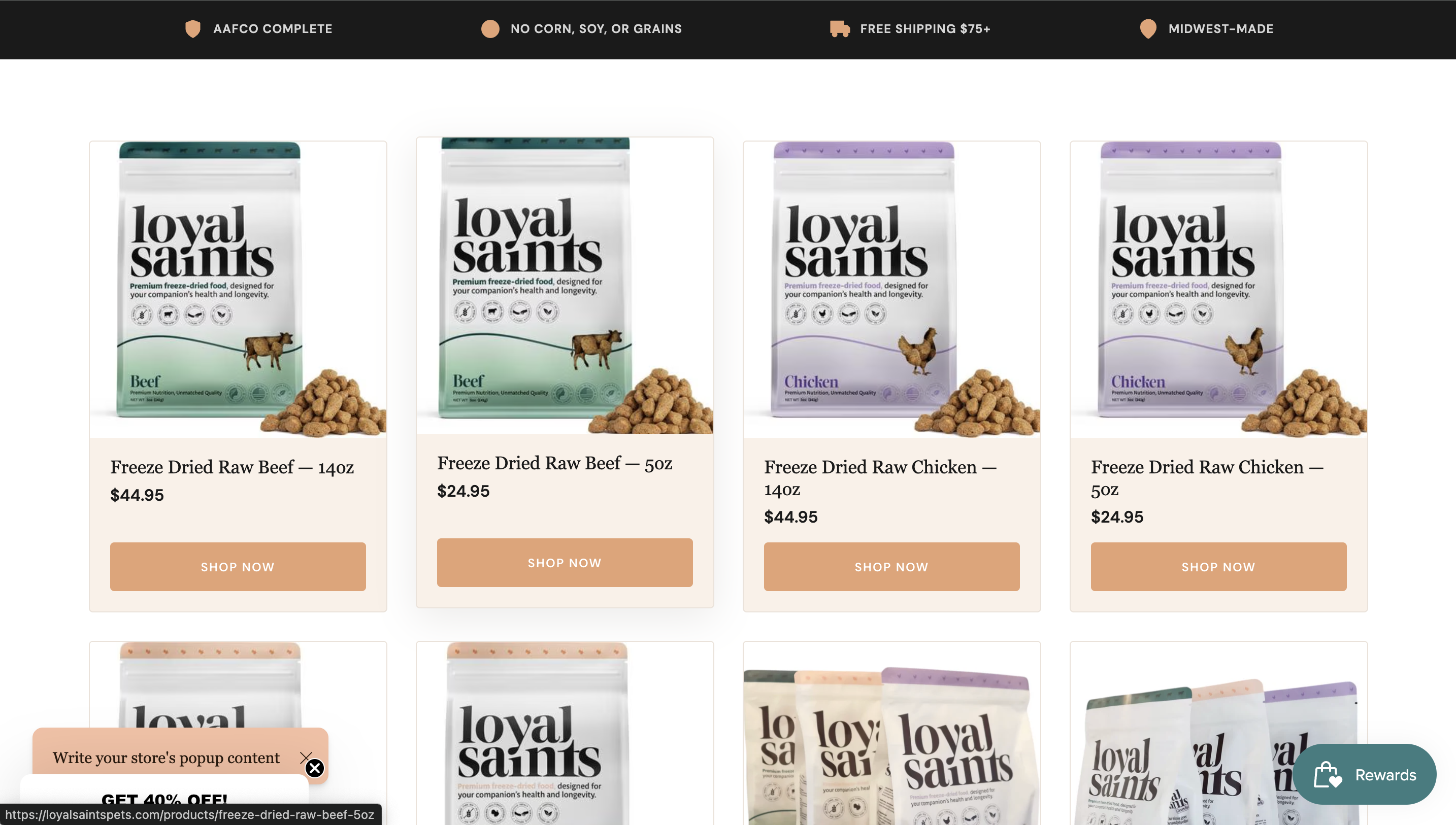
Every recipe uses whole, human-grade ingredients with no synthetic fillers, which means the mineral content stays consistent from batch to batch instead of drifting the way some mass-produced kibble can. The Freeze Dried Raw Chicken — 14oz is a solid starting point for most adult dogs, and the Freeze Dried Raw Chicken — 5oz works well if you want to test the transition before committing to a larger bag. Dogs who do better on a different protein can try the Freeze Dried Raw Beef — 14oz instead.
Even with a complete diet, always compare the guaranteed analysis to your dog’s specific life stage, and check with your veterinarian if you’re feeding a large-breed puppy or managing a medical condition. Ready to see the full guaranteed analysis for yourself? Shop the current lineup and pick the recipe that fits your dog’s stage.
Frequently Asked Questions
What is the best calcium phosphorus ratio for adult dog food? Most veterinary sources point to 1.2:1 to 1.4:1 as ideal for adult maintenance, staying within AAFCO’s broader 1:1 to 2:1 allowance.
Is a 2:1 calcium to phosphorus ratio too high for dogs? A 2:1 ratio sits at AAFCO’s upper limit and is generally considered acceptable for healthy adult dogs, though most nutritionists prefer closer to 1.4:1 for everyday feeding.
Why do large-breed puppies need a different calcium phosphorus ratio? Their skeletons grow faster and absorb calcium less selectively than adult dogs, so excess calcium can accelerate bone growth beyond what joints can structurally support, raising the risk of developmental orthopedic disease.
Can I calculate the calcium phosphorus ratio from a pet food label myself? Yes. Convert the as-fed calcium and phosphorus percentages to a dry-matter basis by adjusting for moisture, then divide calcium by phosphorus to get the ratio.
Do homemade dog diets usually meet calcium phosphorus guidelines? Not without supplementation. Most homemade recipes run low on calcium relative to phosphorus, so a calculated mineral supplement, added after checking your specific recipe, is typically necessary.
This article is general information, not a substitute for advice from a qualified doctor. Consult a qualified healthcare professional about your own circumstances before acting on anything here.
Sources
These sources back the numbers throughout this guide, and they’re worth bookmarking if you want to dig deeper:
- Pet Food Report 2013 — Appendix B (AAFCO)
- Nutritional requirements of small animals — Merck Veterinary Manual
- Dramatic changes to pet food labels proposed by AAFCO (Tufts Pet Foodology)
- Calcium, phosphorus, and vitamin D in dogs and cats — The Veterinary Clinics: Small Animal Practice (review)
- Nutrient Requirements of Dogs (NRC) — NCBI Bookshelf


