
Copper is essential for your dog’s health, but it can build up silently in the liver and cause serious disease in certain dogs. If your dog is a predisposed breed, eats an organ-heavy or home-prepared diet, or you simply don’t know how much copper is in their food, call your veterinarian and ask about baseline bloodwork before changing anything. The rest of this guide walks through why copper matters, how to read the numbers, and what to do next.
TL;DR:
- Most commercial dog foods are only required to meet minimum copper levels, with no established maximum, so actual content can vary widely between brands.
- Dogs with genetic predispositions, such as Bedlington terriers or certain retrievers, are at higher risk of copper buildup due to impaired liver excretion, especially without routine bloodwork.
- Early signs of copper toxicity are silent, making regular testing of liver enzymes crucial for at-risk breeds to catch issues before severe liver damage occurs.
- Comparing pet foods requires calculating copper content in mg per 1,000 kcal, as labels often list mg/kg without adjusting for caloric density.
- Choosing single-protein, organ-controlled diets from transparent brands reduces unpredictability and simplifies management for dogs prone to copper accumulation.
Table of Contents
- What Copper Does in a Dog’s Body (And How It Can Turn Harmful)
- How Much Copper Do Dogs Need, and Where Do the Limits Come From?
- Which Dogs Are Most Likely to Develop Copper Toxicity?
- What Are the Signs of Copper Toxicity, and How Is It Treated?
- How Do You Find or Confirm a Low-Copper Dog Food?
- How Loyal Saints Pets Approaches Copper in Its Freeze-Dried Formulas
- A Balanced Take on Copper and Canine Nutrition
- A Practical Next Step for Owners Managing Copper Intake
- Sources
- FAQ
What Copper Does in a Dog’s Body (And How It Can Turn Harmful)
Copper helps your dog’s body form red blood cells, build connective tissue, and support nerve function. It works as a cofactor for enzymes involved in iron metabolism, meaning your dog’s body actually needs adequate copper to use iron properly. Without it, dogs can develop anemia and connective tissue problems even when iron intake looks fine on paper.
The trouble starts with where copper goes after it’s absorbed. Dietary copper is taken up in the small intestine, transported to the liver, and stored there until the body needs it. The liver is copper’s warehouse, and in a healthy dog, excess copper gets packaged and excreted through bile. Some dogs, though, have livers that don’t excrete copper efficiently. Instead of being cleared, copper keeps accumulating in liver tissue, year after year, meal after meal.
This is why copper-associated hepatopathy (CAH) is such a sneaky disease. The liver has substantial reserve capacity, so a dog can be quietly stockpiling copper for years while looking completely normal. By the time symptoms show up, meaningful damage has often already occurred. That’s precisely why routine bloodwork matters so much for at-risk dogs. Liver enzymes often creep upward long before a dog acts sick.
A few basics worth remembering about how copper moves through your dog’s system:
- Copper absorption happens mainly in the small intestine and depends partly on other minerals present in the diet.
- The liver stores copper and normally excretes the surplus through bile.
- Genetic differences affect how efficiently that excretion process works.
- Chronic accumulation, not a single meal, is what drives CAH over time.
Pro Tip: Ask your vet to add a liver enzyme panel (ALT and AST) to your dog’s annual bloodwork, even if nothing seems wrong. For predisposed breeds, this small step catches problems years before symptoms appear.
How Much Copper Do Dogs Need, and Where Do the Limits Come From?
AAFCO sets copper minimums at 7.3 mg/kg (parts per million) on a dry-matter basis for adult maintenance diets, and 12.4 mg/kg for growth and reproduction. Here’s the catch that surprises a lot of owners: those are floors, not ceilings. There is currently no established maximum copper level for dog food in the United States.
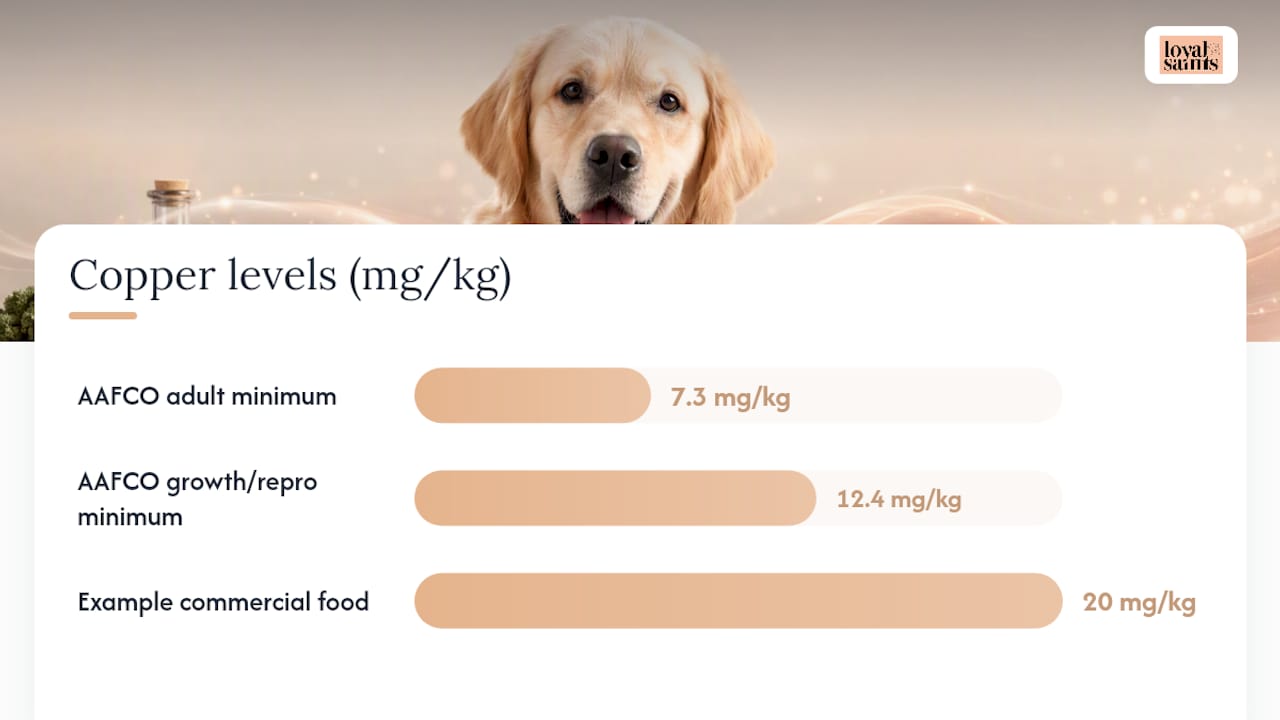
That regulatory gap has real consequences. Two commercial diets can both be “AAFCO complete” while containing very different copper levels, because the standard only requires enough copper, never a cap on how much is too much. An AAFCO expert panel has discussed setting a “low copper” claim threshold on a dry-matter basis but has acknowledged the science is insufficient to set a universal maximum for all dogs.
To actually compare foods, you need copper expressed the same way across every bag. Here’s a simple process:
- Find the food’s copper content in mg/kg (ppm) on a dry-matter basis, either on the label or from the manufacturer.
- Get the food’s caloric density in kcal per kilogram, often listed as “calorie content” on the guaranteed analysis panel.
- Divide copper (mg/kg) by calorie density (kcal/kg), then multiply by 1,000 to get mg of copper per 1,000 kcal.
A worked example: a food listing 20 mg/kg copper and 3,800 kcal/kg works out to about 5.3 mg of copper per 1,000 kcal. Compare that to a therapeutic target of very low copper per 1,000 kcal for dogs actively managing CAH, and you can see how far apart “normal” and “restricted” really are.
The regulatory gap in one line: AAFCO guarantees a copper minimum for every complete dog food, but sets no maximum, leaving owners to do their own math when comparing brands.
Which Dogs Are Most Likely to Develop Copper Toxicity?
Certain breeds carry inherited defects that reduce their ability to excrete excess copper, which stacks the deck against them regardless of diet quality. Genetic research has documented these defects most clearly in a handful of breeds, though the underlying biology likely affects others to a lesser degree.
Breeds with well-documented copper handling issues include:
- Bedlington terriers, where a specific gene defect is understood well enough that genetic testing is available and widely recommended for the breed.
- Labrador retrievers, where copper accumulation has become increasingly recognized over the last two decades.
- Doberman pinschers, often diagnosed with a chronic hepatitis pattern tied to copper.
- West Highland white terriers, historically one of the first breeds linked to hereditary copper storage disease.
- Other breeds show sporadic cases, and researchers suspect gene-environment interactions play a role even in dogs without a clear breed predisposition.
Genetic testing exists for Bedlington terriers, but it isn’t available or reliable for most of the other predisposed breeds, which means bloodwork remains your best early-detection tool across the board. A sensible screening approach starts with a baseline CBC and chemistry panel, paying close attention to ALT and AST, ideally by age two or three for predisposed breeds. If those enzymes trend upward over successive visits, your vet may recommend abdominal ultrasound or referral to a specialist for further workup. A liver biopsy with copper quantification remains the only definitive way to confirm and stage CAH.
For predisposed breeds, annual bloodwork is a reasonable baseline, with some vets recommending every six months once a dog is middle-aged or if early enzyme changes appear. Mixed-breed dogs and breeds without known predisposition can generally follow standard wellness screening schedules unless symptoms or lab abnormalities suggest otherwise.
What Are the Signs of Copper Toxicity, and How Is It Treated?
Early copper accumulation produces almost no visible signs, which is exactly the problem. By the time owners notice something is wrong, the disease has usually progressed. Watch for reduced appetite, intermittent vomiting, weight loss, lethargy, increased thirst and urination, or in advanced cases, jaundice and abdominal swelling from fluid buildup. None of these are specific to copper toxicity, which is why lab work and imaging matter more than symptom-watching alone.
Diagnosis typically follows a stepwise path:
- Bloodwork showing elevated liver enzymes is usually the first clue, often found incidentally during a wellness visit.
- Abdominal ultrasound can reveal changes in liver architecture consistent with chronic hepatitis.
- Liver biopsy with quantitative copper analysis is the definitive diagnostic step, since blood copper levels don’t always reflect what’s stored in liver tissue.
Treatment generally combines chelation therapy, often starting with D-penicillamine to actively pull copper out of the liver, alongside strict dietary copper restriction. Some clinical protocols target therapeutic diets below roughly 0.12 mg of copper per 100 kcal during active treatment, which is dramatically lower than what most commercial diets provide. Zinc supplementation often follows once copper levels stabilize, since zinc interferes with intestinal copper absorption and helps maintain lower levels long term. Recovery isn’t a one-time fix. Dogs on treatment need repeat liver enzyme monitoring, sometimes for the rest of their lives, to catch any relapse early.
Pro Tip: If your dog is diagnosed with CAH, ask your vet for the exact copper target (in mg per 100 kcal or mg per 1,000 kcal) rather than a vague “low copper” instruction. That number is what lets you actually compare therapeutic diets against each other.
How Do You Find or Confirm a Low-Copper Dog Food?
Most copper toxicity risk isn’t about one bad ingredient. It’s about not knowing what’s actually in the bag. Here’s a practical way to figure it out.
- Pull your current food’s full details. Write down the exact product name, batch or lot number, and the guaranteed analysis panel from the bag or the manufacturer’s website.
- Contact the manufacturer directly. Ask for total copper content in mg/kg on a dry-matter basis, and if possible, mg per 1,000 kcal. Many companies will share lab analyses on request even when copper isn’t printed on the label, since it’s rarely a required disclosure.
- Ask about the copper source. Copper sulfate and chelated (amino-acid bound) copper are more bioavailable than copper oxide. Industry shifts toward more bioavailable copper sources since the late 1990s are theorized to contribute to rising CAH diagnoses.
- Scan the ingredient list for red flags. Liver, other organ meats, and some novel proteins can carry naturally high copper concentrations. A food that lists liver as a top-three ingredient deserves a closer look if your dog is at risk.
- Favor single-protein, organ-controlled formulas if you’re managing risk proactively. Limiting the number of unknown ingredient sources makes it easier to track what’s actually going into your dog, an approach worth understanding in more depth through resources on limited ingredient diets.
- Consider mineral balance, not just copper in isolation. Zinc, iron, and molybdate all interact with copper absorption. A diet engineered around one mineral in isolation, without attention to the whole nutritional balance, can create new problems while solving another.
- Transition gradually. Switch foods over seven to ten days, mixing increasing amounts of the new diet with the old one, and coordinate timing with your vet if your dog is currently on chelation therapy or has recent abnormal labs.
Pro Tip: Keep a simple spreadsheet with each food’s copper in mg/1,000 kcal, updated whenever you switch brands. It takes five minutes and turns “I think it’s fine” into “I know it’s fine.”
How Loyal Saints Pets Approaches Copper in Its Freeze-Dried Formulas
Loyalsaintspets builds every recipe to meet AAFCO complete-and-balanced standards using human-grade ingredients, which gives owners a documented nutritional baseline rather than a guessing game. The freeze-dried single-protein lines, including chicken and beef options, are formulated around one primary protein source rather than a blend of multiple meats and organ meats, which naturally limits the number of unpredictable copper contributors in the bowl.
That single-protein structure matters for owners actively trying to manage copper exposure, since it’s far easier to evaluate one protein’s mineral profile than to untangle a multi-protein formula with organ inclusions from several species. If you want specifics beyond what’s printed on the bag, reach out to Loyalsaintspets directly and ask for the guaranteed copper analysis or maximum copper statement for your dog’s exact recipe. Transparency on request is a reasonable standard to hold any pet food company to, and it costs you nothing but an email.
A Balanced Take on Copper and Canine Nutrition
Copper isn’t the enemy here. It’s a required nutrient, and most dogs process it without any issue their whole lives. The real story is that a small subset of dogs, largely defined by breed and individual genetics, can’t clear copper efficiently, and commercial pet food’s copper ceiling has never been formally capped in the United States. That combination is what turns an essential mineral into a slow-moving risk for the wrong dog.
My honest advice: don’t panic, but don’t guess either. Ask your vet for baseline labwork if your dog fits a risk profile, and when you compare foods, do the math in mg per 1,000 kcal rather than trusting a vague “low copper” label claim. The pet food industry could make this dramatically easier by simply disclosing copper content on every bag. Until that happens, the burden falls on owners to ask the right questions.
— Kristina
A Practical Next Step for Owners Managing Copper Intake
Loyalsaintspets was built for exactly the kind of ingredient control this article recommends. Instead of guessing what’s hiding in a multi-protein blend, you get single-protein, AAFCO-complete recipes made from human-grade ingredients, so you know precisely what your dog is eating meal to meal.
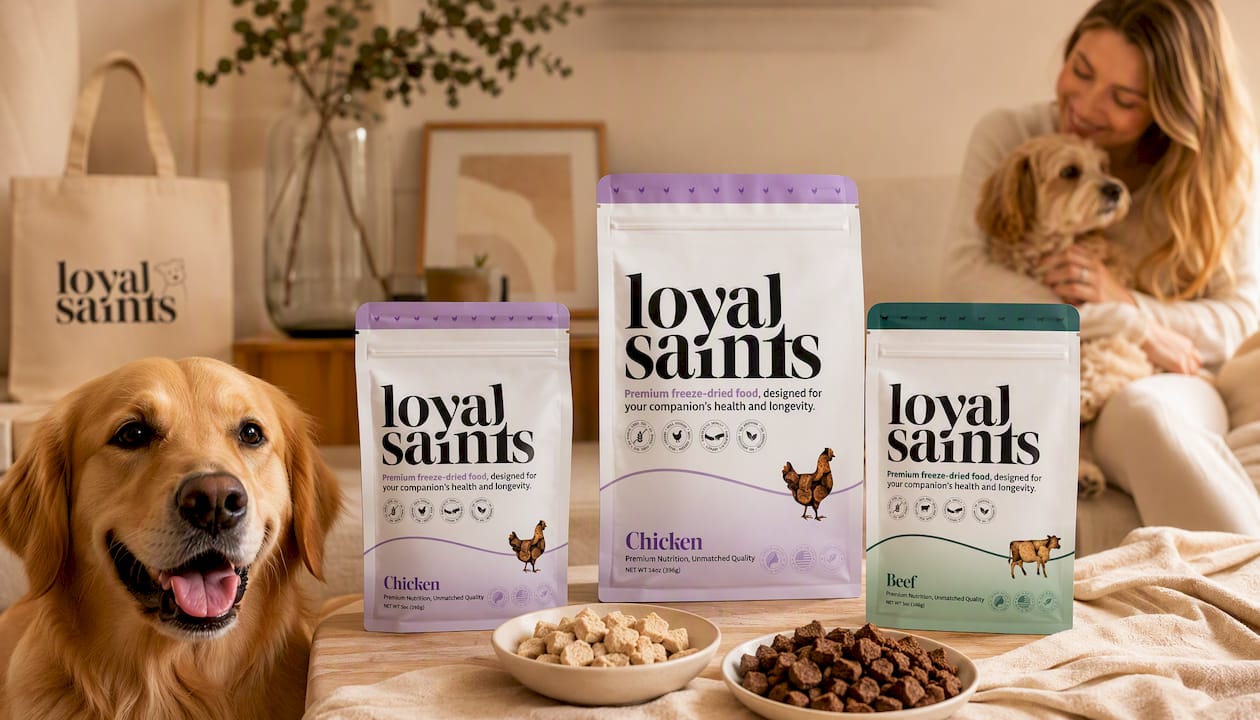
If you’re managing copper risk or simply want tighter control over your dog’s diet, the Freeze Dried Raw Chicken 5oz is a solid starting size for a trial switch, while the 14oz Freeze Dried Raw Chicken suits dogs already settled into the recipe. Prefer red meat protein? The Freeze Dried Raw Beef 5oz offers the same single-protein structure. Owners who feed consistently can save with the Halo Club membership, with recurring delivery built in. Visit the website for current pricing details.
One important note: if your dog has been diagnosed with copper-associated liver disease or is currently on chelation therapy, talk with your veterinarian before switching foods, since therapeutic copper targets require close supervision. For everyone else, a gradual transition to a single-protein formula is a straightforward, low-risk way to simplify what’s going into your dog’s bowl.
Sources
This article draws on peer-reviewed veterinary literature and clinical guidance, including a comprehensive review of canine copper metabolism, Cornell’s clinical guidance on copper hepatopathy, and the Merck Veterinary Manual’s summary of copper toxicosis. Additional detail on genetic risk comes from published research on breed susceptibility, and Morris Animal Foundation provides accessible guidance on why routine bloodwork catches this disease early. Owners who suspect a problem with a specific commercial product can also file a complaint with the FDA.
This article is general information, not a substitute for advice from a qualified doctor. Consult a qualified healthcare professional about your own circumstances before acting on anything here.
- Copper metabolism and its implications for canine nutrition - PMC
- Copper hepatopathy and dietary management — Cornell College of Veterinary Medicine
- PubMed: genetic susceptibility and copper accumulation
- Morris Animal Foundation: copper-associated liver disease in dogs
FAQ
Which dog food has the least amount of copper?
There’s no single “lowest copper” commercial food, since copper content isn’t required on most labels and varies by manufacturer. Your best approach is contacting manufacturers directly for copper content in mg per 1,000 kcal, or asking your vet about prescription therapeutic diets formulated specifically for copper restriction.
What dog breeds are prone to copper toxicity?
Bedlington terriers, Labrador retrievers, Doberman pinschers, and West Highland white terriers all have documented genetic susceptibility to copper accumulation. Genetic testing is available for Bedlington terriers specifically, while other breeds rely on regular bloodwork for early detection.
What are the symptoms of too much copper in dogs?
Early copper accumulation typically causes no visible symptoms at all, which is why it’s often called silent progression. As liver damage advances, dogs may show reduced appetite, vomiting, weight loss, lethargy, increased thirst, and eventually jaundice or abdominal swelling.
How can you avoid copper toxicosis in dogs?
Schedule regular liver enzyme bloodwork for predisposed breeds, avoid organ-heavy or unbalanced home-prepared diets, and choose single-protein, organ-controlled commercial foods like Loyalsaintspets’ freeze-dried lines when you want clearer ingredient control. Always consult your veterinarian before making dietary changes if your dog already shows abnormal liver values.


