
Ingredient splitting is when a manufacturer breaks one ingredient into several smaller-sounding components so it lists lower on the bag, pushing cheaper fillers artificially above real protein. It’s completely legal under current labeling rules, but it can seriously mislead you about what you’re actually feeding your dog. The good news: once you know the pattern, spotting it takes about thirty seconds per bag.
TL;DR:
- Ingredient splitting often targets cheap fillers like peas or grains, which can Outweigh the named protein despite the label’s order rules.
- Laws require ingredients to be listed in order of weight as formulated, enabling splitting without breaking regulations, but this can mislead owners.
- Spotting splitting takes seconds by checking for repeated root words, parentheticals, and mismatched product names versus ingredient order.
- Focus on formulas with short, verifiable ingredient lists and transparent percent declarations rather than just the first ingredient.
- Brands like Loyal Saints Pets avoid splitting by using whole, named proteins and real produce, reducing the risk of misleading marketing tactics.
Table of Contents
- What Is Ingredient Splitting in Dog Food?
- Why Manufacturers Split Ingredients and How Ordering Actually Works
- What U.S. Regulations Actually Require on Pet Food Labels
- How to Spot Ingredient Splitting: A Step-by-Step Checklist
- Red-Flag Ingredients and Label Patterns to Watch For
- Safer Buying Checklist: What Matters Beyond Ingredient Order
- How Loyal Saints Pets Approaches Ingredient Transparency
- How to Read a Dog Food Ingredient List the Right Way
- Does Ingredient Splitting Actually Hurt Your Dog’s Health?
- How Ingredient Splitting Practices Compare Across Major Brands
- Why Ingredient Splitting Changes How Owners Perceive Quality
- Tips for Verifying Ingredient Quality Beyond the Label
- Our Take: Why Label Literacy Beats Brand Loyalty
- Where to Buy Freeze-Dried Dog Food Built on Transparency
- Sources
- FAQ
What Is Ingredient Splitting in Dog Food?
Ingredient splitting happens when a manufacturer divides one ingredient category into multiple smaller-sounding entries instead of listing it as one line. Because pet food labels must show ingredients in descending order by weight, breaking a bulk filler into pieces lets each piece weigh less individually, so it drops further down the list, even though the total amount hasn’t changed.
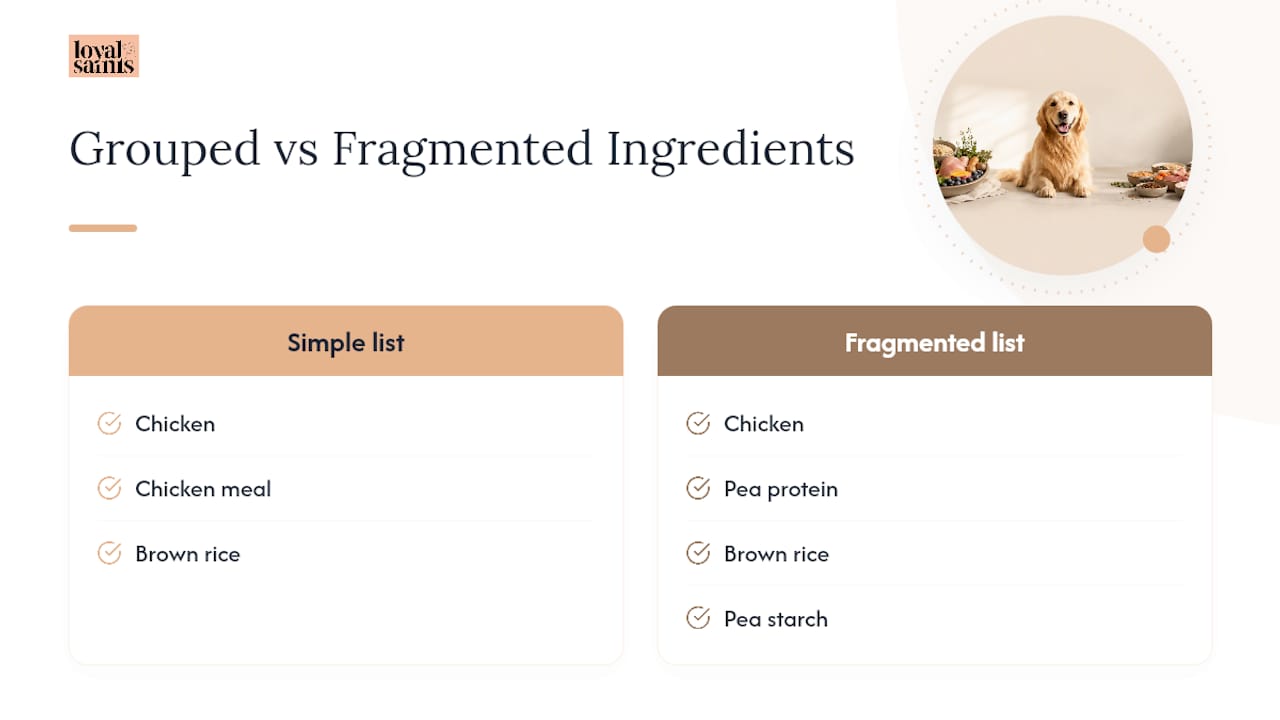
Here’s a simple hypothetical. Listed honestly, “peas” might appear second, right after chicken. Split into “peas, pea protein, pea starch, and pea fiber,” each of those four entries weighs less on its own, so they scatter lower down the ingredient statement. Chicken now appears to dominate the recipe, even though the pea-derived total may rival or exceed it.
- The total weight of the split ingredient never changes, only its visual position
- Splitting typically targets inexpensive carbohydrate or protein fillers, not premium meats
- The tactic works because federal law regulates order, not grouping
Why Manufacturers Split Ingredients and How Ordering Actually Works
The motive is almost always marketing. Product naming rules reward whichever ingredient appears to dominate the list, and a bag that opens with “chicken, chicken meal, sweet potato” reads as a meat-first formula, even when the combined plant-based fillers outweigh the meat. Since AAFCO requires ingredients listed in order of predominance by weight on an “as formulated” basis, manufacturers have a direct incentive to fragment cheap bulk ingredients into smaller units that each rank lower.
Processing adds another wrinkle. Fresh meat includes water weight that fresh vegetables might not, so a raw chicken listed first can shrink dramatically after cooking, while a dry starch stays essentially the same weight throughout. That’s not deception by itself. It’s simply how “as formulated” weight works before any heat or moisture loss happens. Splitting layered on top of that natural water-weight effect is what pushes a technically legal label into genuinely misleading territory.
What U.S. Regulations Actually Require on Pet Food Labels
Federal law sets the baseline, and it’s narrower than most owners assume. 21 CFR 501.4(a) requires that pet food ingredients be listed by their common or usual names, in descending order by weight as formulated. That’s it. The rule governs order and naming, not grouping strategy or nutritional balance.
FDA guidance on animal food labeling confirms every ingredient used must appear on the label, and that labeling claims fall under agency review. AAFCO adds its own layer: pet food labels cannot substitute a collective term, like “grain products,” for the individual ingredients actually used, though AAFCO-defined premix parentheticals for vitamins and minerals are allowed and appear routinely.
The rules regulate weight order and naming, not marketing intent. Nothing in federal or AAFCO guidance sets a minimum percentage an ingredient must hit before it’s split into components, and nothing bars a manufacturer from choosing names that happen to scatter a filler across several lower-ranked lines.
That gap, no minimum threshold and no quality descriptors allowed inside the ingredient statement itself, is exactly what makes splitting possible without technically breaking any law.
How to Spot Ingredient Splitting: A Step-by-Step Checklist
You don’t need a nutrition degree to catch this. You need about a minute and a little pattern recognition.
- Scan the first four ingredients. Look for a whole, named protein (chicken, beef, salmon) rather than a meal or by-product, and compare it against similar products side by side.
- Count repeated root words. If you see “peas,” “pea protein,” “pea starch,” and “pea fiber” scattered through the list, add their positions together mentally. That combined total often outweighs the meat listed first.
- Read parentheticals carefully. Premix declarations like “Vitamins (Vitamin E, Vitamin B1…)” are normal and legal, but they can bump other ingredients down visually.
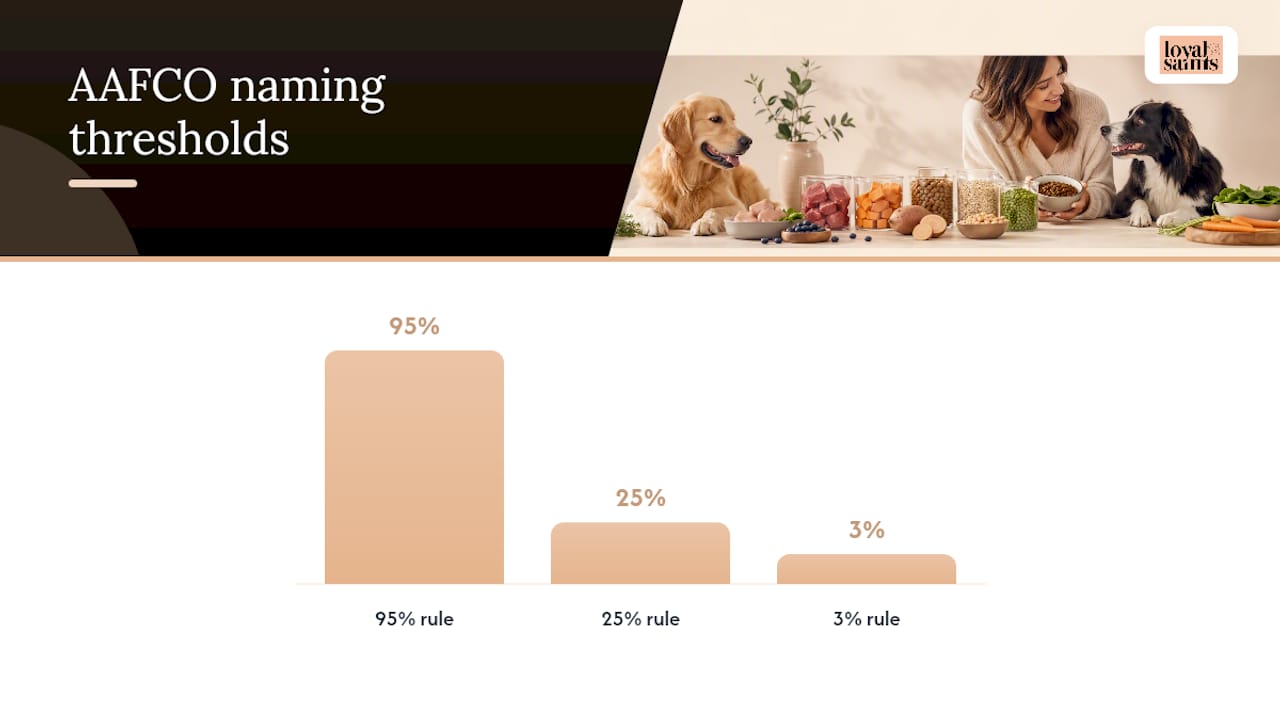
- Check the product name against the 95%, 25%, and 3% rules. A “Beef Dog Food” must meet specific percentage thresholds of beef content according to labeling rules; a “Beef Dinner” and a “with Beef” claim have lower required percentages respectively. Mismatches between the name and the ingredient order are a real tell.
- Ask the manufacturer directly. Reputable companies will share percent declarations or formulation details if you ask; a refusal to answer is itself useful information.
Pro Tip: Keep a note on your phone with the first four ingredients of your dog’s current food. Next time you’re comparing bags at the store, you’ll spot splitting patterns in seconds instead of squinting at six different labels from memory.
Red-Flag Ingredients and Label Patterns to Watch For
Certain patterns show up again and again on labels that lean on splitting or vague sourcing.
- Multiple entries built from the same root word (pea, potato, rice, corn) scattered through the list instead of grouped
- Unnamed “by-products” or “meal” with no species attached, since AAFCO requires proper species-specific naming
- A long ingredient list where the first four items are all plant-based despite a meat-forward product name
- Chemical-sounding minor ingredients near the bottom, which are often normal preservatives or micronutrients but deserve a quick look
Most of these chemical-sounding entries near the end of the list are trace vitamins, minerals, or approved preservatives, and they’re normal even in high-quality formulas. The real concern is upstream: dogs with allergies, weight sensitivity, or digestive issues can react to a formula where the actual dominant ingredient turns out to be a starch or plant protein blend rather than the named meat, simply because splitting hid the real composition.
Safer Buying Checklist: What Matters Beyond Ingredient Order
Ingredient order tells you one thing. It doesn’t tell you sourcing, processing quality, or whether the company stands behind its formulation. Purina Institute’s own guidance on reading labels makes this point directly: the ingredient statement is a regulatory disclosure, not a quality report.
- Confirm the AAFCO nutritional adequacy statement matches your dog’s life stage
- Prefer limited-ingredient formulas built around one or two named whole proteins
- Look for published percent declarations on characterizing ingredients, not just an ingredient list
- Use a dog food ingredient analyzer to check formulation claims against the label
- Ask your veterinarian to weigh in when a specific health condition is in play
A formula that names its lead protein and backs it with a percent declaration gives you something concrete to check. A formula that hides behind vague “meat meal” language and a scattered ingredient list gives you nothing to verify at all, which is precisely the gap AAFCO’s own naming rules were built to close.
How Loyal Saints Pets Approaches Ingredient Transparency
Freeze-dried raw formulas built around a single named protein leave very little room for splitting games. When beef, chicken, or turkey and salmon are the whole point of the recipe, there’s no filler bulk to fragment into a dozen confusing sub-entries.
Loyal Saints Pets formulates its freeze-dried lineup around human-grade, whole ingredients, single or limited proteins, fruits, and vegetables, with no synthetic additives or fillers to hide.
- Formulas built on named whole proteins rather than fragmented plant-based fillers
- AAFCO-aligned nutritional adequacy statements on every product
- Formulations designed for digestive health and allergy management
- A dog food ingredient comparison tool that lets you check formulations side by side before you buy
That structure reduces the incentive for splitting in the first place, since there’s no cheap bulk filler to disguise.
How to Read a Dog Food Ingredient List the Right Way
Reading a label correctly starts with one fact: everything is listed by weight as formulated, before cooking, dehydrating, or freeze-drying changes the water content. That single detail explains most of the confusion owners run into at the shelf.
Fresh meat contains a high proportion of water. Once you account for that, “chicken” listed first might represent a smaller dry-matter contribution than a dehydrated meal listed third, since meal has already had most of its moisture removed before weighing. This isn’t splitting. It’s just physics, and it’s one of the more common misreadings, right alongside the fragmentation tactic covered earlier.
To read a list properly, work through it in order without skipping ahead:
- Note whether the first ingredient is fresh (implies water weight) or a meal/dehydrated form (implies concentrated dry matter).
- Track how many entries share a root ingredient name, and mentally group them.
- Check the guaranteed analysis panel for crude protein percentage, since that number reflects the finished product, not the as-formulated order.
- Cross-reference the product name against the applicable AAFCO percent rule (95%, 25%, or 3%) to see if the name matches the actual composition.
None of this requires special tools, just a slower read than most of us give a bag of food at the store. For a deeper walkthrough of naming conventions and formatting rules, this guide to reading dog food labels covers the mechanics in more detail than we can here.
Does Ingredient Splitting Actually Hurt Your Dog’s Health?
Splitting itself isn’t a toxin. It’s a presentation trick, and the nutrients in a split-ingredient formula are still nutrients. The real risk is indirect: splitting obscures what you’re actually feeding, which makes it much harder to manage allergies, weight, or digestive sensitivity with any precision.
Consider a dog with a suspected chicken sensitivity. If the label reads “chicken, chicken meal, brown rice,” the diagnosis is straightforward. If instead it reads “chicken, pea protein, brown rice, pea starch, chicken meal, pea fiber,” you can’t easily tell whether chicken or peas make up the larger share of the formula, and an elimination diet built on that label becomes guesswork. The same problem hits weight management. A dog food marketed as high-protein can still deliver a meaningful share of its calories from split plant starches rather than meat, which matters for a dog on a strict calorie or macronutrient plan.
Digestive sensitivity follows the same logic. Multiple pea-derived or legume-derived ingredients, even split into separate entries, add up to a real fiber and starch load that can affect a dog with a sensitive gut, regardless of how far down the list each individual line appears. The health impact isn’t in the splitting mechanic itself. It’s in what splitting hides from an owner trying to make an informed, health-driven decision.
How Ingredient Splitting Practices Compare Across Major Brands
Ingredient splitting isn’t limited to one price tier or one category of dog food. It shows up across budget kibble, mid-range grocery brands, and even some products marketed as “premium,” because the underlying incentive, naming rules that reward apparent meat dominance, applies to every manufacturer working within the same AAFCO and FDA framework.
What varies is degree, not presence. Lower-cost formulas tend to rely more heavily on split plant proteins like pea protein, pea fiber, and pea starch, often because plant-based amino acid blends cost less than additional animal protein. Formulas built around a single named protein and a short ingredient list have far less room to split anything, simply because there’s less bulk filler to fragment in the first place. Limited-ingredient formulas, by design, tend to show the clearest, most verifiable ingredient statements on the market.
This is one area where reading the ingredient list against the comparison tool for dog food ingredients pays off directly: placing two labels side by side makes fragmented ingredient patterns obvious in a way that reading one bag in isolation never will. A brand that splits three separate pea derivatives across a fifteen-ingredient list looks very different once you line it up against a formula with six total ingredients and one named protein at the top.
Why Ingredient Splitting Changes How Owners Perceive Quality
A shorter ingredient list generally reads as higher quality to most shoppers, and a meat-first ingredient statement reads as more trustworthy. Manufacturers know this, and ingredient splitting exploits both perceptions at once: it can shrink the apparent presence of cheap fillers while pushing a named protein to the top of the list, even when the real composition tells a different story.
This creates a strange effect where two products with nearly identical actual formulations can look completely different in perceived quality, purely because one company chose to list “peas” as a single line and another chose to fragment it into four. The second company hasn’t changed its recipe. It’s changed how the recipe reads to a shopper scanning ingredients in the aisle for fifteen seconds.
The fix isn’t cynicism about every ingredient list. It’s recognizing that ingredient order is a formatting choice within legal boundaries, not a certified quality score, and treating it as one input among several rather than the deciding factor.
Tips for Verifying Ingredient Quality Beyond the Label
The ingredient statement can’t tell you where the chicken was raised, how the peas were sourced, or whether the manufacturer runs its own quality testing. For that, you need to look past the required label text entirely.
Start with the guaranteed analysis panel alongside the ingredient list, since crude protein, fat, and fiber percentages give you a nutritional cross-check that ingredient order alone can’t provide. Then check whether the manufacturer publishes sourcing information, country of origin for key proteins, or third-party testing results on its website. Companies confident in their formulation tend to make this information easy to find rather than burying it behind a customer service request.
Contacting the manufacturer directly is underused and genuinely effective. Ask for the specific percent declaration on the named protein, or ask whether the company can provide a certificate of analysis for a given batch. A company that answers specifically is telling you something different from one that responds with marketing language and nothing concrete.
Finally, loop in your veterinarian when a specific health condition, allergy, weight issue, or digestive sensitivity, is part of the equation. A vet can help you interpret how a formulation actually performs for your dog’s specific situation, which is a layer of verification no label, however honest, can replace on its own.
Our Take: Why Label Literacy Beats Brand Loyalty
Most advice on this topic tells owners to “read the label,” as if that solves the problem. It doesn’t, not fully. The label is a legal disclosure built around weight order and common names, and nothing in 21 CFR 501.4(a) or AAFCO’s naming rules requires a manufacturer to make that disclosure easy to interpret at a glance.
What the research actually supports is narrower and more useful: ingredient order is a starting point, not a verdict. The owners who get the best results treat the label as one data point, then cross-check it against percent declarations, product-name rules, and manufacturer transparency before making a call. Conventional advice stops at “check the first ingredient.” That’s not wrong, it’s just incomplete, and incomplete advice on a health decision for your dog isn’t much better than no advice at all.
If you take one thing from all of this, prioritize formulas with short, verifiable ingredient lists over formulas with impressive-sounding first entries. A recipe with nothing to hide doesn’t need to split anything.
— Kristina
Where to Buy Freeze-Dried Dog Food Built on Transparency
If you’re ready to buy a formula where the ingredient list has nothing to fragment, that’s exactly where Loyal Saints Pets starts. Every recipe is built around named whole proteins and real produce, so there’s no cheap bulk filler to split into confusing sub-entries in the first place.
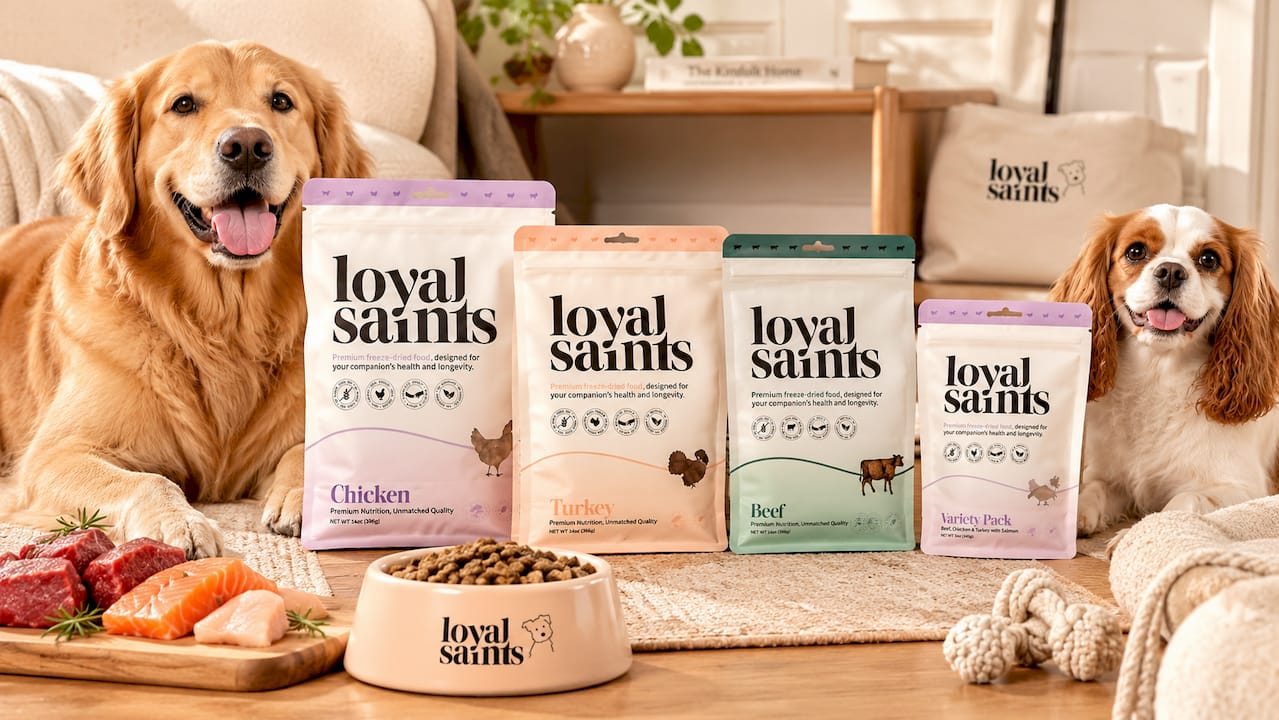
The Variety Pack — 14oz featuring Beef, Chicken & Turkey with Salmon gives you three distinct single-protein formulas in one order, useful if your dog does well on rotation feeding or you simply want to compare how each protein sits with their digestion. Prefer to sample before committing to a larger order? The Variety Pack — 5oz version offers the same three flavors in a smaller trial size. And if your dog needs a strict single-protein diet for allergy management, the Freeze Dried Raw Beef — 5oz delivers exactly one named ingredient category doing all the work.
Check the current lineup and compare formulations directly on the Loyal Saints Pets product pages before your next order.
Sources
- 21 CFR § 501.4 - Animal food; designation of ingredients. | Electronic Code of Federal Regulations (e-CFR) | US Law | LII
- Animal Food Labeling and Pet Food Claims | FDA
- Ingredients - Making Pet Food | AAFCO
- Understanding pet food labels | Purina Institute
FAQ
What ingredients should you stay away from in dog food?
Watch for multiple entries built from the same root ingredient (several pea or potato derivatives listed separately), unnamed by-products with no species attached, and vague collective terms, since AAFCO prohibits using collective grouping in place of individual named ingredients.
What is the best dog food with the fewest ingredients?
The best low-ingredient options are formulas built around a single named whole protein with minimal additions, like a limited-ingredient freeze-dried recipe, since fewer ingredients leave less room for splitting or obfuscation.
What are red-flag ingredients in dog food?
Red flags include repeated ingredients from the same source split into separate lines, unnamed meat by-products, and ingredient statements where the product name doesn’t match the actual predominant ingredient once you account for splitting.
Is ingredient splitting illegal?
No. Ingredient splitting is legal under current FDA and AAFCO rules, since those rules regulate ingredient order and naming, not how a manufacturer chooses to group similar components.


