
TL;DR:
- Most dog owners find a hybrid diet works best, combining kibble with freeze-dried toppers for optimal nutrition. Research shows freeze-dried food offers higher digestibility and palatability but costs more and requires careful portioning and handling. For most households, mixing a small amount of freeze-dried with quality kibble balances health benefits with affordability and convenience.
For most dog owners, a hybrid approach wins: use a quality kibble as the daily base and add a freeze-dried topper to boost protein density, palatability, and digestibility without the full cost of an all-freeze-dried diet. If your dog is a picky eater, has a sensitive stomach, or you simply want the closest thing to a whole-food diet in a shelf-stable format, going fully freeze-dried is a well-supported choice.
The case for freeze-dried rests on real science. A 2024 study published in Translational Animal Science found that freeze-dried and frozen-raw formats showed higher apparent total tract macronutrient digestibility than extruded kibble, with lower fecal output and different microbiota profiles. That means more of what your dog eats actually gets absorbed. AAFCO’s “complete and balanced” standard is the baseline you need on any label you buy, and Loyalsaintspets meets it across their freeze-dried line with human-grade, whole-ingredient formulas that are veterinarian-approved.
Table of Contents
- How does freeze-dried dog food compare to kibble at a glance?
- How freeze-drying and kibble production create different foods
- What does the research actually show about nutrition and digestibility?
- Honest pros and cons of freeze-dried vs. kibble for dog owners
- How much does freeze-dried dog food actually cost per month?
- Which dogs and households benefit most from each format?
- How to combine freeze-dried and kibble: ratios, mixing, and simple recipes
- Step-by-step transition plan and portioning formulas
- What to look for on labels and how to handle freeze-dried safely
- How the evidence and Loyal Saints products align
- Loyalsaintspets freeze-dried products worth trying
- Key Takeaways
- Why I recommend the hybrid approach for most dogs
- Sources and further reading
How does freeze-dried dog food compare to kibble at a glance?
Before going deep on the science, here is the quick picture. These are the dimensions that matter most when you are making a buying decision.
Quick comparison bullets:
- Nutritional density: Freeze-dried protein runs higher on a dry-matter basis than standard kibble, which typically has noticeably lower protein levels.
- Moisture and hydration: Freeze-dried moisture content is very low, while kibble has a higher moisture range. Your dog needs fresh water available at all times with either format, but especially with dry kibble.
- Digestibility and stool quality: Freeze-dried formats score higher on apparent digestibility in controlled studies; expect firmer, smaller stools.
- Palatability: Most dogs prefer freeze-dried. The concentrated aroma and real-food texture are hard to compete with.
- Shelf-stability and prep: Both are shelf-stable when sealed. Freeze-dried can be served dry or rehydrated; kibble needs no prep.
- Monthly cost: Freeze-dried costs meaningfully more per calorie. A hybrid strategy is the most practical middle ground for most households.
| Dimension | Freeze-Dried | Kibble |
|---|---|---|
| Protein (dry matter) | ~40–52% | ~24–32% |
| Fat (dry matter) | ~25–35% | ~12–18% |
| Moisture content | ~2% | ~8–12% |
| Digestibility | Higher (controlled studies) | Lower; highest fecal output |
| Palatability | Very high | Moderate |
| Shelf life (sealed) | 1–2+ years | 6–18 months |
| Monthly cost (medium dog) | Significantly higher | Lower to moderate |
| Prep required | Optional rehydration | None |
The bottom line: freeze-dried wins on nutrition and palatability; kibble wins on cost and convenience. Most owners land somewhere in between.
How freeze-drying and kibble production create different foods
The gap between these two formats starts at the factory, and understanding the process helps you trust the label claims you will read later.
Freeze-drying, step by step:
- Raw ingredients (meat, organs, fruits, vegetables) are assembled and portioned.
- The product is rapidly frozen. Speed matters here: fast freezing creates small ice crystals that preserve cellular structure and improve how well the finished product rehydrates.
- The frozen product enters a vacuum chamber. Pressure drops so low that ice converts directly to vapor without passing through liquid water, a process called sublimation.
- The result is a product with roughly 2% moisture that retains its original shape, color, and much of its native nutrient profile because no sustained high heat is applied.
Kibble extrusion, step by step:
- Ingredients are ground and mixed into a dough, often with grains, starches, or legumes as binders.
- The dough is cooked under high heat and pressure inside an extruder barrel.
- It is forced through a die, cut into pieces, and dried again to reach the 8–12% moisture range.
- A fat or flavor coating is typically sprayed on after drying to improve palatability.
The critical difference is heat. Freeze-drying avoids prolonged high-temperature processing, which means heat-sensitive nutrients, natural enzymes, and flavor compounds stay closer to their original state. Extrusion’s high heat and pressure are efficient and affordable, but they degrade some vitamins and alter protein structures in ways that affect digestibility.
Pro Tip: Because freeze-drying leaves microscopic channels where ice crystals once were, freeze-dried pieces rehydrate quickly. Add warm water or low-sodium bone broth and let it sit for 2–3 minutes for a texture closer to fresh food.
What does the research actually show about nutrition and digestibility?
Freeze-dried formats consistently outperform extruded kibble on digestibility in controlled feeding studies, and that gap has real consequences for how you portion and what you see in the yard.
The 2024 Translational Animal Science study is the most directly relevant piece of research for this comparison. It measured apparent total tract digestibility (ATTD) across multiple diet formats and found that extruded kibble had the lowest digestibility and the highest fecal output of the formats tested. Freeze-dried raw showed higher protein and fat digestibility, along with different fecal characteristics and microbiota profiles. Diet format, not just ingredient quality, drives these outcomes.
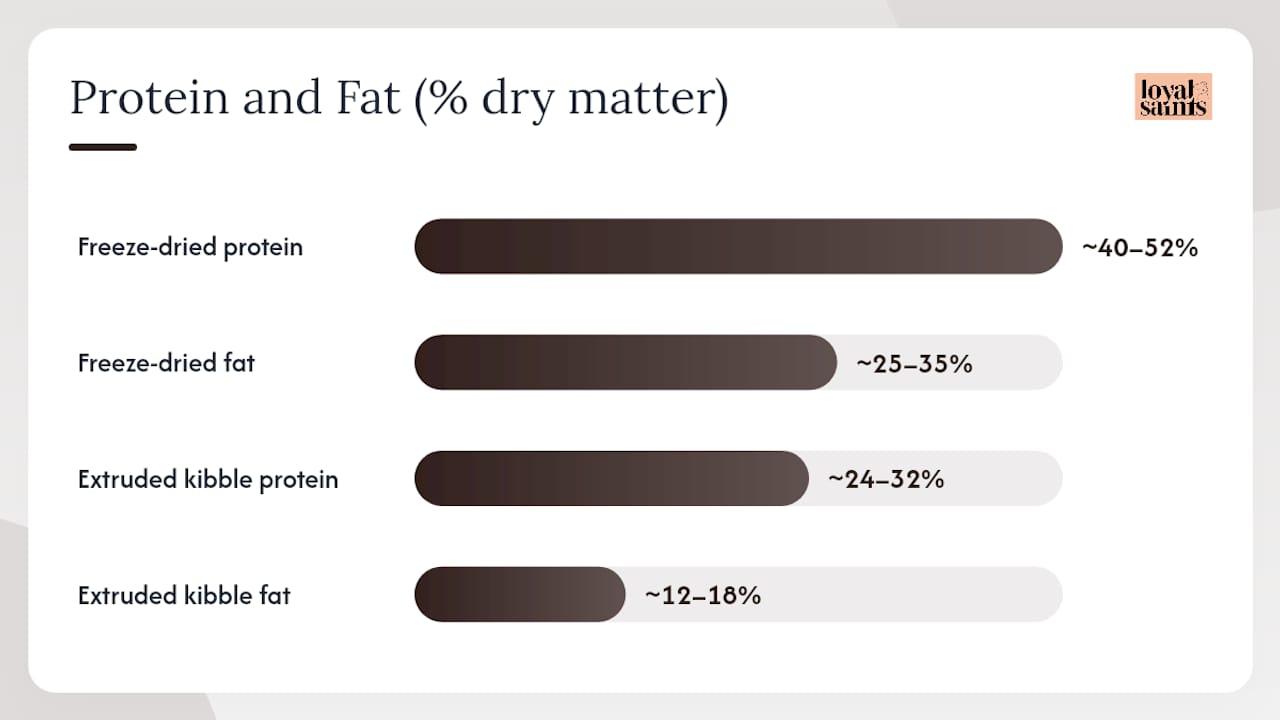
On a dry-matter basis, the macronutrient gap is substantial. Freeze-dried products typically carry protein around 40–52% and fat around 25–35%, while standard kibble runs 24–32% protein and 12–18% fat. That concentration is a feature, not a flaw, but it also means calorie density per cup-equivalent is higher for freeze-dried formulas, often between 450 and 650 kcal per cup-equivalent, compared with 320–420 kcal per cup for kibble. Feeding by volume rather than weight is a common and costly mistake.
| Metric | Freeze-Dried | Extruded Kibble |
|---|---|---|
| Protein (dry matter) | ~40–52% | ~24–32% |
| Fat (dry matter) | ~25–35% | ~12–18% |
| Apparent digestibility | Higher | Lower |
| Fecal output | Lower, firmer | Higher, softer |
| Calorie density (per cup-equiv.) | ~450–650 kcal | ~320–420 kcal |
| Microbiota effect | Different profile | Baseline comparison |
What this means practically: when you switch to freeze-dried or add it as a topper, expect smaller, firmer stools within a week or two. If stools become too firm or your dog drinks less water, rehydrating the freeze-dried portion before serving is a simple fix. The freeze-dried dog food benefits for digestive health are real, but they require adjusted portions to avoid overfeeding.
Honest pros and cons of freeze-dried vs. kibble for dog owners
No format is perfect for every household. Here is the balanced picture.
Freeze-dried: pros
- Higher protein and fat density supports muscle maintenance and energy, especially for active dogs.
- Better palatability. Even picky eaters tend to eat freeze-dried willingly.
- Higher apparent digestibility means more nutrients absorbed per gram consumed.
- Shelf-stable without refrigeration, making it easier to store than raw frozen.
- Minimal processing preserves natural flavors and many heat-sensitive nutrients.
- Single-protein or limited-ingredient options simplify allergy management.
Freeze-dried: cons
- Significantly more expensive per calorie than kibble, which limits full-diet use for many owners.
- Calorie density is easy to misjudge; volume-based feeding leads to overfeeding.
- Raw-style foods carry a risk of pathogens like Salmonella and Listeria; freeze-drying reduces moisture but does not guarantee sterility.
- Not recommended as the sole diet for households with immunocompromised people, infants, or elderly family members without veterinary guidance.
- Environmental cost of freeze-drying is higher due to energy-intensive vacuum processing.
Kibble: pros
- Affordable and widely available across all price points.
- Convenient: no prep, no rehydration, easy to measure by cup.
- Long shelf life once opened (typically 4–6 weeks after opening).
- AAFCO-complete options are easy to find at every budget.
- Lower pathogen risk due to cooking during extrusion.
Kibble: cons
- Lower apparent digestibility and higher fecal output compared to freeze-dried formats.
- High-heat processing degrades some heat-sensitive vitamins and enzymes.
- Palatability is lower, which can be a real problem for picky dogs.
- Many formulas include fillers, starches, or synthetic flavor coatings that add calories without nutritional benefit.
- Moisture content of 8–12% is low; dogs on kibble-only diets often drink less water than ideal.
Pro Tip: If you are not ready to commit to a full freeze-dried diet, start by using freeze-dried as a topper over your dog’s regular kibble. Even a small amount, roughly 10–15% of the meal by calories, can noticeably improve palatability and add a protein boost without a dramatic cost increase.
How much does freeze-dried dog food actually cost per month?
Freeze-dried generally costs more per calorie than kibble. The gap is real, and knowing the numbers helps you plan a feeding strategy that works for your budget.
Freeze-dried raw typically costs several times more per pound and per calorie than standard kibble. For a medium-size dog (around 40 lbs), feeding 100% freeze-dried can run significantly higher monthly than a quality kibble diet. That cost gap is the primary reason hybrid feeding is the approach most pet nutrition experts recommend for cost-conscious households.
| Feeding Strategy | Approx. Monthly Cost (40 lb dog) | Notes |
|---|---|---|
| 100% premium kibble | Lower end | Widely available; AAFCO-complete options at all price points |
| Hybrid (kibble base + freeze-dried topper, ~15–20% FD by calories) | Moderate | Most practical balance of cost and nutrition |
| 100% freeze-dried | Highest | Best nutrition profile; best for dogs with specific health needs |
A simple worked example: A 40 lb active dog needs roughly 1,000–1,100 kcal per day. If your freeze-dried product delivers around 500 kcal per 100g, you would need approximately 200–220g daily for a full diet. At typical freeze-dried price points, that adds up quickly. Using freeze-dried as a 15–20% calorie topper instead reduces the daily freeze-dried amount to roughly 30–40g, which stretches a bag considerably further.
A few ways to manage cost:
- Subscribe for recurring delivery. Loyalsaintspets’s Halo Club membership offers discounts and free shipping on repeat orders.
- Start with a smaller bag (like the 5oz trial size) to confirm your dog loves the formula before committing to a larger purchase.
- Use freeze-dried on top of a quality AAFCO-complete kibble rather than as a full replacement.
Which dogs and households benefit most from each format?
The right format depends on your dog’s needs and your household’s priorities. Here is a quick profile-by-profile guide.
- Picky eaters: Freeze-dried or a freeze-dried topper. The concentrated aroma and real-food texture convert even the most reluctant eaters.
- Dogs with sensitive digestion: Freeze-dried, especially single-protein formulas. Higher digestibility and limited ingredients reduce the variables that trigger GI flares.
- Senior dogs: Hybrid or full freeze-dried. Higher protein density supports muscle maintenance as metabolism slows; easier digestibility reduces the work an aging gut has to do.
- Puppies: AAFCO-complete freeze-dried formulas designed for “all life stages” are appropriate. Confirm the AAFCO statement covers growth before feeding any freeze-dried product to a puppy.
- Multi-dog households: Hybrid is usually the most practical. The cost of feeding multiple dogs 100% freeze-dried is prohibitive for most budgets; a kibble base with a shared freeze-dried topper keeps costs manageable.
- Budget-conscious owners: Kibble as the primary diet with freeze-dried used sparingly as a topper or training reward. You still get the palatability and protein benefits without the full cost.
- Households with immunocompromised family members, infants, or elderly adults: Use extra caution with raw-style freeze-dried products. Consult your veterinarian and follow strict handling protocols, or choose a cooked-format food instead.
Quick decision rules:
- Choose 100% freeze-dried if: your dog has chronic digestive issues, severe allergies, or refuses kibble entirely.
- Choose kibble if: budget is the primary constraint and your dog is healthy and thriving.
- Choose hybrid if: you want better nutrition and palatability than kibble alone but cannot absorb the full cost of freeze-dried.
How to combine freeze-dried and kibble: ratios, mixing, and simple recipes
A hybrid diet is not complicated, but the ratios and method matter. Here is how to do it well.
Recommended starting approach: Use freeze-dried as a topper at roughly 10–20% of your dog’s daily calorie target. This is enough to noticeably improve palatability and add a real protein boost without dramatically changing the diet’s nutritional balance or your monthly spend.
Ratio examples by goal:
- Palatability boost (picky eater): 10–15% of daily calories from freeze-dried, served dry on top of kibble. No rehydration needed; the aroma alone does the work.
- Protein and digestibility boost: 20–25% of daily calories from freeze-dried, rehydrated with warm water. Mix into kibble just before serving so the kibble absorbs some moisture.
- Hydration support (senior or kidney-health dogs): Rehydrate freeze-dried with low-sodium bone broth or plain warm water, then mix with kibble. The added moisture helps dogs who do not drink enough on their own.
- Full meal replacement (one meal per day): Serve freeze-dried rehydrated as the morning meal; feed kibble in the evening. This approach works well for dogs transitioning toward a fuller raw-style diet.
Simple topper recipe: Measure your dog’s freeze-dried portion by weight (not volume). Add warm water at roughly a 1:1 ratio by weight. Let sit 2–3 minutes. Spoon over kibble and serve immediately.
Monitoring checklist after starting a hybrid diet:
- Stool consistency: aim for firm, well-formed stools. Loose stools suggest too much change too fast.
- Appetite: your dog should be eager at mealtime. Disinterest may signal the ratio or formula is not right.
- Body weight: weigh your dog every 2 weeks for the first month. Freeze-dried’s higher calorie density can cause gradual weight gain if portions are not adjusted.
- Coat and energy: improvements in coat shine and energy are common within 4–6 weeks on a higher-quality diet.
Step-by-step transition plan and portioning formulas
Switching formats too fast is the most common reason dogs experience GI upset during a diet change. A gradual transition protects your dog’s gut microbiome and gives you time to dial in portions accurately.
7–10 day transition schedule:
- Days 1–2: 90% current food, 10% freeze-dried (by calorie). Serve the freeze-dried dry or lightly rehydrated on top.
- Days 3–4: 75% current food, 25% freeze-dried. Watch stool consistency closely.
- Days 5–6: 60% current food, 40% freeze-dried. If stools remain firm and appetite is good, continue.
- Days 7–8: 50/50 split. This is a natural stopping point for a hybrid diet, or a midpoint if going fully freeze-dried.
- Days 9–10: 25% current food, 75% freeze-dried, then 100% freeze-dried if that is your goal.
Portioning formula: Because freeze-dried calorie density often exceeds 450–650 kcal per cup-equivalent compared with 320–420 kcal per cup for kibble, you cannot swap cup-for-cup. Use a digital kitchen scale and the brand’s calorie-per-gram figure to calculate grams per meal. Most brands list kcal/100g on the packaging or their website.
A simple formula: Daily calorie target ÷ product kcal per gram = daily grams needed. Divide by the number of meals per day for each serving weight.
Any of these signs warrants a call to your veterinarian before continuing.
What to look for on labels and how to handle freeze-dried safely
A good label tells you almost everything you need to know before you buy. Here is what to check.
Label checklist:
- AAFCO complete and balanced statement: Must specify the life stage (adult maintenance, growth, or all life stages). “For supplemental feeding only” means the product is not nutritionally complete on its own.
- Guaranteed analysis: Check minimum crude protein and fat, and maximum crude fiber and moisture. Compare on a dry-matter basis when comparing freeze-dried to kibble.
- Ingredient order: The first ingredient should be a named meat source (chicken, beef, salmon), not a generic “meat meal” or a grain.
- Vitamin and mineral premix: Look for a named premix or individually listed vitamins and chelated minerals. This confirms the formula is nutritionally complete.
- Feeding instructions and batch/lot codes: Lot codes let you check recall databases quickly if a recall is announced.
- Human-grade or whole-ingredient claims: These are meaningful when the brand can back them up with sourcing transparency.
Safety checklist for raw-style freeze-dried foods:
- Wash hands thoroughly before and after handling.
- Do not leave rehydrated food sitting at room temperature for more than 30–60 minutes.
- Store opened bags sealed tightly in a cool, dark place. Even though freeze-dried is shelf-stable, oxidative degradation of oils and fragile nutrients can occur after air exposure.
- Monitor the FDA’s pet food recall database and sign up for alerts.
- Freeze-drying reduces moisture but does not guarantee sterility; Salmonella, Listeria, and E. coli risks remain in raw-style products.
- Households with infants, elderly adults, or immunocompromised individuals should consult a veterinarian before feeding raw-style diets.
A note on environmental impact: Freeze-drying is energy-intensive, which gives it a higher production footprint than kibble extrusion. However, shelf-stable packaging reduces cold-chain logistics waste, and higher digestibility means less food and fewer calories are needed per dog per day. Loyalsaintspets uses sustainable packaging to offset some of that production impact.
How the evidence and Loyal Saints products align
The research points in a consistent direction: minimally processed, high-protein, high-digestibility diets produce better nutrient absorption and different (often improved) gut microbiota profiles compared to extruded kibble. Loyalsaintspets’s product design reflects exactly those findings.
The 2024 Translational Animal Science study confirmed that freeze-dried formats outperform extruded kibble on apparent total tract digestibility and produce lower fecal output. Loyalsaintspets’s freeze-dried line uses human-grade, whole ingredients with no fillers or synthetic additives, low-heat processing that preserves native nutrients, and AAFCO-complete formulations that meet the nutritional standards for complete and balanced feeding. Single-protein options (chicken, beef) align with the limited-ingredient approach that digestibility research and allergy management both support.
The brand’s veterinarian-approved positioning is grounded in these same principles. For owners who want to dig deeper into the freeze-dried dog food benefits behind the label claims, the science is accessible and the logic is straightforward: less processing, better ingredients, higher digestibility.
Loyalsaintspets freeze-dried products worth trying
Real food for your dog does not have to mean a complicated feeding overhaul. Loyalsaintspets makes it straightforward with three ready-to-buy options that fit the hybrid or full freeze-dried strategies covered in this article.
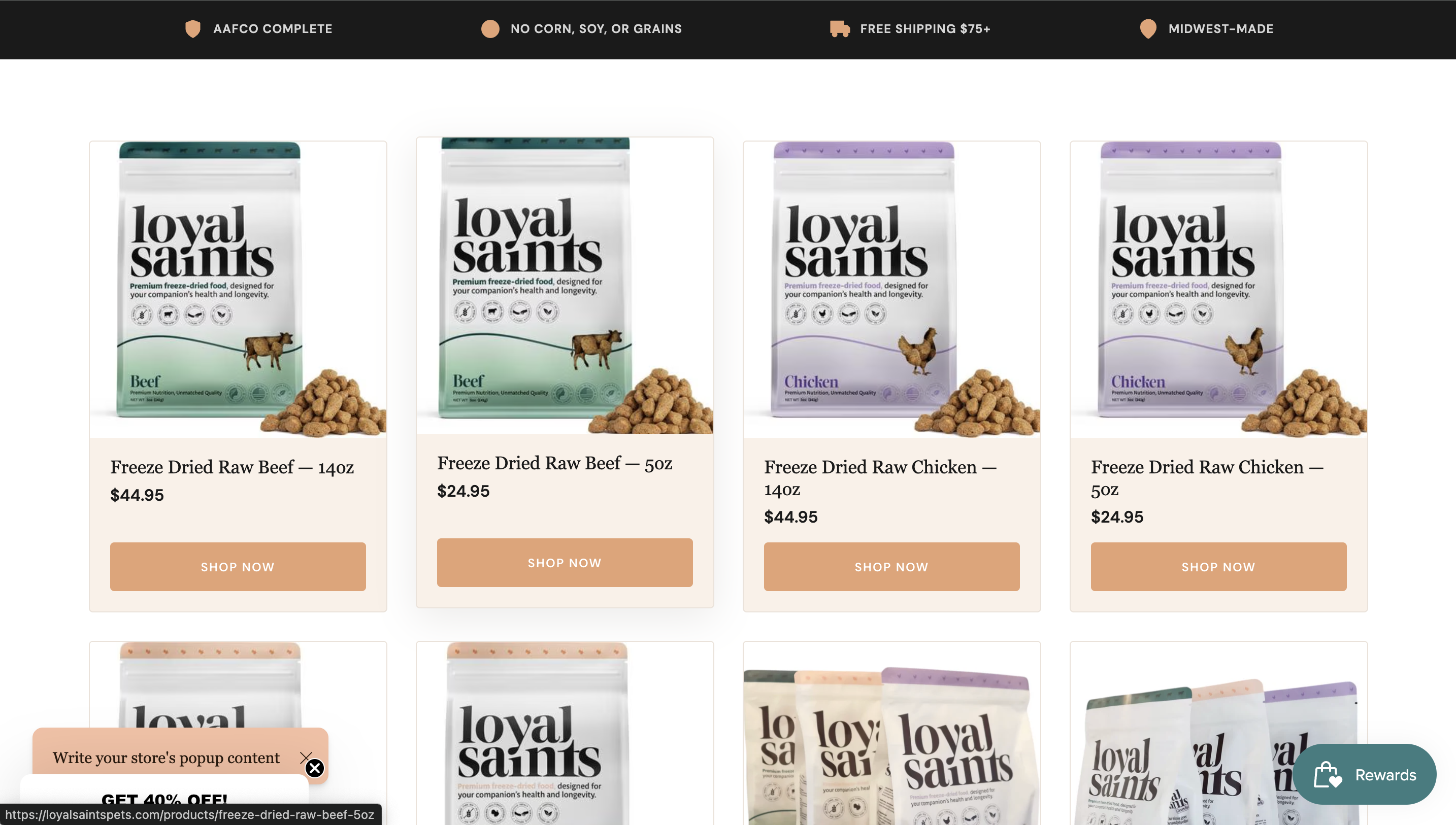
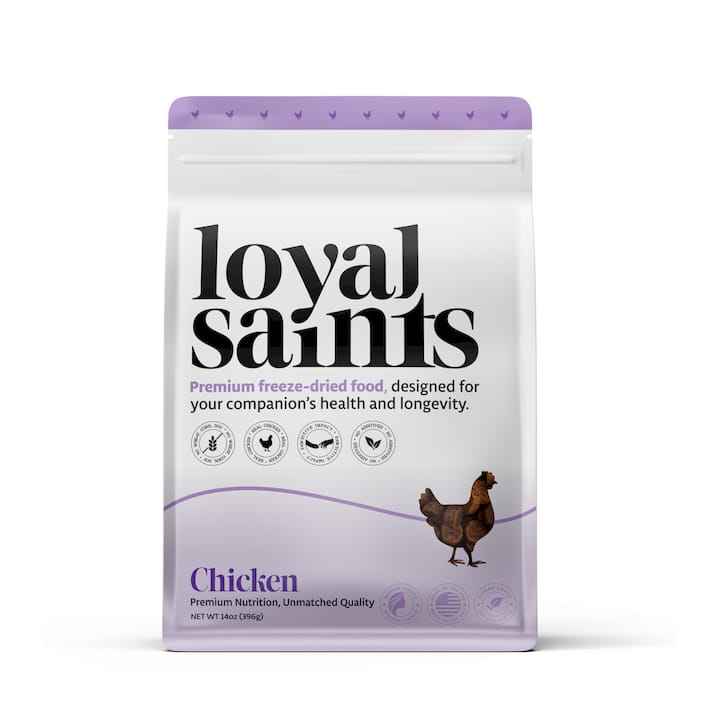
The Freeze Dried Raw Chicken — 5oz is the natural starting point if you want to try freeze-dried as a topper before committing to a larger bag. It is a single-protein, human-grade formula that is AAFCO-complete, which means it works as a full meal or a nutrient-dense addition to your dog’s current kibble. For owners ready to go bigger, the Freeze Dried Raw Chicken — 14oz is the better value per ounce and the right size for daily hybrid feeding. Dogs who do better on beef have the Freeze Dried Raw Beef — 14oz, a single-protein option that works especially well for dogs with chicken sensitivities or owners who want to rotate proteins.
All three are shelf-stable, free of fillers and synthetic additives, and made with whole ingredients your dog’s body can actually use. Join the Halo Club for recurring delivery with membership savings and free shipping, so you never run out mid-bag. Start with the 5oz chicken to find out if your dog loves it (they almost always do), then scale up from there.
Key Takeaways
Freeze-dried dog food consistently outperforms extruded kibble on digestibility and palatability, making a hybrid approach the most practical and nutritious strategy for most U.S. dog owners.
| Point | Details |
|---|---|
| Hybrid feeding wins for most owners | Kibble as the base plus a freeze-dried topper balances nutrition, palatability, and monthly cost. |
| Digestibility advantage is real | Controlled research shows freeze-dried formats have higher apparent digestibility and lower fecal output than extruded kibble. |
| Portion by weight, not volume | Freeze-dried calorie density often exceeds 450–650 kcal per cup-equivalent; use a digital scale to avoid overfeeding. |
| Safety handling is non-negotiable | Freeze-drying reduces moisture but does not eliminate pathogen risk; follow safe handling and storage protocols. |
| Loyalsaintspets fits the evidence | The Freeze Dried Raw Chicken and Beef options are AAFCO-complete, human-grade, and designed for hybrid or full freeze-dried feeding. |
Why I recommend the hybrid approach for most dogs
The freeze-dried vs. kibble debate tends to get framed as an either/or choice, and that framing does most dog owners a disservice. The research is clear that freeze-dried formats offer real digestibility and palatability advantages. But the cost reality is equally clear, and pretending otherwise sets owners up for frustration or guilt when the budget does not stretch to a full freeze-dried diet.
What the evidence actually supports is a flexible, practical middle ground. A quality AAFCO-complete kibble as the daily foundation, with a freeze-dried topper that delivers concentrated protein, real-food flavor, and the digestibility benefits the studies document, is a strategy that works for most dogs and most budgets. The dogs who genuinely need 100% freeze-dried are those with chronic digestive conditions, severe food allergies, or palatability issues so significant that kibble simply will not work. For everyone else, the hybrid approach gets you most of the benefit at a fraction of the cost.
One thing I would push back on: the idea that freeze-dried is only for premium or “fussy” owners. The digestibility data from Translational Animal Science applies to every dog, not just the ones with Instagram accounts. If your dog is absorbing more nutrition from every gram of food, that matters for long-term health regardless of your budget or lifestyle. Start small, use a scale, and pay attention to what your dog’s body tells you. The signs of a better diet show up faster than most owners expect.
Sources and further reading
- Apparent total tract nutrient digestibility of frozen raw, freeze-dried raw, fresh, and extruded dog foods and their effects on serum metabolites and fecal characteristics, metabolites, and microbiota of healthy adult dogs — Translational Animal Science, 2024
- Standardized amino acid digestibility and nitrogen-corrected true metabolizable energy of frozen and freeze-dried raw dog foods — Journal of Animal Science
- How Freeze-Dried Raw Dog Food Is Made, Step by Step — ScienceInsights
- The Complete Guide to Freeze-Dried Raw Dog Food: Benefits, Safety, and Feeding Tips — Dog Food Advisor
- What Research Reveals About Freeze Dried Raw vs Kibble — PawWisePick
- Freeze Dried Dog Food vs Kibble: Which Is Best for Your Dog? — Houndsy
- Freeze-Dried Dog Food Benefits for Your Dog’s Health — Loyalsaintspets
- Freeze-Dried Dog Food vs. Kibble: Long-Term Health Impact — Loyalsaintspets
- Why Freeze Dried? — Loyalsaintspets
This article is for general informational purposes only and is not a substitute for professional veterinary advice. Consult your veterinarian before making significant changes to your dog’s diet, especially if your dog has an existing health condition.


