
TL;DR:
- “Premium” on dog food labels is a marketing term with no legal standard, and actual quality depends on transparency and verification. Consumers should examine AAFCO statements, feeding trial claims, and ingredient sourcing to assess real nutritional value. Brands that publish detailed testing, involve veterinary nutritionists, and disclose ingredient origin often offer trustworthy options.
“Premium” on a dog food bag is a marketing label, not a legal standard. In the U.S., no regulatory body defines it — not AAFCO, not the FDA. The real measures of quality are an AAFCO nutritional adequacy statement, feeding-trial substantiation, named animal proteins, and a brand’s willingness to be transparent about sourcing, manufacturing, and safety. Organizations like WSAVA (the World Small Animal Veterinary Association) have published guidance that cuts through the buzzwords and focuses on verifiable criteria instead. Loyalsaintspets publishes this guide to help you apply those criteria every time you read a label.
Your first two moves: find the AAFCO statement on the back panel, and check whether it says the food was substantiated by “animal feeding tests using AAFCO procedures” or simply “formulated to meet” AAFCO nutrient levels. That single phrase tells you more about a food’s real quality than any front-of-bag claim.
Table of Contents
- What does “premium” actually mean on a dog food label?
- How do U.S. regulations actually protect your dog?
- How to read a dog food label step by step
- Premium vs. standard vs. prescription: which does your dog need?
- What does premium dog food actually cost?
- Red flags and trust signals when a brand claims “premium”
- An evidence-based checklist for evaluating any “premium” claim
- Which ingredients in premium dog food actually improve nutrition?
- How does the manufacturing process affect nutritional quality?
- Certification marks that go beyond AAFCO
- How to verify a brand’s transparency through third-party testing
- Does ingredient sourcing (local vs. imported) affect quality?
- Key Takeaways
- Why transparency is the only premium standard that holds up
- Loyalsaintspets freeze-dried options that meet the checklist
- Useful sources for going deeper
What does “premium” actually mean on a dog food label?
The short answer: nothing enforceable. AAFCO does not define “premium,” and neither does the FDA for pet food labeling purposes. A manufacturer can print “premium,” “super-premium,” or “ultra-premium” on any product regardless of ingredient quality, processing method, or nutritional testing. The term is chosen for pricing and positioning, full stop.
The same applies to several other front-of-bag phrases you see constantly:
- “Natural” — AAFCO does have a working definition here (no artificial flavors, colors, or preservatives), but it does not speak to ingredient quality, sourcing, or nutritional completeness.
- “Gourmet” — entirely unregulated; no standard exists.
- “Super-premium” — no legal meaning; used interchangeably with “premium” by different brands.
- “Human-grade” — meaningful only when a brand can document that every ingredient was processed in a USDA-inspected facility under human-food standards. Without that documentation, it is a marketing phrase.
- “Holistic” — no regulatory definition in pet food; avoid reading anything into it.
None of these terms replace the AAFCO nutritional adequacy statement. WSAVA guidance is direct on this point: manufacturer transparency — feeding trials, nutritionist involvement, traceable sourcing — matters far more than what appears on the front of the bag. A long ingredient list or a premium price tag does not automatically equal higher nutritional quality.
How do U.S. regulations actually protect your dog?
Understanding the regulatory framework helps you know where the real safeguards are — and where the gaps are.
AAFCO’s role. AAFCO sets the nutrient profiles and model label language that most U.S. states adopt into their own feed laws. It does not certify, test, or approve individual brands. What it does do is define the exact wording that must appear on a label for a food to claim it is “complete and balanced.” That wording is the AAFCO nutritional adequacy statement, and it comes in two forms:
- “Formulated to meet the nutritional levels established by the AAFCO Dog Food Nutrient Profiles” — the food was designed on paper to hit nutrient targets, but it was not tested in live animals.
- “Animal feeding tests using AAFCO procedures substantiate that [product] provides complete and balanced nutrition” — the food was actually fed to dogs in a controlled trial. Feeding trials are considered the gold standard for confirming a food works in practice, not just in theory.
FDA’s role. The FDA regulates pet food safety — contamination, adulteration, and recalls. A clean recall history is a meaningful trust signal. Consumer Reports testing has found that some products deviate on nutrients like vitamin D and copper relative to AAFCO guidelines, which is why checking the guaranteed analysis panel matters even for well-known brands.
The 95% / 25% / 3% rules. These govern how product names can reference ingredients:
- The 95% rule applies when a named ingredient (e.g., “Beef for Dogs”) makes up at least 95% of the total product weight, excluding water.
- The 25% rule (also called the “dinner rule”) applies to names like “Beef Dinner” or “Beef Recipe” — the named ingredient must be at least 25% of the product.
- The 3% rule covers “with beef” claims — the named ingredient needs to be only 3% of the product.
Life-stage statements. AAFCO recognizes four life-stage categories: growth (puppies), maintenance (healthy adults), gestation/lactation (pregnant or nursing dogs), and all life stages. A food labeled “for all life stages” must meet the higher nutrient requirements for growth, making it suitable for puppies but sometimes calorie-dense for sedentary adults.
How to read a dog food label step by step
Use this checklist in the store or when browsing online. Work through it in order — the items at the top carry the most weight.
- Find the AAFCO nutritional adequacy statement. It is usually on the back or side panel. Confirm it names a life stage appropriate for your dog. If there is no AAFCO statement at all, the food is not complete and balanced.
- Check whether it says “feeding tests” or “formulated to meet.” Feeding-trial language is the stronger claim. Formulation-based statements are acceptable but tell you less about real-world performance.
- Read the first five ingredients. Ingredients are listed by weight before cooking. A named animal protein (chicken, beef, salmon) should appear first or second. Watch for water-heavy whole meats that drop in rank once cooked — the guaranteed analysis gives a truer picture of actual protein content.
- Evaluate protein specificity. “Chicken” and “deboned beef” are named proteins. “Meat meal,” “poultry by-product meal,” and “animal digest” are vague. Named proteins are preferable because you know the species and can trace the source.
- Review the guaranteed analysis. This panel lists minimum crude protein, minimum crude fat, maximum crude fiber, and maximum moisture. Use it to compare foods on a dry-matter basis, especially when comparing wet and dry foods.
- Look for calorie information. The calorie statement (kcal/kg and per cup or can) is required on U.S. labels. It helps you calculate daily feeding amounts and avoid overfeeding.
- Find manufacturer contact information. A phone number, physical address, and website are required. If a brand does not list them clearly, that is a red flag.
- Search for sourcing and testing transparency. Check the brand’s website for information about where ingredients come from, which facility produces the food, and whether batch-level test results are available.
Pro Tip: One of the strongest non-obvious trust signals is a named veterinary nutritionist (board-certified, DACVN) listed on the brand’s website or in published feeding-trial reports. This credential means a qualified professional reviewed the formulation — not just a general veterinarian or a marketing team.
When it comes to processing claims, here is what the common terms mean in practice:
- Freeze-dried: Raw ingredients are frozen and moisture is removed under vacuum, preserving nutrients and eliminating pathogens without high heat. Shelf-stable and lightweight.
- Air-dried: Low heat over extended time removes moisture; gentler than extrusion but less precise than freeze-drying for nutrient retention.
- Cold-pressed: Ingredients are pressed at low temperatures; preserves some heat-sensitive nutrients but is less common in the U.S. market.
- Extruded (kibble): High heat and pressure form the familiar pellet shape. The most common processing method; nutrient losses from heat are partially compensated by added vitamins and minerals.
Premium vs. standard vs. prescription: which does your dog need?
These three categories have genuinely different formulation goals, and mixing them up can cost you money or, in the case of prescription diets, your dog’s health.
Standard commercial diets meet AAFCO minimums and are appropriate for healthy dogs without specific sensitivities. They are formulated to be nutritionally complete, and many undergo feeding trials. The ingredient quality and sourcing transparency vary widely within this category.
Premium and super-premium diets typically use named animal proteins, higher-quality ingredient sourcing, and more rigorous manufacturing processes. Many are substantiated by feeding trials rather than formulation alone. The WSAVA guidelines recommend looking for brands that employ a full-time board-certified veterinary nutritionist and publish their research — criteria that tend to correlate with the premium tier, though not universally.
Prescription diets are formulated for specific diagnosed medical conditions: kidney disease, urinary crystals, severe food allergies, pancreatitis, and others. They require a veterinarian’s recommendation because the nutrient modifications that help one condition can harm a healthy dog. No front-of-bag “premium” claim substitutes for a prescription diet when your vet has identified a medical need.

For a healthy adult dog, a well-substantiated premium diet with named proteins and feeding-trial documentation is a reasonable choice. For puppies, seniors, or dogs with diagnosed conditions, veterinary guidance should come first.
What does premium dog food actually cost?
Price ranges vary significantly by processing method and ingredient sourcing. Here is a realistic breakdown of what you can expect to pay per day for an average 30-pound dog:
- Freeze-dried raw and human-grade fresh: Typically the highest tier, driven by specialized equipment, shorter shelf life management, and sourcing costs. These formats often replace or supplement home-cooked components.
- Premium dry kibble with named proteins and feeding trials: A mid-to-upper tier that balances cost with quality signals.
- Mid-range dry kibble: Meets AAFCO minimums; ingredient sourcing and transparency vary.
- Budget dry kibble: Meets minimum standards but often uses less specific protein sources and fewer transparency disclosures.
Freeze-drying and air-drying require specialized equipment and longer production processes, which genuinely drives up retail price compared to extruded kibble. That cost difference reflects processing, not necessarily a proportional difference in raw-ingredient quality. A brand can charge a premium for freeze-drying while still using lower-grade ingredient sourcing — which is why the label checklist above matters regardless of price.
Price correlates with meaningful nutritional differences most clearly when the processing method preserves nutrients that cooking destroys (enzymes, heat-sensitive vitamins) and when the brand can document that through third-party testing. Price alone, without those verifiable signals, is not proof of superior nutrition. Veterinary experts consistently note that high-quality diets exist at multiple price points — the evidence-based checklist finds them more reliably than the price tag does.
Red flags and trust signals when a brand claims “premium”
Knowing what to avoid is just as useful as knowing what to look for.
Red flags:
- No AAFCO nutritional adequacy statement anywhere on the label
- Vague protein sources: “meat,” “poultry,” “animal by-products” with no species named
- No manufacturer name, address, or phone number on the packaging
- Recent FDA recalls, especially for contamination or nutrient imbalances
- Health claims that sound medical (“cures,” “treats,” “prevents disease”) without FDA approval
- Missing guaranteed analysis or calorie information
- No sourcing or manufacturing information on the brand’s website
Trust signals:
- Named animal proteins in the first two ingredients (chicken, beef, salmon, lamb)
- AAFCO feeding-trial language, not just formulation language
- A named, board-certified veterinary nutritionist (DACVN) on staff or credited in formulation
- Published sourcing information: country of origin, facility name or location
- Batch-level third-party lab results available on the brand site or upon request
- Clean recall history verifiable through the FDA’s recall database
- Accessible customer service with a real phone number and physical address
Consumer Reports testing has flagged instances where products deviated from AAFCO guidelines on nutrients like vitamin D and copper — a reminder that even established brands benefit from independent verification. Published feeding-trial results and third-party lab reports are the strongest evidence a brand invests in quality beyond its marketing.
An evidence-based checklist for evaluating any “premium” claim
The criteria below synthesize WSAVA manufacturer-selection guidance, AAFCO feeding-trial standards, and Vetstreet’s editorial checklist for identifying high-quality dog food. Use them to evaluate any brand, regardless of what the front of the bag says.
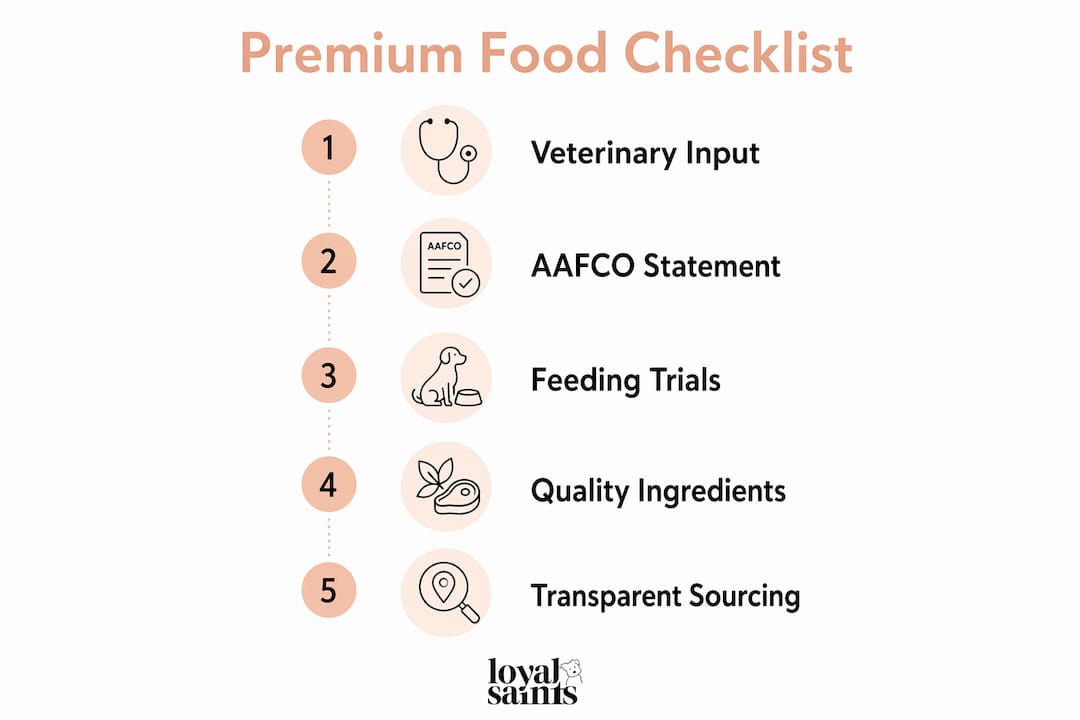
| Criterion | What to look for | Where to verify |
|---|---|---|
| Veterinary nutritionist involvement | Named DACVN on staff or credited in formulation | Brand website, “Our Team” or “Nutrition” page |
| Feeding-trial substantiation | “Animal feeding tests using AAFCO procedures” on label | Back or side panel of packaging |
| Named animal proteins | Species-specific protein (chicken, beef, salmon) as first or second ingredient | Ingredient list on label |
| Traceable sourcing | Country of origin, supplier names, or facility location disclosed | Brand website, sourcing/transparency page |
| Clean recall history | No FDA recalls in recent years, or clear corrective action documented | FDA recall database (fda.gov) |
| Third-party testing | Batch-level lab results published or available on request | Brand website or direct inquiry |
| Guaranteed analysis and calorie info | Crude protein, fat, fiber, moisture minimums/maximums; kcal/kg stated | Back panel of packaging |
These criteria are verifiable. You do not need to take a brand’s word for any of them — each has a specific place on the label or brand site where the evidence either exists or does not.
A few additional points worth noting:
- AAFCO sets the framework but does not certify individual products. The adequacy statement is the brand’s own claim, substantiated by either feeding trials or formulation analysis.
- WSAVA recommends contacting manufacturers directly to ask about their quality-control processes if the information is not publicly available.
- Vetstreet’s guidance specifically flags boutique or exotic-ingredient diets as frequently conflated with superior nutrition — the evidence-based criteria above apply equally to those products.
Which ingredients in premium dog food actually improve nutrition?
Not every ingredient on a premium label earns its place. Some genuinely improve nutrition; others are filler dressed up with a marketing name.
Ingredients that contribute real nutritional value:
Named whole proteins (chicken, beef, salmon, turkey, lamb) supply essential amino acids in forms dogs digest efficiently. Organ meats like liver add concentrated vitamins A, B12, and iron. Whole eggs provide a complete amino acid profile and are highly bioavailable. Fish and fish oil contribute omega-3 fatty acids (EPA and DHA), which support skin, coat, and joint health — the role of omega-3 supplementation in pet diets is well-documented in veterinary nutrition literature. Sweet potatoes and peas provide digestible carbohydrates and fiber. Blueberries and cranberries add antioxidants.
Ingredients that are neutral or filler:
Corn, wheat, and soy are not inherently harmful, but they are often used to boost protein percentages on paper while contributing less bioavailable protein than named animal sources. “Meat meal” and “poultry by-product meal” are rendered products — not necessarily dangerous, but less specific and traceable than named proteins. Artificial colors, flavors, and chemical preservatives (BHA, BHT, ethoxyquin) add nothing nutritionally and are absent from genuinely premium formulations.
The ingredient list order reflects weight before cooking. A whole chicken listed first may rank lower than a chicken meal after moisture is removed during processing. That is why the guaranteed analysis and dry-matter calculations give a more accurate picture of actual nutrient content than ingredient order alone.
How does the manufacturing process affect nutritional quality?
The way a food is made changes what nutrients survive to reach your dog’s bowl. This is one area where processing genuinely differentiates products — and where premium pricing can be justified by something real.
Extrusion is the dominant method for dry kibble. Ingredients are cooked at high heat and pressure, which kills pathogens but also degrades heat-sensitive vitamins, enzymes, and some amino acids. Manufacturers compensate by adding synthetic vitamins and minerals after processing. The result is a nutritionally complete food, but one where the nutrient profile is partly reconstructed rather than preserved from whole ingredients.
Cold-pressed processing uses lower temperatures, preserving more heat-sensitive nutrients. It is less common in the U.S. and produces a denser, less shelf-stable product than extruded kibble.
Freeze-drying removes moisture from raw ingredients under vacuum at low temperatures, preserving the nutrient profile of the original whole ingredients without high-heat degradation. The result is shelf-stable, lightweight, and nutritionally close to a raw diet. This is one of the few processing methods where the premium price reflects a genuine technical difference in how nutrients are preserved. You can read more about what makes dog food premium from a processing and ingredient standpoint on the Loyalsaintspets blog.
Air-drying uses gentle, sustained heat to remove moisture. It sits between extrusion and freeze-drying in terms of nutrient preservation and cost.
The practical takeaway: freeze-dried and cold-pressed formats preserve more of the original ingredient’s nutritional profile, which is a meaningful difference from extruded kibble — provided the underlying ingredients and formulation are sound.
Certification marks that go beyond AAFCO
AAFCO compliance is the baseline. Several third-party certifications signal that a brand has gone further.
USDA Organic certification means ingredients were grown without synthetic pesticides, herbicides, or GMOs, and that the processing facility meets USDA organic handling standards. For a dog food to carry the USDA Organic seal, at least 95% of its ingredients must be certified organic. This is a meaningful, audited standard — not a marketing phrase.
Non-GMO Project Verified indicates that ingredients have been tested and verified to avoid genetically modified organisms. The Non-GMO Project conducts independent testing and requires ongoing compliance, making this a verifiable claim rather than a self-declared one.
NSF International and ISO-certified manufacturing facilities indicate that production processes meet independently audited quality and safety standards. These certifications apply to the facility, not the specific product, but they signal a higher baseline of manufacturing rigor.
Certified Humane and Animal Welfare Approved labels on protein sources indicate that the animals providing the meat were raised under specific welfare standards. These are audited by third parties and carry real accountability.
None of these certifications replace the AAFCO nutritional adequacy statement — they layer on top of it. A USDA Organic food still needs to be complete and balanced for your dog’s life stage.
How to verify a brand’s transparency through third-party testing
A brand that claims premium quality should be able to back it up with documentation you can actually find. Here is how to check.
Start with the brand’s website. Look for a dedicated “Quality” or “Transparency” page that lists sourcing information, manufacturing facility details, and any third-party testing partnerships. Brands that publish this information proactively are signaling that they have nothing to hide.
Search the FDA’s recall database at fda.gov for the brand name. A clean history is a positive signal; a history of recalls without documented corrective action is a reason to look elsewhere.
Ask directly. Reputable brands respond to questions about their testing protocols, veterinary nutritionist credentials, and sourcing. If a customer service team cannot or will not answer basic questions about where ingredients come from or whether batch testing is conducted, that tells you something.
Look for published Certificates of Analysis (COAs). These are lab reports confirming that a specific production batch meets its stated nutrient profile. Some brands publish COAs on their website; others provide them on request. COAs from accredited third-party labs carry more weight than in-house testing results.
Check independent databases. The FDA’s recall database, the Better Business Bureau, and consumer watchdog organizations can surface complaints or safety issues that do not appear on a brand’s own site.
Does ingredient sourcing (local vs. imported) affect quality?
Where ingredients come from matters, but not always in the way marketing suggests.
U.S.-sourced ingredients are subject to FDA oversight and USDA inspection standards for human-food facilities. That regulatory coverage provides a baseline of safety accountability. Imported ingredients, particularly from countries with less stringent food-safety regulations, carry a higher risk of contamination or adulteration — a concern that became highly visible during the 2007 melamine contamination crisis, which affected pet foods using imported wheat gluten and rice protein concentrate.
That said, “made in the USA” does not automatically mean superior nutrition, and “imported” does not automatically mean inferior. New Zealand lamb, Norwegian salmon, and Argentinian beef are common premium protein sources with strong safety records and traceability. What matters is whether the brand can document the origin, the supplier’s safety standards, and the testing protocols applied to imported ingredients before they enter production.
The strongest sourcing claims are specific: a named country, a named supplier or farm, and documented testing at the point of entry into the manufacturing facility. Vague claims like “globally sourced quality ingredients” tell you very little. Ingredient sourcing transparency is one of the criteria Loyalsaintspets treats as non-negotiable in its own product formulations.
Key Takeaways
“Premium” is a marketing label with no legal definition in the U.S.; the only reliable quality measures are AAFCO feeding-trial substantiation, named animal proteins, manufacturer transparency, and a clean safety record.
| Point | Details |
|---|---|
| “Premium” is unregulated | No U.S. law defines it; evaluate foods by AAFCO statements and verifiable criteria instead. |
| Feeding trials vs. formulation | “Animal feeding tests” language on the label is stronger evidence than “formulated to meet” AAFCO levels. |
| Named proteins matter | Species-specific proteins (chicken, beef, salmon) are more traceable and nutritionally reliable than vague listings like “meat meal.” |
| Transparency is the real signal | Published sourcing, batch-level testing, and a named veterinary nutritionist are the strongest brand-level trust signals. |
| Loyalsaintspets products | Freeze-dried, human-grade, named single proteins with AAFCO completeness — verifiable on each product page. |
Why transparency is the only premium standard that holds up
Most dog food marketing is built around the assumption that you will not read past the front of the bag. The word “premium” is placed there precisely because it triggers a quality association without requiring any proof. After spending time with the AAFCO guidance, WSAVA criteria, and Vetstreet’s editorial checklist, one thing stands out clearly: the brands that invest in real quality are almost always the ones willing to show their work.
That means publishing feeding-trial reports, not just claiming them. It means listing a board-certified veterinary nutritionist by name, not just saying “vet-approved.” It means telling you which facility made the food and where the proteins came from — not hiding behind “premium ingredients sourced globally.” The checklist in this article is not complicated. It is just specific enough that a brand either meets it or does not.
What I find genuinely encouraging is that freeze-dried formats, when backed by real formulation rigor and transparent sourcing, represent one of the few cases where a higher price reflects a real technical difference. The processing method preserves nutrients that extrusion destroys. That is a meaningful claim — but only when the brand can document the underlying ingredient quality and nutritional completeness to match. Price without proof is still just marketing.
Loyalsaintspets freeze-dried options that meet the checklist
If you have worked through the label-reading criteria above and want a product that checks those boxes, Loyalsaintspets offers three freeze-dried options worth looking at closely.
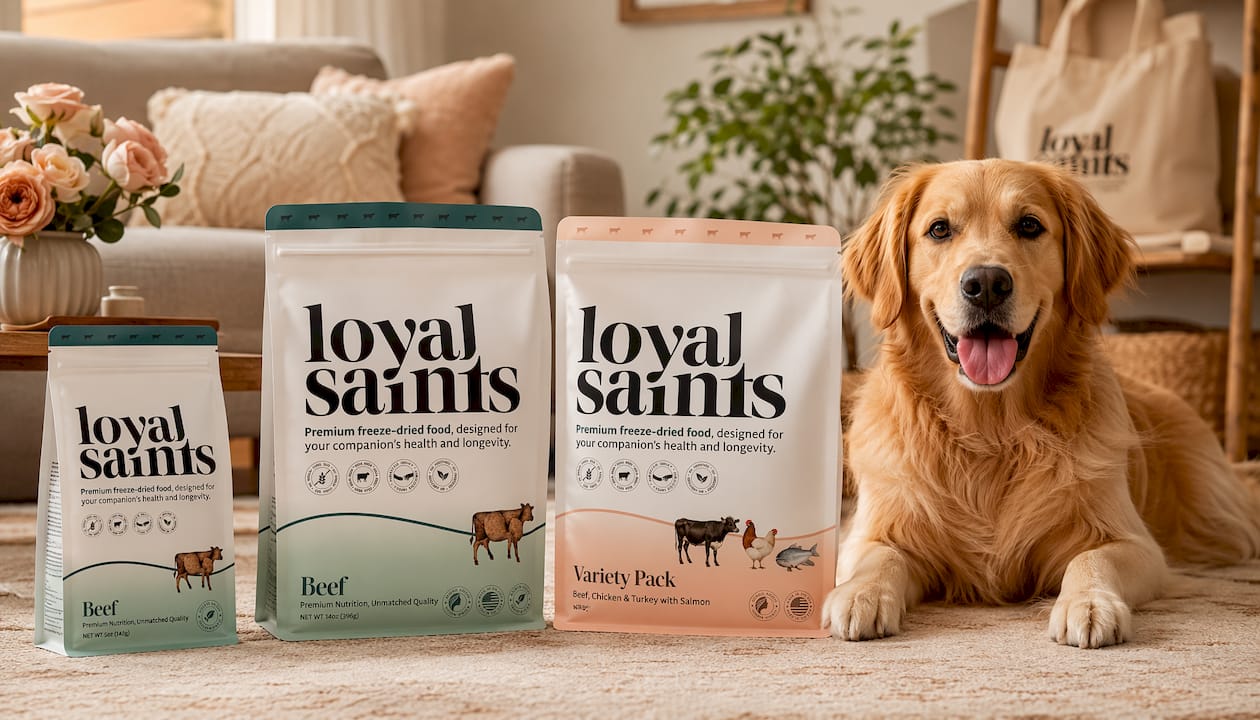
The Freeze Dried Raw Beef — 14oz leads with a single, named animal protein — beef — with no fillers, artificial additives, or vague by-product listings. The Freeze Dried Raw Beef — 5oz is the same formulation in a smaller size, useful for introducing freeze-dried food or for smaller dogs. For owners who want variety without sacrificing ingredient specificity, the Variety Pack — 14oz combines beef, chicken, and turkey with salmon — four named proteins, each traceable to a specific species.
All three are made with human-grade, whole ingredients, free of synthetic additives, and formulated to meet AAFCO nutritional standards. Sourcing and ingredient details are available directly on each product page. Loyalsaintspets also offers a Halo Club membership for recurring orders, which includes discounts and free shipping. Visit loyalsaintspets.com to review the full ingredient lists and confirm the formulation details for your dog’s life stage.
Useful sources for going deeper
These U.S.-focused resources let you verify label language, check recall history, and read the primary guidance that informs this article.
- AAFCO — Understanding Pet Food: The primary consumer resource for label language, nutritional adequacy statements, and the model regulations most U.S. states adopt. Start here to understand what any label claim actually means.
- AAFCO — Frequently Asked Questions: Covers specific terms including “natural,” “organic,” and why “premium” has no defined meaning. Useful for quick verification of front-of-bag claims.
- FDA — Complete and Balanced Pet Food: Explains the FDA’s role in pet food safety, what “complete and balanced” means under federal law, and how to report a concern or check recall status.
- WSAVA Global Nutrition Guidelines: The veterinary profession’s consensus guidance on evaluating pet food manufacturers. Covers feeding trials, nutritionist involvement, and the questions every pet owner should ask a brand.
- MSD Veterinary Manual — Dog and Cat Foods: Clinical-level reference on life-stage nutrition, AAFCO categories, and how to interpret guaranteed analysis panels.
- Vetstreet — High-Quality Dog Food: An accessible editorial checklist from veterinary experts covering the five criteria that most reliably identify quality beyond marketing.
- Consumer Reports — What’s Really in Your Dog’s Food: Independent laboratory testing of commercial dog foods, including findings on nutrient deviations from AAFCO guidelines. Useful for understanding why guaranteed analysis verification matters.
Use these sources to cross-check any brand’s claims before purchasing. For dogs with diagnosed health conditions, confirm dietary choices with your veterinarian — this article is general information, not medical or veterinary advice.


