
Commercial raw diets, including freeze-dried, typically cost more per day and per 1,000 kcal than dry kibble, and that gap holds up across most independent comparisons. DIY raw can sometimes close the distance, but supplements, prep time, and the occasional vet consult often erase the savings. Before you commit to either path, run the numbers as cost per 1,000 kcal, not cost per pound, and confirm the food carries a “complete and balanced” label.
TL;DR:
- Cost per 1,000 kcal reveals that raw diets, including freeze-dried, are usually several times more expensive than high-quality kibble, especially for larger dogs.
- Ancillary expenses such as shipping, freezer space, spoilage, supplements, and vet visits often add hundreds of dollars annually, making raw diets more costly than they initially appear.
- Properly formulated DIY raw diets tend to cost nearly double dry kibble once ingredient prices and extra costs are factored in, and safety measures further increase expenses.
- Shelf-stable freeze-dried raw options eliminate freezer costs and spoilage risks, offering a middle ground but still costing more per day than kibble.
- Ensuring a “complete and balanced” diet with safe handling practices is essential, regardless of the raw feeding method, to avoid nutritional gaps and health risks.
Table of Contents
- Raw Vs Kibble Cost: What the Numbers Actually Show
- The Hidden Costs Nobody Puts in the Cost Comparison
- How Do You Build a Dog Food Budget Worksheet?
- Is the Diet Actually Complete and Safe to Feed?
- Which Diet Fits Your Budget and Risk Tolerance?
- A Freeze-Dried Option That Skips the Freezer
- Sources
- FAQ
Raw Vs Kibble Cost: What the Numbers Actually Show
Comparing dog food by price per pound is the single biggest mistake owners make when weighing raw vs kibble cost. A pound of freeze-dried raw contains far more concentrated calories than a pound of kibble because most of the water has been removed, so the sticker price looks scarier than the actual feeding cost sometimes turns out to be. The only honest comparison converts everything to cost per 1,000 kcal, which is exactly what Tufts’ veterinary nutrition team at Pet Foodology recommends before you buy anything.
Here’s what that looks like once you do the math for three common dog sizes, using typical maintenance energy requirements and midrange retail pricing:
- A small dog needs roughly 300 to 400 kcal a day. On premium kibble, that runs about a dollar or less per day. On commercial freeze-dried or frozen raw, expect multiple times more per day for the same calories.
- A medium dog needs roughly 700 to 900 kcal a day. Kibble costs are generally lower per day. Commercial raw options typically run several times higher per day.
- A large dog needs roughly 1,300 to 1,600 kcal a day. Kibble costs remain lower per day. Commercial raw can be several times more expensive per day, with premium formulas costing more.
DIY raw sits in between, but not always where owners expect. A published comparison of home-cooked diets found median costs of $0.29 per 1,000 kcal for dry commercial diets versus $0.55 for home-cooked diets and $1.01 for canned commercial diets, meaning complete home-cooked meals often cost nearly double dry kibble once you account for real ingredient prices, not the discount bulk-meat pricing many DIY calculators assume.
Commercial raw and freeze-dried diets generally cost substantially more than high-quality kibble on a per-calorie basis, largely because of the costs involved in keeping raw meat safe to ship and store. A 2025 peer-reviewed review on raw meat diets points to freshness and hygiene requirements as major cost drivers, since raw products need cold-chain packaging, faster transport, and stricter handling than shelf-stable kibble, and that manufacturing overhead shows up directly on the price tag.
Freeze-dried raw changes the equation slightly. It strips out the freezer and the ice packs, but the ingredient premium stays put. You’re still paying for human-grade protein and a slower processing method. What you’re not paying for is the cold-chain shipping and the freezer space, which matters more than it sounds once you look at the next set of costs.
The Hidden Costs Nobody Puts in the Cost Comparison
The advertised price per bag is never the full story. Once you start budgeting for dog food realistically, a handful of ancillary costs show up that most cost calculators skip entirely.
- Shipping frequency. Frozen raw typically ships in small batches because it needs to stay cold, and each shipment carries its own fee. A household buying frozen raw every one to two weeks can spend $60 to $150 a year on shipping alone, compared with one or two bulk kibble orders a year.
- Freezer space and electricity. A chest freezer dedicated to raw food runs $150 to $400 to buy and adds measurable electricity draw every month. Kibble needs a shelf and a sealed bin, nothing more.
- Spoilage. Thawed raw food that isn’t eaten within a day or two often gets tossed, and that’s money down the drain. Kibble left in a bowl for a week is a minor mess, not a $12 loss.
- Supplements. DIY raw diets frequently run short on calcium, certain vitamins, and trace minerals, and correcting that gap costs $10 to $30 a month depending on the supplement.
- Vet follow-ups. Owners who build their own raw recipes benefit from a periodic nutrition check, and that visit typically runs $75 to $200 depending on your area and whether you see a board-certified veterinary nutritionist.
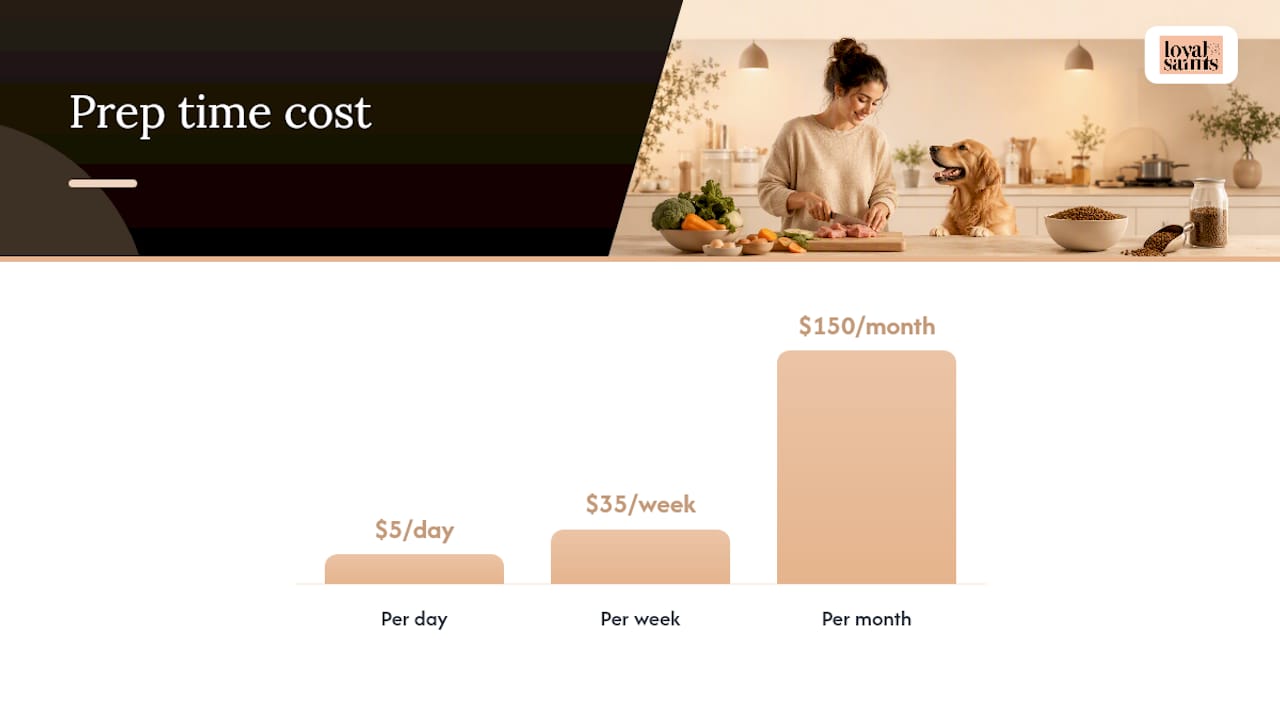
Prep time is the cost owners underestimate most, and it’s the one you’ll never see on an invoice. Portioning, thawing, and cleaning up after raw meat takes real time every single day, and that time has value even if nobody sends you a bill for it.
Pro Tip: Value your own time honestly when comparing DIY raw to anything premade. If prepping raw meals takes 15 minutes a day and you value your time at $20 an hour, that’s roughly $150 a month in labor you’re not counting when you compare sticker prices.
Shelf-stable freeze-dried formats sidestep several of these line items at once. There’s no freezer to buy, no thawing schedule, and less risk of spoilage sitting in the fridge for three days. It doesn’t erase the ingredient cost, but it does remove some of the friction that makes raw feeding feel like a part-time job.
How Do You Build a Dog Food Budget Worksheet?
Three steps get you from a bag’s price tag to a real monthly number, and you can run this for any diet you’re considering.
- Step 1: Find the cost per 1,000 kcal. Check the bag or product page for kcal per cup, per ounce, or per package, then divide the price by that number and multiply by 1,000. This single number is the only fair way to compare a 14 oz freeze-dried bag against a 30 lb bag of kibble.
- Step 2: Calculate your dog’s daily kcal need. Use your dog’s maintenance energy requirement (roughly 30 times body weight in kilograms, plus 70, adjusted for activity level), then multiply by your cost per 1,000 kcal to get cost per day.
- Step 3: Add every ancillary cost from the list above, divide by 30, and add it to your daily food cost to get a realistic monthly total.
Here’s a worked example for a 30 lb medium dog, moderately active:
The freeze-dried column carries a higher food cost, but it also skips freezer purchase, electricity draw, and most spoilage risk, which narrows the total gap versus DIY more than the per-day number alone suggests.
Is the Diet Actually Complete and Safe to Feed?
Cost only matters if the diet is actually feeding your dog what they need. The first thing to check on any bag, tub, or homemade recipe is whether it carries an AAFCO “complete and balanced” statement for your dog’s specific life stage, since a food built for adult maintenance isn’t automatically appropriate for a growing puppy or a pregnant dog.
DIY raw recipes are where nutrient gaps show up most often. Peer-reviewed reviews of homemade diets consistently find recurring shortfalls in calcium-to-phosphorus ratios and certain vitamins when owners build recipes without professional formulation. Fixing that typically means adding a calcium source and a vitamin supplement, which is exactly the $10 to $30 a month line item from the budget breakdown above.
Safety costs deserve equal weight next to nutrition costs. The CDC and the AVMA both flag genuine pathogen risk with raw feeding:
- The CDC notes that raw pet food can carry pathogens that make both pets and people sick, regardless of how carefully it’s sourced.
- The AVMA’s policy on raw diets warns that apparently healthy animals can still shed pathogens, which matters for any household with young kids, elderly family members, or immunocompromised residents.
- Dedicated cutting boards, a separate prep zone, and regular sanitizing supplies add a modest but real monthly cost, usually $10 to $20.
If you’re feeding raw with kids or older adults in the house, safe handling isn’t optional. Budget for the cleaning supplies the same way you’d budget for supplements.
Which Diet Fits Your Budget and Risk Tolerance?
Three owner profiles cover most of the raw vs kibble decision. If you’re budget-first, premium kibble with an AAFCO life-stage statement remains the least expensive way to feed a nutritionally complete diet, full stop. If you’re a health-investor willing to spend more for whole-food ingredients, freeze-dried raw is often the more rational middle ground since it keeps the ingredient quality without stacking on freezer costs and shipping frequency. If you’re managing a multi-dog or large-breed household, run the per-1,000-kcal math before committing to any raw format, because the daily cost multiplies fast at 60 pounds and up. Whichever path you choose, the label matters more than the marketing. Confirm “complete and balanced,” and loop in your vet if your dog has any medical condition that changes their nutrient needs.
— Kristina
A Freeze-Dried Option That Skips the Freezer
Some freeze-dried raw dog food brands offer the ingredient quality of raw feeding without the shipping frequency, freezer investment, or spoilage risk that can push DIY and frozen raw budgets higher. Our Freeze Dried Raw Beef, 14oz and Freeze Dried Raw Beef, 5oz formats let you match portion size to your dog’s daily kcal need without buying more than you’ll use, and the Freeze Dried Raw Chicken, 14oz option gives multi-protein households a rotation choice.

Every bag is shelf-stable, so there’s no freezer to buy and no thawed meat sitting in the fridge risking spoilage. If you feed consistently, joining Halo Club locks in recurring pricing and shipping perks that smooth out the per-bag cost swings you’d otherwise absorb ordering one bag at a time. Check shipping rates or browse the full protein lineup, including Beef, Chicken, and Turkey + Salmon, to run your own cost-per-day numbers against your current diet.
Sources
- About Pet Food Safety | Healthy Pets, Healthy People | CDC
- Pet Food Costs by Type | Tufts Pet Foodology
- Current Evidence on Raw Meat Diets in Pets: A Natural Symbol, but a Nutritional Controversy
- Home-cooked diets cost more than commercially prepared dry kibble diets for dogs with chronic enteropathies
- AVMA policy on animal-source protein and raw diets
FAQ
Why don’t some vets recommend raw feeding?
Many veterinarians raise concerns because raw meat can carry pathogens like Salmonella and Listeria, which pose risk to both pets and the humans handling their food. The AVMA’s policy specifically notes that healthy-looking animals can still shed these pathogens into the household environment.
Is it better to feed a dog raw food or kibble?
Neither format is automatically better; what matters more is whether the diet is complete and balanced for your dog’s life stage. Kibble is generally the least expensive option per 1,000 kcal, while raw and freeze-dried options cost more but some owners prioritize the whole-food ingredient profile enough to accept that premium.
What is the 80-10-10 rule for raw dog food?
It’s a starting framework, not a guaranteed complete diet, and recipes built this way still frequently fall short on calcium-to-phosphorus balance and certain vitamins without additional formulation.
What is the cheapest and healthiest way to feed a dog?
A premium dry kibble carrying an AAFCO “complete and balanced” statement is typically the least expensive way to meet a dog’s full nutrient needs without added supplements. For owners who want more whole-food ingredients without the freezer and spoilage costs of frozen raw, shelf-stable options like Loyal Saints freeze-dried raw beef offer a middle path, though it costs more per day than kibble.
Does freeze-dried raw cost less than frozen raw over time?
Freeze-dried raw doesn’t cost less per calorie than frozen raw, since both carry similar ingredient premiums. It often costs less in practice once you factor out freezer purchase, electricity, and the shipping frequency that frozen raw requires to stay cold.

