
Healthy adult dogs have no strict dietary requirement for carbohydrates, but that does not make carbs pointless. Most commercial dry dog foods run roughly 30% to 60% carbohydrate by weight, giving dogs usable energy and supporting gut health, and canned foods land lower because of their higher moisture. The big exception is pregnancy and lactation, where a mother’s body actually performs better with carbs in the mix.
TL;DR:
- Carbohydrate content in dry kibble typically ranges from 30% to 60% by weight, with moisture content affecting the actual dry matter percentage.
- Dogs do not require dietary carbs but benefit from digestible starch for energy, gut health, and stool support, especially in forms like cooked grains or vegetables.
- Label percentages include water weight, so owners should convert to dry matter basis and estimate carbs via nitrogen-free extract for accurate comparison.
- Carbohydrates are not inherently harmful; issues like allergies or weight gain are more often caused by portion control and specific health conditions.
- Special conditions such as pregnancy, lactation, or metabolic diseases require tailored diets, making vet consultation essential before dietary changes.
Table of Contents
- How Much Carbs Are in Dog Food? Reading the Percentages
- What Do Carbs Actually Do in Your Dog’s Body?
- Are Carbs Bad for Dogs? Sorting Fact From Fear
- Life Stages and Conditions Where Carb Levels Really Matter
- How to Choose the Right Carb Level for Your Dog
- How Loyal Saints Pets Approaches Carbohydrates
- Practical Takeaways From an Evidence-First View
- Ready to Simplify Feeding? Here’s Your Next Step
- Sources
- FAQ
How Much Carbs Are in Dog Food? Reading the Percentages
Carbs in dog food vary more than most owners expect, and the reason comes down to format and formulation goals. Dry kibble needs starch to hold its shape during extrusion, so it typically lands between 30% and 60% carbohydrate by weight, according to a peer-reviewed review of pet food carbohydrate sources. Canned and freeze-dried foods usually run much lower simply because water (or rehydrated water) takes up so much of the weight.
Here’s where it gets tricky: the percentage printed on a bag isn’t the number you actually want. Pet food labels list “as-fed” percentages, which include moisture. To compare a 10% moisture kibble against a 78% moisture canned food fairly, you need the dry matter (DM) basis.
- Subtract the moisture percentage from 100 to get the dry matter percentage.
- Divide the as-fed nutrient percentage by the dry matter percentage.
- Multiply by 100 to get the dry-matter percentage.
A kibble listing 10% moisture and 12% crude protein actually has 12 ÷ 90 × 100, or about 13.3% protein on a dry-matter basis. Carbohydrates aren’t listed directly on any label, so you estimate them using nitrogen-free extract (NFE), calculated as 100 minus the sum of protein, fat, crude fiber, ash, and moisture, per FEDIAF’s carbohydrate guidance. Say a food lists 26% protein, 16% fat, 4% fiber, 7% ash, and 10% moisture: 100 minus 63 leaves 37% NFE, your carb estimate. Typical fiber content in adult diets runs about 2.5% to 4.5% and counts as part of that total carb picture, even though fiber behaves very differently in the gut than starch does.
What Do Carbs Actually Do in Your Dog’s Body?
Carbohydrates aren’t dead weight in the bag. Digestible starch breaks down into glucose, which fuels your dog’s cells and, importantly, spares protein from being burned for energy so it can go toward muscle and tissue repair instead. Adult, non-reproducing dogs can make glucose from amino acids or fat through a process called gluconeogenesis, which is exactly why they have no defined dietary carb requirement. But “not required” and “not useful” are two different things, and dogs have actually evolved more amylase gene copies than wolves, giving many of them a real edge at digesting starch.
Carbs show up in dog food for a few concrete reasons, not just cost-cutting:
- Structure: starch is what makes extruded kibble hold its shape and crunch instead of crumbling apart.
- Energy: digestible carbohydrate delivers about 3.5 to 4 kilocalories per gram, similar to protein and less than fat.
- Gut support: soluble fiber ferments into short-chain fatty acids that feed colon cells, while insoluble fiber adds bulk that keeps stool firm.
- Satiety: fiber slows digestion, which can help dogs on calorie-restricted diets feel full longer.
Not every carb fraction behaves the same way once it hits your dog’s gut. Simple sugars absorb fast, standard starches digest steadily when cooked properly, resistant starch skips digestion in the small intestine and feeds bacteria in the colon instead, and fiber mostly passes through providing bulk and fermentation substrate. Skipping the idea that “carbs” is one monolithic ingredient helps explain why two foods with the same carb percentage can affect your dog’s stool completely differently. For a deeper look at how these roles play out, our breakdown of carbohydrate function in canine diets covers the energy-versus-filler debate in more depth.
Pro Tip: If your dog’s stool is consistently loose or greasy, don’t just blame “grains.” Check whether the food leans on fermentable fiber sources like inulin or beet pulp, since too much of those can upset stool quality even in dogs that tolerate grains fine.
Are Carbs Bad for Dogs? Sorting Fact From Fear
Carbohydrates, at typical inclusion levels in balanced commercial diets, are not broadly harmful to healthy dogs. The concern usually gets misdirected. Food allergies in dogs are overwhelmingly reactions to specific proteins, like chicken or beef, not to starches or grains, so blaming “carbs” for itchy skin usually points the finger at the wrong nutrient entirely.
Weight gain follows the same pattern of misplaced blame. A dog gains weight from eating more calories than it burns, full stop, and carbohydrate-heavy foods aren’t automatically higher in calories than protein or fat-heavy ones. Portion size and treat habits matter far more than whether the calories came from rice or chicken.
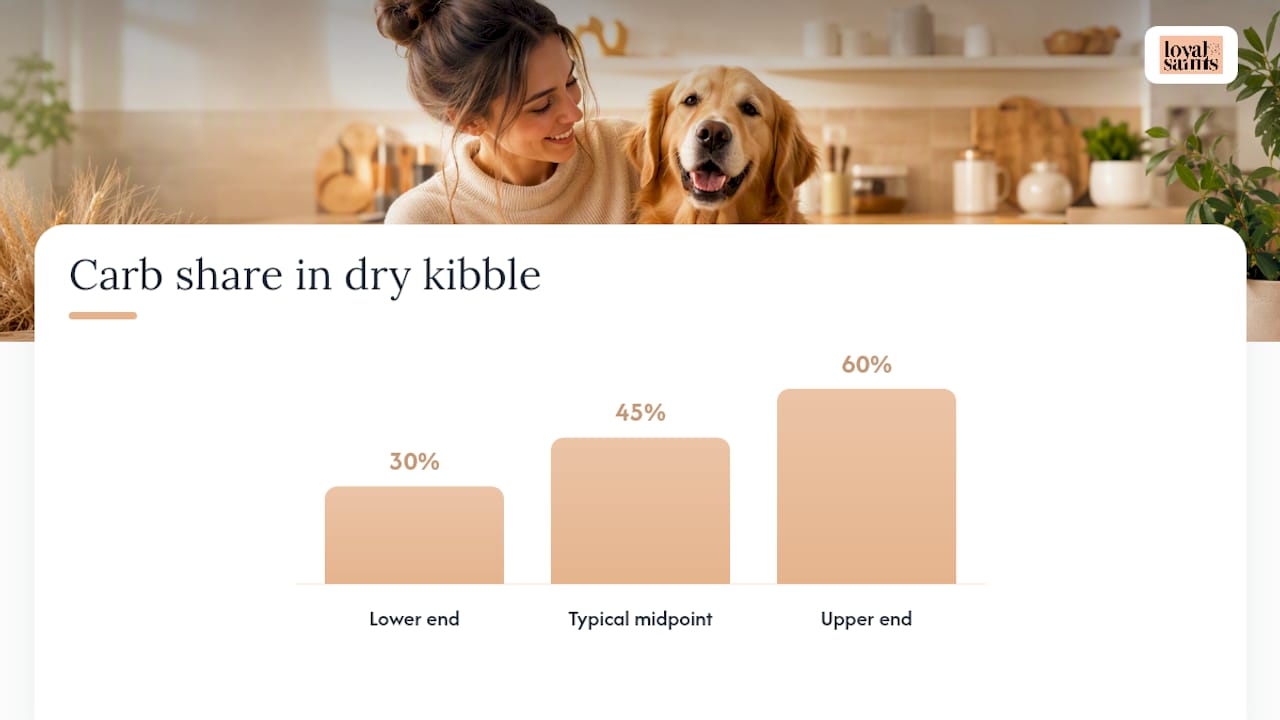
Most commercial dry dog foods land in the 30% to 60% carbohydrate by weight range, and that range covers everything from weight-management formulas to high-energy performance diets, which tells you carb percentage alone says very little about whether a food is right for your dog.
Diabetes is the one area where carb type and consistency genuinely matter, but the evidence for one “best” carbohydrate approach across all diabetic dogs is limited, and management needs to be individualized with your veterinarian rather than pulled from a general guide. A few situations do call for real caution:
- Sudden, unexplained loose stool or vomiting after a food switch
- Persistent gas or bloating that doesn’t resolve within a week of a diet change
- A diagnosed condition like diabetes, pancreatitis, or inflammatory bowel disease
Any of those warrants a call to your vet before you troubleshoot further on your own.
Life Stages and Conditions Where Carb Levels Really Matter
Most healthy adult dogs don’t need special carb math. A few life stages and medical conditions are the exception, and getting these right can matter more than almost any other feeding decision you make.
- Pregnancy and lactation: diets providing roughly 20% to 30% of energy from carbohydrates support better maternal metabolic stability and improve pup survival rates. This is a case where carbs genuinely become conditionally important rather than optional.
- Puppies and highly active dogs: the goal isn’t zero carbs or maximum carbs, it’s balance. Growing puppies and working or sporting dogs need enough total energy, protein, and fat to support development or exertion, with digestible carbs filling in efficiently as an energy source alongside those.
- Diabetes, severe GI disease, or metabolic disorders: these require a veterinary-supervised diet plan, often a prescription therapeutic formula, rather than an owner picking a “low-carb” bag off the shelf and hoping it helps.
If your dog falls into any of these categories, loop in your vet before making changes based on general guidance like this article, including anything you read on our own canine endurance and carbohydrate content.
How to Choose the Right Carb Level for Your Dog
Start with the label math you learned earlier, since it’s the fastest way to compare foods honestly. Convert to dry matter, calculate NFE, and you’ll often find that a “grain-free” bag and a grain-inclusive bag land within a few percentage points of each other on total carbohydrate.
A few habits make label reading and diet transitions go smoother:
- Look past “grain-free” marketing and check the actual ingredient list for potatoes, peas, or tapioca stacked high, which signals a starch-heavy formula regardless of grain content.
- Favor named whole-food ingredients (chicken, sweet potato, oats) over vague terms like “meat by-product” or “cereal food fines.”
- If your dog needs a lower-carb or higher-fiber profile, look for named animal proteins listed first and moderate fiber from sources like pumpkin or beet pulp rather than pure starch fillers.
- Transition any new food gradually over 7 to 10 days, mixing increasing amounts of the new food into the old to avoid GI upset.
After switching foods, watch three things closely: stool consistency, weight trend over 2 to 4 weeks, and energy level. If any of those move in the wrong direction, that’s your signal to reassess, not push through. For dogs with diagnosed conditions, a prescription or therapeutic diet from your vet should take priority over any general commercial food, no matter how well-formulated it looks on paper.
Pro Tip: Weigh your dog on the same scale, same time of day, weekly for the first month after a diet change. Small increments are easy to miss with the naked eye but obvious in numbers over time.
How Loyal Saints Pets Approaches Carbohydrates
Freeze-dried, whole-ingredient formulas take a different path to carbohydrates than extruded kibble does. Instead of relying on dense starch to bind the product together, these recipes are built around proteins with fruits and vegetables contributing modest amounts of natural carbohydrate and fiber, not starch-heavy fillers doing structural work. Every formula is AAFCO-complete and veterinarian-approved, so balance is maintained even with a lower starch load.
The current lineup includes:
- Freeze Dried Raw Chicken, 5oz, a single-protein option sized for trial runs or smaller dogs.
- Freeze Dried Raw Chicken, 14oz, the same recipe in a larger format for regular feeding.
- Freeze Dried Raw Beef, 5oz, a second protein choice for dogs who need variety or have chicken sensitivities.
Freeze-dried whole-food diets fit well for healthy dogs whose owners want ingredient transparency and lower reliance on starch fillers. They are not a substitute for a prescription diet if your vet has diagnosed diabetes, pancreatitis, or another condition requiring tightly controlled nutrient ratios. Our piece on ingredient choices for digestion goes further into how these formulas support gut health specifically.
Practical Takeaways From an Evidence-First View
Carbohydrates are a tool in dog food formulation, not a villain and not a miracle either. What actually matters is balance: total calories, protein quality, fiber type, and your dog’s specific life stage or health condition, not a single percentage on a bag. Do the label math yourself when you’re comparing foods, and bring any real health concern, especially around weight, allergies, or diabetes, to your vet rather than trying to solve it from an ingredient list alone.
— Kristina
Ready to Simplify Feeding? Here’s Your Next Step
Loyalsaintspets gives you an alternative to guessing your way through starch-heavy kibble labels: whole-food, human-grade recipes where you can see exactly what’s contributing carbs and what’s contributing protein, with no filler ingredients doing the heavy lifting.

Start with a single bag of Freeze Dried Raw Chicken, 5oz or the 14oz size if you’ve got a bigger dog at home, or try the Beef formula for variety. If you feed regularly, joining Halo Club gets you recurring shipments at $10.99 a month or $79.99 a year, plus the shipping perks that come with it. Standard shipping runs $7.99, with express shipping available at $14.99 if you need it faster. And if your dog has a diagnosed condition like diabetes or GI disease, talk to your vet before switching foods. No commercial diet, freeze-dried or otherwise, replaces a therapeutic plan built for a specific medical need. Browse the full Beef, Chicken, and Turkey + Salmon lineup to find the right starting point for your dog.
Sources
Grains like rice, corn, oats, and wheat remain the most common carbohydrate sources in dog food, and they’re joined regularly by legumes (peas, lentils, chickpeas) and root vegetables or tubers (potatoes, sweet potatoes, tapioca). Each brings a slightly different nutrient package. Rice digests easily and is often the go-to for sensitive stomachs. Oats and legumes carry more fiber and micronutrients alongside their starch. Potatoes and tapioca are nearly pure starch with very little fiber or protein riding along.
Raw starch is barely digestible to dogs. Cooking and extrusion change that through gelatinization, a process where heat and moisture cause starch granules to swell and unravel, making the starch far easier for digestive enzymes to break down, according to Tufts University’s Petfoodology program. That’s a major reason kibble and canned foods, both of which go through significant heat processing, digest so differently than raw ingredients would.
A few things worth knowing before you shop:
- Nutritional value of common carbohydrate sources used in pet foods — PMC
- Nutrient Requirements of Dogs and Cats — National Academies Press (NRC)
- FEDIAF carbohydrate review (expert summary)
Our guide to starch sources in dog food walks through how corn, rice, and potato compare ingredient by ingredient if you want to go deeper on any one source.
FAQ
What dog food has the least amount of carbs?
Canned and freeze-dried foods generally have the lowest carbohydrate content because they’re built around high-moisture, protein-forward ingredients rather than starch-based binders needed for kibble.
What types of dog food are high in carbohydrates?
Standard extruded dry kibble tends to run highest, often between 30% and 60% carbohydrate by weight, since starch is what gives kibble its shape and crunch during processing.
What is the healthiest carbohydrate for dogs?
There’s no single “healthiest” option, but well-cooked sources like rice, oats, and sweet potato tend to digest easily and bring fiber or micronutrients along with their starch, unlike nearly pure-starch fillers like tapioca.


