
Dogs can digest cooked starch efficiently, and it supplies real energy, but starch is not an essential nutrient for dogs and comes with trade-offs worth understanding before you fill your pup’s bowl. According to the FEDIAF Scientific Advisory Board Carbohydrate Expert Review, dogs evolved greater starch-digesting capacity than wolves, yet starch remains a non-essential ingredient used mainly for processing convenience and cost. Loyalsaintspets freeze-dried formulas skip starch as a structural ingredient entirely. This is one reason they appeal to owners who want something closer to a whole-food diet.
Here is what you need to know at a glance:
- Where starch comes from: Corn, wheat, rice, potatoes, peas, and tapioca are the most common sources in commercial dog food; the word “starch” rarely appears on the label itself.
- How processing changes it: Extrusion cooks and expands starch, making it highly digestible but also raising the glycemic load; minimally processed formats like freeze-dried retain a different starch profile or avoid starch altogether.
- Who benefits most from lower starch: Overweight dogs, insulin-resistant or diabetic dogs, and some senior dogs with sedentary lifestyles tend to do better on reduced-starch diets.
- Your next step: Check your dog’s current food label using the nitrogen-free extract (NFE) method below, and consider a freeze-dried or low-starch option if your dog fits any of the above profiles.
Key Takeaways
Starch in dog food is not inherently harmful, but its source, processing level, and proportion in the diet all determine whether it helps or hurts your specific dog.
| Point | Details |
|---|---|
| Starch is not essential | Dogs have no dietary requirement for starch; protein and fat can supply all needed glucose and energy. |
| Kibble is 30–60% starch by energy | Calculate NFE from the guaranteed analysis to estimate starch load; higher NFE percentages indicate higher starch content. |
| Processing determines starch type | High-shear extrusion produces mostly rapidly digestible starch; lower-shear or freeze-dried formats retain more resistant starch or less starch overall. |
| Mycotoxin risk is ingredient-driven | Corn and grain co-products are associated with higher DON, FUM, and ZEA levels; ingredient sourcing matters as much as starch quantity. |
| Loyalsaintspets freeze-dried is starch-free by design | Freeze-drying skips the structural need for starch, making Loyalsaintspets a protein-first, AAFCO-complete option for owners reducing starch. |
Table of Contents
- What is starch in dog food and where does it come from?
- How do dogs actually digest starch?
- How does processing change the starch your dog actually eats?
- What are the real benefits and risks of starch for dogs?
- How do you read a dog food label to estimate starch content?
- Which dogs benefit from lower starch, and how do you make the switch safely?
- What does the research actually say? A study digest
- How does starch affect your dog’s gut microbiota?
- How should you adjust starch levels gradually in your dog’s diet?
- What do nutrition experts say about starch requirements for dogs?
- Can starch or starch-containing ingredients cause allergic reactions in dogs?
- What I actually think about starch in dog food
- Loyalsaintspets freeze-dried diets are a practical low-starch option
- Sources
What is starch in dog food and where does it come from?
Starch is a carbohydrate made of two glucose polymers: amylose (a mostly linear chain) and amylopectin (a branched chain). Together they form the energy-storage molecule found in plant seeds, roots, and tubers. In dog food, starch serves two roles simultaneously: a nutrient that supplies glucose for energy and a functional ingredient that gives kibble its shape and texture.
There is an important distinction between digestible starch and resistant starch (RS). Digestible starch breaks down in the small intestine and enters the bloodstream as glucose. Resistant starch passes through to the large intestine, where gut bacteria ferment it, producing short-chain fatty acids that feed the colon lining. The ratio between these two fractions matters a great deal for your dog’s blood sugar, gut health, and satiety.
How do dogs actually digest starch?
The short answer: very well, as long as the starch has been cooked. The FEDIAF carbohydrate review reports that cooked starch digestibility in dogs approaches 100% in multiple studies. Raw starch is a different story. Uncooked granules resist enzymatic breakdown, which is why raw or undercooked starchy ingredients can cause digestive upset.
Dogs produce pancreatic amylase, which breaks starch into shorter chains in the small intestine. Brush-border enzymes then cleave those chains into glucose for absorption. Compared to wolves, domestic dogs carry more copies of the amylase gene (AMY2B), which is one of the clearest genetic signals of adaptation to starch-containing diets over thousands of years of living alongside humans. That said, copy number varies between individual dogs and breeds, meaning some dogs are genuinely better starch digesters than others.
Key digestibility terms you will see in the research
Understanding a few technical terms helps you read study summaries and product claims more critically:
- ATTD (Apparent Total Tract Digestibility): The percentage of a nutrient that disappears between mouth and feces; for cooked starch, ATTD is typically very high.
- RDS (Rapidly Digestible Starch): Digested within 20 minutes in the small intestine; produces a fast glucose spike.
- SDS (Slowly Digestible Starch): Digested between 20 and 120 minutes; produces a more gradual glucose response.
- RS (Resistant Starch): Reaches the colon undigested; fermented by bacteria into short-chain fatty acids.
- Starch gelatinization: The process by which heat and moisture disrupt starch granule structure, making it far more accessible to digestive enzymes.
For most healthy dogs eating a commercial kibble, the practical takeaway is that their bodies handle cooked starch efficiently. The more nuanced question is whether a high proportion of RDS is ideal for every dog, especially those prone to weight gain or blood sugar swings.
How does processing change the starch your dog actually eats?
Manufacturing choices transform starch more dramatically than most owners realize. A large-scale extrusion study published in Foods demonstrated that changing screw speed, in-barrel moisture, and particle size during kibble production measurably shifts the balance of RDS, SDS, and RS in the finished product. In other words, two kibbles made from the same ingredients can have meaningfully different starch profiles depending on how they were processed.
Extrusion works by forcing a wet dough through a die under high temperature, pressure, and mechanical shear. The heat and moisture gelatinize starch granules, and the sudden pressure drop at the die causes the kibble to expand. That expansion is why kibble has its characteristic puffed texture. Gelatinized starch is highly digestible, which is nutritionally efficient, but it also means a high proportion of RDS and a fast glucose response after eating.
| Processing variable | Direction of change | Effect on starch fractions |
|---|---|---|
| Higher screw speed (more shear) | Increases gelatinization | More RDS, less RS |
| Lower screw speed (less shear) | Reduces gelatinization | More RS retained |
| Higher in-barrel moisture | Increases gelatinization | More RDS |
| Finer particle size (pre-milling) | Increases surface area | More RDS, faster digestion |
| Coarser particle size | Reduces surface area | Slower digestion, more SDS |
The practical signal for you as an owner: a highly puffed, light kibble has typically been extruded at high shear and is likely to be predominantly RDS. A denser kibble, or one made with lower-shear processing, may retain more RS. Freeze-dried and raw formats bypass extrusion entirely, so they carry a fundamentally different starch profile, often much lower in available starch overall. That structural difference is exactly why freeze-dried diets compare so differently to kibble on energy density and digestive impact.
What are the real benefits and risks of starch for dogs?
Starch supplies economical, digestible energy and is structurally necessary for kibble production, but it carries nontrivial risks for some dogs and can introduce contamination vectors that have nothing to do with starch chemistry itself.
Benefits worth acknowledging
- Energy density: Starch provides glucose efficiently, supporting activity and organ function.
- Kibble structure: Gelatinized starch binds the kibble matrix and allows expansion; without it, extrusion-based manufacturing is not feasible.
- Palatability: Lightly cooked starch contributes to the flavor and texture dogs find appealing.
- Cost efficiency: Grain and tuber starches are far less expensive than protein, keeping commercial diets affordable.
Risks that deserve your attention
- Mycotoxin contamination: Grain ingredients, particularly corn, carry a real contamination risk. A composition-based mycotoxin risk study found that corn presence in dry dog foods was associated with higher median levels of deoxynivalenol (DON), fumonisins (FUM), and zearalenone (ZEA). Regulatory limits for these compounds in pet food are often extrapolated from livestock data, not established from canine-specific toxicology.
- Antinutrients in legumes: Peas, lentils, and chickpeas contain lectins and phytates that can reduce mineral absorption and, in large amounts, irritate the gut lining.
- Glycemic load: High-RDS diets produce repeated postprandial glucose and insulin spikes. Over time, this pattern is associated with fat storage and metabolic strain, particularly in dogs that are not very active.
- Obesity and insulin resistance: Sedentary, neutered, or genetically predisposed dogs are most vulnerable. A crossover trial in 10 beagles found measurable differences in metabolic markers and fecal metabolite profiles between high-starch and high-fat isocaloric diets, though the authors were careful to note that larger studies are needed before clinical conclusions can be drawn.
That range means a 30-pound bag of kibble can contain a substantial carbohydrate load that many owners never consider.
The dogs most likely to experience harm from high starch are those with obesity, diagnosed insulin resistance or diabetes, or grain-related mycotoxin sensitivity. Healthy, active adult dogs on a balanced diet with moderate starch generally tolerate it well. For owners managing weight or metabolic conditions, practical weight-management strategies that include dietary starch reduction can make a meaningful difference alongside veterinary guidance.
How do you read a dog food label to estimate starch content?
There is no “starch” line on a US pet food label. The FDA and AAFCO do not require manufacturers to report starch directly, so you have to work with what is there. Here is a step-by-step approach:
-
Check the first three ingredients. If a grain (corn, wheat, rice), tuber (potato, sweet potato), or legume (peas, lentils) appears in the top three, starch is a primary component of the formula.
-
Look for named grains versus vague terms. “Brown rice” is more informative than “grain products.” Vague terms like “cereal grains” or “plant protein products” obscure the actual starch source and quality.
-
Flag corn gluten meal and cereal co-products. These ingredients concentrate protein from grain processing but still carry starch fractions and, importantly, the mycotoxin risk associated with their parent grain.
-
Pull the guaranteed analysis and calculate NFE. The nitrogen-free extract (NFE) is the closest proxy for digestible carbohydrates, including starch. The formula is:
NFE% = 100 − (Crude Protein% + Crude Fat% + Crude Fiber% + Moisture% + Ash%)
-
Check for an AAFCO statement. “Complete and balanced” means the food meets minimum nutrient requirements, but it says nothing about starch level. A grain-free food can still be high in starch if it relies heavily on potatoes or peas.
-
Use format as a proxy. Freeze-dried and raw formats do not require starch for structure, so they tend to be significantly lower in available starch than extruded kibble. The label format itself is a meaningful signal.
A review of mycotoxin contamination in pet foods notes that surveys frequently detect mycotoxins in commercial pet food samples, often at low concentrations, but the risk correlates with ingredient choice. Knowing which grains are in your dog’s food is the first step toward assessing that risk.
Which dogs benefit from lower starch, and how do you make the switch safely?
For most healthy adult dogs, moderate starch is not a crisis. But for dogs with obesity, diabetes, insulin resistance, or certain digestive sensitivities, reducing dietary starch can produce real improvements in weight, energy, and metabolic markers. Always consult your veterinarian before making significant dietary changes for a dog with a diagnosed condition.
Here is a practical sequence for reducing starch safely:
- Assess your dog’s current health status. Note body condition score, energy level, stool quality, and any diagnosed metabolic conditions. If your dog is diabetic or insulin-resistant, get a vet consultation before changing anything.
- Choose a balanced low-starch option. Options include low-starch kibble formulations (check NFE below 30% on a dry-matter basis), grain-free diets that are also low in tubers and legumes, or freeze-dried raw formats that skip starch as a structural ingredient entirely. For a detailed comparison of how these formats differ in energy and health impact, the freeze-dried vs. kibble energy comparison is worth reading.
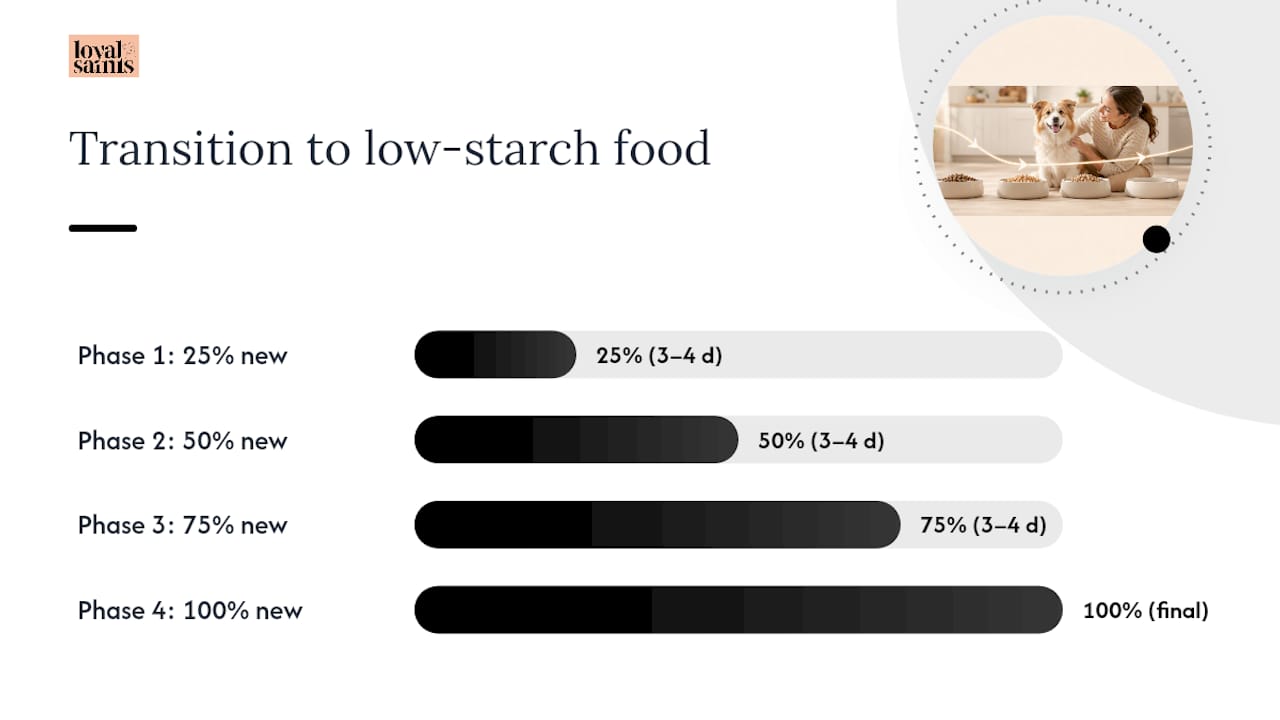
- Transition gradually over 7–14 days. Start with 75% old food and 25% new food for three to four days. Move to 50/50 for another three to four days, then 25% old and 75% new, and finally 100% new food. Rushing this step is the most common cause of digestive upset during a diet change.
- Monitor weight, stool, and energy weekly. Loose stools or significant weight loss in the first two weeks usually signal too-fast a transition or a protein level that needs adjusting. Firm, well-formed stools and stable energy are the signs you want.
- Recheck with your vet at 4–6 weeks. For dogs with metabolic conditions, a follow-up blood glucose or lipid panel at this point gives you objective data on whether the change is working.
Pro Tip: If you cook for your dog at home and want to preserve more resistant starch, cook starchy ingredients like potatoes or rice, then cool them in the refrigerator overnight before serving. Cooling converts some digestible starch back into resistant starch, which slows glucose absorption and feeds beneficial gut bacteria. Reheating gently keeps some of that RS intact.
For owners adding high-protein toppers to reduce the starch proportion of a meal without switching foods entirely, dog food toppers can be a practical intermediate step. Pair that with the transition plan above and you have a flexible, low-risk approach.
What does the research actually say? A study digest
The scientific consensus on starch in dog food is clearer on some questions than others. Properly processed starch is highly digestible; processing level determines the proportion of RDS versus RS; and ingredient choice, particularly the presence of corn and grain co-products, is the primary driver of mycotoxin risk.
| Study / Source | Scope | Variable tested | Key finding | Limitation |
|---|---|---|---|---|
| FEDIAF Carbohydrate Expert Review | Narrative review, multiple canine studies | Starch digestibility across sources and processing | Cooked starch ATTD approaches 100%; dogs evolved increased AMY2B copy number | Review article; individual study designs vary |
| Extrusion Processing Modifications (Foods) | Production-scale extrusion trial | Screw speed, moisture, particle size | Changing parameters measurably shifts RDS/SDS/RS fractions | Single ingredient matrix; results may vary by formula |
| Factors Affecting Starch Digestibility (Animal Feed Sci. & Tech.) | Narrative review | Source, processing, food matrix effects | 30–60% of kibble energy from starch; RS improves glycemic control and colonic fermentation | Knowledge gaps on pulses and long-term outcomes |
| Mycotoxin Risk Estimation (Foods) | Composition-based risk model, dry dog foods | Ingredient composition vs. mycotoxin levels | Corn presence associated with higher DON, FUM, ZEA | Observational; does not establish causation or clinical thresholds |
| High-Starch vs. High-Fat Metabolic Trial (Frontiers Vet. Sci.) | Crossover feeding trial, 10 beagles | Diet composition (isocaloric) | Differences in NEFA, alanine trends, fecal metabolites between diet types | Very small sample; authors recommend larger trials |
A few methodological caveats are worth naming. The mycotoxin risk study is observational and composition-based, meaning it identifies correlation between ingredient choice and contamination levels but does not establish clinical harm thresholds for dogs specifically. The metabolic trial used only 10 beagles in a crossover design, which limits generalizability. The digestibility reviews are robust on the core question of cooked starch ATTD, but peer-reviewed literature on long-term outcomes for newer ingredients like pulses and ancient grains remains thin.
The FDA’s pet food safety guidance provides the regulatory framework manufacturers and owners can use to evaluate contamination risk mitigation, including hazard analysis approaches relevant to mycotoxin monitoring.
How does starch affect your dog’s gut microbiota?
The connection between dietary starch and gut microbiota is one of the more interesting areas of canine nutrition research, and it has real practical implications. Resistant starch that reaches the colon is fermented by bacteria, primarily Lactobacillus, Bifidobacterium, and Faecalibacterium species, producing short-chain fatty acids (SCFAs) like butyrate, propionate, and acetate. Butyrate in particular is the preferred fuel source for colonocytes, the cells lining the colon wall.
High-RDS diets, by contrast, leave little fermentable substrate for the colon. Over time, a low-fiber, low-RS diet can reduce microbial diversity and shift the microbiome toward less favorable populations. The metabolic trial comparing high-starch and high-fat diets found measurable differences in fecal metabolite profiles between diet types, which reflects these microbial shifts even in a short-term study.
Practically, this means the type of starch matters as much as the amount. A diet with some RS from cooled cooked starches, legumes, or minimally processed ingredients can support a healthier microbial community than one built entirely on high-RDS extruded kibble. Grain-free diets that replace cereals with large amounts of peas or lentils introduce a different starch and fiber profile, and the long-term microbiome effects of pulse-heavy diets in dogs are still being studied. For owners curious about how grain-free options address starch and allergy concerns, that category is worth understanding in context rather than as a blanket solution.
How should you adjust starch levels gradually in your dog’s diet?
Abrupt dietary changes are one of the most common causes of digestive upset in dogs, and starch level is no exception. When you shift from a high-starch kibble to a lower-starch or starch-free format, the gut microbiome needs time to adjust its enzyme production and microbial populations.
A 7–14 day transition is the standard recommendation, and it applies whether you are moving toward a freeze-dried diet, a grain-free kibble, or a home-cooked protocol. Dogs with sensitive stomachs or a history of digestive issues may need a slower 21-day transition.
Watch stool consistency closely throughout. Loose, frequent stools in the first week are common and usually resolve as the microbiome adapts. If loose stools persist beyond 10 days or your dog shows lethargy, vomiting, or significant appetite loss, slow the transition further and check in with your vet. The digestive health transition guide covers the specific signals to watch when moving from kibble to freeze-dried, which is one of the more common transitions owners make when reducing starch.
One detail that often gets overlooked: treats and toppers count. If you switch your dog’s main food but continue feeding high-starch treats, the overall starch load stays higher than you intended. Audit the full diet, not just the primary food.
What do nutrition experts say about starch requirements for dogs?
The scientific and regulatory consensus is consistent on one key point: starch is not an essential nutrient for dogs. Dogs have no dietary requirement for carbohydrates, including starch, as long as sufficient protein and fat supply the glucose and energy their bodies need. FEDIAF’s carbohydrate expert review states this clearly, noting that dogs evolved increased starch-digesting capacity but that this adaptation reflects historical dietary exposure, not physiological necessity.
AAFCO nutrient profiles for dogs do not set a minimum carbohydrate or starch requirement. The absence of a minimum does not mean starch is harmful at typical levels; it means the body can meet its needs through other macronutrients. What AAFCO does require is that a food be “complete and balanced,” which means meeting minimums for protein, fat, vitamins, and minerals. A food can satisfy all AAFCO requirements with very low or zero starch.
Veterinary nutritionists generally take a pragmatic position: for healthy adult dogs, moderate starch from quality sources is not a concern. For dogs with obesity, diabetes, or metabolic disease, reducing starch and glycemic load is a reasonable therapeutic goal, ideally guided by a board-certified veterinary nutritionist. The long-term health impact comparison between kibble and freeze-dried diets is relevant reading for owners thinking about chronic starch exposure over a dog’s lifetime.
Where expert opinion is less settled is on the specific starch sources that carry the most risk. The mycotoxin concern associated with corn and grain co-products is well-documented, but the long-term metabolic effects of pulse-heavy grain-free diets are still under investigation, partly because of the ongoing FDA inquiry into dilated cardiomyopathy (DCM) and grain-free diets. That inquiry has not established a causal link, but it has prompted researchers to look more carefully at how legume-heavy formulas affect taurine metabolism and cardiac function.
Can starch or starch-containing ingredients cause allergic reactions in dogs?
True starch allergies in dogs are rare. Starch itself is a simple carbohydrate, and carbohydrates are generally not the trigger for immune-mediated food reactions. Most food allergies in dogs are protein-driven, with beef, chicken, dairy, and wheat protein being the most commonly identified allergens in peer-reviewed literature.
That said, starch-containing ingredients can absolutely cause problems in sensitive dogs, and the mechanism is not always allergy. There are a few distinct scenarios worth separating:
Protein co-contamination: Wheat starch, for example, is rarely pure starch in commercial pet food. It comes packaged with wheat gluten, and gluten proteins are the actual allergen for wheat-sensitive dogs. The starch is innocent; the protein fraction riding along with it is the issue.
Antinutrient sensitivity: Legumes like peas and lentils contain lectins and phytates that can irritate the gut lining in some dogs, producing symptoms that look like an allergy (loose stools, gas, skin reactions) but are actually a non-immune digestive response.
Mycotoxin reactions: Chronic low-level mycotoxin exposure from grain ingredients can produce immune suppression, liver stress, and skin or coat changes that owners sometimes attribute to a food allergy. The mycotoxin risk study underscores that ingredient choice drives this risk, not starch chemistry per se.
If your dog shows recurring skin issues, chronic ear infections, loose stools, or excessive gas on a grain-heavy diet, an elimination diet trial using a novel protein and a limited, clearly identified carbohydrate source is the standard diagnostic approach. Work with your vet to design it properly; over-the-counter “hypoallergenic” foods are often not sufficiently restricted to be diagnostically useful.
What I actually think about starch in dog food
The starch conversation in pet nutrition tends to collapse into two unhelpful camps: “carbs are fine, stop worrying” and “grain-free is always better.” Neither is quite right, and both miss the more interesting question, which is not whether starch exists in your dog’s food but what form it takes, where it comes from, and what else comes with it.
The mycotoxin data is the part I find most underappreciated. Owners spend a lot of energy debating glycemic index and grain-free marketing, but the more concrete risk from high-grain kibble is contamination. Corn and grain co-products are associated with measurably higher levels of DON, FUM, and ZEA in finished products. That is not a reason to panic, but it is a reason to care about ingredient sourcing and quality, not just macronutrient ratios.
The “grain-free equals healthier” shortcut is also worth questioning. Replacing corn with large amounts of peas and lentils swaps one starch source for another, often at similar total starch levels, while adding a different set of antinutrients and an unresolved question about taurine and cardiac health. The real upgrade is minimally processed, human-grade ingredients with transparent sourcing, not a label claim.
Freeze-dried formats like those from Loyalsaintspets make sense to me not because starch is poison but because they sidestep the structural dependency on starch that extrusion creates. The result is a food that can be genuinely protein-first and ingredient-transparent in a way that most kibble, even premium kibble, cannot be.
Loyalsaintspets freeze-dried diets are a practical low-starch option
If you have read this far and you are thinking about reducing the starch load in your dog’s diet, freeze-dried raw is one of the most straightforward ways to do it without compromising nutrition. Because freeze-drying does not require starch to bind or expand a food matrix, Loyalsaintspets can build their formulas around whole proteins, fruits, and vegetables with no fillers or synthetic additives, and still meet AAFCO complete-and-balanced standards.
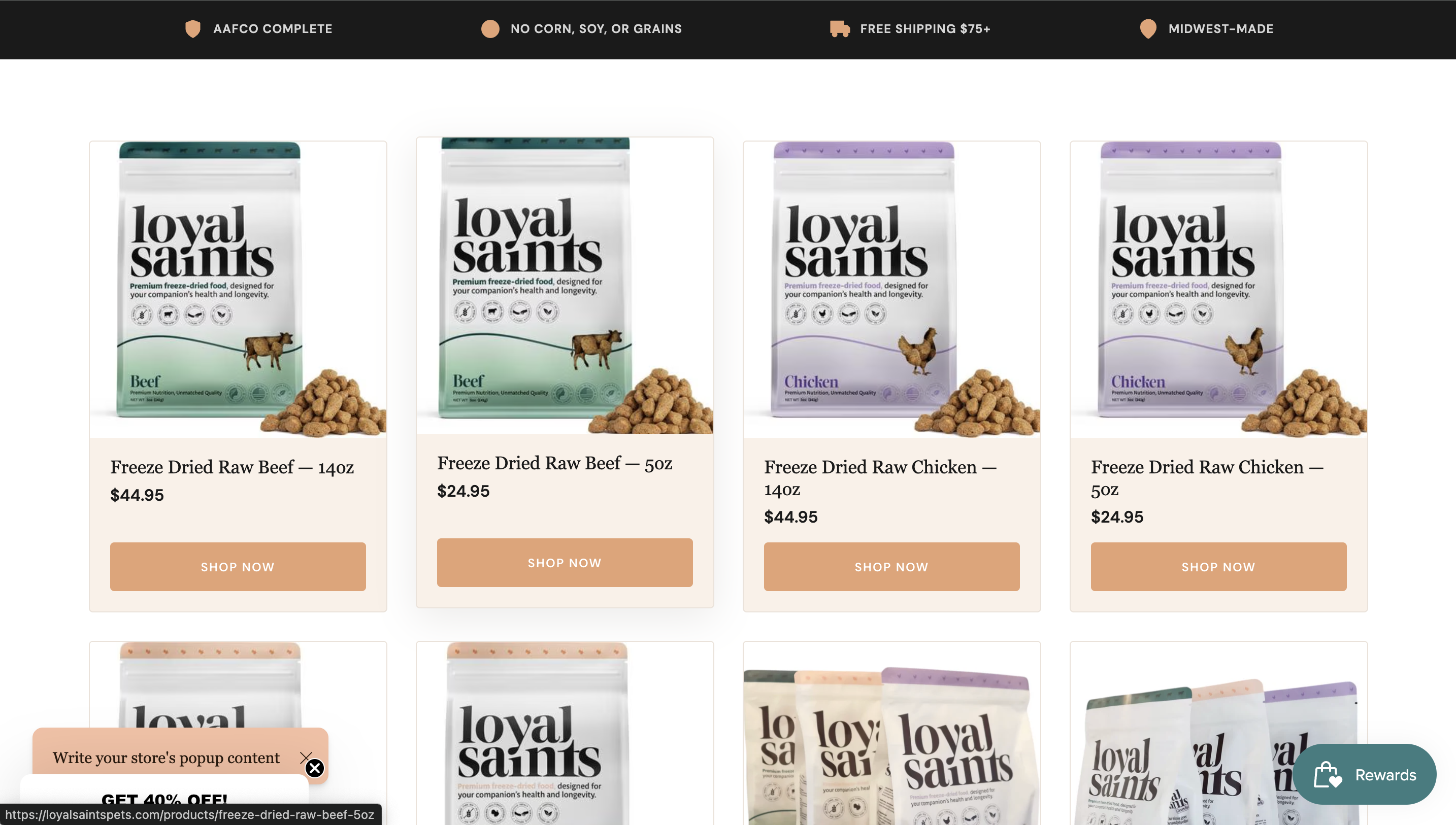
For owners making the switch from kibble, the Freeze Dried Raw Chicken 14oz is a strong starting point: single-protein, human-grade, and easy to portion for a gradual transition. The Freeze Dried Raw Chicken 5oz is ideal if you want to sample the format before committing to a larger bag. For dogs that do better on red meat, the Freeze Dried Raw Beef 14oz offers the same whole-ingredient approach with a different protein profile. Not sure why freeze-drying matters? The Why Freeze Dried? page explains the process and what it means for nutrient retention and ingredient integrity. For dogs with diagnosed metabolic conditions, always confirm any diet change with your vet before switching.
Sources
- Factors affecting digestibility of starches and their implications on adult dog health (review)
- Differences in metabolic profiles of healthy dogs fed a high-fat vs. a high-starch diet
- FDA guidance/resource (pet food safety-related document)
This article is general information, not a substitute for advice from a qualified doctor. Consult a qualified healthcare professional about your own circumstances before acting on anything here.


