

Carrageenan is a seaweed-derived thickener that shows up mostly in canned and loaf-style dog foods. Regulators have reviewed it and not found it unsafe for dogs at approved levels, but some owners still prefer to skip it, especially with sensitive tummies. This guide covers what it does, what the research actually says, how to find it on a label, and how to decide what is right for your dog.
TL;DR
- Carrageenan is a gelling and thickening agent from red seaweed, used mainly in canned pâté and loaf foods to keep the texture consistent.
- A 2023 European Food Safety Authority opinion found semi-refined carrageenan safe for dogs at the levels it assessed, and the claim that it causes cancer in dogs is not confirmed in the literature.
- Avoiding it is a reasonable personal preference, particularly if your dog has a sensitive stomach, but removing it is not proof it was the cause of any symptoms.
- Check the ingredient list, which must show every ingredient in order of weight, and talk to your vet before changing diets for a dog with ongoing symptoms.
- Dry and freeze-dried foods do not need a gel to hold a loaf together, so carrageenan is rarely part of their formulas.
Table of Contents
- What carrageenan is and why it ends up in dog food
- Is carrageenan bad for dogs? What the research says
- Why many dog parents choose carrageenan-free food anyway
- Does every dog need carrageenan-free food?
- How to check a dog food label for carrageenan
- A quick worked example: reading two labels
- What to do if you think an ingredient is upsetting your dog
- Perspective: why we keep our formulas simple
- Choosing a carrageenan-free food that still fits your life
- Try Loyal Saints freeze-dried raw
- FAQ
- Sources
What carrageenan is and why it ends up in dog food
Carrageenan is a refined substance extracted from certain red seaweeds. In the United States, the FDA allows it in food as an emulsifier, stabilizer or thickener under 21 CFR 172.620. The FDA’s own food substance database lists its technical effects as stabilizing, thickening and texturizing.
You probably know it from human foods like ice cream, deli meats and plant milks. In pet food it has a very specific job.
The job it does in canned food
Canned pet foods often rely on hydrocolloids such as carrageenan, guar gum, locust bean gum and xanthan gum to thicken meat batters and control how firm the finished product is. In practice, carrageenan helps a canned loaf hold together, retain moisture and slide out of the can intact.
The same industry piece quotes nutritionist Dr. Greg Aldrich saying its main purpose is appearance and an even mix of meat and other ingredients throughout the container. In other words, it is there for texture and consistency, not for nutrition.
That explains where you will and will not find it. Wet pâtés, loaves and some gravies are the usual places. Kibble and freeze-dried foods have no loaf to hold together, so they have little reason to include it.

Is carrageenan bad for dogs? What the research says
This is the question most owners really want answered, and the honest answer has two sides: the safety reviews are reassuring, and the debate has not completely gone away.
What regulators and reviewers found
In 2023, the European Food Safety Authority’s feed additives panel concluded that semi-refined carrageenan was safe for dogs at 6,000 mg/kg of final wet feed, which corresponds to 26,400 mg/kg of complete feed. The same opinion did not raise concern about genotoxicity, carcinogenicity or reproductive toxicity.
Earlier academic work points the same way. A critical review in the toxicology literature reported that food-grade carrageenan with a high molecular weight is not broken down in the digestive tract or absorbed from it in the species examined, dogs included. The same review noted that long-term bioassays have not found food-grade carrageenan to be carcinogenic.
Why the concern persists
You will find websites saying carrageenan causes cancer and inflammation in dogs. A 2021 academic paper on hydrocolloids in pet food notes that a small segment of pet owners believes some of these ingredients are toxic or carcinogenic, though this is not confirmed in the literature.
Two things keep the conversation alive:
- The science on people is still developing. A 2023 scoping review covering 196 publications said that more research at realistic dietary exposure levels, plus randomized controlled trials, is needed to understand potential intestinal effects.
- Research does not transfer neatly. Studies on restructured meat for human consumption may not apply directly to pet foods, because formulation and processing differ.
The fair summary: there is no confirmed evidence that carrageenan at permitted levels harms healthy dogs, and there is no study that settles every question for every dog. That is why this is a choice about comfort and preference more than an emergency.
Why many dog parents choose carrageenan-free food anyway
Most owners who avoid carrageenan are not chasing a proven danger. They are doing something simpler: choosing foods with shorter, more recognizable ingredient lists. Pet food makers have noticed. The 2021 paper observes that companies are looking for new ingredients to replace common hydrocolloids as use has waned and brands try to stand apart.
Here are the reasons we hear most often from dog parents:
- A sensitive stomach. If your dog has loose stools or occasional vomiting, you want to take every unnecessary variable off the plate.
- A “fewer additives” philosophy. You would rather feed whole ingredients and skip processing aids that do not add nutrition.
- Peace of mind. When you are not sure about an ingredient, skipping it can be the easiest way to feel confident at feeding time.
All three are valid. What matters is not turning them into a certainty the science does not support. If you want a broader look at how we think about additives, our post on why to avoid additives in pet food goes into more detail.
Does every dog need carrageenan-free food?
No, and a good vet will tell you the same. VCA Animal Hospitals explains that a commercial diet should be complete, balanced and appropriate for your dog, and that unless a dog has a food allergy, the nutrients matter more than the individual ingredients. It also says there is no clear evidence that alternative diets benefit most healthy dogs more than suitable conventional ones, while an individualized diet may help dogs with specific medical needs.
So the question to ask is not “Is carrageenan evil?” but “What does my dog need?” A few situations where it is worth being more careful:
- Your dog has chronic soft stool, gas, or vomiting with no clear cause.
- Your vet has recommended a limited-ingredient or elimination diet.
- Your dog has a history of reacting to new foods.
In each case, the plan comes from your veterinarian, not from a label alone.
How to check a dog food label for carrageenan
This part is easy once you know where to look.
- Read the full ingredient panel. Under the AAFCO model pet food regulation, all ingredients must appear in a single, uninterrupted list in descending order of weight, using defined names where available. That means carrageenan cannot hide in a separate box.
- Look near the end of the list. Thickeners are used in small amounts, so they usually sit after the meat, vegetables and vitamins.
- Scan the gums together. Guar gum, xanthan gum and locust bean gum do a similar job. If you are avoiding thickeners in general, check for all of them.
- Start with the format. Canned pâtés, loaves and some toppers are the most likely to include it. Dry and freeze-dried foods rarely do.
- Use a second set of eyes. Our dog food ingredient checker walks you through what to look for in any ingredient list.
The FDA also reminds owners that under the Federal Food, Drug, and Cosmetic Act, pet food must be safe, produced under sanitary conditions, free of harmful substances and truthfully labeled. It does not generally require FDA review before a product is sold unless a substance counts as a food additive, so reading the label yourself is worthwhile. Our guide to dog food additives and pet health covers more of what to watch for.
A quick worked example: reading two labels
Imagine two foods. The first is a canned chicken loaf, and its ingredient list ends with “carrageenan, guar gum, vitamins and minerals.” The second is a freeze-dried formula where every ingredient is a protein, an organ, a fruit, a vegetable, or a vitamin and mineral blend.
The first food is not automatically a bad choice. The gums are there to keep the loaf firm, and the food may be complete and balanced. But if your dog has a touchy stomach and you want to simplify, the second list gives you fewer things to wonder about. That is the whole logic of a carrageenan-free choice: fewer unknowns, not a guaranteed fix.
What to do if you think an ingredient is upsetting your dog
It is tempting to blame the last new ingredient you noticed. Resist that for a moment and start with your vet.
Step 1: See your veterinarian
Tufts’ pet nutrition team advises seeing a vet if your dog vomits often, has frequent diarrhea or seems ill. Digestive signs can come from parasites, infections, stress, treats, or other conditions that have nothing to do with a thickener.
Step 2: Simplify the extras
Before any diet change, Tufts suggests cutting out the extras, including treats, chews, human foods and supplements, unless the dog is on a home-cooked diet.
Step 3: Use a proper diet trial if allergy is suspected
VCA describes an elimination-challenge trial in which potential allergens are removed from food and oral items, then the previous diet or individual ingredients are reintroduced while you watch for signs. A 2023 JAVMA review states that a diet trial followed by provocation is currently the only reliable way to diagnose canine food allergy, and it should use a novel or hydrolyzed protein diet.

The same review is a good reality check: improvement after dropping an ingredient does not prove that ingredient was the cause, because environmental disease, treatment and natural ups and downs can mimic a food response. A controlled challenge is what tells you.
Step 4: Report a suspected pet food problem
If you believe a pet food made your dog sick, the FDA lets you file a report through its Safety Reporting Portal. It asks for details such as the product, amount eaten, timing, signs, diagnosis and medical records. Keep the packaging and lot number handy.
Perspective: why we keep our formulas simple
We started Loyal Saints because we are dog moms who wanted to read a label and understand every word on it. That is still how we think about food. We do not ask you to be afraid of any single ingredient. We ask you to look at the whole bowl.
Our freeze-dried raw formulas are made with human-grade, whole ingredients: proteins, fruits and vegetables from Midwest farms, with no fillers or synthetic additives and complete AAFCO nutrition. Because the food is freeze-dried and shelf-stable, it does not need a gel to hold a loaf together or a fridge to stay fresh. That simplicity is by design, and it is why so many of our dog parents tell us the ingredient list gave them peace of mind.
Our approach is built around what we believe: that a short, honest ingredient list, a vet-approved recipe and a food you can scoop and serve without thawing make mealtime easier and happier for you and your dog. We always encourage you to check the label on the product page and talk with your own vet about what suits your dog.
Kristina
Choosing a carrageenan-free food that still fits your life
If you decide to avoid carrageenan, you want the switch to be simple, nutritionally complete and affordable enough to stick with. Here is a short checklist:
- Complete and balanced. Look for an AAFCO statement that the food provides complete nutrition for your dog’s life stage.
- A short, readable ingredient list. Whole proteins, fruits and vegetables first.
- A format that does not need a binder. Freeze-dried and dry foods rarely do.
- Convenience you will actually use. If a food needs thawing, ice packs or a fridge, it is easier to skip on a busy morning.
- A slow transition. Mix the new food in gradually over several days so your dog’s digestion can adjust, and ask your vet if your dog has a medical condition.
The choice of protein matters too, particularly for dogs who do better on one meat than another. Our beef, chicken and turkey with salmon comparison can help you narrow it down.
Try Loyal Saints freeze-dried raw
Our freeze-dried raw dog food comes in three formulas: Beef, Chicken, and Turkey with Salmon. Prices run from $24.95 to $44.95 depending on bag size. You can start with a single bag or pick a variety pack to see which protein your dog loves.
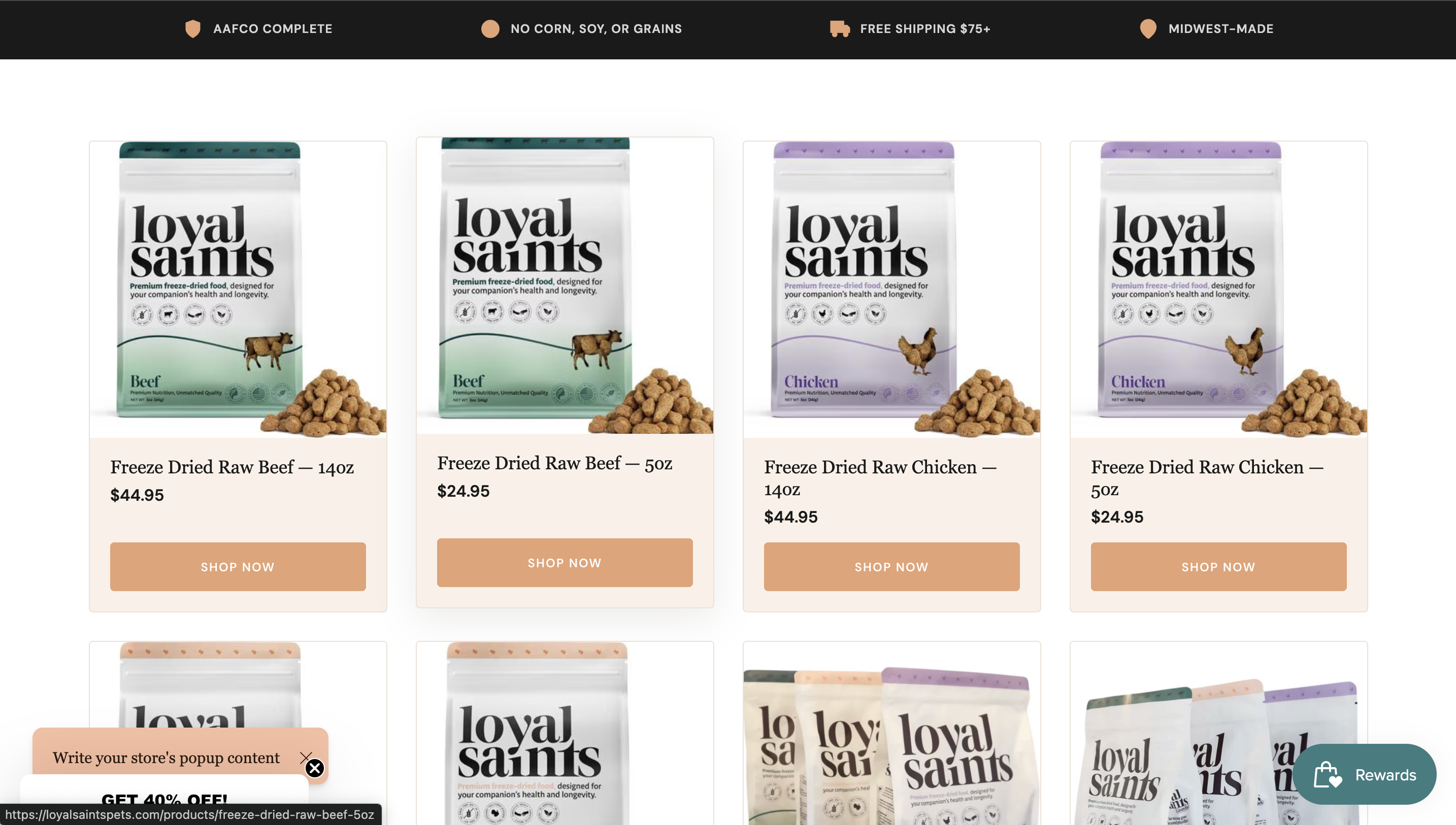
If you plan to feed it regularly, the Halo Club membership is $10.99 per month or $79.99 per year and includes savings and free shipping. Standard shipping on one-time orders is $7.99 and express is $14.99, and you can see the current details on our shipping and returns page. Ready to browse? Head to our freeze-dried raw dog food shop and check the ingredient list for each formula yourself.
FAQ
Is carrageenan bad for dogs?
The research does not confirm that it is. In 2023, EFSA’s feed panel judged semi-refined carrageenan safe for dogs at the levels it assessed, and it did not raise genotoxicity or carcinogenicity concerns. Some owners still prefer to avoid it, which is a fair choice, especially for dogs with sensitive stomachs.
What dog foods do not contain carrageenan?
Many do. It is mainly found in canned pâtés and loaves, so dry, freeze-dried and many other formats do not use it. Because every ingredient must be listed in order of weight, you can confirm by reading the panel. Always check the specific product, since recipes change.
Why do some people say carrageenan causes inflammation?
The claims usually come from experimental research and from studies on people that may not apply to pet foods. A 2023 scoping review said more research at realistic dietary levels is needed. Until then, the evidence for harm in dogs at permitted levels remains unconfirmed.
My dog has loose stools on a canned food. Is carrageenan the cause?
It might be, but many other things could be, including other ingredients, treats, stress or illness. Book a vet visit, cut out the extras, and ask whether a diet trial makes sense. Improvement after dropping one ingredient is not proof on its own, so a controlled challenge gives you the real answer.
Does freeze-dried dog food contain carrageenan?
It generally has no need to, since there is no loaf to bind. Still, formulas differ by brand, so read the ingredient list on each product page before you buy.
Sources
- eCFR, 21 CFR 172.620 Carrageenan
- FDA, Substances Added to Food: Carrageenan
- The Effects of Select Hydrocolloids on the Processing of Pet Foods (PMC)
- Carrageenan: for appearance’s sake only? (Petfood Industry)
- EFSA, Safety and efficacy of semi-refined carrageenan as a feed additive
- A Critical Review of the Toxicological Effects of Carrageenan (PubMed)
- Evidence and hypotheses on adverse effects of carrageenan (Critical Reviews in Toxicology)
- VCA, Designer Diets: What’s in My Dog’s Food?
- AAFCO, Revised Label Review Checklist
- FDA, FDA’s Regulation of Pet Food
- Tufts, Figuring Out Food Sensitivities
- VCA, Implementing an Elimination-Challenge Diet Trial
- JAVMA, Food allergy in dogs and cats
- FDA, How to Report a Pet Food Complaint


