
Working dog nutrition has one job: deliver enough energy, in the right macronutrient mix, from a complete and balanced diet, so your dog can do demanding physical work without losing muscle, condition, or coat quality. That means starting with an AAFCO-complete diet, then adjusting calories and nutrients to match your dog’s actual workload, life stage, and climate. There is no universal working-dog food. A search-and-rescue dog logging six-hour shifts in summer heat needs a different plan than a weekend agility competitor or a herding dog working cold mountain pastures in January.
Here’s what a sound plan actually produces:
- Stable body condition, checked against a 9-point Body Condition Score rather than a bathroom scale
- Preserved muscle mass through training blocks and recovery weeks
- Hydration that keeps pace with sweat-free but real water loss during work
- Recovery nutrition that replenishes glycogen and repairs tissue between sessions
Action step: Score your dog’s body condition this week using the Royal Canin Academy’s 9-point BCS system, and if you’re unsure how to read the score or how it should shift with your dog’s workload, book a consult with your veterinarian before changing anything.
Pro Tip: Take BCS photos from three angles (overhead, side, and rear) every two weeks and date them. A photo log catches subtle muscle loss or fat gain long before it shows up in performance.
Key Takeaways
Working dog nutrition succeeds when calorie intake, macronutrient ratios, and hydration are matched to actual workload and checked against Body Condition Score every few weeks, not set once and left alone.
| Point | Details |
|---|---|
| Measure BCS regularly | Use the 9-point scale every two to four weeks to catch muscle loss or excess weight early. |
| Match macros to activity class | Endurance dogs need high fat and protein; sprinters need more carbohydrate; intermediate dogs need a blend. |
| Prioritize water over electrolytes | Offer frequent small sips during work; electrolyte products are rarely necessary for panting dogs. |
| Consult a vet for complex cases | Persistent weight loss, medical conditions, or multi-day endurance events call for a board-certified nutritionist. |
| Use freeze-dried toppers for calorie density | Loyal Saints single-protein freeze-dried chicken and beef offer precise, high-protein portion control for handlers scaling calories up or down. |
Table of Contents
- Working Dog Nutrition and Calculating Daily Energy Needs
- Macronutrient Strategy By Activity Type
- Hydration and Electrolytes for Working Dogs
- Meal Timing and Portioning During Training
- Commercial Diets, Homemade Recipes, and Raw Feeding Safety
- Supplements and Ergogenic Aids: What the Evidence Actually Supports
- Monitoring Nutrition: BCS, Performance Markers, and Warning Signs
- Life Stage and Environment Change the Nutrition Equation
- Choosing a Diet and Knowing When to Call a Vet Nutritionist
- Your Two-Week Feeding Plan Starting Point
- Adding Loyal Saints Freeze-Dried Formulas to Your Working Dog’s Plan
- Sources
Working Dog Nutrition and Calculating Daily Energy Needs
Every feeding plan starts with maintenance energy requirement, or MER, the calories your dog burns just existing at rest. From there, workload multiplies that number, sometimes dramatically. Cornell’s Riney Canine Health Center notes that endurance athletes can require up to five times resting calories, while sprint-type dogs need a smaller bump because their work bursts are short and glycolytic rather than sustained.
Calorie density varies by food type and workload category. Sprint-oriented performance formulas often run 300 to 400 calories per cup, while endurance formulas can reach 500 to 600 calories per cup, according to Cornell’s guidance. That difference matters enormously when you’re trying to hit a daily target without forcing your dog to eat an unrealistic volume of food.
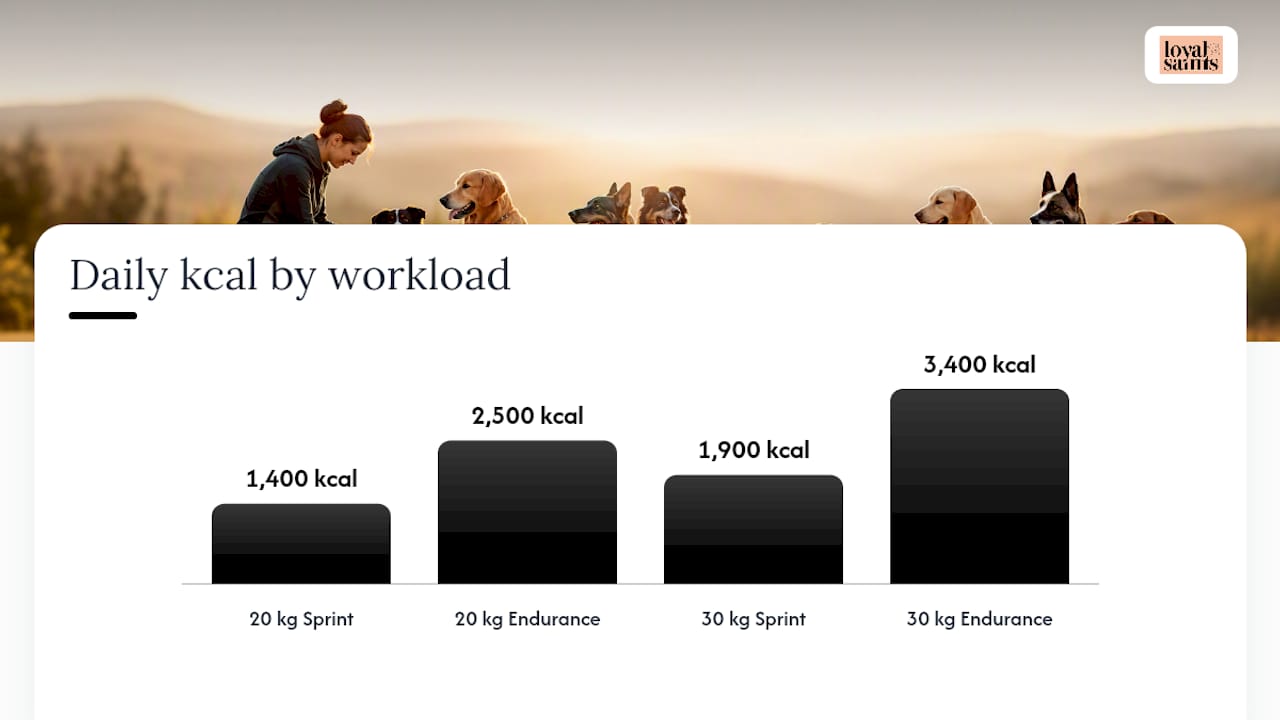
Here’s how that plays out for two common working-dog weights across three workload types:
| Dog Weight | Workload Type | Estimated Daily Kcal | Approx. Cups (400 kcal/cup food) |
|---|---|---|---|
| 20 kg | Sprint/intermittent | 1400 | 3.5 cups |
| 20 kg | Intermediate | 1700 | 4.25 cups |
| 20 kg | Endurance | 2500 | 6.25 cups |
| 30 kg | Sprint/intermittent | 1900 | 4.75 cups |
| 30 kg | Intermediate | 2300 | 5.75 cups |
| 30 kg | Endurance | 3400 | 8.5 cups |
These ranges are starting points, not prescriptions. Feeding a performance formula to a dog that’s between work seasons will pack on weight fast unless you scale the portion down, which is exactly why so many working dogs gain weight during injury layoffs or off-season rest.
Comparing calorie density across brands only works if you compare on a dry-matter basis, not the “as fed” numbers on the bag. Canned food, freeze-dried food, and kibble all carry different moisture content, so a straight label comparison misleads you badly.
Pro Tip: To convert a guaranteed analysis to dry matter, divide each nutrient percentage by (100 minus the moisture percentage), then multiply by 100. A food that’s 10% protein and 78% moisture actually delivers about 45% protein on a dry-matter basis, which is why comparing labels the right way changes the whole conversation.
Macronutrient Strategy By Activity Type
Endurance dogs run on fat and protein. Sprinters lean more on carbohydrate. Intermediate workers need a blend of both, and getting this wrong is one of the more common reasons a diet for active breeds underperforms even when total calories look right.
- Endurance dogs often consume diets high in fat and protein on a dry-matter basis, according to research on sled dogs and greyhounds.
- Sprinters need carbohydrate-rich diets with moderate fat to support their glycolytic energy system.
- Intermediate workers require a balanced protein and fat intake to meet mixed aerobic and anaerobic demands.
The science backing these dietary approaches is real but not exhaustive. Research shows sled dogs perform best on high-fat, high-protein diets, while greyhound studies show mixed results with moderate fat sometimes preferred, indicating that macronutrient needs vary meaningfully by sport rather than following one universal formula.
If you’re adjusting a commercial food rather than switching entirely, small, calculated additions work better than guesswork. Any macronutrient shift should happen gradually. Cornell recommends transitioning to a performance diet over four to six weeks to give the digestive system time to adapt, a timeline that also applies to shifting a topper ratio or protein source. For a deeper look at how these two macronutrients interact during sustained effort, protein and fat’s role in canine endurance is worth reading before you make changes.
Hydration and Electrolytes for Working Dogs
Fresh water is the primary hydration strategy for almost every working dog, and electrolyte supplements are rarely necessary because dogs lose relatively few electrolytes through panting compared to sweating species like humans and horses. That single fact surprises a lot of handlers who assume their dog needs a canine sports drink.
Water needs climb fast in warm conditions. VCA Hospitals notes that highly active dogs may need up to 50% more water when temperatures rise, and the smartest hydration protocol during long-duration work involves small sips every 15 to 20 minutes rather than infrequent large gulps.
Pro Tip: Offer water in a shallow, wide bowl during breaks rather than a deep bucket. Dogs drink faster and more comfortably from a wide surface, and you’ll notice they take in more water per stop.
Hydration is often the limiting nutrient for performance, not calories or protein. Small, frequent water intake preserves both thermoregulation and scent-detection accuracy, which matters enormously for search, hunting, and detection dogs whose entire job depends on a functioning nose.
Watch for two very different emergencies here. Dehydration shows up as tacky gums, skin that stays tented when pinched, and lethargy. Bloat, or gastric dilation and volvulus (GDV), shows up as a distended abdomen, unproductive retching, and restlessness, and it’s a life-threatening emergency requiring immediate veterinary care. Avoid letting a dog gulp large amounts of water immediately before intense exercise, since a full stomach combined with hard activity is one of the recognized risk patterns for GDV.
Meal Timing and Portioning During Training
Timing matters as much as total calories. Avoid feeding a large meal immediately before intense work, and give your dog at least two hours to digest before asking for hard effort; Cornell’s guidance suggests waiting even longer, up to eight hours after a small meal or longer after a large one, for full gastric emptying in extreme cases. Post-work, hold off on a full meal for about an hour to let heart rate and core temperature settle first.
A sample day for three activity types looks different in shape, not just size:
- Sprint dog (flyball, short agility runs): small breakfast 3 hours before competition, light snack post-run, full dinner in the evening once fully recovered.
- Intermediate worker (herding, hunting dogs): breakfast at least 2 hours before work begins, small mid-day snack if the shift runs long, main meal after work wraps up.
- Endurance dog (sled dogs, multi-hour field trials): light pre-work meal, periodic small snacks during rest breaks on multi-day events, a full recovery meal with added carbohydrate within an hour of finishing.
Treats and training rewards should stay under about 10% of total daily energy intake, a benchmark VCA Hospitals emphasizes specifically because it’s easy for treat calories to quietly unbalance an otherwise well-formulated diet. If you’re transitioning to a higher-calorie performance food, stretch the changeover across four to six weeks:
- Days 1 to 7: 25% new food, 75% current food
- Days 8 to 14: 50% new food, 50% current food
- Days 15 to 21: 75% new food, 25% current food
- Days 22 onward: 100% new food, monitor stool quality and BCS weekly
Your daily feeding workflow should follow the same order every time: check body condition, weigh the actual portion rather than eyeballing a scoop, log any changes in a notebook or app, and decide whether today calls for a full meal or a lighter snack around scheduled work. Consistency here catches problems weeks before they’d otherwise show up.
Commercial Diets, Homemade Recipes, and Raw Feeding Safety
Start with a commercial diet carrying an AAFCO complete-and-balanced statement, ideally one that has passed AAFCO feeding trials rather than relying solely on nutrient-profile formulation. That’s the safest baseline for the overwhelming majority of working dogs, and homemade or raw approaches should be treated as an addition to that baseline, not a casual replacement.
Before buying any bag, check the label for these four things:
- An AAFCO adequacy statement specifying life stage and, ideally, feeding-trial substantiation
- Calorie content per cup or per kilogram so you can calculate portions accurately
- Guaranteed analysis, which you then convert to dry-matter basis for real comparison
- Ingredient sourcing and quality signals, including named protein sources rather than vague meat meals
Raw diets carry documented risks worth taking seriously. Bacterial and parasitic contamination in raw meat products poses a real hazard, and that risk extends beyond the dog to anyone handling the food or cleaning up after it. VCA Hospitals specifically flags that veterinary nutritionists generally advise against raw feeding for dogs that interact with immunocompromised people or work in institutional settings like hospitals, nursing homes, or schools.
Bacterial and parasitic contamination in raw meat products creates human-health risk alongside the risk to the dog, which is why raw feeding is often discouraged for working dogs placed in therapy, hospital, or school settings.
Vet-formulated homemade recipes have a real place, but that place is narrower than internet forums suggest. They make the most sense when a dog has a diagnosed medical condition that commercial diets can’t accommodate, or during an extreme endurance season when calorie density needs exceed what a bag of kibble can realistically deliver. In either case, source the recipe from a board-certified veterinary nutritionist rather than a generic online formula, since even well-intentioned homemade diets frequently come up short on calcium, trace minerals, or essential fatty acids.
Supplements and Ergogenic Aids: What the Evidence Actually Supports
Only a handful of supplements have consistent evidence behind them for working dogs. Omega-3 fatty acids for inflammation and joint support sit near the top of that short list, while most other “performance boosters” marketed to handlers lack strong supporting research.
- Omega-3 fatty acids (fish oil): Reasonably well-supported for reducing inflammation and supporting joint and skin health in dogs under repetitive physical stress.
- Glucosamine and chondroitin: Commonly used for joint support in working dogs with high-impact jobs; evidence is more modest than omega-3 support but the risk profile is low.
- Antioxidants (vitamin E, vitamin C): Sometimes added to counter oxidative stress from intense training, though most complete diets already include adequate levels.
- Maltodextrin: A digestible carbohydrate sometimes used specifically for post-event glycogen repletion on competition days, not as a daily additive.
Dosing risk is real, especially when handlers stack multiple supplements without accounting for overlap. Fat-soluble vitamins in particular can accumulate to harmful levels with excessive supplementation, so any high-dose or multi-supplement regimen deserves a conversation with your veterinarian first. For ingredient-level guidance on what actually supports muscle recovery and strength, it’s worth reviewing before adding anything new to the bowl.
Pro Tip: If your dog’s base diet is already complete, calorie-dense, and appropriately high in protein for the workload, most supplements are unnecessary. Add them to solve a specific, identified gap, not as a blanket insurance policy.
Monitoring Nutrition: BCS, Performance Markers, and Warning Signs
Body Condition Score is the single best routine tool for judging whether a diet is working, and it beats a bathroom scale because it accounts for muscle and fat distribution rather than a single number. On the 9-point scale that Royal Canin Academy recommends, high-intensity athletes are often maintained at a leaner 3 to 4, while dogs with lighter or more intermittent workloads typically sit closer to 4 to 5.
Watch for these red flags, and treat more than one appearing together as a reason to escalate quickly:
- Unexplained weight loss or gain over a two-week window
- Visible muscle wasting along the spine, hips, or shoulders
- Chronic or recurring GI upset, especially loose stool after meals
- A noticeable drop in speed, stamina, or willingness to work
- Frequent overheating or slower-than-normal recovery after exertion
Re-evaluate calories and macronutrient mix every two to four weeks during active training blocks, and more frequently during rapid transitions like the start of a competition season or a sudden climate shift. A dog holding steady BCS with strong performance markers doesn’t need changes just because the calendar says it’s time. A dog sliding toward BCS 2 or ballooning toward BCS 7 needs intervention now, not at the next scheduled check-in.
Life Stage and Environment Change the Nutrition Equation
Age and climate move the needle more than breed does for most working dogs. A growing working-breed puppy, a senior dog holding onto muscle, and an adult dog working outdoors in extreme heat or cold each need a meaningfully different approach, even if they’re the same breed and job type.
Growing puppies destined for working roles need carefully balanced calcium and phosphorus, since imbalances during rapid skeletal growth contribute to developmental orthopedic problems that can end a working career before it starts. Senior working dogs benefit from higher-quality, more digestible protein to counter age-related muscle loss, sometimes at a slightly higher percentage than a young adult dog doing the same job would need. Cold and heat both raise energy demands, though for different reasons: cold increases metabolic heat production, while heat increases both energy cost of thermoregulation and dehydration risk.
| Condition | Nutritional Adjustment | Key Watch Point |
|---|---|---|
| Extreme cold | Increase daily calories, often via added fat | Monitor weight weekly; cold-weather calorie needs can spike fast |
| Extreme heat | Prioritize hydration over calorie increases | Watch for reduced appetite and heat-related dehydration |
| Growing puppy (working breed) | Controlled calcium/phosphorus ratio, moderate calories | Avoid over-supplementing calcium independently |
| Senior working dog | Higher-quality, more digestible protein | Monitor for gradual muscle loss despite stable weight |
Pro Tip: A senior working dog that maintains the same weight on the scale can still be losing muscle and gaining fat underneath. BCS combined with a hands-on muscle check along the spine catches this shift that a scale alone will miss.
Choosing a Diet and Knowing When to Call a Vet Nutritionist
Start with an AAFCO-complete food as your non-negotiable baseline, then layer on calorie density and macronutrient profile decisions based on your dog’s specific workload and current BCS. That order matters. Handlers who reverse it, chasing a trendy macronutrient ratio before confirming the food is complete and balanced, are the ones who end up with deficiency problems months later.
Before a vet consult, bring three things: your current food’s label (or a photo of it), a two-week activity log noting hours worked and intensity, and recent BCS photos. That preparation turns a vague “what should I feed her” conversation into a specific, productive one. Useful questions to bring include:
- What’s my dog’s estimated daily energy requirement given her current workload?
- How does my current food compare to a performance formula on a dry-matter basis?
- Are any supplements actually necessary given what she’s already eating?
- What specific signs should I watch for that mean this diet isn’t working?
Run through this checklist before settling on a food: confirm the AAFCO statement, look for feeding-trial evidence rather than formulation-only claims, check digestibility indicators like stool quality and volume, and verify the manufacturer has real quality-assurance practices rather than vague marketing language.
Refer to a board-certified veterinary nutritionist when you see persistent weight loss despite adequate calories, a complex medical condition complicating standard feeding advice, or when you’re planning a multi-day endurance event that pushes well beyond typical daily energy needs. A general practice veterinarian handles most routine questions well, but these specific scenarios usually benefit from specialist input.
Pro Tip: Photograph your dog’s current food label before your vet visit, front and back. Nutritionists need the guaranteed analysis and ingredient list to give you a real answer, not a general one.
Your Two-Week Feeding Plan Starting Point
Turning all of this into action doesn’t require overhauling everything at once. This 14-day framework gives you a measurable starting point:
- Days 1 to 2: Weigh your dog, score BCS, and photograph from three angles. Log current food, portion size, and daily activity hours.
- Days 3 to 5: Calculate estimated daily energy needs based on workload class and compare against what you’re currently feeding on a dry-matter basis.
- Days 6 to 10: If a change is needed, begin the gradual transition (25% new food blended in), continuing to log weight, stool quality, and energy levels daily.
- Days 11 to 14: Re-score BCS, compare photos against day one, and note any performance changes, whether that’s stamina, recovery speed, or coat condition.
Log these five things daily throughout the two weeks: body weight, BCS, hours worked, approximate water intake, and stool quality. That single log, kept consistently, tells you more about whether a diet is working than any single dramatic before-and-after comparison ever will.
- Measure baseline intake accurately before changing anything
- Make macronutrient or calorie adjustments gradually, never overnight
- Re-check BCS and performance markers at the two-week mark, then again at four weeks
- Read the full Cornell performance dog guidance if you’re planning a multi-day endurance event, since the calorie math changes substantially for sustained multi-day work
For a broader framework on daily feeding workflow beyond these two weeks, this step-by-step feeding guide walks through the habits worth keeping long term.
A note from the field
Most handlers I talk to don’t fail at working dog nutrition because they lack information. They fail because they make one big change and expect it to hold for a season, when the reality is that a working dog’s needs shift with training load, weather, and age almost month to month. The handlers who get this right treat feeding like they treat conditioning: small adjustments, checked often, rather than a single formula set and forgotten.
The most useful small tweak I’ve seen handlers make isn’t a supplement or a fancy new formula. It’s adding a calorie-dense, high-protein topper on heavier training days and pulling it back on rest days, rather than feeding the same static amount regardless of workload. A freeze-dried single-protein topper works well here because it’s easy to portion precisely, whether you’re adding a quarter cup to boost calories before a long field day or using it as a full meal replacement when travel makes regular feeding logistics difficult. Kristina, who covers nutrition for Loyalsaintspets, points to this kind of flexible, portion-controlled approach as one of the more underrated tools in a handler’s kit, especially paired with veterinarian-approved formulations that keep the ingredient list transparent.
Adding Loyal Saints Freeze-Dried Formulas to Your Working Dog’s Plan
Loyal Saints freeze-dried single-protein options give you a straightforward way to boost calorie density and protein quality without guessing what’s actually in the bag. Every ingredient is human-grade and listed plainly, which matters when you’re trying to calculate precise dry-matter comparisons for a working dog’s plan.

| Product | Best Use Case | Portion Note |
|---|---|---|
| Freeze Dried Raw Chicken — 14oz | Full meal replacement or daily topper for endurance and intermediate dogs | Rehydrate and scale to replace a portion of daily kibble calories |
| Freeze Dried Raw Chicken — 5oz | Travel, trial runs, or portion-controlled training rewards | Ideal size for testing a new protein before committing to a larger bag |
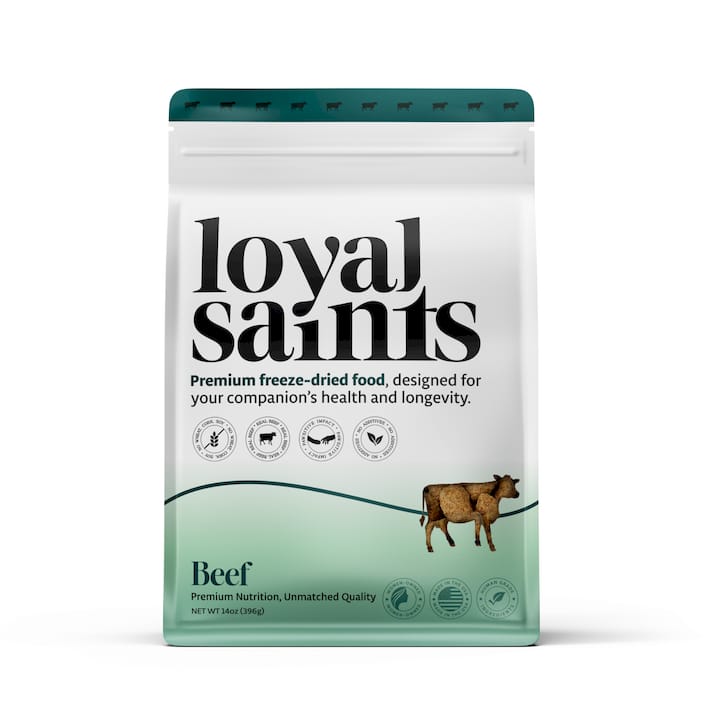
| Freeze Dried Raw Beef — 14oz | Protein rotation or dogs needing a different amino acid profile | Same conversion approach as chicken; compare calorie density on the label |
If you’re switching from kibble to a freeze-dried topper or meal, start small: calculate the calorie content of the freeze-dried portion, then reduce your current kibble amount by that same calorie value rather than simply adding freeze-dried food on top. That keeps total daily energy on target instead of accidentally overfeeding. Because freeze-drying preserves nutrients without synthetic fillers, it’s a clean way to raise protein density for a dog stepping up into a heavier training block. Read more about why freeze-dried food retains nutritional value that cooking or extrusion often reduces.
If you’re making a significant change, whether that’s a full diet switch or adding a daily topper at meaningful volume, loop in your veterinarian first, especially for dogs with existing health conditions. From there, picking a starting product and portion size is the easiest next step toward a feeding plan that actually matches your dog’s workload.
Sources
- Feeding your performance dog | Cornell University College of Veterinary Medicine
- Nutrition for working and service dogs — VCA Hospitals
- Practical nutrition for working dogs — Royal Canin Academy
- Nutrition of exercising dogs — ScienceDirect / Journal article
Handlers planning multi-day endurance events or navigating a complex medical situation should read the full Cornell and ScienceDirect materials directly. They go deeper into the physiology behind these recommendations than any single article can cover.


