
Freeze-dried dog food typically costs between $25 and $60 per pound at U.S. retail, which translates to roughly $10–$30 per bag for smaller sizes and $30–$80 for larger complete-diet bags. Per serving, most owners pay a varied amount depending on their dog’s size and whether they feed freeze-dried as a full meal or a topper. The short verdict: this is a premium food category, not a budget one, but there are real ways to make it work for most households.
- Toppers vs. complete diets: Using freeze-dried as a topper (20–25% of daily food) costs a fraction of full feeding and still delivers meaningful nutrition benefits.
- Small bags vs. large bags: A 5 oz bag runs a moderate price; a 14 oz bag typically costs more but less per ounce; larger bags for complete feeding can be substantially more expensive.
- Per-serving shorthand: Budget modest per-serving amounts depending on dog size and feeding strategy, with small dogs on toppers costing less and large dogs on full feeding costing more.
Key Takeaways
Freeze-dried dog food costs $25–$60 per pound at U.S. retail.
| Point | Details |
|---|---|
| Typical U.S. price range | Freeze-dried dog food retails at roughly $25–$60 per pound; per-bag prices run $10–$80 depending on size. |
| Best cost-saving tactic | Using freeze-dried as a 20–25% topper over AAFCO-complete kibble reduces monthly spend by 60–75%. |
| Subscription savings | Brand-direct subscriptions typically save 10–20% per order, plus free shipping above the qualifying threshold. |
| Trust signals that matter | Look for an AAFCO “complete and balanced” statement, veterinarian approval, and named single-source protein as the first ingredient. |
| Loyalsaintspets recommendation | The Halo Club subscription on the 14 oz chicken or beef SKUs delivers the lowest effective cost per serving with human-grade, AAFCO-complete formulas. |
Table of Contents
- What does freeze-dried dog food cost per bag, ounce, and pound?
- How do you calculate cost per serving and monthly spend?
- How do bag sizes and feeding charts work together?
- What drives the price of freeze-dried dog food?
- Where can you buy freeze-dried food and how do you get a lower price?
- Is freeze-dried dog food worth the extra cost?
- Practical ways to lower your monthly freeze-dried spend
- Why Loyalsaintspets is worth your attention
- How does freeze-dried cost compare to raw, dehydrated, and canned food?
- A note from the editor on freeze-dried food and real-world budgets
- Loyalsaintspets makes freeze-dried feeding more affordable
- Sources
What does freeze-dried dog food cost per bag, ounce, and pound?
Retail prices cluster into a few clear bands once you know what you’re looking at. Single-ingredient treats and snack-style toppers sit at the low end, around $20–$30 per pound. Complete-diet freeze-dried raw formulas, the kind meant to replace kibble entirely, run closer to $40–$60 per pound. Specialty or limited-ingredient formulas with novel proteins (rabbit, venison, duck) can push past $60 per pound.
The per-pound number can mislead you, though. Freeze-dried food has almost all its moisture removed, so a pound of freeze-dried chicken delivers far more dry-matter nutrition than a pound of wet food or even most kibbles. You’re comparing concentrated nutrition to diluted nutrition, which is why the per-pound price looks shocking at first glance.
| Format | Typical bag size | Approx. price per bag | Approx. price per pound |
|---|---|---|---|
| Treat / single-ingredient snack | 2–4 oz | $8–$15 | $28–$40 |
| Complete diet (small bag) | 5 oz | $10–$30 | $30–$80 |
| Complete diet (mid-size bag) | 14 oz | $10–$30 | $30–$80 |
| Complete diet (large bag) | 1–2 lb | $40–$80 | $40–$60 |
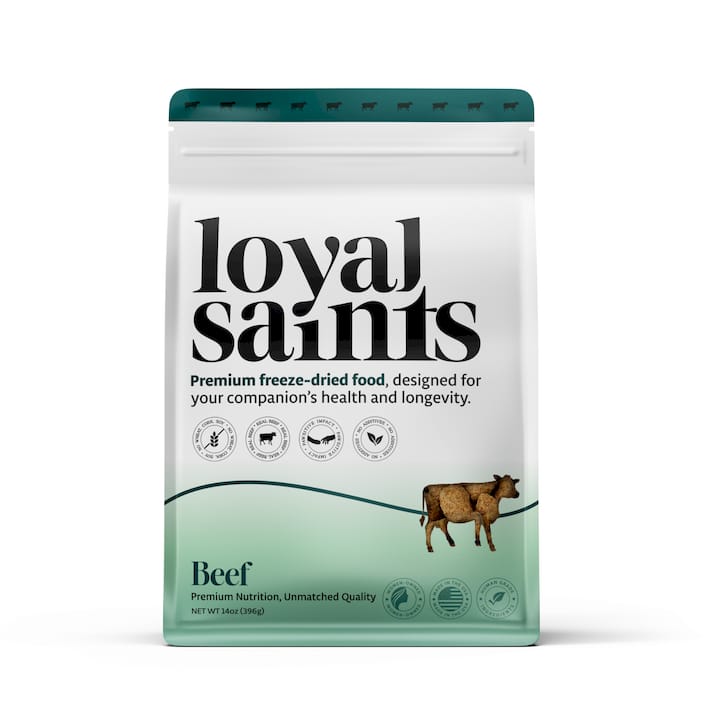
Pro Tip: Watch out for small-sample pricing tricks. A 2 oz “trial” bag priced at $7 looks affordable, but that’s $56 per pound. Always divide the price by the bag’s weight in ounces before comparing products.
How do you calculate cost per serving and monthly spend?
Getting to a real monthly number takes three steps. Here’s the math you can copy for your own dog.
- Find the daily serving size. Check the feeding chart on the package. Most complete freeze-dried diets express this in grams per day based on your dog’s weight. If the chart uses cups, convert: 1 cup of freeze-dried food weighs roughly 2–3 oz (56–85 g) depending on density.
- Divide bag weight by daily serving. A 14 oz (396 g) bag divided by a 28 g daily serving = 14 days of food per bag.
- Multiply bags per month by bag price. If you need roughly 2 bags per month at $28 each, your monthly cost is $56.
The WSAVA Global Nutrition Toolkit recommends basing daily portions on your dog’s Resting Energy Requirement (RER) rather than a flat weight band, especially for dogs that are overweight, underweight, or highly active. That said, the feeding chart on the package is a reliable starting point for most healthy adult dogs.
A veterinary consumer guide estimates daily costs for a 50-lb dog on a complete freeze-dried diet at roughly $14.73 per day, which aligns with the medium-dog range above.
How do bag sizes and feeding charts work together?
Feeding charts are the key to accurate cost estimates, and they vary more than most labels let on. Some charts give grams per day; others give cups. Some are built for complete feeding; others assume the product is a topper or supplement. Reading the fine print matters.
A 14 oz bag used as a complete diet for a 20-lb dog lasts about 11 days. The WSAVA Global Nutrition Guidelines note that supplemental feeding should still be assessed for overall diet balance, so if you’re mixing formats, check that the primary food is AAFCO-complete on its own.
What drives the price of freeze-dried dog food?
The freeze-dried dog food price premium comes from several real cost layers, not just marketing. Understanding them helps you spot when a higher price is justified and when it isn’t.
- Human-grade proteins: Sourcing chicken, beef, or fish to human-food standards costs significantly more than feed-grade ingredients. The AKC’s ingredient guidance highlights why single-source, high-quality proteins matter for both nutrition and digestibility.
- The freeze-drying process itself: Lyophilization (the technical term for freeze-drying) runs at sub-zero temperatures under vacuum for 20–40 hours per batch. Long cycle times, high energy use, and low throughput per chamber all add directly to unit cost.
- Barrier packaging: Nitrogen-flush pouches, oxygen absorbers, and resealable closures are necessary to preserve shelf life but add materially to per-bag cost.
- Testing and compliance: The FDA’s regulatory framework for pet food requires safety and labeling compliance for all commercial pet foods, including freeze-dried formats. Third-party testing for pathogens and nutritional adequacy adds cost that responsible brands don’t skip.
- Small-batch manufacturing: Most premium freeze-dried brands run smaller production volumes than kibble manufacturers, which means fixed costs spread across fewer units.
Pro Tip: Check the label for an AAFCO “complete and balanced” statement before buying. A product without it is a supplement or treat, not a full diet, and you’ll need to account for that in your cost math.
Where can you buy freeze-dried food and how do you get a lower price?
Buying channel matters as much as brand when it comes to effective price per serving.
- Direct-to-consumer brand sites typically offer the best subscription pricing and first-order discounts, often 10–20% off. Shipping thresholds for free delivery vary, but many brands waive shipping above $50–$75.
- Pet specialty retailers (brick-and-mortar and online) carry a wide selection but rarely match brand-site subscription rates. They do run seasonal promos and loyalty point programs worth stacking.
- Big-box and online marketplaces offer competitive one-time prices and fast shipping, but subscription savings through these channels are usually lower than buying direct.
- Local feed stores sometimes carry regional or smaller-batch brands at competitive prices, though selection is narrower.
That’s a meaningful number, and it compounds if you’re feeding a medium or large dog. Wholesale and bulk procurement analyses also note that minimum order quantities and lead times affect true unit cost, so buying two or three bags at once when a promo runs is often smarter than single-bag purchases.
Is freeze-dried dog food worth the extra cost?
For most dogs, the answer is situational rather than a flat yes or no. The freeze-dried nutrition benefits are real: the low-heat process preserves more heat-sensitive nutrients than extrusion (the method used for kibble), and palatability tends to be noticeably higher, which matters for picky eaters or dogs recovering from illness.
Market research consistently shows freeze-dried buyers are willing to pay a 4–8x premium over kibble for perceived health benefits, and veterinary-adjacent reviews back up the reasoning: higher protein bioavailability, fewer synthetic additives, and better ingredient transparency are genuine advantages.
The most cost-effective approach for most households is the topper strategy. For a 40-lb dog, that can mean $30–$40 per month instead of $120–$155.
Trust signals to look for when evaluating whether a product justifies its price:
- AAFCO “complete and balanced” statement on the label, confirming the product meets minimum nutritional standards for your dog’s life stage.
- Veterinarian formulation or approval noted on the packaging or brand site.
- Third-party pathogen testing or a published quality-assurance process.
- Clear ingredient sourcing (human-grade, single-source protein named as the first ingredient).
Practical ways to lower your monthly freeze-dried spend
You don’t have to choose between your dog’s nutrition and your budget. These tactics work in combination.
- Use freeze-dried as a topper. Mix 20–25% freeze-dried with a quality AAFCO-complete kibble. Your dog gets the flavor and nutrient boost; you cut the monthly cost by 60–75%.
- Buy the largest bag size your dog will finish. Opened bags typically stay fresh for 4–6 weeks when sealed properly. A 14 oz bag almost always costs less per ounce than a 5 oz bag of the same formula.
- Sign up for a subscription or autoship. Brand-direct subscriptions typically save 10–20% per order. That discount applies every time, not just the first order.
- Buy during promotional windows. Holiday sales, new-product launches, and anniversary promos are predictable. Stocking up on a 15–20% sale effectively lowers your annual cost without changing what you feed.
- Compare price per serving, not price per bag. A $35 bag with 14 servings costs $2.50 per serving. A $22 bag with 7 servings costs $3.14 per serving. The cheaper bag isn’t always the better deal.
- Blend with dehydrated food on tight months. Dehydrated dog food costs less than freeze-dried and still offers better ingredient transparency than most kibbles. Rotating formats can smooth out monthly spend.
Pro Tip: After opening, press out as much air as possible, roll the top of the bag down tightly, and clip it shut. For bags you won’t finish within two weeks, transfer to an airtight glass or stainless container. Moisture is the main enemy of shelf life once the seal is broken.
Why Loyalsaintspets is worth your attention
Loyalsaintspets builds its freeze-dried raw food around human-grade whole ingredients, including single-source proteins, fruits, and vegetables, with no fillers or synthetic additives. Every formula carries an AAFCO “complete and balanced” statement, meaning it can serve as your dog’s full diet, not just a supplement. Products are veterinarian-approved, and the brand’s sustainable packaging includes the resealable, barrier-quality pouches that protect freshness after opening.
Three products worth knowing if you’re comparing freeze-dried dog food prices:
- Freeze Dried Raw Chicken — 14oz: The mid-size bag that hits the sweet spot for most small-to-medium dogs. Human-grade chicken as the primary protein, AAFCO-complete, and a practical size for testing a full-diet switch.
- Freeze Dried Raw Chicken — 5oz: The right starting point if your dog hasn’t tried freeze-dried before. Lower upfront cost, same formula, and easy to use as a topper while you gauge your dog’s response.
- Freeze Dried Raw Beef — 14oz: A single-source beef option for dogs with chicken sensitivities or owners who want to rotate proteins. The 14 oz size makes per-serving cost more manageable than the 5 oz equivalent.
The Halo Club subscription brings a meaningful per-order discount plus free shipping above the qualifying threshold, which is the fastest way to lower your effective cost per serving on any of these SKUs.
Pro Tip: If your dog is new to freeze-dried raw food, start with the 5 oz bag as a topper for one to two weeks before transitioning to a full diet. It reduces digestive adjustment and lets you confirm your dog loves the formula before committing to a larger bag.
How does freeze-dried cost compare to raw, dehydrated, and canned food?
Freeze-dried sits at the top of the per-pound price range among common dog food formats, but the comparison is more nuanced than a simple price stack.
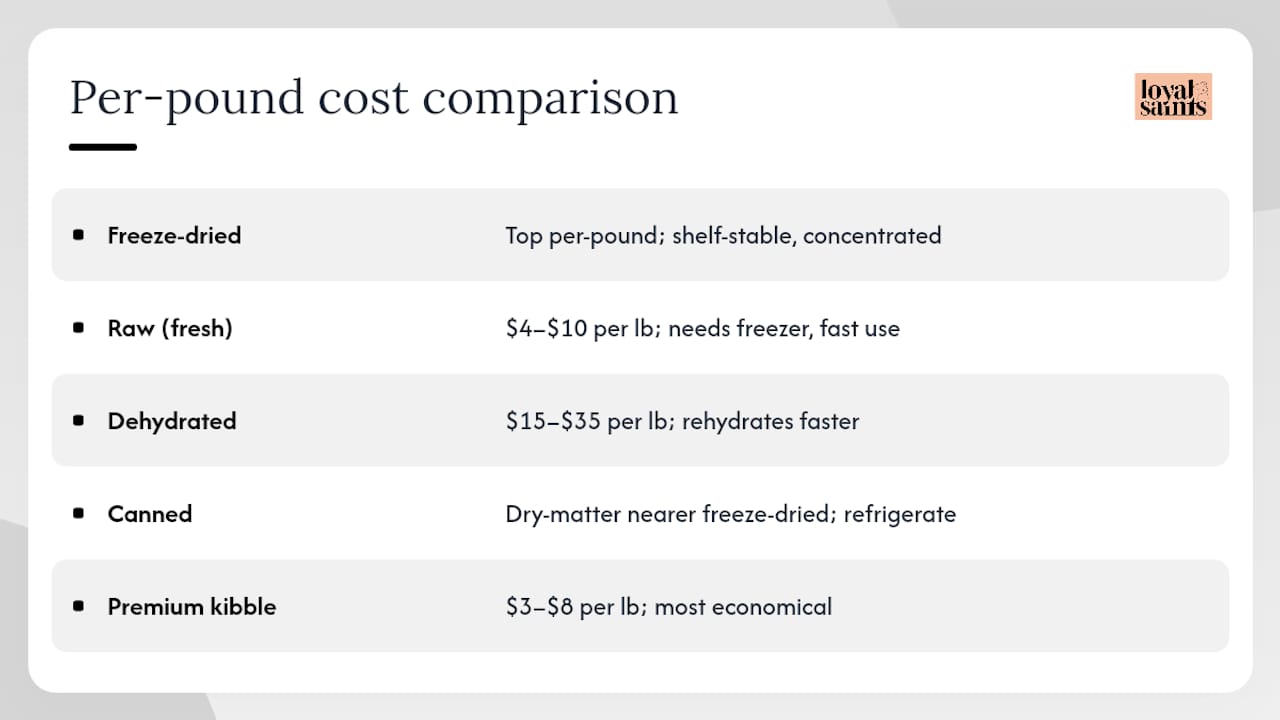
Fresh or raw (refrigerated/frozen): Raw diets can cost $4–$10 per pound for commercially prepared patties or grinds, which looks cheaper than freeze-dried per pound. But raw requires freezer space, careful thawing, and faster use after opening. Freeze-dried’s shelf stability and concentrated nutrition often make it more practical and cost-comparable once you account for waste and storage.
Dehydrated dog food: Dehydrated food removes moisture at low heat but not as completely as freeze-drying, so it rehydrates faster and costs less to produce. Retail prices typically run $15–$35 per pound, meaningfully below freeze-dried. Nutrient retention is good but generally lower than freeze-dried, and shelf life after opening is shorter.
On a dry-matter basis, the cost gap between canned and freeze-dried narrows considerably. Canned food also has a shorter shelf life once opened and requires refrigeration.
Kibble (premium): Quality dry kibble costs $3–$8 per pound and is the most economical format by a wide margin. The freeze-dried vs. kibble comparison comes down to ingredient quality, processing temperature, and palatability. Kibble’s extrusion process uses high heat, which degrades some heat-sensitive nutrients that freeze-drying preserves.
For budget-conscious owners, the practical takeaway is this: freeze-dried as a topper over quality kibble gives you most of the nutritional upside of raw or freeze-dried feeding at a cost that sits between premium kibble and full freeze-dried feeding.
A note from the editor on freeze-dried food and real-world budgets
Freeze-dried dog food gets positioned as an all-or-nothing choice in a lot of online discussions, and that framing does budget-conscious owners a disservice. The topper approach isn’t a compromise; it’s a genuinely smart feeding strategy that most veterinary nutritionists would support.
What I’d push back on is the idea that you need to wait until you can afford full freeze-dried feeding to start. A 5 oz bag used as a topper three or four times a week is a meaningful upgrade from an all-kibble diet, and it costs less per month than most people spend on their own coffee. Start where your budget is, use the math in this guide to find your real per-serving cost, and adjust from there. Any permanent diet change, especially for dogs with health conditions, is worth a quick conversation with your veterinarian first.
Loyalsaintspets makes freeze-dried feeding more affordable
The biggest barrier to feeding freeze-dried consistently isn’t the per-bag price; it’s not knowing how to make the math work month to month. Loyalsaintspets addresses that directly through the Halo Club subscription, which takes a meaningful percentage off every order and qualifies you for free shipping above the threshold, so you’re not paying extra to have premium food delivered to your door.
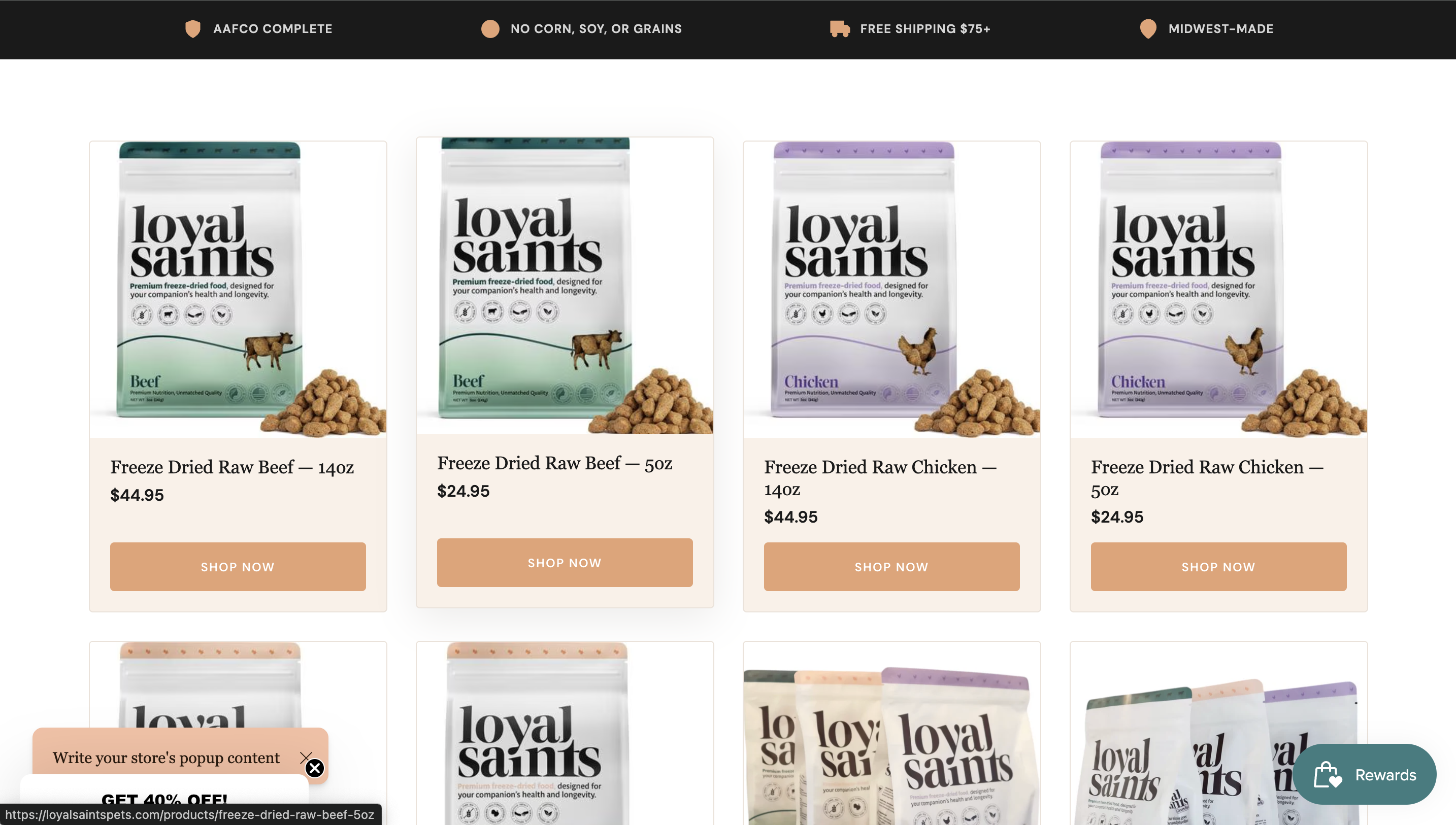
Whether you’re starting with the 5 oz chicken bag as a topper or committing to the 14 oz beef or chicken bags for full feeding, the subscription pricing makes the per-serving cost genuinely competitive with other premium formats. Every formula is AAFCO-complete, veterinarian-approved, and made from human-grade ingredients with no fillers. Visit Loyalsaintspets to see current subscription pricing, review the feeding charts for your dog’s weight, and place your first order.
Sources
- Fda
- Aafco
- Wsava
- Freeze Dried Dog Food Market Research Report 2034
- 6 Best Freeze-Dried Dog Food - Bestie Paws Hospital


