

If you want a dog food with no synthetic vitamins, start with the label rather than the front of the bag. In the United States, “natural” has a specific AAFCO definition that excludes chemically synthesized vitamins, but a food can still carry the word and add synthetic vitamins if it uses a set disclaimer. So the useful skill is reading the ingredient panel and the nutritional adequacy statement together. Our freeze-dried recipes are built from human-grade whole ingredients, free of fillers or synthetic additives, and formulated to be AAFCO-complete, so you get a whole-food approach without giving up complete nutrition.
TL;DR
- AAFCO, the body that sets U.S. pet food label models, excludes chemically synthesized vitamins from its definition of “natural”, but a food can add them if its label carries a disclaimer.
- The FDA has not defined “natural” for pet food, so the ingredient list matters more than the front of the bag.
- “Complete and balanced” is the check that protects your dog, whatever the vitamin source.
- Our freeze-dried raw recipes use whole ingredients, are AAFCO-complete and are free of fillers or synthetic additives.
Table of Contents
- What “no synthetic vitamins” means on a dog food label
- How to read the ingredient panel for vitamin sources
- Why dogs need vitamins at all, and why the source matters to owners
- Complete and balanced: the check that matters most
- Do you need to add a multivitamin?
- Switching foods the careful way
- Our perspective
- Try a whole-food freeze-dried recipe
- FAQ
- Sources
What “no synthetic vitamins” means on a dog food label
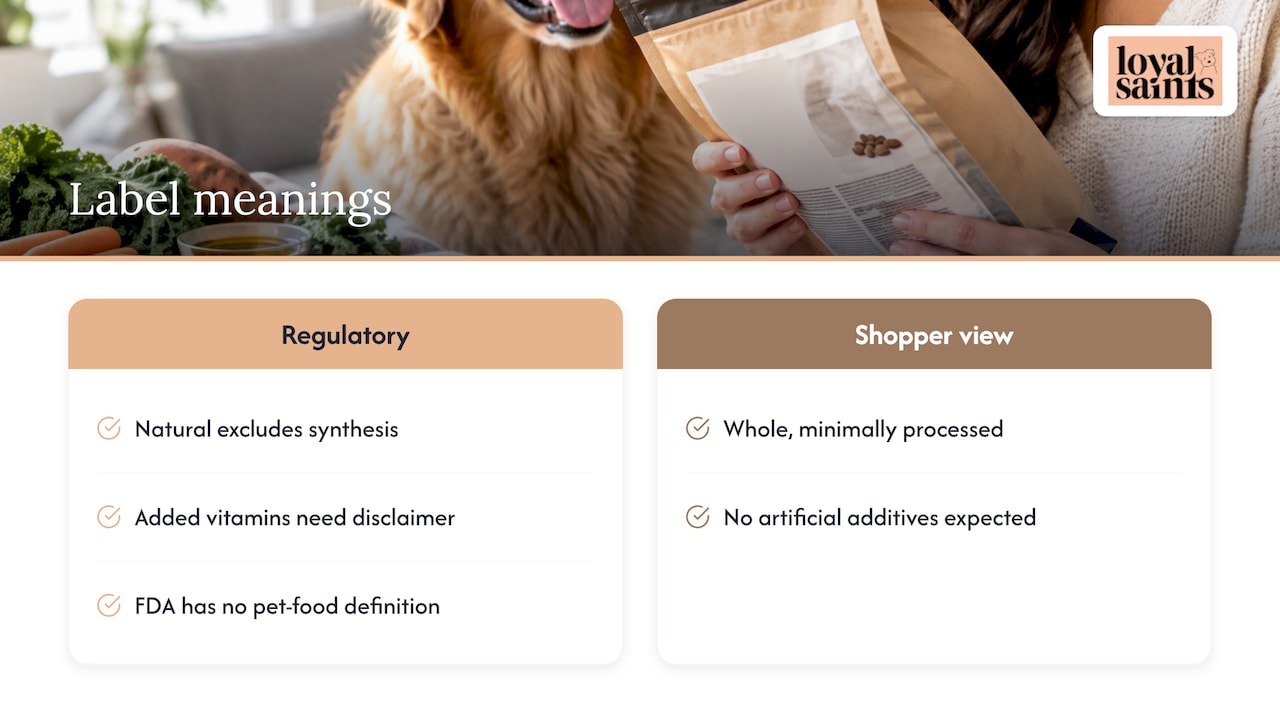
There is no official, standalone “no synthetic vitamins” claim on U.S. dog food. What exists is the word “natural,” and AAFCO’s definition of it leaves out chemically synthesized ingredients, including vitamins. According to AAFCO’s guidance on natural pet food, a product that otherwise meets the definition may still contain synthetic vitamins, minerals and trace nutrients if it carries a specific disclaimer. The FDA has not defined “natural” for pet food. It relies on the rule that labeling must not be false or misleading, and most states that follow AAFCO’s models require its definition.
In practice, the disclaimer reads along the lines of “natural with added vitamins, minerals and other trace nutrients.” A 2014 review in the Journal of the American Veterinary Medical Association notes that AAFCO recommends it appear at half the font size of the word “natural” and right beside it. If you see that small line under a big “NATURAL,” the recipe adds vitamins or minerals from outside the food ingredients.
The same review points out that shoppers tend to read “natural” as whole, minimally processed food with no artificial additives, while the regulatory meaning is narrower. That gap is why a label alone rarely settles the question.
How to read the ingredient panel for vitamin sources
AAFCO’s label-reading guidance says ingredients are listed individually in descending order by weight, using AAFCO-established names. That gives you a simple three-part routine.
- Look at the front of the list. Named whole foods such as beef, chicken, turkey, salmon, fruits and vegetables should lead.
- Scan the tail end. Vitamins and minerals added as supplements are usually listed after the main ingredients, under chemical-sounding names. Examples include thiamine mononitrate, folic acid, ascorbic acid, zinc oxide and sodium selenite. A long run of these near the end typically points to a vitamin and mineral premix, which is a pre-blended mix added to the recipe. We explain the idea in plain terms on our page about what a synthetic vitamin premix is.
- Check the guaranteed analysis and the disclaimer. AAFCO says vitamin or mineral supplements must guarantee the amounts they supply, and nutrients outside the AAFCO profiles appear last with an asterisked note. If there is a “with added vitamins” line near the word natural, you know where the vitamins come from.
If a term on the panel is unfamiliar, our dog nutrition glossary defines the common ones.
Phrases on the front of the bag
“Whole food nutrition,” “made with real ingredients” and “natural” are marketing phrases with different weights. Only “natural” has an AAFCO definition, and even that comes with the disclaimer exception above. Treat the other phrases as an invitation to read the back panel, not as a finding.
Why dogs need vitamins at all, and why the source matters to owners
Whatever the source, dogs need a full range of vitamins and minerals every day. A 2021 review of 128 homemade pet diets found that none met every vitamin and mineral requirement for dogs or cats. None were properly balanced for copper, zinc and iron, and vitamins E and D were often short. The authors noted that poor mineral balance could contribute to oxidative stress and aging.
That finding is a good reason to choose a commercially formulated food over improvising your own. Diets can be formulated to lean on food-based sources: Dr. Laura Gaylord, a board-certified veterinary nutritionist, writes in Veterinary Practice News that recipes can use functional foods such as nutritional yeast for B vitamins, ground pumpkin seeds for manganese and beef liver for copper. She adds that this takes formulation expertise, and that calcium deficiency and an upside-down calcium-to-phosphorus ratio are among the most common problems in homemade diets. Balanced whole-food nutrition is a formulation job, and it is best done by people who do it for a living.
Complete and balanced: the check that matters most
No matter how a food handles vitamins, the nutritional adequacy statement is your assurance. The FDA explains that “complete and balanced” means the food is intended as a dog’s sole diet and must either meet an AAFCO nutrient profile or pass a feeding trial run under AAFCO procedures. Dog profiles cover growth and reproduction, and adult maintenance.
The Merck Veterinary Manual adds that AAFCO recognizes four categories: growth, maintenance, gestation/lactation and all life stages. “All life stages” means the food was formulated or tested for gestation/lactation, growth and adult maintenance.
Here is a quick way to use that on a bag:
| What you see on the label | What it tells you |
|---|---|
| “Formulated to meet AAFCO Dog Food Nutrient Profiles for…” | The recipe was designed on paper to meet a life-stage profile |
| “Animal feeding tests using AAFCO procedures substantiate…” | The finished food was fed to dogs in a trial |
| “For intermittent or supplemental feeding only” | Not a sole diet, so not a full meal |
| Life stage named (adult maintenance, growth, all life stages) | Whether it suits a puppy, an adult or a senior |
If you want to go deeper on formulation versus feeding trials, we cover it in AAFCO feeding trials vs formulation, and our three bag checks for AAFCO raw and freeze-dried foods walk through the label step by step.
Label rules are also being updated at the state level. Washington State, for example, published a 2025 rulemaking notice on pet food label modernization aimed at making pet labels look more like human food labels. Reading the panel is a habit that will keep paying off.
Do you need to add a multivitamin?
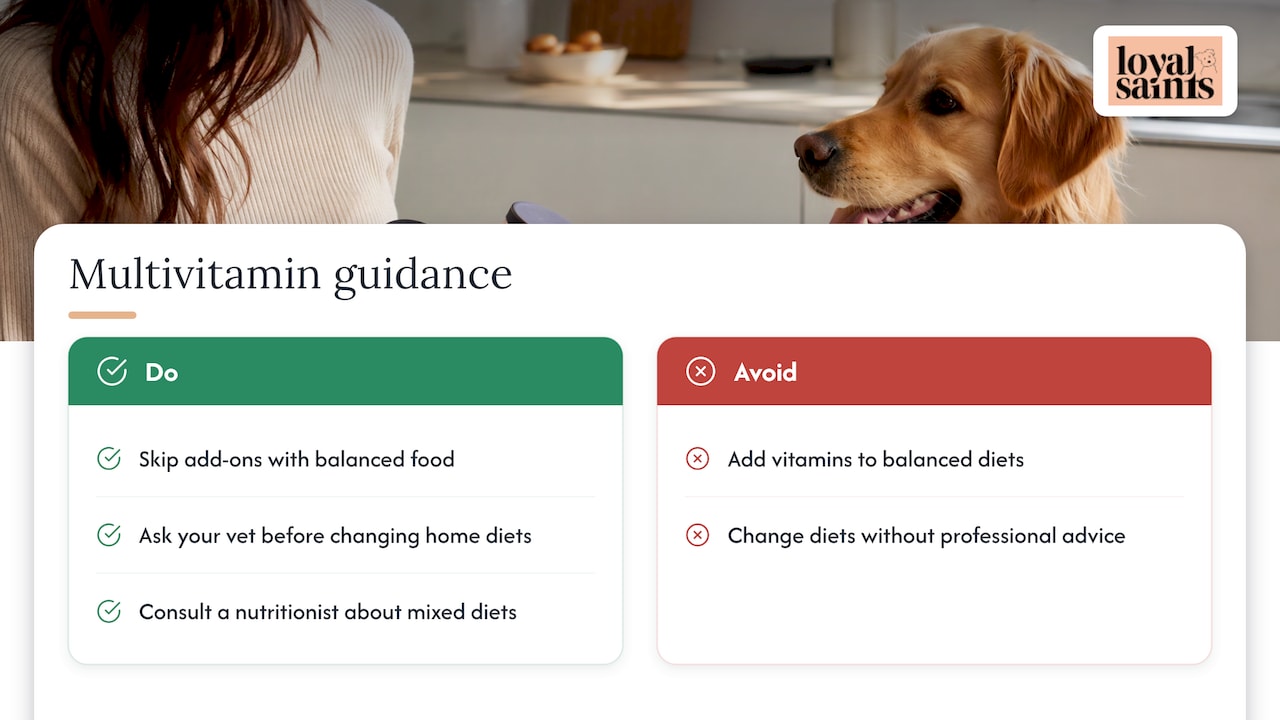
With a complete and balanced food, usually not. VetScoop reports that healthy pets eating a complete and balanced diet from a reputable maker don’t need a multivitamin, and that extra vitamins or minerals could unbalance the diet. This matters most for growing large- and giant-breed puppies, where excess minerals or vitamins can affect skeletal development.
So if your dog eats a complete recipe, keep the bowl simple and skip the add-ons. If you cook at home or feed a mixed diet, talk to your veterinarian or a board-certified veterinary nutritionist before you change anything, especially for a puppy, a senior dog, a dog that is pregnant or nursing, or one with a medical condition.
Switching foods the careful way
Before you move your dog to any new food, including one with whole-food ingredients, bring a few questions to your vet:
- Does this food state it is complete and balanced for my dog’s life stage?
- Does my dog’s size, age or health history change the nutrient targets?
- How should I transition, and what should I watch for in the first weeks?
A gradual switch over about a week, mixing the new food into the old in growing amounts, is the usual approach. Your veterinarian can tailor it to your dog, particularly if your dog has digestive issues or allergies.
Our perspective
When I started Loyal Saints, I wanted what most dog moms want: a bowl I could feel good about, with ingredients I could recognize. The first thing I did was read labels, and I think you should too.
Here is how we think about it. The real question behind “no synthetic vitamins” is whether the food is made of real, whole ingredients and whether it is complete. We care about both. Our recipes are made with human-grade whole ingredients, with proteins, fruits and vegetables, free of fillers and synthetic additives, and they are formulated to be AAFCO-complete. Our ingredients come from Midwest farms, and our freeze-dried format keeps the food shelf-stable with no fridge, thawing or ice packs.
We also think you deserve a label you can read in a minute. That is why we publish plain-language pages on balanced canine nutrition and on natural pet nutrition, so you can compare any bag to what you see on ours.
Your dog is family. Feed them like it, and enjoy the tail wags that follow.
Kristina
Try a whole-food freeze-dried recipe
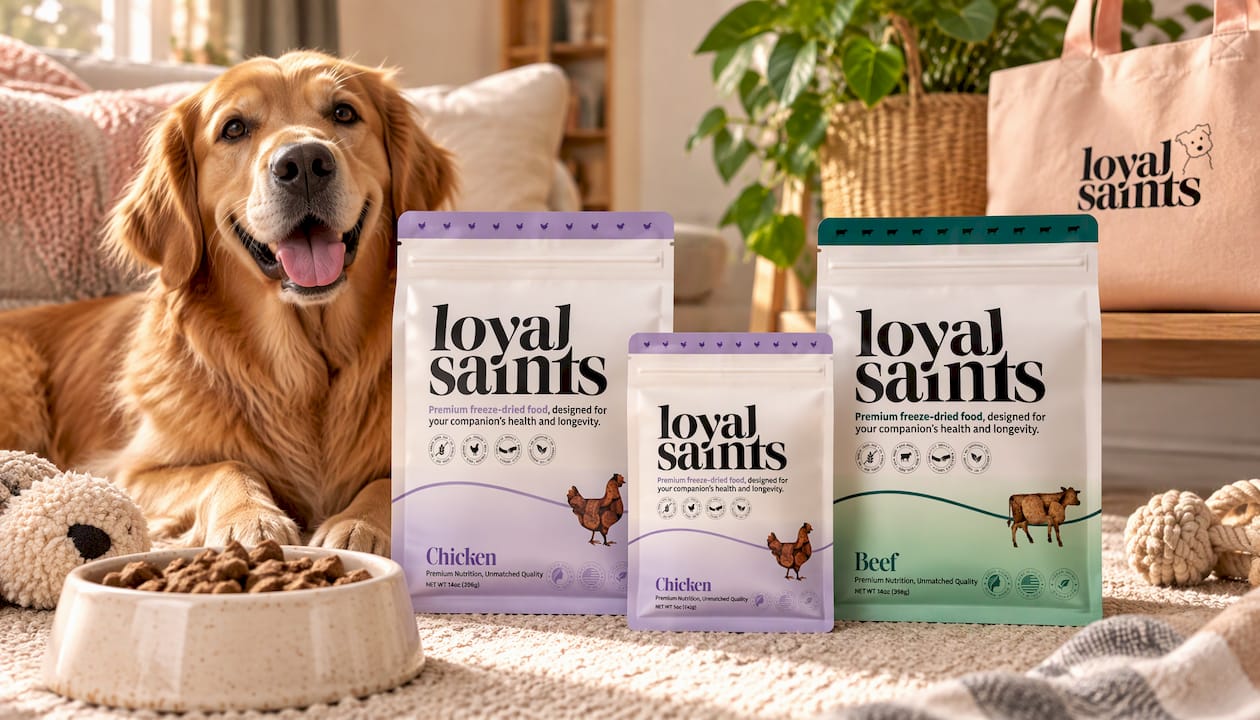
If you want to feed a recipe built on whole ingredients that is AAFCO-complete, our freeze-dried raw line comes in three recipes: Beef, Chicken, and Turkey + Salmon. Pouches are priced from $24.95 to $44.95 depending on size, and you can start with the Chicken 5 oz pouch or the Beef 14 oz bag. If you plan to feed us regularly, the Halo Club membership is $10.99 per month or $79.99 per year, and members get savings and free shipping. Standard shipping is $7.99 and express is $14.99; see shipping and returns for details.
You can browse all recipes on our home page.
FAQ
Is dog food with no synthetic vitamins always better?
What matters most is that the food is complete and balanced for your dog’s life stage and made from ingredients you trust. Look for the AAFCO nutritional adequacy statement, then read the ingredient list. If your dog has a health condition, ask your veterinarian what to look for.
Does “natural” on the bag mean no synthetic vitamins?
Not automatically. AAFCO’s definition of natural excludes chemically synthesized ingredients, but a product can still add vitamins and minerals if its label carries the disclaimer about added vitamins, minerals and trace nutrients. Check for that line next to the word “natural.”
How do I spot a vitamin premix on an ingredient list?
Look near the end of the list for chemical-style names such as folic acid, ascorbic acid, zinc oxide or sodium selenite, often several in a row. Whole-food sources look like food: liver, kelp, pumpkin or spinach. Our page on vitamin premixes explains the term in more detail.
Can I make whole-food dog food at home?
It is hard to get right. A review of 128 homemade pet diets found none met every vitamin and mineral requirement. If you want to cook for your dog, work with a board-certified veterinary nutritionist, or choose a commercially formulated AAFCO-complete food.
Sources
- Natural | AAFCO
- Awareness and evaluation of natural pet food products, JAVMA 2014
- Reading Labels | AAFCO
- 128 Homemade Pet Diets, PMC
- Home-prepared diets for pets, Veterinary Practice News
- “Complete and Balanced” Pet Food | FDA
- Dog and Cat Foods | Merck Veterinary Manual
- Washington State Register notice 25-13-018