
Raw dog food can carry Salmonella, and that risk is backed by peer-reviewed testing, CDC guidance, and real recalls. If anyone in your household is very young, elderly, pregnant, or immunocompromised, skip raw feeding or follow strict handling protocols without exception. The single best move you can make today is treating every raw or freeze-dried product like raw chicken from your own grocery store, and choosing a brand that’s transparent about sourcing and safety.
TL;DR:
- Salmonella contamination in raw pet food varies widely and is linked to manufacturing controls, with recalls demonstrating real health risks for pets and humans.
- Freeze-drying slows spoilage but does not reliably kill Salmonella, making proper handling and hygiene essential regardless of shelf stability labels.
- Households with immunocompromised individuals, children, or pregnant women should avoid raw diets or follow strict safety protocols due to the persistent risk of bacterial shedding.
- Proper food storage, dedicated utensils, and thorough cleaning significantly reduce household transmission risks, but they do not eliminate the possibility of infection.
- Regulatory and industry measures, including increased testing and potential high-pressure processing, aim to improve raw food safety but do not make raw feeding risk-free.
Table of Contents
- How Common Is Salmonella in Raw Pet Food?
- What the Science and Regulators Actually Say
- How Salmonella Spreads From Bowl to Household
- Safe-Handling Steps That Actually Cut Risk
- If You Suspect Contaminated Food or Illness
- Loyalsaintspets’ Approach to Safety
- How Labs Actually Detect Salmonella in Raw Food
- Raw vs. Cooked vs. Kibble: Comparing the Actual Risk
- What Vets and Owners Should Actually Do About the Risk
- Regulatory Pressure Is Reshaping the Raw Pet Food Industry
- Can Probiotics Lower Salmonella Risk in Dogs?
- Where to Go for Official Guidance
- A Science-First Take on Raw Feeding
- Why Loyalsaintspets Is Built for the Safety-Conscious Raw Feeder
- Sources
- FAQ
How Common Is Salmonella in Raw Pet Food?
Prevalence studies on raw pet diets have found Salmonella contamination rates varying considerably depending on the product batch, testing method, and year of the survey. That’s a wide range, and it reflects real variability in manufacturing controls across the raw pet food industry, not a flaw in the science.
The Joffe 2002 study was among the first to document this clearly. Researchers detected Salmonella in commercial raw chicken diets and, notably, in the stool of dogs eating those diets, demonstrating a documented risk pathway from diet to canine shedding. That second detail matters: it proved contaminated food doesn’t just sit inertly in a bag. It moves through the dog and back into the environment.
Recalls confirm the lab findings play out in the real world. The FDA and CDC jointly investigated Salmonella cases linked to pet food made by Mid America Pet Food, tracing illness in both pets and their owners back to contaminated product across multiple brands.
Here’s the detail many owners miss:
- Freeze-drying and dehydration slow spoilage, but they do not reliably kill bacteria. Salmonella can survive the drying process and remain viable in the finished product for extended periods.
- A “shelf-stable” label refers to texture and storage life, not sterility.
Quick stat: In humans, Salmonella symptoms typically show up 6 to 72 hours after exposure), and most cases resolve within a week, though severe illness can hit vulnerable groups much harder.
What the Science and Regulators Actually Say
Two studies anchor most of what we know about raw dog food safety. Joffe’s 2002 work established that Salmonella in raw diets isn’t theoretical; it showed up in real product and real dog stool. More recently, Dhakal et al. (2024) reviewed a broader set of pet foods and confirmed that Salmonella and other zoonotic bacteria remain a persistent, ongoing issue, not a solved problem from two decades ago.
What changed between those two studies is the toolkit. Investigators now use whole-genome sequencing to match bacterial isolates from suspect pet food directly to isolates pulled from sick people and sick pets. A 2019 investigation using this method confirmed the pathogen chain from product to person with genetic precision, not just correlation.
The FDA’s own guidance treats this seriously on the regulatory side:
Pet food contaminated with Salmonella can be considered adulterated under federal law when the product won’t undergo a commercial kill step before it reaches the animal. That’s the legal basis for many raw pet food recalls.
- Prevalence sampling varies by testing lab, sample size, and region, so no single percentage applies to every product on every shelf.
- Peer-reviewed studies sample specific batches at specific times, which means contamination risk can shift between production runs.
- Regulatory action tends to follow illness clusters, not routine testing, so absence of a recall doesn’t guarantee absence of risk.
How Salmonella Spreads From Bowl to Household
The chain runs in one direction, but every link matters. Contaminated raw or freeze-dried product enters your dog’s gut. From there, bacteria can be shed in feces and sometimes saliva, landing on food bowls, floors, countertops, and hands.
The tricky part: your dog can carry and spread Salmonella without ever looking sick. Cornell’s Riney Canine Health Center notes that asymptomatic shedding is common, which means a perfectly healthy-looking pet can still be a transmission risk to everyone in the house.
In people, watch for:
- Diarrhea, fever, and stomach cramps starting 6 to 72 hours after exposure
- Symptoms lasting anywhere from a few days to a week in most cases
- Severe or prolonged illness concentrated in young children, older adults, pregnant people, and anyone immunocompromised
In dogs, watch for:
- Diarrhea (sometimes with blood), vomiting, fever, or lethargy
- Loss of appetite lasting more than a day
- Any of these symptoms combined with known raw food exposure, which warrants a call to your veterinarian promptly
Safe-Handling Steps That Actually Cut Risk
Good news: most of the risk reduction here isn’t complicated. It’s the same discipline you’d already use handling raw chicken breast for your own dinner.
- Store it sealed and low. Keep raw or freeze-dried food in a sealed container on the lowest fridge or pantry shelf, away from human food.
- Use dedicated bowls and utensils. Don’t let your dog’s scoop or bowl touch anything else in your kitchen.
- Clean with the right products. Wash surfaces and bowls with hot water and soap, then disinfect with an EPA-registered surface cleaner rated for Salmonella.
- Wash your hands, every time. Scrub for at least 20 seconds after touching food, bowls, or your dog’s rear end or bedding.
- Wash the laundry hot. Bedding or towels touched by raw food or a shedding dog should go through a hot cycle separately.
- Dispose of packaging carefully. Seal empty pouches before tossing them, and bag pet waste before it hits the trash.
- Feed away from human food prep zones. A mud room, laundry room, or outdoor spot beats the kitchen counter.
- Skip raw entirely if you’re high-risk. Households with infants, elderly members, pregnant people, or immunocompromised individuals should lean toward diets that have gone through a kill step.
Pro Tip: Treat freeze-dried food exactly like raw food for handling purposes. Drying slows bacteria; it doesn’t reliably eliminate them, so the same gloves, bowls, and cleaning routine apply.
For a deeper storage walkthrough, our guide on how to store freeze-dried dog food safely covers shelf-life specifics you won’t find on most packaging.
If You Suspect Contaminated Food or Illness
Act fast and keep evidence. If your dog gets sick, save a sample of the uneaten food, keep the packaging with its lot number, and call your veterinarian right away, mentioning the raw exposure specifically. Your vet may run a fecal culture to confirm Salmonella.
If a person in your home gets sick, seek medical care and tell the provider about the pet food exposure. Hold onto the purchase receipt and lot number in case public-health investigators need it.
To report a suspected contaminated product:
- File a complaint through the FDA’s consumer portal or contact your state public-health department.
- Ask your vet whether paired animal and human testing through a Vet-LIRN-affiliated lab makes sense for your case.
- Quarantine the remaining product immediately. Don’t feed more from that batch, and don’t donate or discard it where other animals could access it.
Loyalsaintspets’ Approach to Safety
Transparency is the baseline we hold ourselves to, not a marketing line. Loyalsaintspets formulates every recipe to meet AAFCO nutritional standards, and our formulas are developed with veterinarian input before they ever reach a bag.
That said, we’re not going to pretend freeze-drying is the same as cooking. It isn’t, and treating it that way is how mistakes happen. Here’s how the handling guidance above applies to our specific products:
- Freeze Dried Raw Turkey with Salmon, 5oz: A trial-size format best suited for testing your dog’s response; still handle with sealed storage and dedicated utensils.
- Freeze Dried Raw Turkey with Salmon, 14oz: Our standard household size; store on a low, sealed shelf and wash bowls after every meal.
- Variety Pack, 14oz (Beef, Chicken & Turkey with Salmon): Great for owners rotating proteins; apply the same hygiene routine across all three flavors, not just one.
How Labs Actually Detect Salmonella in Raw Food
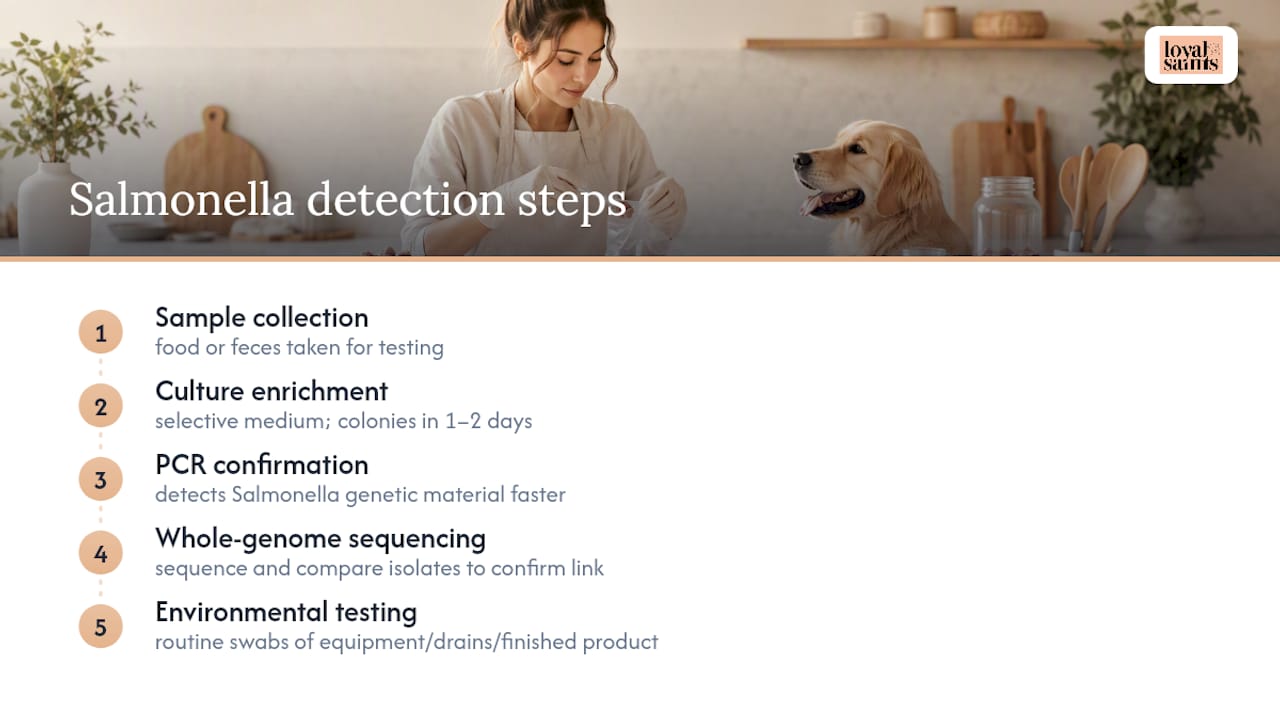
Testing isn’t a single test; it’s a sequence. Most labs start with a culture-based method: a sample of food or feces is placed in a selective growth medium that encourages Salmonella to multiply while suppressing other bacteria, making colonies visible within a day or two.
Positive cultures then move to confirmation testing, often PCR (polymerase chain reaction), which detects the pathogen’s genetic material directly and rules out false positives from similar-looking bacteria. This step is faster than culturing alone and has become standard in both regulatory labs and university research settings.
The most advanced step, whole-genome sequencing, comes into play once a positive case is confirmed. Investigators sequence the bacterial genome from the food sample and compare it against isolates collected from sick people or pets. A close genetic match is what allowed investigators to confirm, isolate by isolate, that specific raw pet food products caused specific illness clusters rather than assuming a coincidental link.
For pet food manufacturers, routine environmental testing (swabbing equipment, drains, and finished product) is meant to catch contamination before it ships. The gap between “tested” and “tested this specific batch” is exactly why prevalence numbers vary so much between studies. A clean environmental swab last month doesn’t guarantee a clean batch today.
Raw vs. Cooked vs. Kibble: Comparing the Actual Risk
Raw diets carry meaningfully higher documented Salmonella risk than cooked or kibble diets, and the reason comes down to one manufacturing step: heat.
Commercial kibble goes through an extrusion process that cooks the mixture at high temperatures, which functions as a kill step for Salmonella and most other pathogenic bacteria. Home-cooked or gently cooked commercial diets rely on the same principle: sustained heat above the temperature threshold that denatures bacterial proteins.
Raw diets, by definition, skip that step. Freeze-dried raw sits in an odd middle ground. It undergoes no cooking, but the drying process does reduce bacterial load somewhat, just not reliably to zero. That’s why the FDA’s adulteration framework singles out products without a kill step for stricter scrutiny, regardless of whether they’re frozen, fresh, or freeze-dried.
None of this means kibble is risk-free. Dry pet food has had its own contamination recalls over the years, usually tied to manufacturing lapses rather than the inherent nature of the product. But the baseline risk profile differs: a cooking or extrusion step gives kibble and cooked diets a structural advantage that raw and freeze-dried products simply don’t have built in. That gap is why safe handling matters more, not less, once you choose raw.
What Vets and Owners Should Actually Do About the Risk
Veterinary guidance on raw feeding has converged on a fairly consistent message over the past decade: if you’re going to feed raw, treat safety as a non-optional part of the diet, not an accessory.
For veterinarians, that means asking about diet history during any gastrointestinal workup, since a dog presenting with diarrhea and a raw food history changes the differential diagnosis and testing priorities. Groups like VCA and Cornell’s veterinary programs have pushed for more proactive diet questions during routine visits, not just during illness.
For owners, the practical checklist is shorter than you’d think:
- Ask your vet directly whether raw feeding fits your household’s specific risk profile before starting.
- Buy from manufacturers that publish testing protocols and lot-tracking information.
- Rotate feeding locations away from shared human spaces.
- Reassess if anyone in the household becomes pregnant, gets a new diagnosis affecting immune function, or a new baby arrives.
The honest middle ground here isn’t “never feed raw” or “raw is always fine.” It’s matching the diet choice to the household’s actual vulnerability, then handling the food with the rigor the science demands regardless of which diet wins.
Regulatory Pressure Is Reshaping the Raw Pet Food Industry
Recalls have consequences of a single bad batch. Each major Salmonella-linked recall tends to trigger tighter scrutiny across the raw pet food category, not just for the brand involved.
The Mid America Pet Food recall is a clear example. It affected multiple brands manufactured at the same facility, which pushed the FDA to look harder at shared manufacturing sites, not just individual product lines. That kind of investigation tends to raise the bar for everyone using that facility or a similar one.
Industry response has included more frequent environmental monitoring, third-party lab verification, and, in some cases, the addition of high-pressure processing, a non-thermal method that uses intense pressure rather than heat to reduce pathogen load without cooking the product. It’s not a universal fix, and it doesn’t replace good hygiene practices at home, but it represents a real shift in how seriously manufacturers are treating pathogen reduction.
Regulators have also leaned harder into genomic tracing as a deterrent. Knowing that a contaminated batch can be traced back to a specific facility through whole-genome sequencing changes the incentive structure for manufacturers in a way that random spot-checks never did. The result is a raw pet food industry under more consistent pressure to document, test, and prove safety rather than simply claim it.
Can Probiotics Lower Salmonella Risk in Dogs?
Probiotics show some promise for gut resilience, but they are not a substitute for safe handling or a kill step. The evidence for probiotics specifically preventing or clearing Salmonella infection in dogs is limited and mixed, not a settled, proven intervention.
The theory behind probiotic supplementation is reasonable: certain beneficial bacteria strains may compete with Salmonella for space and nutrients in the gut, potentially making it harder for the pathogen to establish an infection. Some small trials in various animal species have shown modest support for this competitive exclusion effect.
What the evidence doesn’t support is treating probiotics as a safety net that offsets the risk of feeding contaminated food. A dog with a healthy, probiotic-supported gut can still shed Salmonella and still get sick from a high enough bacterial load. Supplements can be a reasonable part of a broader digestive health routine, but they don’t change the core handling advice: sealed storage, dedicated utensils, and thorough cleaning still apply whether or not your dog takes a daily probiotic.
If you’re considering probiotics, talk to your veterinarian about strain-specific products with documented research behind them rather than assuming any probiotic label offers protection against foodborne pathogens.
Where to Go for Official Guidance
- CDC pet food safety page — up-to-date handling recommendations and outbreak alerts.
- FDA guidance on Salmonella in animal food — the regulatory framework behind recalls.
- Joffe 2002 and Dhakal et al. 2024 — the peer-reviewed studies anchoring prevalence claims in this article.
- Loyalsaintspets’ own Salmonella outbreak case review — a real-world breakdown of how one outbreak unfolded.
A Science-First Take on Raw Feeding
The conventional advice on this topic tends to split into two unhelpful camps: raw evangelists who wave away contamination data, and blanket “never feed raw” warnings that ignore how many households actually manage it safely. Neither camp serves the dog owner standing in their kitchen with a bag of freeze-dried turkey, trying to decide what’s actually true.
What the research supports is more specific than either extreme. Salmonella contamination in raw and freeze-dried pet food is real, documented, and traceable through genomic evidence, not a rare fluke. Freeze-drying is not a kill step, no matter how shelf-stable the bag looks. And the risk isn’t evenly distributed. It concentrates hardest in households with young kids, older adults, or anyone immunocompromised.
What gets underrated is how much control owners already have. The prevalence numbers in the studies reflect testing across an entire industry, not a verdict on any single well-made product handled correctly. Sealed storage, dedicated bowls, and consistent handwashing close most of the gap between “statistically risky” and “safely managed” in your own home.
— Kristina
Why Loyalsaintspets Is Built for the Safety-Conscious Raw Feeder
You’ve just read what separates a well-handled raw diet from a genuine health risk, and that’s exactly the standard Loyalsaintspets holds its recipes to. The formulas start with human-grade proteins and skip fillers and synthetic additives that add contamination surface area without adding nutrition.
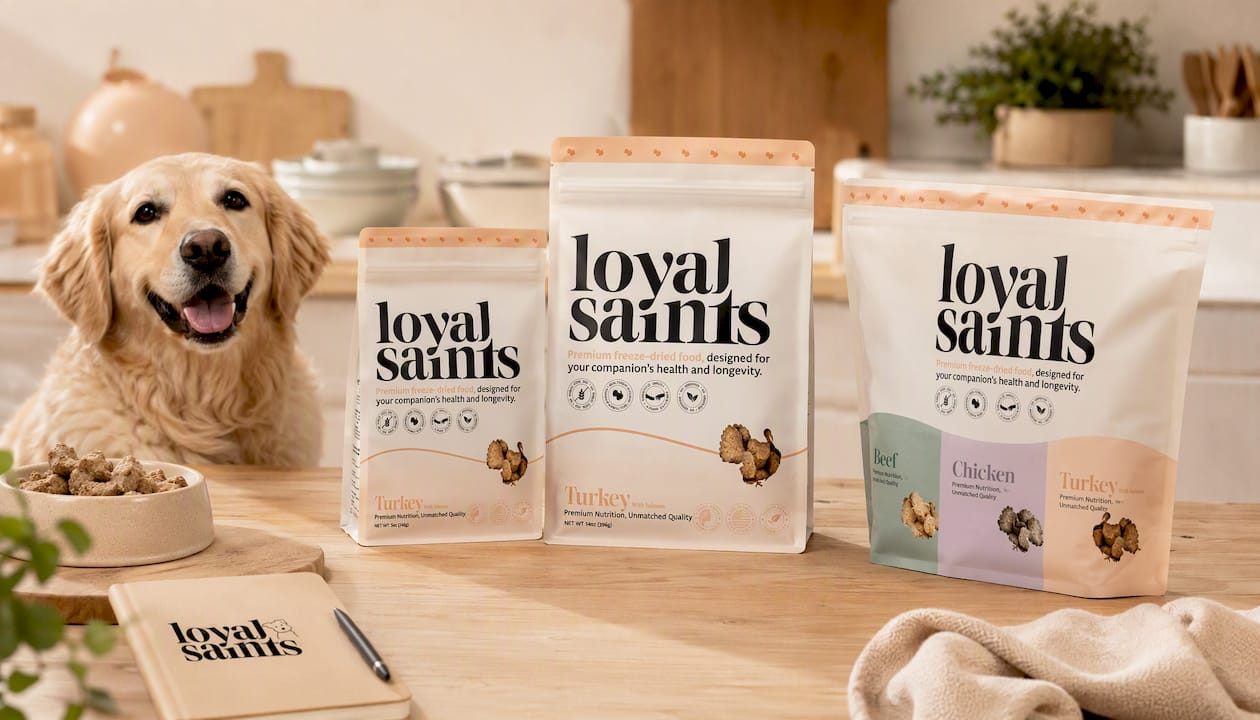
If you’re weighing whether raw feeding fits your household, start small. The 5oz Freeze Dried Raw Turkey with Salmon lets you introduce the diet gradually while you dial in the storage and handling routine covered above. Ready to commit to a full rotation? The 14oz Turkey with Salmon and the 14oz Variety Pack across Beef, Chicken, and Turkey with Salmon give your dog protein variety without asking you to juggle multiple brands’ handling instructions. Order from a preferred source and pair your first bag with the safe-handling checklist above from day one.
Sources
- About pet food safety | Healthy Pets, Healthy People — CDC
- Preliminary assessment of the risk of Salmonella infection in dogs fed raw chicken diets — Joffe 2002
- Salmonella presence and risk mitigation in pet foods — Dhakal et al. 2024
- FDA and CDC investigate cases of Salmonella linked to pet food made by Mid America Pet Food; Multiple Brands recalled — FDA
FAQ
Why Do Vets Say Not to Feed Raw?
Many veterinarians caution against raw feeding because studies have repeatedly detected Salmonella and other pathogens in raw diets, and dogs eating those diets can shed bacteria even without symptoms, creating a household transmission risk.
What Dog Food Has Been Linked to Salmonella?
Multiple raw pet food brands have been named in FDA investigations, including products tied to the Mid America Pet Food recall, which affected several brands manufactured at one shared facility.
How Rare Is It for a Dog to Get Salmonella?
Exact rates vary widely by product and testing method, with peer-reviewed surveys finding contamination in a meaningful share of tested raw diet batches; dogs can also carry Salmonella without showing any illness at all.
Can a Dog Get Sick From Raw Food?
Yes. Dogs can develop diarrhea, vomiting, fever, or lethargy from Salmonella-contaminated raw food, and some dogs become carriers that shed the bacteria while appearing completely healthy.
Is Freeze-Dried Raw Food Safer Than Fresh Raw Food?
Freeze-drying reduces some bacterial load but doesn’t reliably eliminate Salmonella, so freeze-dried products still require the same sealed storage, dedicated utensils, and handwashing routine as fresh raw diets.


