
Freeze-dried dog food earns its keep as a topper for almost any dog and works as a full diet only when the label carries an AAFCO “complete and balanced” statement and your household can handle raw-style food safely. The main catch: freeze-drying isn’t cooking, so pathogen risk doesn’t disappear. Loyal Saints Pets’ Freeze Dried Raw Chicken (5oz and 14oz) and Freeze Dried Raw Beef (14oz) work well as either. If you have a puppy, a senior, or anyone immunocompromised at home, loop in your vet first.
TL;DR:
- Freeze-dried dog food is almost always raw and can carry pathogens that survive the drying process unless it is processed with High Pressure Processing.
- It offers high nutritional value, especially in protein digestibility, and is preferable for picky eaters, seniors, or traveling without refrigeration.
- The biggest risks include bacterial contamination, higher cost compared to kibble, and the need for careful handling and portion control to prevent overfeeding.
- Always verify AAFCO’s complete-and-balanced statement and feeding trials on the label to ensure nutritional adequacy for your dog’s life stage.
- Freeze-dried food is environmentally less demanding than frozen raw but has a higher energy footprint than kibble, especially due to the freeze-drying process.
Table of Contents
- What Is Freeze-Dried Dog Food, Exactly?
- What Are the Real Benefits of Freeze-Dried Dog Food?
- What Are the Drawbacks of Freeze-Dried Dog Food?
- How Do You Handle Freeze-Dried Dog Food Safely?
- How Do You Know if a Freeze-Dried Food Is Nutritionally Complete?
- Who Should Use Freeze-Dried Dog Food, and Who Should Skip It?
- How Do You Transition to Freeze-Dried Dog Food Safely?
- Why Trust This Guidance on Freeze-Dried Dog Food?
- Does Freeze-Dried Dog Food Have an Environmental Footprint?
- A Balanced Take on Feeding Freeze-Dried
- Ready to Try Freeze-Dried the Safe Way?
- Sources
What Is Freeze-Dried Dog Food, Exactly?
Freeze-drying works through sublimation. Raw ingredients get flash-frozen, then placed in a vacuum chamber where ice crystals convert straight to vapor without ever passing through a liquid state. That’s different from kibble, which goes through extrusion under high heat and pressure, and different from frozen raw, which just gets chilled solid and shipped that way.
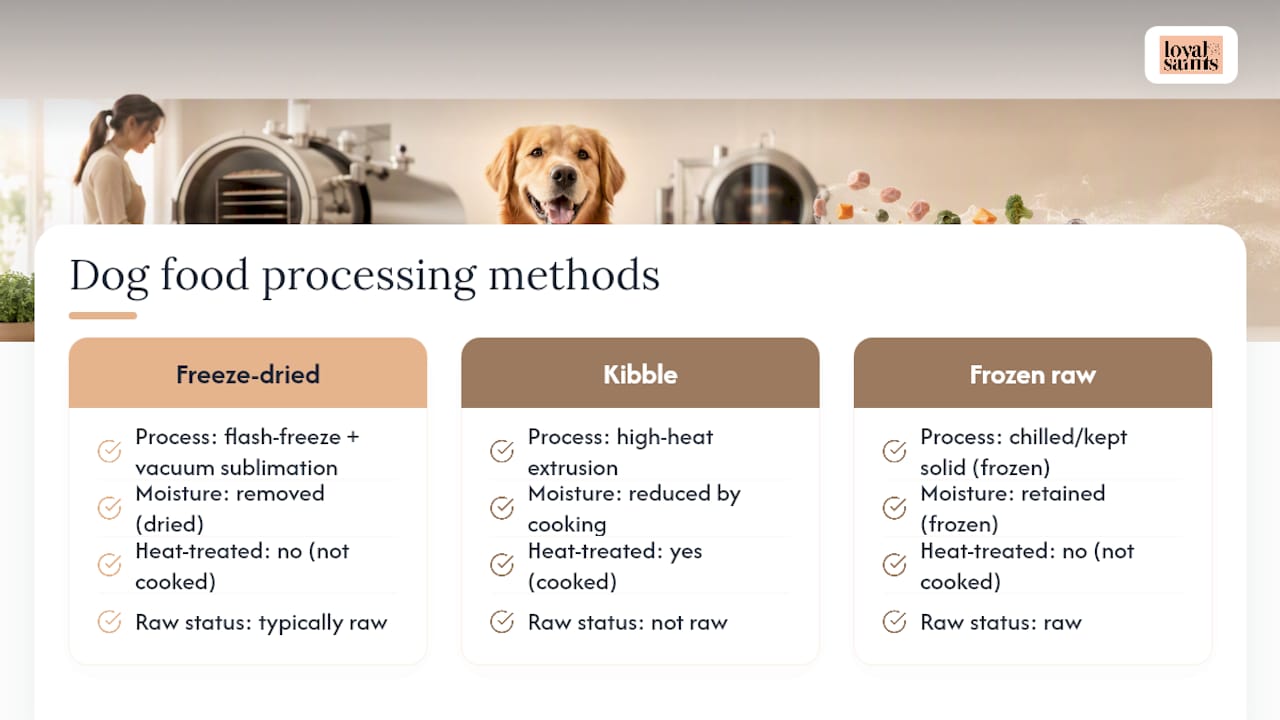
Most freeze-dried dog foods start as raw muscle meat, organ meat, sometimes ground bone, and a mix of fruits and vegetables. The process pulls out moisture but leaves the raw structure of the food mostly intact, which is exactly why nutrient levels hold up better than in cooked products.
Here’s the part a lot of shoppers miss: freeze-dried almost always means raw, even when the bag doesn’t say “raw” anywhere on the front. Cornell’s Riney Canine Health Center is blunt about this: freeze-drying does not equal cooking, and pathogens that were present in the raw meat can survive the drying process. Flip the bag over and read the ingredient panel before you assume it’s been heat-treated.
What Are the Real Benefits of Freeze-Dried Dog Food?
The nutrient case for freeze-dried food isn’t just marketing. A peer-reviewed comparison of frozen and freeze-dried raw diets found high amino-acid digestibility across both formats, which backs up the claim that freeze-drying preserves protein quality better than high-heat cooking does.
Pro Tip: If your dog turns her nose up at dinner, crumble a little freeze-dried food on top before you try anything more drastic. The smell alone often does the job.
Beyond nutrition, freeze-dried food solves some everyday problems that kibble and frozen raw don’t:
- Palatability. The concentrated aroma and texture make it genuinely effective for picky eaters, dogs recovering from illness, or seniors with a fading appetite.
- Shelf stability unopened. An unopened bag can sit in your pantry for months without refrigeration, which frozen raw simply can’t offer.
- Travel convenience. Lightweight, no cooler required. It’s the format that actually makes sense for a road trip or a weekend at the cabin.
- Flexibility. It shines as a topper, a training reward, or a short-term recovery food when your dog needs extra encouragement to eat.
Research summarizing freeze-dried versus kibble comparisons has found freeze-dried products often outperform frozen raw on palatability and convenience, even though the price tag runs higher.
What Are the Drawbacks of Freeze-Dried Dog Food?
The biggest downside is pathogen risk, and it’s not theoretical. Because freeze-drying doesn’t cook the food, bacteria that were present in the raw meat can survive the process. A University of Pennsylvania study on commercial raw pet products detected antibiotic-resistance genes and Gram-negative bacteria in a portion of the products tested, which matters if an infection develops and standard antibiotics don’t work as expected. Separate lab work has also cultured viable pathogens from a meaningful share of raw pet food samples, freeze-dried formats included.
Cost is the second reality check. Freeze-dried runs considerably higher per calorie than kibble, and a medium or large dog eating it as a full diet can push a household’s food budget up noticeably. Our own cost-versus-benefit breakdown walks through what that looks like month to month.
Watch out for these three practical downsides too:
- Once opened, freeze-dried food loses its shelf-life advantage fast and needs to be sealed tight and used within the timeframe on the label.
- Rehydration changes texture, and some dogs need a few tries to accept the consistency.
- It’s calorie-dense, so eyeballing portions instead of measuring can lead to overfeeding.
How Do You Handle Freeze-Dried Dog Food Safely?
Treat it exactly like raw meat, because that’s what it is. The CDC’s guidance on raw pet food calls for extra caution in any household with infants, elderly family members, or anyone immunocompromised, since these products can carry pathogens that put people at risk, not just dogs.
- Check the bag for High Pressure Processing (HPP) and an AAFCO complete-and-balanced statement. No AAFCO language means treat it as a topper, not a full meal.
- Keep a dedicated prep area, wash your hands after handling, and disinfect bowls and countertops the same way you would after handling raw chicken breast for your own dinner.
- Don’t let rehydrated portions sit out. Cornell’s advice is that raw-style meals shouldn’t sit at room temperature more than two hours.
- Watch for changes in your dog’s stool or your own health, and report anything suspicious to the FDA’s pet food safety program, which also tracks recalls.
Pro Tip: HPP reduces bacterial load significantly, but it isn’t sterilization. Some bacterial spores survive HPP, so good hygiene habits still matter even with a treated product.
How Do You Know if a Freeze-Dried Food Is Nutritionally Complete?
The AAFCO statement on the bag tells you almost everything. A “formulated to meet” statement means the recipe was built to match AAFCO nutrient profiles on paper. A statement citing “feeding trials” means the formula was actually tested on live animals over time, which is the stronger claim.
- Look for the specific life stage: growth (puppies), maintenance (adults), or “all life stages.”
- Check that calcium-to-phosphorus ratios are mentioned or available on request, especially for large-breed puppies.
- If your dog is pregnant, nursing, growing, or managing a medical condition like kidney disease or pancreatitis, ask a veterinary nutritionist before making freeze-dried the main diet rather than a topper.
Our nutrient-rich food checklist walks through exactly what to look for on a label before buying.
Who Should Use Freeze-Dried Dog Food, and Who Should Skip It?
Freeze-dried food fits some households far better than others.
- Good fits: picky adult dogs, frequent travelers, dogs recovering from minor illness with vet approval, and owners who want a topper to boost an otherwise complete kibble diet.
- Use caution or avoid: households with young children, elderly residents, or anyone immunocompromised; dogs with pancreatitis or compromised immune systems; very young puppies without vet guidance.
- The middle path most owners land on: kibble as the everyday base, with freeze-dried food layered on top for flavor, nutrition, and enthusiasm at the bowl.
That combination gets you most of the palatability benefit without asking your whole household to adopt raw-food handling habits full-time.
How Do You Transition to Freeze-Dried Dog Food Safely?
Go slow.
- Rehydrate with room-temperature or lukewarm water, not hot, which can cook off some of the nutrients you’re paying for. Most brands recommend a five- to ten-minute soak.
- Don’t leave a rehydrated bowl out longer than two hours.
- For a 50-pound dog eating around 900 to 1,000 calories a day on kibble, match that calorie count on the freeze-dried label rather than matching cup-for-cup, since freeze-dried is far denser.
- Watch stool consistency, appetite, and energy. Loose stool, vomiting, or a sudden appetite drop means slow down or call your vet.
Pro Tip: Weigh food on a kitchen scale for the first couple of weeks. Freeze-dried is dense enough that “eyeballing” a portion is one of the easiest ways to accidentally overfeed.
Why Trust This Guidance on Freeze-Dried Dog Food?
Loyal Saints Pets builds every recipe to meet AAFCO complete-and-balanced standards, with veterinarian-reviewed formulas across the Freeze Dried Raw Chicken (5oz), Freeze Dried Raw Chicken (14oz), and Freeze Dried Raw Beef (14oz) lines. The safety guidance here leans on public health sources: the CDC’s pet food safety page, the FDA’s pet food resources, and Cornell’s veterinary research on raw feeding. Our five-step processing overview details the quality controls behind each batch we produce.
Does Freeze-Dried Dog Food Have an Environmental Footprint?
Freeze-drying is energy-intensive. The vacuum chambers that pull moisture out of raw meat run for extended cycles, and that process draws more electricity than the high-heat, fast-throughput extrusion used for kibble. If you’re picking a food partly on environmental grounds, that’s worth knowing upfront rather than assuming “less processed” automatically means “lower impact.”
Where freeze-dried tends to win back some ground is in packaging and transport. Because the water weight is gone, a 14oz bag of freeze-dried food often represents several pounds of fresh meat equivalent, which means fewer shipments and lighter freight compared to frozen raw, which needs cold-chain trucks and constant refrigeration from processor to freezer aisle. Shelf-stable freeze-dried products also skip the energy draw of a home freezer running around the clock.
Packaging matters too. Look for brands using recyclable or minimally layered pouches rather than multi-material bags that are difficult for municipal recycling programs to process. Our packaging safety standards page covers what we use and why.
None of this makes freeze-dried food carbon-neutral. But when you weigh it against frozen raw’s cold-chain demands and kibble’s reliance on high-volume grain and rendered meat byproducts, freeze-dried lands somewhere in the middle rather than at either extreme. If sustainability is a real factor in your decision, buying in the larger 14oz format less frequently, rather than smaller bags more often, cuts down on packaging waste per pound of food.
A Balanced Take on Feeding Freeze-Dried
Freeze-dried food earns its reputation when it’s AAFCO-complete and your household follows basic raw-handling hygiene. Used carelessly, as a full diet with no label check and no hand-washing routine, it’s a different story. Most dogs do best with kibble as the foundation and freeze-dried layered on for palatability and nutrition. Talk to your vet before making it your dog’s whole diet, and check out our storage and handling guide for the details. Halo Club members get ongoing support for exactly these kinds of feeding questions.
— Kristina
Ready to Try Freeze-Dried the Safe Way?
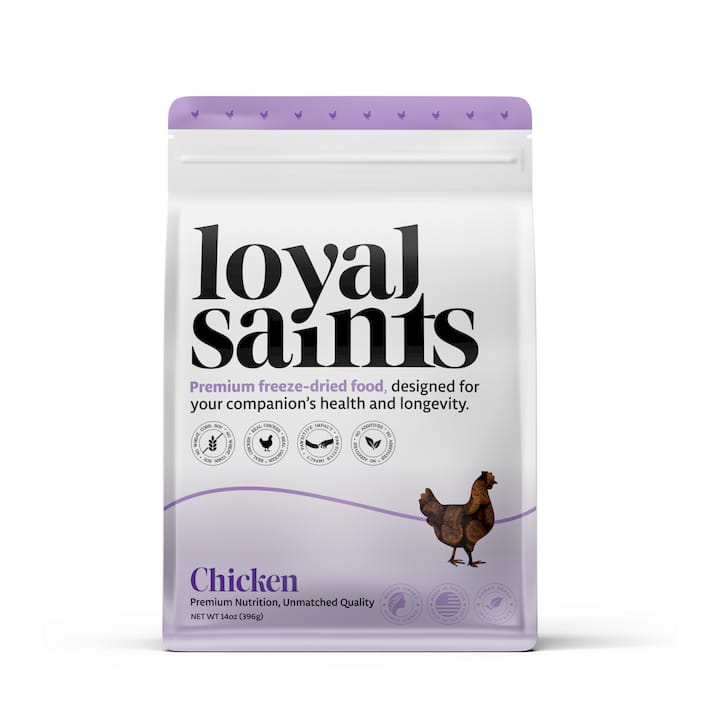
Loyal Saints Pets gives you a straightforward way to test freeze-dried feeding without committing to a full diet overnight. Start small: the 5oz Freeze Dried Raw Chicken is sized for travel or a first trial with a picky eater, while the 14oz Freeze Dried Raw Chicken and 14oz Freeze Dried Raw Beef work as a daily topper or, if your vet gives the go-ahead, a full meal rotation.

Every SKU carries an AAFCO complete-and-balanced statement and clear feeding guidelines right on the bag, so you’re never guessing whether it’s a topper or a meal. Join the Halo Club for recurring savings and free shipping on qualifying orders, and check out our current chicken and beef lineup to pick the size that fits your dog’s routine.
This article is general information, not a substitute for advice from a qualified doctor. Consult a qualified healthcare professional about your own circumstances before acting on anything here.
Sources
- CDC — Pet food safety
- Cornell University — Raw foods for dogs: Evidence-based advice
- Journal of Animal Science — TMEn and amino-acid digestibility of frozen vs freeze-dried raw diets (Oba et al., 2023)
- FDA — Pet food resources
- NCBI/PMC — Study on raw pet food contamination


