

A complete dog food is made to be your dog’s whole diet. A supplemental food is made to sit alongside that diet, never replace it. The difference is printed on the bag in a short sentence called the nutritional adequacy statement, and once you know where to look, you can sort any treat, topper or meal in about thirty seconds. Our freeze-dried raw recipes are AAFCO-complete, so they are made to be the main bowl, with no fridge, thawing or ice packs.
This guide shows you how to read that statement, what the supplemental label means, and how to build a bowl where every calorie has a job.
TL;DR
- “Complete and balanced” means a food is intended as your dog’s sole diet. “Intermittent or supplemental feeding only” means it is not.
- A complete food must either meet an AAFCO nutrient profile or pass an AAFCO-style feeding trial, and the label must name the life stage.
- Treats, toppers, mixers and supplements are meant to add to a complete diet. Veterinary nutrition guidelines keep them to 10% of intake or less.
- Check three things on any bag: the adequacy statement, the life stage, and the feeding directions.
- Our freeze-dried beef, chicken and turkey + salmon recipes are AAFCO-complete and shelf-stable.
Table of Contents
- What “complete” and “balanced” actually mean
- The four statements you will see on a bag
- What counts as supplemental
- Why the difference matters at the bowl
- Life stage: the part people skip
- Read any bag in three checks
- “Complete” is a floor, so ingredients still matter
- Label rules are being modernized
- Our freeze-dried recipes, built to be the main bowl
- Our perspective
- FAQ
- Sources
What “complete” and “balanced” actually mean
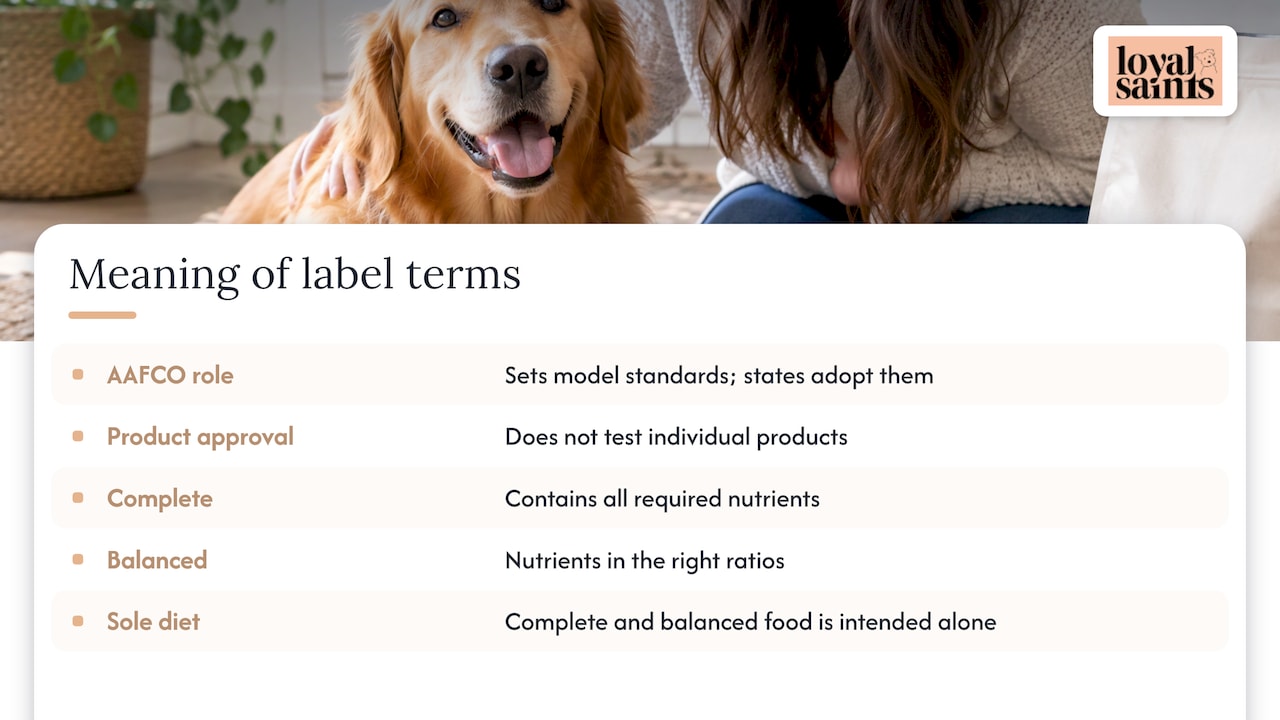
AAFCO, the Association of American Feed Control Officials, is the body that sets model standards for pet food in the United States. It does not approve or test individual products. It writes the nutrient profiles and label rules that most states then adopt, a point AAFCO itself makes on its Reading Labels page, which also notes that FDA labeling requirements apply to products sold across state lines.
On a label, the two words do separate jobs. According to AAFCO’s consumer guidance, “complete” means the product contains all the nutrients required, and “balanced” means those nutrients are present in the right ratios. Together they tell you the food is intended to be fed as the pet’s sole diet, according to the FDA. The Pet Food Institute adds that dogs and cats need more than 40 essential nutrients, which is why a single missing piece matters over months of feeding.
If you want the plain-English version on our own site, our page on what complete and balanced means walks through it, and our explainer on what AAFCO is covers the organization.
The four statements you will see on a bag
According to the Merck Veterinary Manual, one of four AAFCO adequacy statements must appear on pet food labels. Three of them mean “complete.” One means “not complete.”
| Statement type | What it tells you | Complete? |
|---|---|---|
| Formulated to meet AAFCO nutrient profiles for a named life stage | The recipe was designed on paper and analyzed to meet the profile | Yes |
| Animal feeding tests using AAFCO procedures substantiate the food for a named life stage | Dogs actually ate the food in a structured trial | Yes |
| Comparable to a product that passed feeding tests (the “family product” route) | The recipe is similar to one that passed a trial | Yes |
| “This product is intended for intermittent or supplemental feeding only” | It does not meet a complete-and-balanced standard | No |
The three formats come from AAFCO’s label guide. The FDA confirms that a complete claim requires either meeting an AAFCO Dog Food Nutrient Profile or passing a feeding trial, and that AAFCO first set those profiles in 1991 and most recently updated them in 2016.
Curious which route is stronger? We break down the trade-offs in our post on AAFCO feeding trials vs formulation.
What counts as supplemental
Supplemental is a broad bucket. The 2024 AAFCO Model Regulations define several product types that are not meant to be a full diet:
- Treat: given occasionally for enjoyment, training or entertainment, and not generally represented as a complete food or a nutritional supplement.
- Food supplement: supplies specific nutrients or other food components, but is not a complete diet.
- Food mixer: intended to top, accompany or contribute to a complete diet.
AAFCO’s consumer page explains that products not meant to be complete are generally fed in addition to a complete diet. They may carry the “intermittent or supplemental feeding only” wording, and they often show basic nutrition information without any adequacy statement at all. The FDA makes the same point: treats, snacks and supplements are typically not intended as a sole diet.
That is not a flaw. A training treat or a bone-broth topper is doing a different job than a meal. The trouble starts only when a supplemental product quietly becomes the main event.
Why the difference matters at the bowl
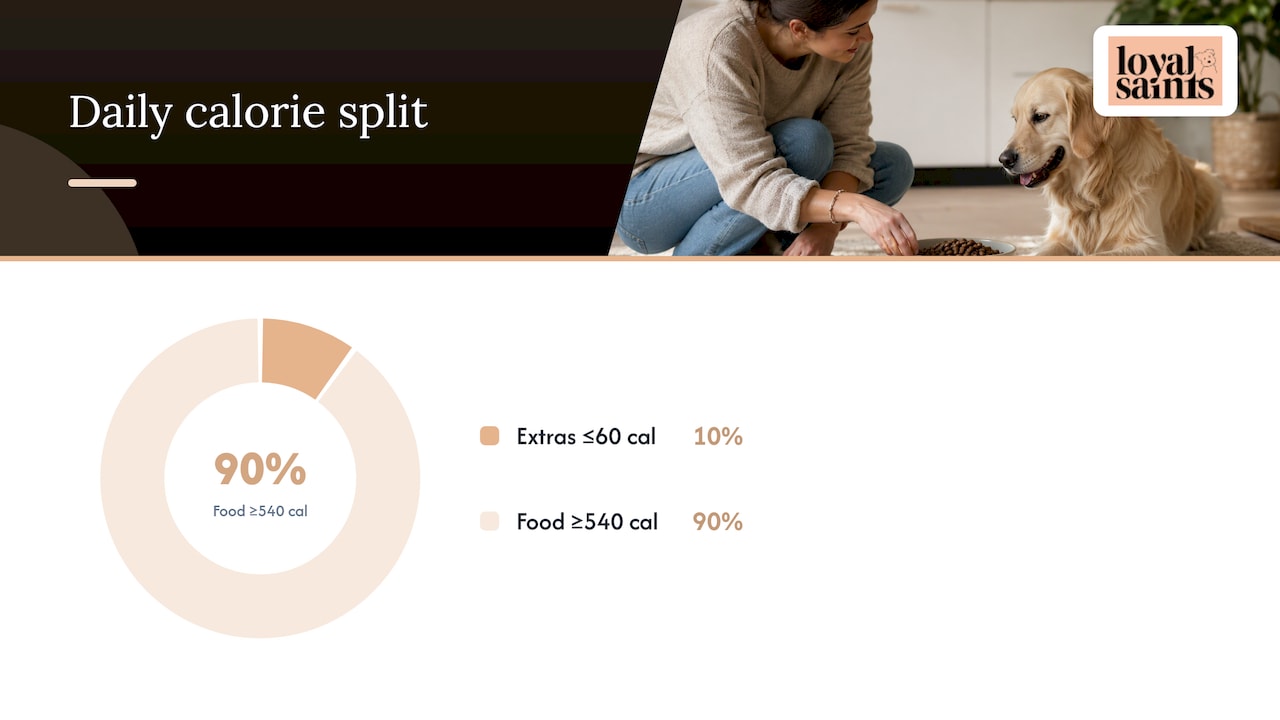
A dog can look great on a diet that is missing something. Weight and body condition can seem ideal while the nutrient mix underneath is off. AAHA’s 2021 guidelines make this point: body weight and condition score do not reveal how calories are distributed across unbalanced food items. That is why the same guidelines recommend that the main source of complete and balanced nutrition make up at least 90% of intake, with treats and other items at no more than 10%.
The WSAVA Global Nutrition Committee agrees. Its selection guidelines say foods labeled for short-term, intermittent or complementary feeding should be a small part of the diet, 10% or less.
A worked example
Say your dog needs about 600 calories a day, a number your veterinarian can tailor to your dog. At the 10% ceiling, treats, toppers and chews together get 60 calories. A single large dental chew or a few training rewards can use that up. Everything else, the other 540 calories or more, should come from a food whose label says complete and balanced for your dog’s life stage.
This is also a useful way to count training. If you work with a trainer or handle a rescue, tiny pea-sized rewards stretch that 10% across a whole session.
Life stage: the part people skip
“Complete” always comes attached to a life stage. AAFCO recognizes four life stages: gestation/lactation, growth, maintenance and all life stages. Virginia Extension’s consumer guide explains that AAFCO built two nutrient profiles, one for growth and reproduction and one for adult maintenance. It also notes that no rules govern the word “senior,” so a senior diet must meet adult maintenance requirements but no more.
Two practical takeaways:
- Puppies and nursing mothers need a statement that names growth or all life stages. Breeders should look for this line first.
- “All life stages” means the food supports the highest-need stage. VCA Animal Hospitals notes that a sedentary 10-year-old Labrador does not need the energy of a 2-year-old nursing ten puppies, so portion size matters. AAFCO also says feeding directions are guidelines that may need adjusting because activity, genetics and environment differ from dog to dog.
Read any bag in three checks
We wrote a short guide on this for raw and freeze-dried foods, our three bag checks. Here is the same idea, boiled down.
- Find the adequacy statement. It is usually in small print near the ingredient list. If you see “intermittent or supplemental feeding only,” or no statement at all, treat the product as an add-on.
- Match the life stage. Puppy, adult maintenance or all life stages, matched to your dog today.
- Check the feeding directions and calories. A complete food should tell you how much to feed. The Merck Veterinary Manual lists a statement of nutritional adequacy, feeding guidelines and caloric content among the items US labels must include.
WSAVA also suggests being cautious with a brand whose maker cannot supply a typical nutrient analysis or contact information for questions. A food you can ask questions about is a food you can feed with confidence.
“Complete” is a floor, so ingredients still matter
An adequacy statement tells you a food covers the nutrient basics. It does not tell you how the food is made or what goes into it. That is where most owners shopping for premium food spend their time: named proteins, whole fruits and vegetables, no fillers, no synthetic additives.
If protein is your focus, our post on what AAFCO protein standards mean explains the minimums. For a broader tour, see understanding AAFCO standards for premium pet nutrition, and our dog nutrition glossary defines the terms you will meet on labels.
Label rules are being modernized
Pet food labeling is in the middle of a refresh, and it varies by state, because AAFCO’s model rules only become law when a state adopts them. Washington State, for example, adopted the 2025 AAFCO label modernization effective July 7, 2025, adding definitions for daily food, food mixer, food supplement, Pet Nutrition Facts and veterinary diet. Kentucky’s amended regulation requires an adequacy statement on dog and cat food unless the package is clearly marked as a snack, treat or supplement, with the change effective June 30, 2026.
What this means for you: the line between “meal” and “extra” is getting clearer on the package. Until your state’s version is in force, the four-statement system above is still the one to read.
Our freeze-dried recipes, built to be the main bowl
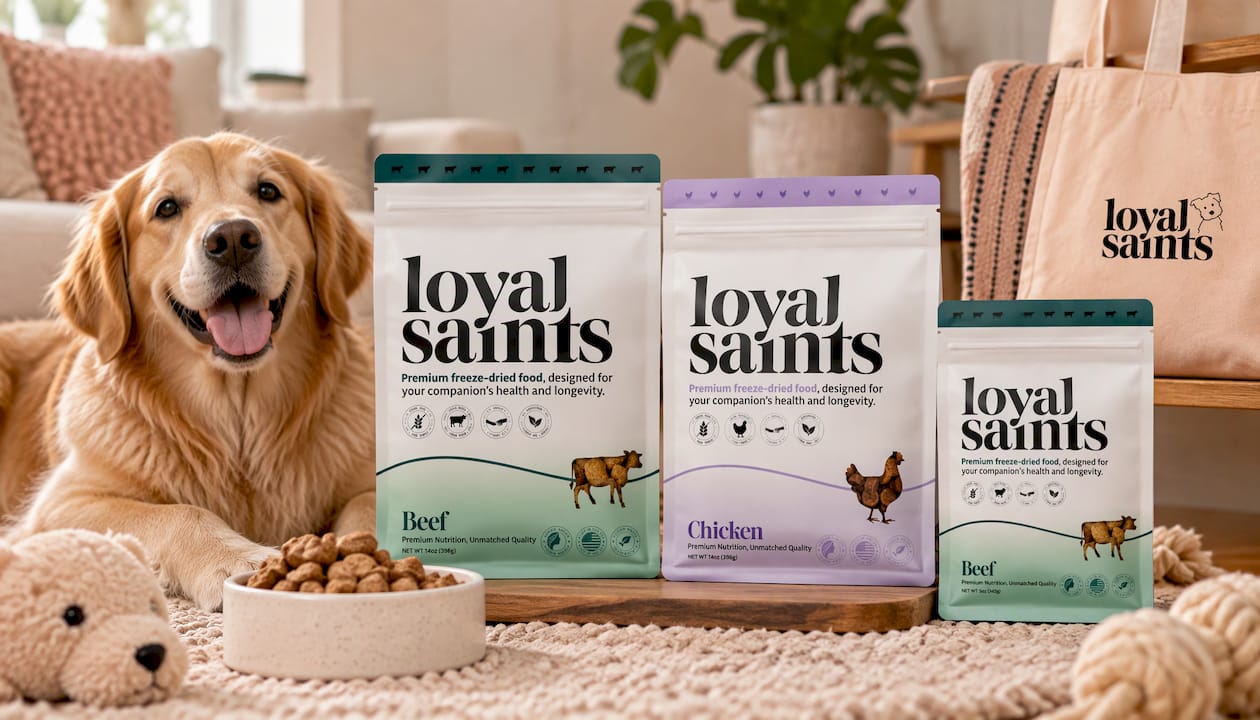
Our Beef, Chicken and Turkey + Salmon recipes are freeze-dried raw dog food made with human-grade, whole ingredients, free of fillers and synthetic additives, and formulated to be AAFCO-complete. They are shelf-stable, so there is no thawing, no fridge space and no ice packs. Bags range from $24.95 to $44.95 for a one-time purchase, and you can start with the beef 14 oz bag or the chicken 14 oz bag.
If you would rather not reorder every few weeks, our Halo Club membership is $10.99 per month or $79.99 per year, with savings and free shipping. Without a membership, standard shipping is $7.99 and express is $14.99, per our shipping page. You can also browse all three recipes on our home page.
Our perspective
We started Loyal Saints because we think of our dogs as family, and family eats real meals, not snacks. When we talk with other dog parents, the most common surprise is how many bags in the pet aisle are not meant to be a full diet at all. A beautiful topper or a crunchy treat can be wonderful, and it still belongs in the 10%.
That is why we built our recipes around a complete foundation: whole proteins, fruits and vegetables from Midwest farms, no fillers, and AAFCO-complete nutrition in a shelf-stable bag. Freeze-drying keeps the food raw and simple to serve, so the main bowl is also the easy one. Many dog parents tell us they want to see results within weeks, and a complete, consistent bowl is where that starts.
Every dog is different, so we always encourage you to talk with your veterinarian about portions and any special needs. Then enjoy the tail wags.
Kristina
FAQ
Can I feed my dog a supplemental food every day?
Yes, as a small part of the day, but not as the whole meal. Veterinary nutrition guidelines keep treats and other non-complete items to 10% of intake or less, with the other 90% or more from a complete and balanced food. Your veterinarian can help you set the exact amount for your dog.
What does “AAFCO compliant” mean?
It usually means the food’s label carries a nutritional adequacy statement showing it either was formulated to meet an AAFCO nutrient profile or passed an AAFCO-style feeding trial. AAFCO does not test or approve individual products. States enforce the rules, and a complete and balanced claim is reviewed by state regulators during full label review.
Is a food topper complete and balanced?
Not unless its label says so. Under AAFCO’s definitions, a mixer is intended to top, accompany or contribute to a complete diet, so it is an addition to the bowl rather than the bowl itself. Look for the adequacy statement to confirm.
Is “all life stages” food right for my adult dog?
It can be, because it meets the needs of the highest-demand stage, including growth and nursing. Adult dogs usually need less energy, so follow the feeding directions and adjust portions with your veterinarian to keep your dog at a healthy weight.
Are our freeze-dried recipes complete?
Yes. Our freeze-dried raw recipes are AAFCO-complete and made to serve as your dog’s main diet. Our complete and balanced page explains what that means in more detail.
Sources
- Selecting the Right Pet Food, AAFCO
- Reading Labels, AAFCO
- “Complete and Balanced” Pet Food, FDA
- A to Z of Pet Food: Understanding the Nutritional Adequacy Statement, Pet Food Institute
- Dog and Cat Foods, Merck Veterinary Manual
- 2024 AAFCO Model Regulations
- Feeding Plans for Healthy, Appropriate Weight Cats and Dogs, AAHA
- Guidelines on Selecting Pet Foods, WSAVA Global Nutrition Committee
- A Consumer’s Guide: Overview of Pet Food Labels, Virginia Extension
- Feeding Your Dog Well, VCA Animal Hospitals
- Washington State rulemaking order WSR 25-13-018
- Kentucky regulation 12 KAR 3:039